On Compatibility Genes: Can You Smell the Perfect Partner?

The Guardian on whether humans have the ability to smell out suitable partners/mates, based on an upcoming book by Daniel M. Davis, The Compatibility Gene: How Our Bodies Fight Disease, Attract Others, and Define Our Selves:

The basis for this notion is the so-called smelly T-shirt experiment, first performed by a Swiss zoologist called Claus Wedekind in 1994. He analysed a particular bit of the DNA of a group of students, looking specifically at the major histocompatibility genes (MHC). The students were then split into 49 females and 44 males. The men were asked to wear plain cotton T-shirts for two nights while avoiding anything – alcohol, cologne etc – that might alter their natural odour. After two days the shirts were placed in cardboard boxes with holes in them, and the women were asked to rank the boxes by smell using three criteria: intensity, pleasantness and sexiness.

Wedekind’s results appeared to show that the women preferred the T-shirts worn by men with different compatibility genes from themselves, raising the possibility that we unconsciously select mates who would put our offspring at some genetic advantage. The experiment was controversial, but it did alter scientific thinking about compatibility genes. And while the mechanism behind this phenomenon is poorly understood, that hasn’t stopped dating agencies from employing MHC typing as a matchmaking tool.

Of course, there are labs out there taking advantage of this science:

One lab offering such testing to online agencies (you can’t smell potential partners over the internet; not yet), a Swiss company called GenePartner, claims: “With genetically compatible people we feel that rare sensation of perfect chemistry.”

But take all this with a big grain of salt, as the research is still preliminary and no one really understands how all this works:

It is not completely understood how all this works at the molecular level, but it is at this forefront that Davis toils. “My research is in developing microscopes that look with better resolution at immune cells and how they interact with other cells,” he says. This interaction is “reminiscent of the way neurons communicate” in the brain, raising the possibility that your compatibility genes are responsible for more than just fighting infection, and could even influence how your brain functions. I confess to Davis that I don’t really understand this part. “None of us do,” he says. “I just happened to write a book about it.”

But how does the smelling thing work – if it works? It has been shown that mice can, and do, detect compatibility genes by smell, and that stickleback fish also choose mates by their odour, but in humans, Davis admits, the jury is out. “How it works on the olfactory level is basically not understood at all,” he says.

I think the more interesting point from Davis’s research is this: since each human responds slightly differently to any particular disease, in the not-too-distant future vaccines and other medications may be tailored to match our compatibility genes.

Is The Economist Left-Wing or Right-Wing? Neither.

Last week, The Economist turned 170 years old. Readers have pondered whether the magazine leans left or right. So The Economist explains itself:

SOME readers, particularly those used to the left-right split in most democratic legislatures, are bamboozled by The Economist’s political stance. We like free enterprise and tend to favour deregulation and privatisation. But we also like gay marriage, want to legalise drugs and disapprove of monarchy. So is the newspaper right-wing or left-wing?

Neither, is the answer. The Economist was founded in 1843 by James Wilson, a British businessman who objected to heavy import duties on foreign corn. Mr Wilson and his friends in the Anti-Corn Law League were classical liberals in the tradition of Adam Smith and, later, the likes of John Stuart Mill and William Ewart Gladstone. This intellectual ancestry has guided the newspaper’s instincts ever since: it opposes all undue curtailment of an individual’s economic or personal freedom. But like its founders, it is not dogmatic. Where there is a liberal case for government to do something, The Economist will air it. Early in its life, its writers were keen supporters of the income tax, for example. Since then it has backed causes like universal health care and gun control. But its starting point is that government should only remove power and wealth from individuals when it has an excellent reason to do so.

Furthermore:

When The Economist opines on new ideas and policies, it does so on the basis of their merits, not of who supports or opposes them. Last October, for example, it outlined a programme of reforms to combat inequality. Some, like attacking monopolies and targeting public spending on the poor and the young, had a leftish hue. Others, like raising retirement ages and introducing more choice in education, were more rightish. The result, “True Progressivism”, was a blend of the two: neither right nor left, but all the better for it, and coming instead from what we like to call the radical centre. 

More explainers like this, media organizations around the world.

On Technology Advancements in the Grocery Store

The Los Angeles Times reports how Ralphs, a grocery store chain, is using technology to speed up checkout times for customers:

Known as QueVision, the system uses hidden infrared cameras with body heat trackers to figure out how many customers are shopping at any given time. Managers use that information to redeploy workers to the cash registers when things get busy.

It’s already paying off. QueVision has trimmed the average time it takes to get to the front of the line to roughly 30 seconds from the national average of four minutes, a Ralphs spokeswoman said.

The checkout system is part of a long-overdue effort by traditional grocery chains to evolve and stay competitive through the use of technology.

I remember reading about this on Tesco’s virtual store:

In 2011, Tesco launched its futuristic Homeplus market at a Seoul subway stop. There’s no food in this virtual grocery store, only interactive walls around the station that display photos of fruit, vegetables, milk and other grocery staples. Using their smartphones, commuters can buy these products by photographing QR codes printed on the images and paying through their phones. Tesco delivers the purchases to customers’ homes the same day.

The article cites something else worth pondering: the grocery store industry is a $518 billion business in the United States.


Interview with Eric Kaplan: On The Science in The Big Bang Theory

It’s no secret that The Big Bang Theory is one of my favorite shows. Not only did I go to graduate school at Caltech (the setting for the show), but as an introvert, I sympathize with the behaviors/personalities of the characters on the show (can you say Bazinga?)

So it was with great interest that I read this interview The New York Times conducted with Eric Kaplan, one of the executive producers and script writers for The Big Bang Theory. Below, selections of the interview.

On going to school at Harvard and how it was similar to Caltech:

Q. Was Harvard anything like your version of Caltech on “The Big Bang Theory”?

A: It was. Because you had people there who were sincerely and passionately interested in what they were doing. That world was about people so entrenched in whatever they were studying that they forget to put their pants on. Now, I don’t think I ever did that. But I’m sure I knew people who did.

The idea that you’re more interested in the amazing problems that life offers than in some kind of status game was genuine there, and that’s what we try to convey about the characters on the show.

On stereotypes of the show, especially that of Sheldon:

Q. Aren’t you stereotyping scientists by labeling them as misfits?

A. Listen, it’s a story, not a thesis about how everyone is. It’s a collection of specific characters. All scientists are not Sheldon Cooper, who finds it difficult to hug someone or go out to lunch and divide a check. But many people whose cognitive ability outstrips their emotional sense can see some aspect of Sheldon in themselves.

Steven Hawking is apparently a fan of the show too:

Q. Do you get fan mail from scientists?

A. We don’t just get mail. Scientists will come to the show and sit in the audience. We’ll often use them as extras in the background during cafeteria scenes.

Stephen Hawking came once. He was happy to portray a version of himself who was petty and childish and enjoyed humiliating Sheldon at a game of online Scrabble. He played himself as a big baby. He didn’t feel like he had to portray himself as a hero of science. That made me respect him even more, because he doesn’t feel the need to pretend to be anything.

I sure hope Eric Kaplan is right on this point:

Q. Do you sometimes hear from scientists who say, “Thank you for showing something about our lives”?

A. Oh, yeah. They’ll sometimes say that there will be a new generation of scientists 10 years from now: kids who watched the show and decided to become scientists because they liked the characters. That would be great. I think there should be more scientists and fewer lawyers. It’s better to invent a plastic airplane than to sue somebody.

If you enjoyed this interview, you might also like this interview with David Salzberg, a UCLA physics professor and advisor to the show.

Why and How Jellyfish are Taking Over the World’s Oceans

Tim Flannery provides an excellent review of Lisa-ann Gershwin’s new book Stung!: On Jellyfish Blooms and the Future of the Ocean in this New York Review of Books piece. It’s such a good, thorough review that I am disinclined to read the book.

From the Arctic to the equator and on to the Antarctic, jellyfish plagues (or blooms, as they’re technically known) are on the increase. Even sober scientists are now talking of the jellification of the oceans. And the term is more than a mere turn of phrase. Off southern Africa, jellyfish have become so abundant that they have formed a sort of curtain of death, “a stingy-slimy killing field,” as Gershwin puts it, that covers over 30,000 square miles. The curtain is formed of jelly extruded by the creatures, and it includes stinging cells. The region once supported a fabulously rich fishery yielding a million tons annually of fish, mainly anchovies. In 2006 the total fish biomass was estimated at just 3.9 million tons, while the jellyfish biomass was 13 million tons. So great is their density that jellyfish are now blocking vacuum pumps used by local diamond miners to suck up sediments from the sea floor.

This particular examples notes the collapse of the fishing economy in Bulgaria, Romania, and Georgia:

Would you believe, Gershwin asks, that “a mucosy little jellyfish, barely bigger than a chicken egg, with no brain, no backbone, and no eyes, could cripple three national economies and wipe out an entire ecosystem”? That’s just what happened when theMnemiopsis jellyfish (a kind of comb jelly) invaded the Black Sea. The creatures arrived from the east coast of the US in seawater ballast (seawater a ship takes into its hold once it has discharged its cargo to retain its stability), and by the 1980s they were taking over. Prior to their arrival, Bulgaria, Romania, and Georgia had robust fisheries, with anchovies and sturgeon being important resources. As the jellyfish increased, the anchovies and other valuable fish vanished, and along with them went the sturgeon, the long-beloved source of blini toppings.

By 2002 the total weight of Mnemiopsis in the Black Sea had grown so prodigiously that it was estimated to be ten times greater than the weight of all fish caught throughout the entire world in a year. The Black Sea had become effectively jellified. 

Some of the reasons for jellyfish growth are downright frightening;

One of the fastest breeders of all is Mnemiopsis. Biologists characterize it as a “self-fertilizing simultaneous hermaphrodite,” which means that it doesn’t need a partner to reproduce, nor does it need to switch from one sex to the other, but can be both sexes at once. It begins laying eggs when just thirteen days old, and is soon laying 10,000 per day. Even cutting these prolific breeders into pieces doesn’t slow them down. If quartered, the bits will regenerate and resume normal life as whole adults in two to three days.

Jellyfish are voracious feeders. Mnemiopsis is able to eat over ten times its own body weight in food, and to double in size, each day.

So what exactly is causing the jellyfish to thrive and take over the oceans? The reasons are numerous, and the review elucidates a few of them:

Our waste, such as plastic bags, and fishing methods like drift nets and long lines are busy destroying the few jellyfish predators, such as sea turtles. We are also creating the most splendid jellyfish nurseries. From piers to boat hulls, oil and gas platforms and industrial waste and other floating rubbish, we’re littering the oceans with the kind of artificial hard surfaces that jellyfish polyps love.

Then there is the amount of oxygen dissolved in seawater. Oxygen is created by plants using photosynthesis, and high oxygen levels allow fish and other complex creatures to compete successfully with jellyfish. But the oxygen in water can be depleted far more quickly that it can be replaced. Where humans add nutrients to seawater (such as fertilizer runoff from farms), areas with depleted oxygen, known as eutrophied zones, form. They can occur naturally, but are spreading quickly as the oceans become filled with excess phosphorus and nitrogen derived from a variety of agriculture and industrial human activities. In river estuaries, and in confined waters such as the Baltic, the Black Sea, and the Gulf of Mexico, eutrophied zones have spread to a frightening extent, and they appear to be permanent. Nothing that needs even moderate amounts of oxygen, including fish, shellfish, prawns, and crabs, can survive in them. But the jellyfish thrive.

Compelling read.

Theranos and the Future of Diagnostic Medicine

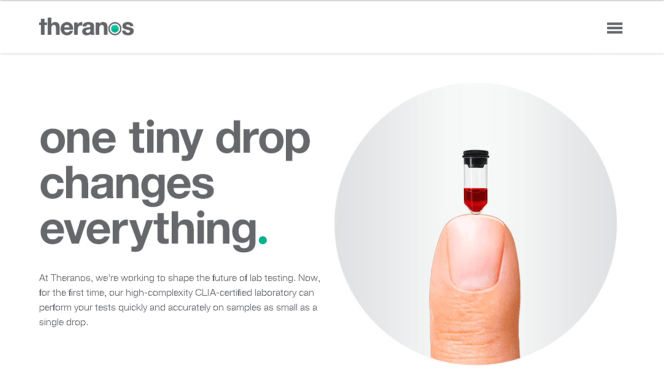
Elizabeth Holmes is a 29-year-old chemical and electrical engineer and entrepreneur who dropped out of Stanford as an undergraduate after founding a life sciences company called Theranos in 2003. Her inventions, which she is discussing in detail for the first time in this Wall Street Journal interview, could upend the industry of laboratory testing and might change the way we detect and treat diseases:

The secret that hundreds of employees are now refining involves devices that automate and miniaturize more than 1,000 laboratory tests, from routine blood work to advanced genetic analyses. Theranos’s processes are faster, cheaper and more accurate than the conventional methods and require only microscopic blood volumes, not vial after vial of the stuff. The experience will be revelatory to anyone familiar with current practices, which often seem like medicine by Bram Stoker.

This is the future of diagnostic medicine. Theranos’s technology will eliminate multiple lab trips because it can “run any combination of tests, including sets of follow-on tests,” at once, quickly, and with just one microsample.

A microsam

A microsample of blood used by Theranos

Another goal is transparency:

Ms. Holmes says her larger goal is increasing access to testing, including among the uninsured, though she might also have a market-share land grab in mind. For instance, she says Theranos will publish all its retail prices on its website. The company’s X-ray of self-transparency also includes reporting its margins-of-error variations online and on test results and order forms, which few if any labs do now.

Worth the read. Don’t miss who’s on the board of directors of Theranos: Henry Kissinger, Sam Nunn (ex-senator from Georgia), and Richard Kovacevich (who served as the CEO of Wells Fargo & Company).

On Measuring Popularity in the Digital Age and the Driving Forces of Pop Culture

The New York Times on Popularity

The New York Times on Popularity

The New York Times Magazine has a fascinating interactive feature of what it means to be popular in modern culture. There’s a lot to digest in the post, but the gist is here:

Where does this leave the concept of popularity? Paradoxically, popularity is now both infinitely quantifiable and infinitely elusive. We’re awash in cold data even as we try and reconcile how these numbers relate to our larger intuitive sense of what people like. Back in 1940, Billboard published a single music chart, simply named the Best-Selling Retail Records, which solely tracked sales. Later, the Billboard Hot 100 collated several factors — radio play, jukebox popularity and sales — into one measure of overall success. Around the same time, the lone tree grew several categorical limbs: R. & B., country, rap and so on, each taking the measure of popularity in a different genre. From one chart grew many. This seemed to make sense.

Then the methodology evolved even further: paid downloads were included in 2005; digital streams in 2007. The top-selling song was no longer necessarily the most popular song in the country. Now it could simply be the song that the most people, somewhere, were listening to, somehow. Then, this year, Billboard announced it would include YouTube playbacks as part of its rankings, and the song “Harlem Shake” immediately became the No. 1 song in America. This was thanks largely to a snippet of it being used as the soundtrack for thousands of viral YouTube videos. That meme, like most, burned out quick as a Roman candle. So instead of “Remember the summer of ‘Harlem Shake’?” we might one day say wistfully, “Remember the two weeks in February of ‘Harlem Shake’?” This is how we ended up with a No. 1 song that isn’t even really exactly a song. I’d venture to say that its ascent to that once-hallowed position — the No. 1 song in America! — felt intuitively correct to exactly no one, including the makers of “Harlem Shake.”

I don’t really pay attention to book rankings (I rely more on recommendations from friends and acquaintances and the occasional strangers):

As for books, we know everything and we know nothing. As any jittery author can confirm, Amazon will now tell you right out in the open where anyone can see exactly where in the vast universe of literature your particular contribution sits. You can watch your sales ranking rise or (more likely) fall in real time, like a stock ticker of public disinterest. On the other hand, The Times publishes 17 separate best-seller lists, from Combined Print and E-Book Fiction to Children’s Middle Grade to Manga. The purpose of all these different lists is to effectively capture the elusive phenomena of consumer choice — the individual decisions that reflect genuine widespread interest.

The Times goes  to cite the popularity of the SyFy movie Sharknado, which took over Twitter the night it aired. But I like this analogy on the ephemeral nature of popularity:

Perhaps the best way to think about the state of popularity is like a kind of quantum element: Both static and in perpetual flux. For example: You can most likely now close the record book on any record that measures how many people did the exact same thing at the exact same time. The movie with the highest box office of all time, adjusted for inflation, is still “Gone With the Wind,” released in 1939.

Not sure I buy this defense of The Fifty Shades of Grey, however:

No, my favorite fact is that, at one point last year, a nurse wrote in the comment section of The Times Magazine’s blog to say that patients (male and female) were reading it while hooked up for dialysis. We’ve all seen the readers on the subway or in the airport lounge, but the dialysis patients seemed like the apotheosis of the “50 Shades” phenomenon. Obviously, it would be much better for literature if dialysis patients across America were reading James Salter or Alice Munro. But “Fifty Shades” has been great in a different way: it has created space within everyday culture for stuff that was once the dominion of pornography. Those who accuse “Fifty Shades” of simply being porn are just wrong; in its innocence and its popularity, the book takes power away from porn, creating from the same basic elements something more human, a kind of squeaky-clean dirt, which can thrive even in the least sexy places on earth: the subway platform, the airport or next to a dialysis machine.

I had absolutely no clue on the most popular podcast in America (I rarely listen to podcasts):

“Welcome to Night Vale” is a twice-monthly podcast about a fictional town styled as a half-hour of community news. The show has been described variously as “the news from Lake Wobegon as seen through the eyes of Stephen King,” “NPR from the Twilight Zone,” “ ‘Lake Wobegon’ by David Lynch” and “ ‘A Prairie Home Companion’ as narrated by Rod Serling.” This summer, the show, which is narrated by Cecil Baldwin and written by Joseph Fink and Jeffrey Cranor, became suddenly, immensely, improbably popular, reaching No. 1 on iTunes, where it has remained, ahead of “This American Life” and “WTF With Marc Maron.”

If you’ve got some time, do explore the entire interactive of 16 popular things in culture that The Times profiles.

Tokyo to Host the 2020 Olympic Games


Tokyo has won the bid to host the 2020 Olympic Games, beating out Istanbul and Madrid. Bloomberg reports:

The Japanese capital was the bookmakers’ favorite leading into this weekend’s meeting of International Olympic Committee members in Buenos Aires, and defeated Madrid and Istanbul today in a vote by the IOC. Madrid was eliminated in a first round of voting after tying for second place with Istanbul, setting up the final vote won by Tokyo.

The winning bid to stage sports’ biggest event came on the city’s second straight attempt. While a lack of public enthusiasm doomed its bid for the 2016 Olympics, a March survey found 70 percent of Tokyo residents were in support this time. The government also billed the Olympics as a way to help Japan recover from a 2011 earthquake, tsunami and nuclear disaster.

Parliament passed two motions in favor of the bid and Prime Minister Shinzo Abe broke into song during a March presentation to the IOC’s evaluation panel in which he said hosting the event was a long-held dream.

“Choose Tokyo today and you choose a nation that is a passionate, proud, and a strong believer in the Olympic movement,” Abe said in today’s final presentation. He was joined on stage by Princess Takamado, the first member of the Japanese Imperial family to address the IOC.

The Japanese capital, now festooned with the bid’s cherry-blossom logo, has emphasized merits such as financial stability, safety, cleanliness and convenience. Tokyo has put aside 408.8 billion yen ($4.1 billion) for building and upgrading facilities. Tokyo’s flagship project is the futuristic 80,000-seat National Stadium designed by London-based Pritzker Prize-winner Zaha Hadid, which will be built on the site of the 1964 Tokyo Games, an event seen as re-launching Japan on the world stage after World War II.

I will make it to Tokyo before 2020, but the Olympic Games there sound like a repeat visit would be in order…

Traveling Around the World For Free with Google+

Twenty-eight year old Michael Lee Johnson, hailing from England, writes about his experience of traveling around the world relying only on one social network: Google+. The catch? He wanted to do it for free:

On July 26th (just over a month ago), I asked the question; Is it possible to travel across the world for FREE using nothing but +Google+  and a whole lot of hugs? 

Why? Because I wanted to show the world that #GooglePlusIsNotAGhostTown and why this platform is different than all of the others. I was just sick and tired of all those news articles and people saying that nobody uses this platform. That nobody is here. 

If nobody is here… Who am I? Who are you? And who the hell is nobody? 

It is now September 6th and so far I have been to London, Paris, Amsterdam, Harderwijk, Emsdetten, Munster, Hamburg, Berlin, Munich, Zurich, Milan, Austria, Hungary, Serbia, Bulgaria and Athens, courtesy of Google+ users from one side of the world to the other. 

I have stayed at multiple peoples houses, in hotels and bed & breakfasts. Travelled across countries via cars, buses and trains. Met lots of awesome people, made new friends, visited multiple Google offices and had an absolutely AMAZING TIME in the process. I have experienced humanity for what it truly is. Thoughtful. Caring. Hospitable. Amazing. – That doesn’t mean I haven’t had problems… I have had plenty of problems, but overall, the experience has been life changing.

As an introvert, he claims that it’s hard for him to reach out to people and ask for help. So this is an experience:

So far I have spent about 10 euros on food and water in the past 5 weeks. I have eaten 3/4/5x per day. People have cooked for me. Taken me to restaurants. Bought me food on the street and taken me out for drinks. Introduced me to their friends and family, and made me feel at home. Showed me around their cities and gone out of their way. They have been there for me. They have trusted me in their homes. They have written all sorts of nice things about me. 

Google+ came through. The people. The place. My life has been turned upside down. As of writing this message my follower count is growing at nearly 1000 users per day. I am getting lots of lovely messages and a fair few horrible messages. (You can’t please everyone). – That’s life.

Pretty cool, if you ask me.