Theranos and the Future of Diagnostic Medicine

Elizabeth Holmes is a 29-year-old chemical and electrical engineer and entrepreneur who dropped out of Stanford as an undergraduate after founding a life sciences company called Theranos in 2003. Her inventions, which she is discussing in detail for the first time in this Wall Street Journal interview, could upend the industry of laboratory testing and might change the way we detect and treat diseases:

The secret that hundreds of employees are now refining involves devices that automate and miniaturize more than 1,000 laboratory tests, from routine blood work to advanced genetic analyses. Theranos’s processes are faster, cheaper and more accurate than the conventional methods and require only microscopic blood volumes, not vial after vial of the stuff. The experience will be revelatory to anyone familiar with current practices, which often seem like medicine by Bram Stoker.

This is the future of diagnostic medicine. Theranos’s technology will eliminate multiple lab trips because it can “run any combination of tests, including sets of follow-on tests,” at once, quickly, and with just one microsample.

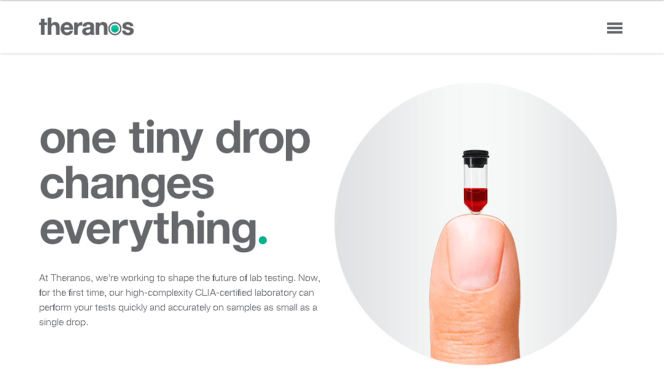
A microsam

A microsample of blood used by Theranos

Another goal is transparency:

Ms. Holmes says her larger goal is increasing access to testing, including among the uninsured, though she might also have a market-share land grab in mind. For instance, she says Theranos will publish all its retail prices on its website. The company’s X-ray of self-transparency also includes reporting its margins-of-error variations online and on test results and order forms, which few if any labs do now.

Worth the read. Don’t miss who’s on the board of directors of Theranos: Henry Kissinger, Sam Nunn (ex-senator from Georgia), and Richard Kovacevich (who served as the CEO of Wells Fargo & Company).

On Measuring Popularity in the Digital Age and the Driving Forces of Pop Culture

The New York Times on Popularity

The New York Times on Popularity

The New York Times Magazine has a fascinating interactive feature of what it means to be popular in modern culture. There’s a lot to digest in the post, but the gist is here:

Where does this leave the concept of popularity? Paradoxically, popularity is now both infinitely quantifiable and infinitely elusive. We’re awash in cold data even as we try and reconcile how these numbers relate to our larger intuitive sense of what people like. Back in 1940, Billboard published a single music chart, simply named the Best-Selling Retail Records, which solely tracked sales. Later, the Billboard Hot 100 collated several factors — radio play, jukebox popularity and sales — into one measure of overall success. Around the same time, the lone tree grew several categorical limbs: R. & B., country, rap and so on, each taking the measure of popularity in a different genre. From one chart grew many. This seemed to make sense.

Then the methodology evolved even further: paid downloads were included in 2005; digital streams in 2007. The top-selling song was no longer necessarily the most popular song in the country. Now it could simply be the song that the most people, somewhere, were listening to, somehow. Then, this year, Billboard announced it would include YouTube playbacks as part of its rankings, and the song “Harlem Shake” immediately became the No. 1 song in America. This was thanks largely to a snippet of it being used as the soundtrack for thousands of viral YouTube videos. That meme, like most, burned out quick as a Roman candle. So instead of “Remember the summer of ‘Harlem Shake’?” we might one day say wistfully, “Remember the two weeks in February of ‘Harlem Shake’?” This is how we ended up with a No. 1 song that isn’t even really exactly a song. I’d venture to say that its ascent to that once-hallowed position — the No. 1 song in America! — felt intuitively correct to exactly no one, including the makers of “Harlem Shake.”

I don’t really pay attention to book rankings (I rely more on recommendations from friends and acquaintances and the occasional strangers):

As for books, we know everything and we know nothing. As any jittery author can confirm, Amazon will now tell you right out in the open where anyone can see exactly where in the vast universe of literature your particular contribution sits. You can watch your sales ranking rise or (more likely) fall in real time, like a stock ticker of public disinterest. On the other hand, The Times publishes 17 separate best-seller lists, from Combined Print and E-Book Fiction to Children’s Middle Grade to Manga. The purpose of all these different lists is to effectively capture the elusive phenomena of consumer choice — the individual decisions that reflect genuine widespread interest.

The Times goes  to cite the popularity of the SyFy movie Sharknado, which took over Twitter the night it aired. But I like this analogy on the ephemeral nature of popularity:

Perhaps the best way to think about the state of popularity is like a kind of quantum element: Both static and in perpetual flux. For example: You can most likely now close the record book on any record that measures how many people did the exact same thing at the exact same time. The movie with the highest box office of all time, adjusted for inflation, is still “Gone With the Wind,” released in 1939.

Not sure I buy this defense of The Fifty Shades of Grey, however:

No, my favorite fact is that, at one point last year, a nurse wrote in the comment section of The Times Magazine’s blog to say that patients (male and female) were reading it while hooked up for dialysis. We’ve all seen the readers on the subway or in the airport lounge, but the dialysis patients seemed like the apotheosis of the “50 Shades” phenomenon. Obviously, it would be much better for literature if dialysis patients across America were reading James Salter or Alice Munro. But “Fifty Shades” has been great in a different way: it has created space within everyday culture for stuff that was once the dominion of pornography. Those who accuse “Fifty Shades” of simply being porn are just wrong; in its innocence and its popularity, the book takes power away from porn, creating from the same basic elements something more human, a kind of squeaky-clean dirt, which can thrive even in the least sexy places on earth: the subway platform, the airport or next to a dialysis machine.

I had absolutely no clue on the most popular podcast in America (I rarely listen to podcasts):

“Welcome to Night Vale” is a twice-monthly podcast about a fictional town styled as a half-hour of community news. The show has been described variously as “the news from Lake Wobegon as seen through the eyes of Stephen King,” “NPR from the Twilight Zone,” “ ‘Lake Wobegon’ by David Lynch” and “ ‘A Prairie Home Companion’ as narrated by Rod Serling.” This summer, the show, which is narrated by Cecil Baldwin and written by Joseph Fink and Jeffrey Cranor, became suddenly, immensely, improbably popular, reaching No. 1 on iTunes, where it has remained, ahead of “This American Life” and “WTF With Marc Maron.”

If you’ve got some time, do explore the entire interactive of 16 popular things in culture that The Times profiles.

Tokyo to Host the 2020 Olympic Games


Tokyo has won the bid to host the 2020 Olympic Games, beating out Istanbul and Madrid. Bloomberg reports:

The Japanese capital was the bookmakers’ favorite leading into this weekend’s meeting of International Olympic Committee members in Buenos Aires, and defeated Madrid and Istanbul today in a vote by the IOC. Madrid was eliminated in a first round of voting after tying for second place with Istanbul, setting up the final vote won by Tokyo.

The winning bid to stage sports’ biggest event came on the city’s second straight attempt. While a lack of public enthusiasm doomed its bid for the 2016 Olympics, a March survey found 70 percent of Tokyo residents were in support this time. The government also billed the Olympics as a way to help Japan recover from a 2011 earthquake, tsunami and nuclear disaster.

Parliament passed two motions in favor of the bid and Prime Minister Shinzo Abe broke into song during a March presentation to the IOC’s evaluation panel in which he said hosting the event was a long-held dream.

“Choose Tokyo today and you choose a nation that is a passionate, proud, and a strong believer in the Olympic movement,” Abe said in today’s final presentation. He was joined on stage by Princess Takamado, the first member of the Japanese Imperial family to address the IOC.

The Japanese capital, now festooned with the bid’s cherry-blossom logo, has emphasized merits such as financial stability, safety, cleanliness and convenience. Tokyo has put aside 408.8 billion yen ($4.1 billion) for building and upgrading facilities. Tokyo’s flagship project is the futuristic 80,000-seat National Stadium designed by London-based Pritzker Prize-winner Zaha Hadid, which will be built on the site of the 1964 Tokyo Games, an event seen as re-launching Japan on the world stage after World War II.

I will make it to Tokyo before 2020, but the Olympic Games there sound like a repeat visit would be in order…

Traveling Around the World For Free with Google+

Twenty-eight year old Michael Lee Johnson, hailing from England, writes about his experience of traveling around the world relying only on one social network: Google+. The catch? He wanted to do it for free:

On July 26th (just over a month ago), I asked the question; Is it possible to travel across the world for FREE using nothing but +Google+  and a whole lot of hugs? 

Why? Because I wanted to show the world that #GooglePlusIsNotAGhostTown and why this platform is different than all of the others. I was just sick and tired of all those news articles and people saying that nobody uses this platform. That nobody is here. 

If nobody is here… Who am I? Who are you? And who the hell is nobody? 

It is now September 6th and so far I have been to London, Paris, Amsterdam, Harderwijk, Emsdetten, Munster, Hamburg, Berlin, Munich, Zurich, Milan, Austria, Hungary, Serbia, Bulgaria and Athens, courtesy of Google+ users from one side of the world to the other. 

I have stayed at multiple peoples houses, in hotels and bed & breakfasts. Travelled across countries via cars, buses and trains. Met lots of awesome people, made new friends, visited multiple Google offices and had an absolutely AMAZING TIME in the process. I have experienced humanity for what it truly is. Thoughtful. Caring. Hospitable. Amazing. – That doesn’t mean I haven’t had problems… I have had plenty of problems, but overall, the experience has been life changing.

As an introvert, he claims that it’s hard for him to reach out to people and ask for help. So this is an experience:

So far I have spent about 10 euros on food and water in the past 5 weeks. I have eaten 3/4/5x per day. People have cooked for me. Taken me to restaurants. Bought me food on the street and taken me out for drinks. Introduced me to their friends and family, and made me feel at home. Showed me around their cities and gone out of their way. They have been there for me. They have trusted me in their homes. They have written all sorts of nice things about me. 

Google+ came through. The people. The place. My life has been turned upside down. As of writing this message my follower count is growing at nearly 1000 users per day. I am getting lots of lovely messages and a fair few horrible messages. (You can’t please everyone). – That’s life.

Pretty cool, if you ask me.

POCBS: Power Outages Caused by Squirrels

Are squirrels causing an uprising? Will the world end in fire or ice? The author of this delightful op-ed piece, Jon Mooallem (the author of Wild Ones: A Sometimes Dismaying, Weirdly Reassuring Story About Looking at People Looking at Animals in America), thinks it could end with the lowly squirrel:

Power outages caused by squirrels are a new hobby of mine, a persnickety and constantly updating data set that hums along behind the rest of my life the way baseball statistics or celebrity-birthing news might for other people. It started in April, after I read about a squirrel that electrocuted itself on a power line in Tampa, Fla., cutting electricity to 700 customers and delaying statewide achievement tests at three nearby schools. I was curious, just enough to set up a Google news alert: squirrel power. But as the summer progressed, and the local news reports of power outages caused by squirrels piled up in my in-box, my interest in power outages caused by squirrels became more obsessive and profound.

I know: it’s hard to accept that a single squirrel can disrupt and frustrate thousands of people at a time, switching off our electrified lives for hours. But since Memorial Day, I’ve cataloged reports of 50 power outages caused by squirrels in 24 states. (And these, of course, are only those power outages severe enough to make the news.) Fifteen hundred customers lost power in Mason City, Iowa; 1,500 customers in Roanoke, Va.; 5,000 customers in Clackamas County, Ore.; and 10,000 customers in Wichita, Kan. — and that was just during two particularly busy days in June. A month later, there were two separate P.O.C.B.S., as I’ve come to call power outages caused by squirrels, around the small town of Evergreen, Mont., on a single day.

All this is quite fascinating! I had no idea that the NASDAQ was affected by squirrel:

Squirrels have been causing power outages since long before I started cataloging power outages caused by squirrels. (In 1987, a squirrel shut down the Nasdaq for 82 minutes and another squirrel shut down the Nasdaq again in 1994 — a seminal bit of P.O.C.B.S. history that was sometimes noted in coverage of the power outage at the Nasdaq in August, which was a power outage not caused by squirrels. “This is a terrible pain in the neck,” the president of one brokerage firm told The Wall Street Journal in 1994 — which, I’ve found, is still a typical reaction to power outages caused by squirrels.)

Here’s the juicy explanation on why squirrels are so dangerous for power lines:

Squirrels chew through electrical wiring because the animals are constantly teething. An adult squirrel’s incisors never stop growing — they can grow as much as 10 inches per year — and the animals must chew constantly to keep them worn down. Squirrels gnaw or burrow their way into transformers for the same reason they enter rotting cavities of aging trees: hollow spaces offer them den sites and safety from predators. Squirrels break into equipment at substations because the seeds and insects they eat get sucked into that machinery by cooling fans, or are pooled inside by the wind

A must-read in entirety here. What’s stopping us from building out infrastructure for underground wiring?

A History of Meh, from Leo Rosten to W.H. Auden to The Simpsons

I’m loving the new Slate blog on words and vocabulary. It’s got a great name: Lexicon Valley. In their most recent post, they trace the development of the now-common “meh” to signify boredom or indifference:

First, a consideration from the early 1990s:

A variant of meh, namely mnyeh, famously appears in the works of the late academic and humorist Leo Rosten, with extended treatment in his Hooray for Yiddish. But Rosten’s work is often disparaged by experts in Yiddishology, and, in any case, there’s no evidence that mnyeh is even a Yiddish word.

The British poet W.H. Auden didn’t think much of the first lunar landing, and he wrote a poem about it (but used “Mneh”):

Worth going to see? I can well believe it.
Worth seeing? Mneh! I once rode through a desert
     and was not charmed: give me a watered
     lively garden, remote from blatherers

Finally, the tracing of “meh” to The Simpsons:

Though Swartzwelder is the most prolific of all Simpsons writers, he has led a reclusive lifewriting novels since leaving the show in 2004. After finding a way to send him a message, I was amazed to actually get a response from the man called “the J. D. Salinger of comedy writing.” He didn’t recall putting meh on the show before his “Hungry Hungry Homer” episode, which aired in 2001, some seven seasons after meh began to be used by Simpsons characters. Oakley, though, suspects meh might have appeared in an early Swartzwelder-penned scene that never made it to air. And Swartzwelder did have a memory of where he first came acrossmeh, though it wasn’t in Mad. “I had originally heard the word from an advertising writer named Howie Krakow back in 1970 or 1971 who insisted it was the funniest word in the world,” he told me. So let’s thank Mr. Krakow for his unwitting role in the spread of the meh meme.


Wikipedia has this to add about “Meh“: the word’s first mainstream print usage occurred in Canadian newspaper the Edmonton Sun in 2003: “Ryan Opray got voted off Survivor. Meh.”

Little Bastard: The Computer Poker Machine

A fascinating piece in New York Times Magazine on the advancement of artificial intelligence in how machines play poker:

The machines, called Texas Hold ‘Em Heads Up Poker, play the limit version of the popular game so well that they can be counted on to beat poker-playing customers of most any skill level. Gamblers might win a given hand out of sheer luck, but over an extended period, as the impact of luck evens out, they must overcome carefully trained neural nets that self-learned to play aggressively and unpredictably with the expertise of a skilled professional. Later this month, a new souped-up version of the game, endorsed by Phil Hellmuth, who has won more World Series of Poker tournaments than anyone, will have its debut at the Global Gaming Expo in Las Vegas. The machines will then be rolled out into casinos around the world.

They will be placed alongside the pure numbers-crunchers, indifferent to the gambler. But poker is a game of skill and intuition, of bluffs and traps. The familiar adage is that in poker, you play the player, not the cards. This machine does that, responding to opponents’ moves and pursuing optimal strategies. But to compete at the highest levels and beat the best human players, the approach must be impeccable. Gregg Giuffria, whose company, G2 Game Design, developed Texas Hold ‘Em Heads Up Poker, was testing a prototype of the program in his Las Vegas office when he thought he detected a flaw. When he played passively until a hand’s very last card was dealt and then suddenly made a bet, the program folded rather than match his bet and risk losing more money. “I called in all my employees and told them that there’s a problem,” he says. The software seemed to play in an easily exploitable pattern. “Then I played 200 more hands, and he never did anything like that again. That was the point when we nicknamed him Little Bastard.”

Read the rest here.

Overhauling the Bar Mitzvahs and Bat Mitzvahs in America

As Jews celebrate the new year tonight, leaders in the largest branch of Judaism, the Reform movement, are starting an initiative to stop the attrition by reinventing the entire bar and bat mitzvah process. Laurie Goodstein, writing for The New York Times:

The problem Jewish leaders are trying to tackle is deeper than the perennial lament about ostentatious bar mitzvah parties, revived last month with a YouTube video from Dallas of a bar mitzvah boy hoofing it with Vegas-style showgirls.

Their concern is that they have built up the bar mitzvah worship service as the pinnacle, putting children through a lot of time and effort geared to preparing them for a daylong event. Rabbis said in interviews that the event has become more a private service for the bar mitzvah family and friends than a communal event for the congregation.

Children and their families go through what some rabbis call an “assembly line” that produces Jews schooled in little more than “pediatric Judaism,” an immature understanding of the faith, its values and spirituality. Most students deliver a short speech about the meaning of the Torah passage they were assigned to read, but they never really learn to understand or speak Hebrew, only to decode the text.

The new initiative by the Reform movement, a liberal branch that claims 1.5 million of the nation’s estimated 6 million Jews, is called B’nai Mitzvah Revolution.

Interesting. I wonder how successful it will be. This comment at The Times is thought-provoking:

Laurie Goodstein’s article about reviving the bar/bat mitzvah is well written. Unfortunately, there is nothing new about the “new look” of the American bar/bat mitzvah. As a former Reform rabbi, I heard and read endless variations of responses to the dilemma of the bar mitzvah/religious school industrial complex for decades. Efforts to include good deeds and social action in the process of bnei mitzvah study have been underway for generations, as have efforts to rewrite the Sabbath morning service to make the bar/bat mitzvah more “meaningful”. Such efforts, however, ignore the basic truth that, for most Reform Jews (and Jews of the other reformed movements), Judaism is a matter of nostalgia, not belief. It is a cultural identity, to be taken out of the drawer during life cycle events and then put back again. There is no getting around the fact that Judaism is based upon a belief in a Jewish God who issued Jewish commandments, not just good or humane ideas. If a Jewish child grows up in a family that does not believe in or follow such a God or such commandments–however moral that family may be–that child will not feel he or she is entering a religious community in any real sense. Do I have the answer? The fact that today I am a Zen Buddhist will tell you. I wish these well-intentioned rabbis and congregants luck, but unless they look issues of belief–belief specific to Judaism–squarely in the face, their efforts will be frustrated.


The Role of Sleep in Brain Repair and Growth

The purpose of sleep is not very well understood. I’ve been fascinated with the topic for a number of years, so I am pretty excited when there’s new developments in the field of sleep research.

A new study sheds light on the role sleep plays in the the ability of the brain’s cells to grow and repair themselves. Preliminary research suggests that sleep replenishes a type of brain cells that go on to make an insulating material known as myelin, which protects our brain’s circuitry.

The research, published in The Journal of Neuroscience, was conducted in mice that were either allowed to sleep, or forced to stay awake. Researchers looked particularly at how sleep affected gene activity of cells called oligodendrocytes, which play a role in the production of myelin. Myelin covers brain and spinal cord nerve cell projections as a sort of “insulation”; researchers explained that it is integral to the movement of electrical impulses from cell to cell.

The study shows that sleep seems to turn on genes known to play a part in the formation of myelin. Conversely, lack of sleep was linked with the activation of genes associated with cell stress and death.

Dr Chiara Cirelli and colleagues from the University of Wisconsin, where the study was conducted, explained:

For a long time, sleep researchers focused on how the activity of nerve cells differs when animals are awake versus when they are asleep.

Now it is clear that the way other supporting cells in the nervous system operate also changes significantly depending on whether the animal is asleep or awake.