Confessions of a Long-Time Fantasy Football Player

Fantasy Football season is upon us once again. I have my live draft scheduled for next week, but I’ve yet to do any preparation.

Tony Gervino, in an essay titled “Eternal Bragging Rights,” reminisces how he’s been playing Fantasy Football since 1991. Since then, his friends have married, divorced, re-married, lost jobs. Only the enthusiasm for Fantasy Football, it seems, has remained static. He confesses further:

A few years ago, I offered to host the draft on my Greenwich Village terrace, but apparently I failed the most important criterion. “Do you have a pool?” a league member asked. “Because the hotel has a pool.” I confessed that while I could have almost anything their hearts desired delivered to my apartment, day or night, I did not, in fact, have a pool.

It has been widely assumed for some time now that I would eventually quit our league. No one has said as much, but I’m not an idiot. I’m the only one who lives in New York City. I don’t play golf or smoke cigarettes. I’m childless and devour The Paris Review. And my team moniker, The Fifty-Pound Head, is derived from the dark British comedy “Withnail & I.” I’m closer in species to a unicorn than I am to some of my friends. Yet I am also resolutely unwilling to surrender one of the few uncomplicated pleasures in what has become an increasingly complicated life — and the tether it provides to friends I might otherwise fall out of touch with.

Is your FF league a lifetime commitment?

###

For a humorous take on Fantasy Football, I highly recommend the TV Series The League. It’s pretty hilarious. Shivakamini Somakandarkram!

Is LinkedIn Cheating Employers and Job Seekers Alike?

Nick Corcodilos started headhunting in Silicon Valley in 1979, and has answered over 30,000 questions from the Ask The Headhunter community over the past decade. In this post for PBS, he is skeptical of the new way LinkedIn is aggressively targeting job seekers and employers:

I couldn’t believe that LinkedIn was going to sucker an employer — who was paying thousands to find the best job applicants — by putting me at the top of the applicant list just because I paid for it.

(Tomkins got the exact same pop-up ad six months ago, listing the same #2 and #3 profiles beneath his own. He notes they are in the “San Francisco Bay Area,” thousands of miles from his own location. You’d think LinkedIn would gin up a pitch that at least delivers “results” that include “candidates” from the same geographic area!)

Could LinkedIn be taking money from job seekers and misleading employers with fake applicant rankings? Thinking that Tomkins and I had somehow gotten this wrong, I did what any LinkedIn user might do: I contacted customer service.

A LinkedIn representative, LaToya (no last name given), explained via e-mail that, if I pay the $29.95, the advantage “is that your at the top of the list rather than listed toward the bottom as a Basic applicant. [sic]”

But what about those other poor suckers, the Basic applicants, who ride free — and whose qualifications might be better than mine?

And what about employers — don’t they get upset when they see someone paid to get bumped to the top of the list of applicants? Another customer service representative, Monica, told me that, “Unfortunately, there isn’t a way for the employer to turn this off.”

So job seekers pay for top billing, and the employer knows the top applicants paid for their positions because their names are highlighted and have a little badge beside them. (Wink, wink! You paid, but employers know you’re not really the top applicant!)

This is today’s leading website for recruiting and job hunting?

My inbox has about a half-dozen emails from LinkedIn, encourage me to pay up to $29/month to sign up for this premium service. I say, no thank you.

Nick Corcodilos goes on to say that LinkedIn has become a cheesy job board:

The changes came quickly. In summer of 2011, we were treated to “LinkedIn’s New Button: Instantly dumber job hunting & hiring.” A user merely clicked an on-screen button which made it ultra-easy to apply to lots of jobs, making it clear that quality of fit was certainly not a top concern. This was truly silly job-board-class “innovation,” to be outdone only by the more recent, meaningless “endorsements” that accomplish little but generate enormous numbers of profitable clicks and traffic for LinkedIn.

Lots more to consider in the post.

MacDo: On The McDonald’s Franchise in France

Very interesting post at Roads & Kingdoms how the McDonald’s in France caters to local taste:

It’s not quite a bistro, but it’s close. This is McDonald’s as a decidedly more grown-up experience, where hard plastic is traded for leather banquettes, pull-out chairs for angular cushioned stools, and golden arches for burnt sienna and low-lit nooks where couples can steal a quiet moment. You can still find a Big Mac and a box of nuggets here, but they are overshadowed on the menu boards by the bigger stars of the French universe: the McDoo, a warm ham and cheese take on the croque-monsieur, leafy salads that bounce like a Kardashian’s backside, and a line of burgers featuring artisanal French cheeses like Comté and Camembert that McDonald’s rolled out earlier this year.

I had no idea about this trivia:

It may surprise some, but McDonald’s France—called MacDo by the locals—is the highest-grossing McDonald’s market outside of the United States (despite the fact that worker pay, a recent source of controversy in the US, starts around $12—France’s minimum wage). It’s a fun story to tell: the lowbrow American chain that won over the fastidious French. Something about it makes Americans feel like a warm apple pie inside. That’ll show those French snobs! But this didn’t happen by accident. If McDonald’s has found success in France, it’s because in many ways it has become the anti-McDonald’s: The service is warm, the interiors thoughtfully designed, and, above all, the food—from the baguette vessels to the pain au chocolat to the camembert-swaddled patties—is made for French palates.

Next time you find yourself in a McDonald’s in France, make sure to order something else besides the Royale with Cheese.

Your Thoughts Can Release Abilities beyond Normal Limits

This is an interesting piece at Scientific American on how our thoughts may expand/better our cognitive and physical limits:

Our cognitive and physical abilities are in general limited, but our conceptions of the nature and extent of those limits may need revising. In many cases, thinking that we are limited is itself a limiting factor. There is accumulating evidence that suggests that our thoughts are often capable of extending our cognitive and physical limits.

Can our thoughts improve our vision? We tend to believe that an essentially mechanical process determines how well we see. Recent research by Ellen Langer and colleagues suggests otherwise. It is a common belief that fighter pilots have very good vision. The researchers put people in the mindset of an Air Force pilot by bringing them into a flight simulator. The simulator consisted of an actual cockpit including flight instruments. The cockpit was mounted on hydraulic lifts that mimic aircraft movement and performance. People were given green army fatigues; they sat in the pilot’s seat, and performed simple flight maneuvers. They took a vision test while “flying” the simulator. A control group took the same vision test in the cockpit while the simulator was inactive. People’s vision improved only if they were in the working simulator.

To rule out the possible effect of motivation, the researchers brought another group of people into the cockpit and asked them to read a brief essay on motivation. After people finished reading, they were strongly urged to be as motivated as possible and try hard to perform well in the vision test. The test was conducted while the simulator was inactive. They did not show a significant improvement.

In an eye exam, we are used to start experiencing problems at the bottom third of the eye chart, where letters start to get small. In another experiment, Ellen Langer and colleagues showed people a shifted chart. At the top, it included letters equivalent to the medium-size letters on the normal eye chart and the chart progressed to letters of very small size at the bottom. Because people were expecting to read the top two thirds of the shifted chart as well, they were able to read much smaller letters.

Here is the paper in which this premise is made clear: vision can be improved by manipulating mind-sets.

This reminds me of this adage I first encountered in high school: “If you believe you can or can’t, you’re right.”

List of Things Debunked by Mythbusters

I wouldn’t really say these are things everyone believes in, but Thought Catalog compiled a list of things that have been debunked by MythBusters:

1. Walter White is awesome at chemistry

MythBusters tested two Breaking Bad scenes–whether a body could really be dissolved with hydrofluoric acid and whether mercury fulminate would really cause a giant explosion. No on both counts.

2. Sharks are highly evolved killing machines

MythBusters has busted a ton of misconceptions we have about sharks including the fact that they can ram a boat with enough power to damage the ship (false), that they can smell a one drop of blood in a swimming pool (it only matters if it’s fish blood, not human blood), that playing dead won’t dissuade a shark from attacking you (it can work), and the fact that sharks have reached peak evolution and have remained unchanged for 400 million years (more like 100 million).

3. It is impossible to swallow a spoonful of cinnamon

Yes, someone did this successfully in the MythBusters experiment but um, be careful. And also, why?

4. A duck’s quack doesn’t echo

While it’s difficult to hear, it’s more difficult to believe that there’s something special about the noise a duck makes that defies the laws of sound.

5. Your friend can “totally” trick a breathalyzer by sucking on a penny/eating an onion/chugging mouthwash

The MythBusters team tested all of these folk remedies to no avail. Also, the police can do a blood test.

6. “A high fall over water can be survived by throwing a hammer ahead of oneself and breaking the surface tension.”

Nope. You will still die. Might even be more painful. Do not try at home.

7. Dropping a penny off the side of the Empire State Building could kill someone

No, it couldn’t. A penny is not big enough or dense enough to do this, even factoring in the distance it would fall. The MythBusters team even fired a penny out of a rifle and it’s fall was still not deadly.

8. You could pick up radio stations and phone calls on an old tooth filling

No, a tooth filling will not act as an antenna.

9. Using your cell phone while pumping gas could trigger an explosion

An explosion could occur while pumping gas due to the gas vapor in the air combusting with an electrostatic charge–but it wouldn’t be your phone’s fault. This kind of static discharge can occur when getting in and out of your car.

10. A playing card could slice through human skin if thrown fast enough

The best card thrower on the MythBuster’s team was able to throw a playing card at a speed of 25mph which caused no injury. With the help of a machine they invented, the card the card speed up to 155mph which still caused only a very minor injury.

11. Quicksand sucks you underground until you die

This is an invention of the movies and our imaginations, fortunately. Real quicksand would be even more buoyant than sand--we’d float to the top.

12. Opening an umbrella while falling from a skyscraper will slow your fall and you can survive

Only in cartoons, unfortunately. Opening the umbrella would slow your fall slightly, but you would still die.

13. You can survive an elevator crash simply but jumping right before the moment of impact

While it seems somewhat logical, this be nearly impossible to time correctly. Even if you could jump at the perfect moment, the velocity of the falling elevator would be so great that you would crash violently into the ceiling. 😦

14. When gathering ocean water to put out a wildfire, a firefighter helicopter could accidentally pick up a scuba diver and drop them onto the fire

No, lol.

15. You could destroy someone’s car by putting sugar in the gas tank

Nope. In the experiment the car actually ran better after the sugar was added.

16. “A Daddy long-legs spider has the most potent venom of all spiders, but is unable to pierce human skin.”

Urban legend.

17. When you store your toothbrush on the sink germs fly up and land on it when you flush your toilet

The fact that this happens didn’t get busted, the fallacy that it matters did:

Fecal coliforms were indeed found on all the test brushes, including the control ones. However, none were of a level high enough to be dangerous, and experts confirm that such coliforms were impossible to completely avoid.

18. A goldfish has a memory of only 3 seconds

Nope, this is just an old wive’s tale. The team actually trained a goldfish to remember an obstacle course a month after it had last swam through it.

19. If you drop a piece of food on the floor, you should apply the 5 second rule

If you’re willing to eat food that’s been on the floor, it really doesn’t make a difference if it was there for 5 seconds or five minutes, the amount of yucky stuff that’s collected on it is going to be the same.

20. You shouldn’t store a tissue box in the back of your car because in the event of a crash, it could fly up, hit the back of your head and kill you

Another old wive’s tale. A box of tissue is so light that it could not kill you.

The rest here.

The Man Who Was Superman For One Day

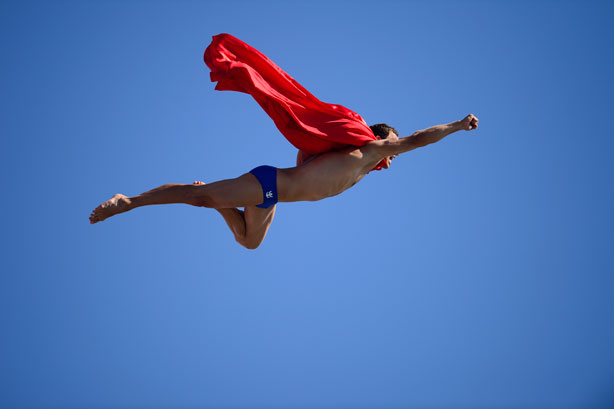
Superman for a day.

Superman for a day.

The above photo of Michal Navratil plummeting from a height of 27 meters (88.6 feet) at the High Diving World Championships in Barcelona in his Superman suit went viral a few days ago (I saw it on SportsCenter, for example). The 28-year-old Czech did an interview with Esquire about his lofty profession of cliff diver.

ESQUIRE:  How did you get started with cliff diving?  When did you do it for the first time?Michael Navratil: I started with my first twenty meter when I was 18 years old in the European Championships, in Switzerland, and there I did my first somersault from that height. Afterwards I kept progressing in height and quality of the diving, and five years later I went for the first competition from 28 meters, Marmeeting in Amalfi coast (Italy).

ESQUIRE:  How do you build up to such intense heights?  Is there a learning curve as you go higher and higher?

MN:  Definitely, your body needs to get used to the pressure of the impact progressively. Every meter that you go higher, the impact is stronger and harder, so I had to prepare myself physically and mentally. The higher you go, the more every meter makes a difference.

ESQUIRE:  Have you ever been hurt?

MN:  Yes a few times!  Five years ago I went to work on a show in China, and I was doing it three times a day. My mind was strong but my body was tired and in one of the high dives from 26 meters I twisted my ankle under water and for ten days I couldn’t step on it… But in two weeks I was diving again, landing head first for a while. Every impact is a lesson on how to protect yourself from the water. Another bad injury was learning to do a handstand from 15 meters, also in China. I was short on my landing and was coughing blood for a week! Still two days after this crash I dived from 20 meters and in another three days I went up to 26 meters, even though my body was injured I was learning a new competition dive and my mind was ready for it. Last bad injury was last year in Boston Red Bull Series stop, I tried a new dive ending in a blind entry three times, and I injured my lower back and my heels badly; I was in pain for the next three months and it really affected my results towards the end of the season.

Read the rest of the interview here.

Becoming Better Through Practice, Leading to Transformation

This post by @saulofhearts titled “I Was A Pretty Strange Kid: Or, How I Became An Expert in the Things That Scared Me” is timely for me. It’s about becoming better at things through practice, iteration, failing, and persevering. Here’s a passage on improving his dating skills:

Around that same time, I decided to get serious about my dating life. I’d grown up in a pretty repressed environment — thirteen years of Catholic school, a virtually non-existent dating life, and a family who never talked about sex, much less suggested I have it.

In college, I went straight into a long-term relationship. While my college friends were dating casually and having one-night stands, I was happily monogamous.

When my girlfriend and I broke up, I thought it would be just a matter of time before I ended up in another relationship. I’m not a virgin, right? I know what I’m doing….

What I didn’t realize was that my long-term monogamous relationship had covered up the fact that I was terrible with women.

I didn’t know how to ask a girl out, or meet someone new at a party.

So what did I do? I went on a billion dates. I set up an OK Cupid profile, sent out a bunch of messages, and arranged to have dinner with some of the girls that I clicked with.

I was scared as hell, terrible at making small talk — was it OK to mention Burning Man? weed? sex? — and most of the dates were awkward.

But over time, I got better. And I continued to challenge myself.

I went to workshops: tantric yoga, cuddle parties, an S&M club. I grewcomfortable talking about subjects that would have embarrassed my 10-year-old self.

This is the key takeaway that I need to repeat, repeat, repeat:

We’re not defined by the identity that we grew up with. We’re not defined by the expectations other people have of us.

It’s time to start becoming a better human.

A Brief History of the Children’s Food Menu

Michele Humes has an interesting post at Slate profiling the brief history of the kid’s menu at restaurants across America:

Depending on where you stand vis-à-vis childrearing, the golden age of youth dining in America either began or ended with the Volstead Act. ​In the century leading up to the dry laws, children rarely ate out. A child had to be relatively well-off in order to dine in public, and a guest at a hotel to boot. (Restaurants not attached to hotels didn’t tend to serve children, reasoning that they got in the way of boozy grown-up fun.) But the lucky boy or girl who could tick these boxes was assured of a pretty good time. When the English novelist Anthony Trollope toured the United States in 1861 (his two volumes of crotchety travelogue were later published as North America), he was astonished to see 5-year-old “embryo senators” who ordered dinner with sublime confidence and displayed “epicurean delight” at the fish course.

Prohibition spelled the end for 5-year-old epicures. Taking effect in January 1920, the dry laws forced the hospitality industry to rethink its policy on children: Could it be that this untapped market could help offset all that lost liquor revenue? The Waldorf-Astoria in New York thought so, and in 1921 it became one of the first establishments to beckon to children with a menu of their very own. But even as restaurants began to invite children in, it was with a new limitation: They could no longer eat what their parents ate.

The earliest children’s menus didn’t look so different from the playful ones we know today. The Waldorf-Astoria put Little Jack Horner on the cover of their pink-and-cream booklet; as he brandishes his plummy thumb, a dish runs away with a spoon. But then there was the food—the bland, practically monastic food, appearing all the more austere for the teddy bear picnic taking place overleaf. Here was flaked chicken over boiled rice; here were mixed green vegetables in butter; here was a splat of prune whip. And the one dish that appeared without exception—the chicken nugget of the Jazz Age—was a plain broiled lamb chop.

Read the rest here.

A Bookish Meditation

I love this short piece written by Gaby Gulo titled “Dear Reader.” In it, if I am interpreting correctly, she anthropomorphizes what’s it like for a book to be neglected, passed over, ignored:

I am a book. Not a poem on a single sheet, not a sheaf of notes, not a paperclipped pile of papers. I am a book.

I am a book with writing, still being written. I have been glanced at, passed over, picked up. I have been many books for many people.

I was the book you didn’t pick up. My cover was too tattered, the font old-fashioned. My hardbound pages were too thick for sand and salt. You picked a paperback instead.

I was the book you picked up but never opened. You saw me on a strange bookshelf, touched me on a whim. You thought my jacket interesting, but other things came along and you forgot I was interesting too, once.

I was the book you opened but never read. I was gifted to you, and you obliged the giver by hastily flipping through a few pages. My words were unfamiliar, my sentences complex. Politeness only goes so far.

I was the book you read partway. You stuck bits of paper, receipts, coffee-stained napkins in my pages to mark your place when you returned. You didn’t. You picked apart my paragraphs with close readings and left me smudged with pencil.

And then the transition, short but poignant, which hits directly in the gut:

Then you. You stroked my spine with curiosity, traced the letters of my title with callused fingers. You picked me up, opened me, read me slowly and carefully. You brushed away the bits of paper, rubbed out the smudges. You lingered over my lines and marked them only with your fingertips. My stories and stanzas were enough to keep you warm.

You carried me with your hands, fell asleep with me on your chest. To you, my rough-cut pages were perfect for turning, my worn cover comforting. You read me chapter by chapter, found shades of meaning in my white spaces. You savored the writing in my beginning and middle, appreciated the blank pages of my end.

Beautiful, poetic writing.

Brief Bits of Wisdom and Life Advice from Woody Allen

In the September issue of Esquire, Woody Allen, who will be 78 years old later this year, narrates some of the things he’s learned in his life. It’s a wonderful collection. Presented in almost in its entirety here:

What people who don’t write don’t understand is that they think you make up the line consciously — but you don’t. It proceeds from your unconscious. So it’s the same surprise to you when it emerges as it is to the audience when the comic says it. I don’t think of the joke and then say it. I say it and then realize what I’ve said. And I laugh at it, because I’m hearing it for the first time myself.

Without fear, you’d never survive.

My dad didn’t even teach me how to shave — I learned that from a cabdriver. But the biggest lesson he imparted is that if you don’t have your health, you have nothing. No matter how great things are going for you, if you have a toothache, if you have a sore throat, if you’re nauseated, or, God forbid, you have some serious thing wrong with you — everything is ruined.

Marshall McLuhan predicted books would become art objects at some point. He was right. [Editor’s note: see this.]

My mother taught me a value — rigid discipline. My father didn’t earn enough, and my mother took care of the money and the family, and she had no time for lightness. She always saw the glass a third full. She taught me to work and not to waste time.

I never see a frame of anything I’ve done after I’ve done it. I don’t even remember what’s in the films. And if I’m on the treadmill and I’m surfing the channels and suddenly Manhattan or some other picture comes on, I go right past it. If I saw Manhattan again, I would only see the worst. I would say: “Oh, God, this is so embarrassing. I could have done this. I should have done that.” So I spare myself.

In the shower, with the hot water coming down, you’ve left the real world behind, and very frequently things open up for you. It’s the change of venue, the unblocking the attempt to force the ideas that’s crippling you when you’re trying to write.

If you’re born with a gift, to behave like it’s an achievement is not right.

I love Mel Brooks. And I’ve had wonderful times working with him. But I don’t see any similarities between Mel and myself except, you know, we’re both short Jews. That’s where it ends. His style of humor is completely different. But Bob Hope? I’m practically a plagiarist.

We took a tour of the Acropolis late in the morning, and I looked down upon the theater and felt a connection. I mean, this is where Oedipus debuted. It’s amazing for someone who’s spent his life in show business or worked in dramatic art to look down at the theater where, thousands of years ago, guys like Mike Nichols and Stephen Sondheim and David Mamet were in togas, thinking,Gee, I can’t get this line to work. You know, I’ve been working on it all night. And that actor, he doesn’t know how to deliver it. Sophocles and Euripides and Aristophanes. The costumes are late, and we gotta go on!

It’s been said about marriage “You have to know how to fight.” And I think there’s some wisdom to that. People who live together get into arguments. When you’re younger, those arguments tend to escalate, or there’s not any wisdom that overrides the argument to keep in perspective. It tends to get out of hand. When you’re older, you realize, “Well, this argument will pass. We don’t agree, but this is not the end of the world.” Experience comes into play.

Back when I started, when I opened Take the Money and Run, the guys at United Artists accumulated the nation’s criticisms into a pile this big and I read them all. Texas, Oklahoma, California, New England… That’s when I realized that it’s ridiculous. I mean, the guy in Tulsa thinks the picture’s a masterpiece, and the guy in Vermont thinks it’s the dumbest thing he’s ever seen. Each guy writes intelligently. The whole thing was so pointless. So I abandoned ever, ever reading any criticisms again. Thanks to my mother, I haven’t wasted any time dwelling on whether I’m brilliant or a fool. It’s completely unprofitable to think about it.

You can only do so much, and then you’re at the mercy of fortune.

Me sitting down for dinner with Ingmar Bergman felt like a house painter sitting down with Picasso.

This last bit of wisdom is particularly eloquent and is a reminder of the fleeting nature of life:
It’s just an accident that we happen to be on earth, enjoying our silly little moments, distracting ourselves as often as possible so we don’t have to really face up to the fact that, you know, we’re just temporary people with a very short time in a universe that will eventually be completely gone. And everything that you value, whether it’s Shakespeare, Beethoven, da Vinci, or whatever, will be gone. The earth will be gone. The sun will be gone. There’ll be nothing. The best you can do to get through life is distraction. Love works as a distraction. And work works as a distraction. You can distract yourself a billion different ways. But the key is to distract yourself.