False Witness Accounts in the News

I’ve learned about this phenomenon in my undergraduate psychology classes, but The New York Times profiles two witness accounts from a recent hammer attack in Manhattan that were false:

// // //

Contrary to what Mr. O’Grady said, the man who was shot had not been trying to get away from the officers; he was actually chasing an officer from the sidewalk onto Eighth Avenue, swinging a hammer at her head. Behind both was the officer’s partner, who shot the man, David Baril.

And Ms. Khalsa did not see Mr. Baril being shot while in handcuffs; he is, as the video and still photographs show, freely swinging the hammer, then lying on the ground with his arms at his side. He was handcuffed a few moments later, well after he had been shot.

There is no evidence that the mistaken accounts of either person were malicious or intentionally false. Studies of memories of traumatic events consistently show how common it is for errors to creep into confidently recalled accounts, according to cognitive psychologists.

“It’s pretty normal,” said Deryn Strange, an associate psychology professor at John Jay College of Criminal Justice. “That’s the hard thing to get our heads around. It’s frightening how easy it is to build in a false memory.”

Entire story here.

###

Further reading: Scientific American on eyewitness testimony.

On Marc Andreessen’s Plan to Win the Future

Tad Friend, writing in The New Yorker, pens a fascinating profile of the venture capitalist Marc Andreessen (and the firm which he co-founded and is currently a general partner, a16z). A representative snippet of the man:

Something of the transporter beam clings to Andreessen, a sense that he just rematerialized from a city on the edge of forever. He’s not great at the basics of daily life: directions confound him, because roadways aren’t logical, and he’s so absent-minded about sunglasses that he keeps a “reload station” with nine pairs on his hall table. Perhaps Edison haunts his conversation because Andreessen is a fellow-tinkerer, except that his gadgets are systems and platforms, and his workshop is his own mind. He regularly reprograms his appearance and deportment—his user interface—to suit his present role, and friends refer to chapters in his life as versions of an operating system: “Marc 1.0,” “Marc 2.0,” and so on. A charismatic introvert, Andreessen draws people in but doesn’t really want them around. Though he has a crisp sense of humor, it’s rarely deployed at his own expense. He hates being complimented, looked at, or embraced, and has toyed with the idea of wearing a T-shirt that says “No hugging, no touching.” He doesn’t grasp the protocols of social chitchat, and prefers getting a memo to which he can e-mail a response, typing at a hundred and forty words a minute. He didn’t attend Netscape’s twentieth-anniversary celebration, because it combined two things from which he recoils: parties and reminiscing.

Curious what would have become of Facebook if it weren’t for Marc’s advice to Mark Zuckerberg:

In 2006, Yahoo! offered to buy Facebook for a billion dollars, and Accel Partners, Facebook’s lead investor, urged Mark Zuckerberg to accept. Andreessen said, “Every single person involved in Facebook wanted Mark to take the Yahoo! offer. The psychological pressure they put on this twenty-two-year-old was intense. Mark and I really bonded in that period, because I told him, ‘Don’t sell, don’t sell, don’t sell!’ ” Zuckerberg told me, “Marc has this really deep belief that when companies are executing well on their vision they can have a much bigger effect on the world than people think, not just as a business but as a steward of humanity—if they have the time to execute.” He didn’t sell; Facebook is now worth two hundred and eighteen billion dollars.

I empathize with this philosophy for the world:

“I could never tolerate not knowing why…You have to work your way back to figure out the politics, the motivations. I always stop when I get to evolutionary psychology, and why we have tribes—oh, O.K., we’re primates cursed with emotions and the ability to do logical thinking.”

This is a key paragraph on how venture capitalism is more about errors of omission:

In venture, it’s not batting average that matters; it’s slugging average. Boldness is all. When Google Glass appeared, a16z joined a collective to seek out investments, and Andreessen declared that, without the face shield, “people are going to find they feel, basically, naked and lonely.” Google withdrew the product in January. But, he would argue, so what? His thesis is that such a16z failures as Fab and Rockmelt and Digg and Kno are not merely a tolerable by-product of the risk algorithm but a vital indicator of it. It’s fine to have a lousy record of predicting the future, most of the time, as long as when you’re right you’re really right. Between 2004 and 2013, a mere 0.4 per cent of all venture investments returned at least 50x. The real mistakes aren’t the errors of commission, the companies that crash—all you can lose is your investment—but those of omission. There were good reasons that a16z passed on buying twelve per cent of Uber in 2011, including a deadline of just hours to make a decision. But the firm missed a profit, on paper, of more than three billion dollars.

A must-read all the way through if you’re at all interested in tech, Silicon Valley, or entrepreneurship.

Harvard Engineering and the Quest to Build an Ultimate Barbecue Grill

This is a great story in The Boston Globe about a Harvard engineering course in which students were tasked to design an ultimate barbecue grill:

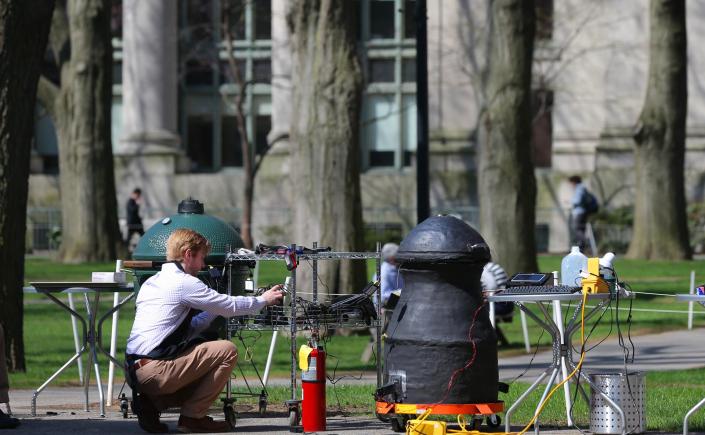
For months, this 16-person team had been designing and modeling and building the prototype for the ultimate barbecuecooker. The handcrafted Harvard smoker is their solution. Tested by countless computer simulations of virtual brisket smoking, nearly two dozen weekend smoking sessions — often in snow or sub-zero temperatures — and 220 pounds of meat, the smoker is a rigorous, data-driven tool for making a feast.

How did the idea for the unusual class come about?

The idea for this unconventional engineering class, offered to Harvard juniors, came three years ago when engineering professor Kevin Kit Parker attended a barbecue-cooking competition in Memphis. Parker grew up in the South and has a deep appreciation for barbecue, and when he looked up from his plate that day, he saw a problem that lacked an optimal solution.

Many products have been refined by cycles of science and engineering. Barbecue, however, has been a veritable Wild West in which pit masters build mishmash setups that incorporate garbage cans, cinder blocks, a giant rotisserie. There seemed to be little in the way of deep understanding of how — or why — one smoker was better than another, Parker said.

And lest you think the class sounded like a joke, the students spent 40 to 50 hours a week on the project! In the end, there is a patent pending and perhaps an actual product in store shelves in the very near future.

Hahaha vs. Hehehe

This is a fun primer from Sarah Larson at The New Yorker on the difference between using “hahaha” and “hehehe” in your texts (or other online communication). Many people have their own interpretations. What’s yours?

The feel-good standard in chat laughter is the simple, classic “haha”: a respectful laugh. “Haha” means you’re genuinely amused, and that maybe you laughed a little in real life. (The singsong Nelson Muntz-style “ha ha,” of course, is completely different—we don’t do this to our friends. There’s also the sarcastic “ha ha,” a British colleague reminded me: he’s used to reading “ha ha” as “Oh, ha ha,” as in, Aren’t you a wag. “But I’m learning to read it as good,” he said. Poor guy.) “Hahaha” means that you’re really amused: now you’re cooking. More than three “ha”s are where joy takes flight. When you’re doing this, you’re laughing at your desk and your co-workers can hear you, or you’re texting with both hands, clacking and laughing away. Somebody has been naughty and fun: a scandalous remark, a zinger, a gut laugh, the high-grade stuff. If things get totally bananas, you might throw a few “j”s in there, because you’re too incapacitated by joy to type properly.

I largely agree with this assessment:

My savvy friend whose use of “hehe” provoked all these questions said that “hehe” is one of his favorite words. He pronounces it “heh heh,” to indicate mild amusement “without having to resort to emoticons, LOLs, or ROTFLs.” He said that “haha” indicates “more serious amusement,” and adds extra “ha”s for “more serious mirth.” He wrote, “There is no such thing as “hehehe” in my vocab, though.” Noted.

I use “haha,” “hahaha,” “hehe,” and “heh.” To me, “hehe” is something that is funny but isn’t something at which I didn’t laugh out loud. However, “haha” and “hahaha” is something that brought a smile or laughter out of me.

A notable omission in the article? Those who write “ahaha” and its many variations.

On Running the Marathon in North Korea

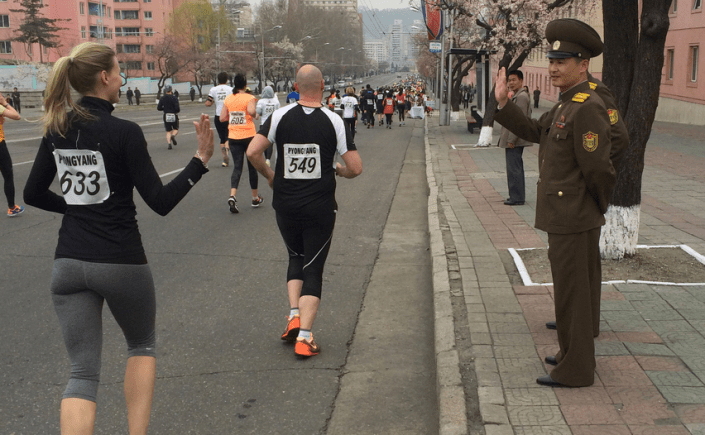
Jeré Longman recently ran a marathon in Pyongyang, North Korea. He was one of several hundred foreign tourists allowed to participate in the spectacle. Writing for The New York Times, he reflects on the experience:

We could not leave the loop course, but we could leave our minders for an hour or two or four. Maybe we could make a personal connection that seemed less scripted than the opening ceremony: a brief smile, a wave, a hello, a thank you, a small encouragement.

Or would it all be staged, a Potemkin race in an authoritarian capital for the elite and loyal, our perceptions influenced by stories in the West, true or not, that Kim Jong-il scored a perfect 300 in his first bowling match and five holes in one on his maiden round of golf?

An early uphill stretch carried us past modest but encouraging crowds along a wide street of apricot blossoms. A soldier high-fived a few runners. A woman waved from the window of her apartment building. Other women in red jackets poured water into cups at small hydration tables.

The 6.2-mile loop brought us back and forth across the Taedong River via bridge and tunnel, the roads decorated with clusters of North Korean flags, their red star and red field meant to symbolize the spilled blood of liberation in a military-first nation.

For the natives, the marathon may have been a chance to act rebelliously:

During his half-marathon, Hank Mannen, 36, of the Netherlands, was startled to see a young woman blow him a kiss. He said he reciprocated, then thought for a moment, “She’s in big trouble now.

Great read.

When Banks Pay Borrowers’s Mortgage Interest, Europe Edition

Falling interest rates in Europe have put some banks in an interesting position: owing money on loans to borrowers.The Wall Street Journal reports on the curiosity:

At least one Spanish bank, Bankinter SA, the country’s seventh-largest lender by market value, has been paying some customers interest on mortgages by deducting that amount from the principal the borrower owes.

The problem is just one of many challenges caused by interest rates falling below zero, known as a negative interest rate. All over Europe, banks are being compelled to rebuild computer programs, update legal documents and redo spreadsheets to account for negative rates.

Interest rates have been falling sharply, in some cases into negative territory, since the European Central Bank last year introduced measures meant to spur the economy in the eurozone, including cutting its own deposit rate. The ECB in March also launched a bond-buying program, driving down yields on eurozone debt in hopes of fostering lending.

So in Spain, Portugal, and Italy, the base interest rate used for many loans, especially mortgages, is the euro interbank offered rate, or Euribor. The rate is based on how much it costs European banks to borrow from each other. Banks set interest rates on many loans as a small percentage above or below a benchmark such as Euribor. If the spread plus the Euribor is below 0, the Bank pays the borrower.

Early Retirement and the Paradox of Success

This is a good piece in The New York Times on the paradox of success:

Similarly, to succeed in the N.F.L., it is not enough to be strong and fast. Witness all the college players who exhibit all the physical skills they need in the league’s draft who never succeed as professionals. Rather, the best players display a certain manic competitiveness such that they keep playing. The Denver Broncos’ quarterback, Peyton Manning, has won a Super Bowl and made $230 million from football alone, and he looked to be in profound physical pain at the end of last season. Yet with his intensively competitive streak, he intends to come back next season at age 39.

The paradox of success is this: The mental wiring that enables a person to claw to the tippy-top of Corporate America or sports or entertainment or any other field that offers vast wealth is the same mental wiring that most of the time leads people not to retire before they have to — no matter what the diminishing marginal utility of money would suggest.

More here.

Researchers Find a Way to Unboil an Egg

Consider this one of the fundamental truths as I was growing up and taking a number of courses in basic biology (and later, microbiology and chemistry): once you boil an egg, there is no way to unboil that egg. Proteins denature once subjected to heat, and do not re-fold back to their original shape/structure.

Turns out, based on most recent research, that may not necessarily be the case: According to findings published in the journal ChemBioChem,

University of California Irvine and Australian chemists have figured out how to unboil egg whites – an innovation that could dramatically reduce costs for cancer treatments, food production and other segments of the $160 billion global biotechnology industry.

To re-create a clear protein known as lysozyme once an egg has been boiled, he and his colleagues add a urea substance that chews away at the whites, liquefying the solid material. That’s half the process; at the molecular level, protein bits are still balled up into unusable masses. The scientists then employ a vortex fluid device, a high-powered machine designed by Professor Colin Raston’s laboratory at South Australia’s Flinders University. Shear stress within thin, microfluidic films is applied to those tiny pieces, forcing them back into untangled, proper form.

In a paper titled “Shear-Stress-Mediated Refolding of Proteins from Aggregates and Inclusion Bodies,” this is the abstract:

Recombinant protein overexpression of large proteins in bacteria often results in insoluble and misfolded proteins directed to inclusion bodies. We report the application of shear stress in micrometer-wide, thin fluid films to refold boiled hen egg white lysozyme, recombinant hen egg white lysozyme, and recombinant caveolin-1. Furthermore, the approach allowed refolding of a much larger protein, cAMP-dependent protein kinase A (PKA). The reported methods require only minutes, which is more than 100 times faster than conventional overnight dialysis. This rapid refolding technique could significantly shorten times, lower costs, and reduce waste streams associated with protein expression for a wide range of industrial and research applications.

Obviously, this is tremendous news that will seek other labs trying to replicate the study.

The Green Bay Packers and Settlers of Catan

As the Green Bay Packers take on the Seattle Seahawks in tomorrow’s NFC Championship game, I found this story interesting about how part of the team spends its time playing Settlers of Catan:

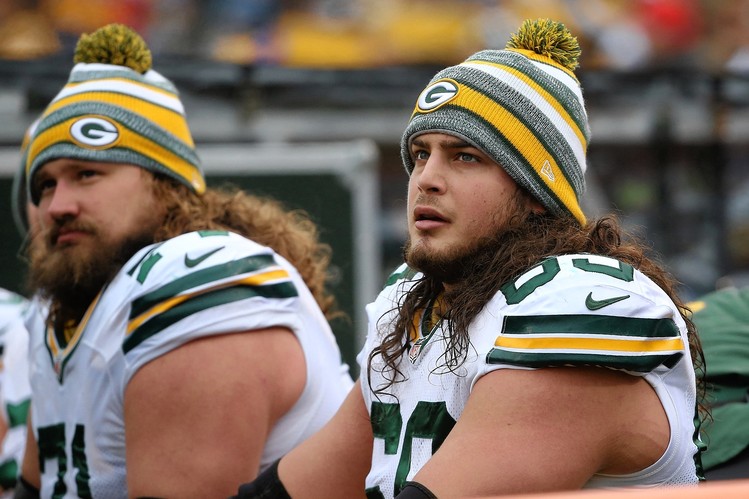
There may not be a more unusual bonding tradition in the NFL than the gang of Packers who get together regularly to play a boardgame called “Settlers of Catan.” For the past two months, it’s been the talk of the lockerroom. The number of players that have devoted a long night to the game is in the double-digits—including most of the team’s starting offensive line, among others. And don’t let the words “board game” fool you, this is not Candy Land.

packers

On any day in Green Bay’s locker room, you can find starting tackle David Bakhtiari, who introduced the game to the team, rounding up players for a Settlers get-together that night—and there’s no shortage of willing participants. But players may not know what they are in for. Backup quarterback Matt Flynn said he was interested in the game because it was “a nonviolent version of Risk,” referring to Parker Brothers’ notoriously lengthy game of world domination. But Flynn said the players take it so seriously that when he stopped by to play for the first time after a win last month, he was shocked by what happened when he attempted to turn on some celebratory music.

I visited Green Bay in December and it is true what they say: there isn’t much to do in the city when it gets too cold.

Sumo Wrestling, Yukio Mishima, and a Search for a Forgotten Man

I’ve been a fan of Brian Phillips’s writing ever since reading and recommending “Pelé as a Comedian.” This year, Brian’s best writing probably comes via his piece at Grantland titled “The Sea of Crises,” in which he goes on a two week trip to Japan. During his visit, he witnesses a sumo tournament, traverses around Tokyo and other parts of Japan, and recounts his fascination with a failed coup attempt by a Japanese writer Yukio Mishima, which ended in ritual suicide, seppuku.

A wonderful description of Tokyo:

Tokyo, the biggest city in the world, the biggest city in the history of the world, a galaxy reflected in its own glass. It was a fishing village barely 400 years ago, and now: 35 million people, a human concourse so vast it can’t be said toend, only to fade indeterminately around the edges. Thirty-five million, almost the population of California. Smells mauling you from doorways: stale beer, steaming broth, charbroiled eel. Intersections where a thousand people cross each time the light changes, under J-pop videos 10 stories tall. Flocks of schoolgirls in blue blazers and plaid skirts. Boys with frosted tips and oversize headphones, camouflage jackets and cashmere scarves. Herds of black-suited businessmen. A city so dense the 24-hour manga cafés will rent you a pod to sleep in for the night, so post-human there are brothels where the prostitutes are dolls. An unnavigable labyrinth with 1,200 miles of railway, 1,000 train stations, homes with no addresses, restaurants with no names. Endless warrens of Blade Runner alleys where paper lanterns float among crisscrossing power lines. And yet: clean, safe, quiet, somehow weightless, a place whose order seems sustained by the logic of a dream.

It’s a dream city, Tokyo. I mean that literally, in that I often felt like I was experiencing it while asleep. You’ll ride an escalator underground into what your map says is a tunnel between subway stops, only to find yourself in a thumping subterranean mall packed with beautiful teenagers dancing to Katy Perry remixes. You will take a turn off a busy street and into a deserted Buddhist graveyard, soundless but for the wind and the clacking of sotoba sticks, wooden markers crowded with the names of the dead. You will stand in a high tower and look out on the reason-defying extent of the city, windows and David Beckham billboards and aerial expressways falling lightly downward, toward the Ferris wheel on the edge of the sea.

This is a beautiful description:

It takes a sumo novice perhaps 10 seconds of match action to see that among the top-class rikishi, Hakuho occupies a category of his own. What the others are doing in the ring is fighting. Hakuho is composing little haiku of battle.

The majority of the piece gives the reader this feeling as though one is in a ship, being gently throttled back and forth as Phillips describes his experiences of traveling and getting lost:

So I wandered, lost, around Tokyo. I went to the shrine of Nomi no Sukune, the legendary father of sumo, who (if he lived at all) died 2,000 years ago. I went to the food courts in the basements of department stores. I thought I should look for the past, for the origins of sumo, so early one morning I rode a bullet train to Kyoto, the old imperial capital, where I was yelled at by a bus driver and stayed in a ryokan — a guest house — where the maid crawled on her knees to refill my teacup. I climbed the stone path of the Fushimi Inari shrine, up the mountain under 10,000 vermilion gates. I visited the Temple of the Golden Pavilion, rebuilt in 1955 after a mad monk burned it to the ground (Mishima wrote a novel about this), and the Temple of the Silver Pavilion, weirder and more mysterious because it is not actually covered in silver but was only intended to be. I spent 100 yen on a vending-machine fortune that told me to be “patient with time.”

Highly recommended in entirety.