Dissecting Bilbo’s Contract in J.R.R. Tolkien’s The Hobbit

James Daily, a lawyer and co-author of The Law and Superheroes, typically focuses his legal critiques on the superhero world at the Law and the Multiverse website he runs with fellow lawyer and co-author Ryan Davidson. And in this piece for Wired, James Daily dissects the lengthy contract between Bilbo Baggins and the dwarves in J.R.R. Tolkien’s The Hobbit.

Two clauses describe Bilbo’s primary obligations:

I, the undersigned, [referred to hereinafter as Burglar,] agree to travel to the Lonely Mountain, path to be determined by Thorin Oakenshield, who has a right to alter the course of the journey at his so choosing, without prior notification and/or liability for accident or injury incurred.

The aforementioned journey and subsequent extraction from the Lonely Mountain of any and all goods, valuables and chattels [which activities are described collectively herein as the Adventure] shall proceed in a timely manner and with all due care and consideration as seen fit by said Thorin Oakenshield and companions, numbering thirteen more or less, to wit, the Company.

All contracts require some consideration from all parties to the contract.  Consideration, in the contract sense, means a bargained-for performance or promise. Restatement (Second) of Contracts § 71(1). Basically, this is something of value given or promised as part of the agreement. This can be anything that the parties agree is valuable; the classic example is a single peppercorn.  Whitney v. Stearns, 16 Me. 394, 397 (1839).

Here, Bilbo is promising to go with the Company to the Lonely Mountain and performing various services there, including extracting the treasure, plus a few more services we’ll get to later. In turn, as we shall see, the Company promises to pay Bilbo one fourteenth of the profits, plus a few other obligations. Thus we have “a promise for a promise,” otherwise known as a bilateral contract.

There are some other details to notice in these clauses. One is the use of defined terms (e.g. “referred to hereinafter as Burglar”). The parties to a contract may define terms however they wish, even in ways that contradict the definition used in statutes or regulations.

Continuing:

Next we have a non-disclosure or confidentiality clause:

Confidentiality is of utmost importance and must be strictly maintained at all times.  During the course of his employment with the Company, Burglar will hear, see, learn, apprehend, comprehend, and, in short, gain knowledge of particular facts, ideas, plans, strategies, theories, geography, cartography, iconography, means, tactics and/or policies, whether actual, tangible, conceptual, historical or fanciful.  Burglar undertakes and agrees to maintain this knowledge in utmost secrecy and confidentiality, and to neither divulge nor make known said knowledge by any means, including but not limited to speech, writing, demonstration, re-enactment, mime, or storage and retrieval within means or apparatus currently known or unknown or as yet unthought of.

(It is a plain drafting error to refer to “the course of [the Burglar’s] employment with the company”, since a later clause specifies in no uncertain terms that “Burglar is in all respects an independent contractor, and not an employee … of the Company.”)

This confidentiality agreement is a little overbroad, since by its strict terms it requires Bilbo to keep confident anything he learns on the journey, not just things he learns in confidence.  The fact that information is already publicly known is usually a defense to a breach of confidentiality, since the information wasn’t actually secret.  Overbreadth probably isn’t fatal to the clause, however.

What’s really unusual about this part of the contract is that it doesn’t appear to include a clause acknowledging that monetary damages alone would be inadequate compensation in the event of a breach of confidentiality.  The purpose of such a clause is to make it easier to obtain an injunction ordering the breaching party to stop disclosing the confidential information.  Ordinarily breach of contract results in a payment of monetary damages, and getting an injunction usually requires showing, among other things, that those damages are insufficient to remedy the harm done.

Recommended reading if you’re a fan of the book. I saw the film in late 2012, but must admit that it was too long for my taste. And they’re making The Hobbit a trilogy!?

The Best Longreads of 2012

This is my third year compiling the best longreads of the year (see the 2010 best longreads and 2011 best longreads). As usual, I will highlight the top five longreads of 2012:

(1) “Battleground America” [The New Yorker] — this piece was published in April of this year, but I highlight it first because of its relevance after the Sandy Hook tragedy. In this exhaustively researched piece, Jill Lepore discusses the history of guns, the Second Amendment, and the course of gun control in America.

(2) “The Personal Analytics of My Life” [Stephen Wolfram] — this blog post by the founder of Mathematica personally resonated with me because I made a strong point to track a number of things in my life this year (weight, diet, sleep habits). While I wasn’t as hardcore about the process as Stephen Wolfram (he’s been collecting data for more than 20 years!), this blog post served as further motivation that if you want to understand how to change your habits, you first have to become good at tracking them.

(3) “The Most Amazing Bowling Story Ever” [D Magazine] — Just as the title says, this is the most amazing bowling story I’ve ever read (and I am not a fan of bowling). Bill Fong is 48 years old and almost did what no bowler has done before: bowl three consecutive perfect games. Read the whole thing, because there’s an amazing twist at the end of the story:

Aside from bowling, Bill Fong hasn’t had a lot of success in life. His Chinese mother demanded perfection, but he was a C student. He never finished college, he divorced young, and he never made a lot of money. By his own account, his parents didn’t like him much. As a bowler, his average in the high 230s means he’s probably better than anyone you know. But he’s still only tied as the 15th best bowler in Plano’s most competitive league. Almost nothing in life has gone according to plan. 

(4) “A Vintage Crime” [Vanity Fair] —  Michael Steinberger write a fascinating piece about Rudy Kurniawan, a 31-year-old Indonesian transplant living in the United States and producing counterfeit wine. It’s a story of a slow rise and an astronomical fall:

No one moved the market more than a twentysomething West Coast collector named Rudy Kurniawan. He first surfaced on the wine scene in the early 2000s. He was reportedly the scion of a wealthy ethnic-Chinese family from Indonesia. In an interview with the Los Angeles Times, in 2006, he explained that Kurniawan was an Indonesian surname his late father had given him to protect his identity. He said that his family had business interests in Indonesia and China, but refused to elaborate.

(5) “Louis C.K. and the Rise of the Laptop Loners” [Los Angeles Review of Books] — as I explained in September when I originally profiled the piece, I hadn’t even heard of Louis C.K. until the Internet hyped his no-strings-attached $5 comedy show. Since then, I’ve watched the first two seasons of Louie’s show, and I must say, I’ve become an even bigger fan. If you haven’t heard of the guy, read Adam Wilson’s brilliant profile (and then purchase the TV series and become a fan like I have)

For comedians, a healthy dose of fatalism is a job requirement. In one of his funniest standup routines, C.K. complains that even the most ideal life will end in the deaths of you and those you love. But Louie’s fatalism is balanced out by an occasional idealism that’s almost shocking in its earnestness. Louie isn’t jaded. When he asks the annoying stoner who lives across the hall to “just be a neighbor, a human being,” it feels as if he’s addressing the world writ large, that basic human decency is something he believes in. We get the sense that he actually cares about other people.

*BONUS*

“Cold Pastoral” by Marina Keegan (published in The New Yorker). All the pieces I highlighted above are works of journalism (non-fiction). “Cold Pastoral” is an exception. I can’t remember how I stumbled upon this incredible short story, but without a doubt, it’s the best piece of short fiction I’ve read in 2012. Tragically, Marina Keegan died in a car accident in May of this year, at the age of 22. She passionately argued in The New York Times that college students should resist the allure of high-paying jobs and go after their dreams. Ms. Keegan’s also wrote an impassioned address to the class of 2012, titled “The Opposite of Loneliness”:

We don’t have a word for the opposite of loneliness, but if we did, I could say that’s what I want in life. What I’m grateful and thankful to have found at Yale, and what I’m scared of losing when we wake up tomorrow and leave this place.

But it is “Cold Pastoral,” published in The New Yorker for the first time, which I think unanimously showcases her craft and beautiful, deep insight into human behavior and emotion. “Cold Pastoral” is the only piece of writing which I’ve read this year which left tears in my eyes after finishing it. Marina Keegan (1989-2012), RIP.

###

You can check out the best 2012 longreads from other contributors on the Longreads blog. You can see what other longreads I’ve read throughout the year by checking out the longreads category.

Snow Fall: The Avalanche at Tunnel Creek

The New York Times recently unveiled an interactive story titled “Snow Fall: The Avalanche at Tunnel Creek.” It’s an experiment, and is thus presented under the “projects” sub-URL of the Times. The story is about survival after an avalanche in the Cascade Mountains:

The Cascades are among the craggiest of American mountain ranges, roughly cut, as if carved with a chain saw. In summer, the gray peaks are sprinkled with glaciers. In winter, they are smothered in some of North America’s deepest snowpack.

The top of Cowboy Mountain, about 75 miles east of Seattle, rises to 5,853 feet — about half the height of the tallest Cascades, but higher than its nearest neighbors, enough to provide 360-degree views. It feels more like a long fin than a summit, a few feet wide in parts. Locals call it Cowboy Ridge.

To one side, down steep chutes, is Stevens Pass ski area, which receives about 400,000 visitors each winter. To the other, outside the ski area’s boundary to what is considered the back of Cowboy Mountain, is an unmonitored play area of reliably deep snow, a “powder stash,” known as Tunnel Creek.

An interactive overview of the Cascades.

An interactive overview of the Cascades.

So far, only the first part of the story is available online. And it’s a delight. From the text, to the in-line photos and videos, this is a top-notch media experiment. I highly recommend clicking through and reading/partaking.

Update (12/21/12): The whole story is now online.

###

(hat tip: @KathrynSchulz)

Alan Sepinwall on the Origins of LOST

Alan Sepinwall, writing for Grantland, recounts the origins of the hit TV show LOST, as told by the people who made it, in an exclusive first serial excerpt from The Revolution Was Televised:

On vacation with his family in Hawaii, Braun watched his network’s broadcast of the Tom Hanks movie Cast Away, then went down to the beach to watch the sunset and meet up with his wife and kids. As he waited, he began pondering the idea of doing Cast Awayas a TV show, but couldn’t figure out how to make it work with only one actor and one volleyball.

“And then the notion of Survivor popped into my head,” recalls Braun. “I don’t know why. And I put it all together: What if there was a plane that crashed and a dozen people survived, and nobody knew each other. Your past was almost irrelevant. You could reinvent who you were. You had to figure out — how do you survive? What do you use for shelter, for water? Is it like Lord of the Flies? How do we get off the island, how do you get home? And I start to get very excited about the idea, and I start thinking about the title Lost.”

Also interesting and surprising was how one of the writers of LOST, Damon Lindelof, reacted to the show’s premiere:

Lindelof, on the other hand? He describes his response to those huge premiere ratings as “Terror, depression, anxiety, anxiety attacks. I’m not exaggerating. Everybody who was around me at the time knows I pretty much wanted to die, and knowing that wasn’t going to happen unless I took matters into my hands, I just wanted to quit. But there was literally no one to quit to.”

Cuse says, “I remember [Lindelof] coming in with the ratings after the opening episode, and he looked completely miserable. He said, ‘Does this mean we have to keep fucking doing this?’ If you’re a producer in television, this is like getting a winning lottery ticket: having a show that’s not only critically acclaimed but gets big ratings. But it was daunting to have to sustain this thing.”

I’ve placed Alan Sepinwall’s The Revolution was Televised on my Christmas wish-list.

###

As some of you may know, LOST is my favorite TV show (to this day). Here was my reflection six months after the show ended.

(hat tip: Longreads)

How the Nerds Helped Obama Win the 2012 Election

The 2012 Presidential Election may be three weeks behind us, but I wanted to highlight this excellent piece by Alexis Madrigal in The Atlantic titled “When The Nerds Go Marching In.” Alexis goes behind the scenes to get the scoop on the top caliber technology team that was behind Obama’s campaign. Led by campaign technology officer Harper Reed,

The team had elite and, for tech, senior talent — by which I mean that most of them were in their 30s — from Twitter, Google, Facebook, Craigslist, Quora, and some of Chicago’s own software companies such as Orbitz and Threadless, where Reed had been CTO. But even these people, maybe *especially* these people, knew enough about technology not to trust it. “I think the Republicans fucked up in the hubris department,” Reed told me. “I know we had the best technology team I’ve ever worked with, but we didn’t know if it would work. I was incredibly confident it would work. I was betting a lot on it. We had time. We had resources. We had done what we thought would work, and it still could have broken. Something could have happened.”

Moreover,

Reed’s team came in as outsiders to the campaign and by most accounts, remained that way. The divisions among the tech, digital, and analytics team never quite got resolved, even if the end product has salved the sore spots that developed over the stressful months. At their worst, in early 2012, the cultural differences between tech and everybody else threatened to derail the whole grand experiment.

By the end, the campaign produced exactly what it should have: a hybrid of the desires of everyone on Obama’s team. They raised hundreds of millions of dollars online, made unprecedented progress in voter targeting, and built everything atop the most stable technical infrastructure of any presidential campaign. To go a step further, I’d even say that this clash of cultures was a good thing: The nerds shook up an ossifying Democratic tech structure and the politicos taught the nerds a thing or two about stress, small-p politics, and the significance of elections.

Above all, Alexis goes behind the scenes to bring the face of the team closer to us, the read. It’s a deeply human story:

If you’re a nerd, Harper Reed is an easy guy to like. He’s brash and funny and smart. He gets you and where you came from. He, too, played with computers when they weren’t cool, and learned to code because he just could not help himself. You could call out nouns, phenomena, and he’d be right there with you: BBS, warez, self-organizing systems, Rails, the quantified self, Singularity. He wrote his first programs at age seven, games that his mom typed into their Apple IIC. He, too, has a memory that all nerds share: Late at night, light from a chunky monitor illuminating his face, fingers flying across a keyboard, he figured something out. 

It’s one of the best pieces I’ve read since the election. Highly, highly recommended.

The Hard Life of an NFL Long Shot

Charles Siebert profiles the story of Pat Schiller, a Northern Illinois football player who is trying to make the NFL. The story gives an inside look of what it takes to make the NFL if your chances are low. Charles is Pat’s uncle, but don’t let that detail get in the way of superb reporting:

Being an undrafted free agent in the N.F.L. is an extended exercise in ego abnegation. You’re not only stripped of your college number; you’re exiled from the N.F.L.’s mandated numerical bracket for your given position. Linebackers on all final team rosters must bear a number in either the 50s or 90s. Pat, for now, was given 45. As for his fellow undrafted competitors, Max Gruder, a linebacker from the University of Pittsburgh, wore 46; Rico Council, a middle linebacker from Tennessee State, 43; and Jerrell Harris, an outside linebacker for last year’s champions, Alabama, 49. Some days in practice, Pat wore 40 and then was switched back to 45. Coaches and fellow players, meanwhile, were constantly confusing Pat with a third-year safety, Shann Schillinger, whose seniority naturally merited his getting dibs on the nickname “Schill,” thus saddling my nephew with — for obscure reasons — “Patty Melt.”

This story was, perhaps, more interesting to me because Pat Schiller was drafted by the Atlanta Falcons, my hometown football team. I think it’s worth the read.

Paul Graham on Good vs. Bad Start-up Ideas

This is a wise essay from Paul Graham on why many start-ups fail while others succeed. The difference is that the founders who build a start-up to solve their own problems versus what they think people need:

Why do so many founders build things no one wants? Because they begin by trying to think of startup ideas. That m.o. is doubly dangerous: it doesn’t merely yield few good ideas; it yields bad ideas that sound plausible enough to fool you into working on them.

At YC we call these “made-up” or “sitcom” startup ideas. Imagine one of the characters on a TV show was starting a startup. The writers would have to invent something for it to do. But coming up with good startup ideas is hard. It’s not something you can do for the asking. So (unless they got amazingly lucky) the writers would come up with an idea that sounded plausible, but was actually bad.

For example, a social network for pet owners. It doesn’t sound obviously mistaken. Millions of people have pets. Often they care a lot about their pets and spend a lot of money on them. Surely many of these people would like a site where they could talk to other pet owners. Not all of them perhaps, but if just 2 or 3 percent were regular visitors, you could have millions of users. You could serve them targeted offers, and maybe charge for premium features.

The danger of an idea like this is that when you run it by your friends with pets, they don’t say “I would never use this.” They say “Yeah, maybe I could see using something like that.” Even when the startup launches, it will sound plausible to a lot of people. They don’t want to use it themselves, at least not right now, but they could imagine other people wanting it. Sum that reaction across the entire population, and you have zero users.

You should read the whole post here.

The Girl That Doesn’t Feel Pain

Justin Heckert, writing for New York Times Magazine, spent some time with Ashlyn Blocker and her parents, Tara and John. Ashlyn suffers from a rare condition called congenital insensitivity to pain in which she doesn’t feel pain:

Tara and John weren’t completely comfortable leaving Ashlyn alone in the kitchen, but it was something they felt they had to do, a concession to her growing independence. They made a point of telling stories about how responsible she is, but every one came with a companion anecdote that was painful to hear. There was the time she burned the flesh off the palms of her hands when she was 2. John was using a pressure-washer in the driveway and left its motor running; in the moments that they took their eyes off her, Ashlyn walked over and put her hands on the muffler. When she lifted them up the skin was seared away. There was the one about the fire ants that swarmed her in the backyard, biting her over a hundred times while she looked at them and yelled: “Bugs! Bugs!” There was the time she broke her ankle and ran around on it for two days before her parents realized something was wrong…

The article goes a bit into the genetic reason for Ashlyn’s insensitivity to pain, namely a mutated SCN9A gene. Interestingly, SCN9A.com lists an older NYT article about the gene.

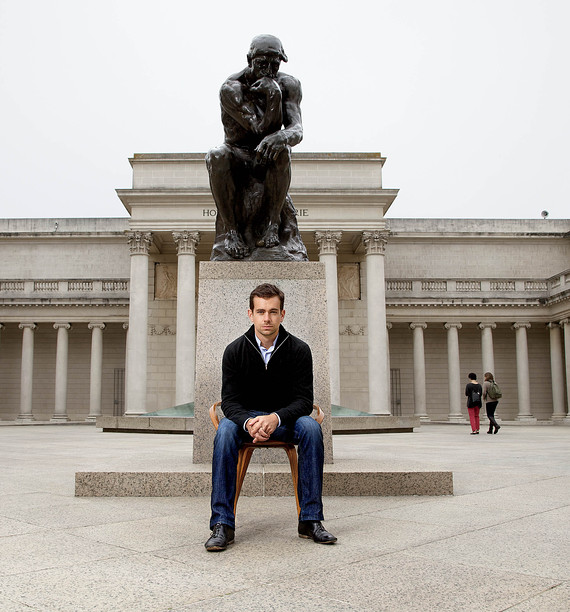
Jack Dorsey, Charlie Chaplin of Technologists

I love this Wall Street Journal profile of Jack Dorsey, co-founder of Twitter and Square. The Journal likens him to Charlie Chaplin of technologists, and based on what I’ve read about him, the analogy seems apt:

[Jack Dorsey] works standing up at an immaculate, clutter-free table in the center of the wide-open office, typing alone on his iPad, easily accessible to colleagues who can informally sidle up and ask him questions. His daily uniform includes dainty Repetto shoes from France (because, as he recently tweeted, they are “light” and “graceful”) and special open-collared shirts, the provenance of which he refuses to identify (“halfway between a Nehru and a priest’s collar,” as he describes them). This allows him to convey enough formality for meetings, yet frees him from the constriction of wearing ties. He encourages midday strolls outside Square’s offices as a means of inspiration. He leads groups of employees on exploratory excursions to museums or across the Golden Gate Bridge.

A man of widely varied interests, Dorsey is a genuine eccentric—not a mere collector of affectations. He treats his obsessions more as callings than as hobbies. When young, he studied botanical illustration under the tutelage of a master at the Missouri Botanical Garden, gazing for hours at the contours of gingko leaves. He later became fascinated by bespoke denim and enrolled in fashion design classes. Perhaps most bizarrely, he devoted himself for a solid year to the art of massage therapy, after dealing with sore wrists from too much coding. “I was ready to do massage for the rest of my life,” he says. “I tried to convince a nightclub owner in St. Louis to let me give people chair massages at the edge of the dance floor, wearing all white clothes and white clogs. He thought it was a terrible idea, so I went back to programming.” To protect his wrists, he trained himself to type in Dvorak—a keyboard alignment that is ergonomically superior to Qwerty.

Dorsey delves deeply and intensely into whatever piques his curiosity, on the theory that innovation happens when disparate thoughts mesh. “It’s important to demystify the term. Innovation is just reinvention and rethinking. I don’t think there’s anything truly, organically new in this world. It’s just mash-ups of all these things that provide different perspectives—that allow you to think in a completely different way, which allows you to work in a different way.”

One of the most fascinating men in Tech, I appreciate Dorsey’s curatorial ability:

Thus he carefully curates the cultural intake of his employees, in hopes that unfamiliar concepts might be distilled into something new. It’s why he screens films: Modern Times for its economy of expression; Bullitt for its stark, empty compositions; Willy Wonka & the Chocolate Factory for its depiction of a company that packages delight and surprise.

In a prominent spot near Square’s welcome lobby stands a communal bookshelf where employees place reading material for their colleagues to peruse and borrow. Most titles lining the shelves cover subjects you might expect at a high-flying tech startup: inspirational CEO biographies, trend-gazing futurist tomes and guides to effective management technique. And then there are books placed on the shelf by Dorsey. He offers up Wabi-Sabi for Artists, Designers, Poets & Philosophers—an explication of the Japanese concept of serendipitous beauty. He suggests Ernest Hemingway’s The Old Man and the Sea for its concision. (Papa Hemingway might have thrived under Twitter’s 140-character constraint.)

Read the whole thing.

Jack Dorsey

Having redefined the communications and payments industries, Dorsey wants to tackle health next. I can’t wait to see what he comes up with. It’s bound to be brilliant.

The New Yorker Editors Endorse Barack Obama

A very articulate message from the editors of The New Yorker in support of re-election of Barack Obama for President of the United States:

The choice is clear. The Romney-Ryan ticket represents a constricted and backward-looking vision of America: the privatization of the public good. In contrast, the sort of public investment championed by Obama—and exemplified by both the American Recovery and Reinvestment Act and the Affordable Care Act—takes to heart the old civil-rights motto “Lifting as we climb.” That effort cannot, by itself, reverse the rise of inequality that has been under way for at least three decades. But we’ve already seen the future that Romney represents, and it doesn’t work.

The reëlection of Barack Obama is a matter of great urgency. Not only are we in broad agreement with his policy directions; we also see in him what is absent in Mitt Romney—a first-rate political temperament and a deep sense of fairness and integrity. A two-term Obama Administration will leave an enduringly positive imprint on political life. It will bolster the ideal of good governance and a social vision that tempers individualism with a concern for community. Every Presidential election involves a contest over the idea of America. Obama’s America—one that progresses, however falteringly, toward social justice, tolerance, and equality—represents the future that this country deserves.

Read the whole thing.