The Man Who Played Rockefeller

Mark Seal’s “The Man Who Played Rockefeller” is far and away the best thing I’ve read all week. It is a riveting, at times unbelievable, account of how a German-born Christian Karl Gerhartsreiter came to the United States at the tender age of 17 and proceeded to climb up the ranks of society. But he did it through conniving tactics, playing cool, and always acting the impostor.

You must read the whole thing, but I highlight some notable passages below. If you’ve seen LOST, you remember the mention of the long con. I claim that Gerhartsreiter’s story can be dubbed The Long Con.

Gerhartsreiter’s ascendance followed discrete steps, beginning with his rise in California:

When he appeared in the wealthy, leafy town of San Marino, California, three years later, Gerhartsreiter, now 20, had transformed himself into Christopher Mountbatten Chichester, a self-proclaimed computer expert, film producer, stockbroker and the nephew of Lord Mountbatten. The new arrival was a whiz at Trivial Pursuit, the American pop-culture game, and proved especially popular with women, who were charmed by his royal bloodline and courtly manners. “He knew everything about everything,” one woman told me recently. “He was fabulous.”

His next move was toward the East Coast, where he took a new name, Christopher C. Crowe, which he’d taken from the producer of the series “Alfred Hitchcock Presents.”

For the freshly minted Crowe, the doors to an incredible new career opened at the Indian Harbor Yacht Club, an exclusive sailing organization that dates back to 1889. It is a picture-perfect setting, a white wooden building festooned with yachting flags looking out onto Long Island Sound. “Imagine hundreds of people here for a regatta,” said my local guide, a woman I’ll call Samantha. “Nobody would know anything. The guy could sneak in [easily], coming up from the shore.”

To me, one of the most astounding part of the story was his rise through the ranks on Wall Street, where he had to pass difficult tests to become a licensed broker dealer:

But Crowe not only had to get through a personal interview with the shrewd Phelps, he also had to pass difficult tests. Everyone who works at a broker-dealer company must take the Series 7 and Series 63 exams, which consist of more than seven hours of questions. The Series 7, which has 250 multiple-choice questions, takes about six hours to complete; Crowe most likely took his test at One Police Plaza in New York City. “Two three-hour parts, with a one-hour break,” said Samantha. “Some people have to take it two or three times. I’ve taken this test. It’s not easy. He might have been odd. He might have been arrogant. But he’s smart.”

Crowe let Samantha and everyone else at S. N. Phelps know that in addition to being a techie he was also the producer of a new series, “Alfred Hitchcock Presents.” “And if you looked at the credits, you would see Christopher Crowe,” said Samantha. “I asked him one time, ‘Christopher, it’s illogical to me. You’re a producer. And you’ve become a techie at a junk bond shop making $24,000 a year?’ He said, ‘I wanted to try something different.’ “

On Crowe’s lifestyle living someone else’s life:

Crowe was living the life of a Wall Street player: a six-figure salary, an office in the World Financial Center and an estate in Greenwich—or at least a few rooms behind an estate in Greenwich. A list of some of the charges on his American Express card (issued in the name of CCC Mountbatten) from 1987 to 1988 shows he dined in Manhattan’s finest restaurants: the “21” Club, Le Bernardin, the Quilted Giraffe and Bellini by Cipriani, among others. He was a regular on Broadway and at the opera, charging tickets to shows including “Phantom of the Opera” and “Madame Butterfly.” There were numerous charges for clothing, from such stores as Burberry, Church’s English Shoes and J. Press. He bought chocolates or flowers on almost a weekly basis—gifts, presumably, for people with whom he wanted to ingratiate himself.

And for the final, most ambitious metamorphosis, Gerhartsreiter became Rockefeller:

When he entered the magnificent Gothic church in early 1992, the former Christopher Crowe had a new name and a meticulously researched persona to go with it. “Hello,” he greeted his fellow worshippers in his perfectly enunciated East Coast prep-school accent, wearing a blue blazer and private-club necktie, which he would usually accent with khaki pants embroidered with tiny ducks, hounds or bumblebees, worn always with Top-Sider boat shoes, without socks. “Clark,” he said, “Clark Rockefeller.”

The newcomer had quite a tale to tell. “He intimated that he was from the Percy Rockefeller branch of the clan—not John D. ultrarich, but plenty rich,” said a member of the congregation I’ll call John Wells. “He claimed to have grown up on Sutton Place [the East Side enclave of some of the grandest townhouses in the city]. He claimed to have gone to Yale at something like age 14. He had the Yale scarf with the blue stripes on it. He said he had one of the J-boats from his grandparents—you know, the classic 1920s, 1930s sailing yachts.”

Read the rest of the story to find out how he was caught. I didn’t mention it above, but interwoven in the story is a murder… This story is a hell a lot more interesting than some of the movies I’ve seen recently, and I am sure you’ll agree when you read the story yourself.

###

Note: Mark Seal’s story is adapted from Mark Seal’s book, The Man in the Rockefeller Suit, which is slated to be released on June 2, 2011.
New Yorker Profile of Joseph Brodsky

In this month’s New Yorker, there is an interesting profile of Joseph Brodsky and the fortune of misfortunes.

If you aren’t familiar with Brodsky’s story and his exile from Russia, that piece is an excellent primer. I’ve previously profiled a conversation between Brodksy and a judge in this post (scroll down to the bottom), but this exchange (profiled in the New Yorker) was new to me:

Judge: Tell the court why in between jobs you didn’t work and led a parasitic life style?
Brodsky: I worked in between jobs. I did what I do now: I wrote poems.
Judge: You wrote your so-called poems? And what was useful about your frequent job changes?
Brodsky: I began working when I was 15 years old. Everything was interesting to me. I changed jobs because I wanted to learn more about life, about people.
Judge: What did you do for your motherland?
Brodsky: I wrote poems. That is my work. I am convinced. . . . I believe that what I wrote will be useful to people not only now but in future generations.
Judge: So you think your so-called poems are good for people?
Brodsky: Why do you say of the poems that they are “so-called”?
Judge: We say that because we don’t have any other idea about them. 

Of note is this paragraph about Brosky’s loneliness when coming to the United States:

Brodsky’s poems during his first years in the States are filled with the most naked loneliness. “An autumn evening in a humble little town / proud of its appearance on the map,” one begins, and concludes with an image of a person whose reflection in the mirror disappears, bit by bit, like that of a street lamp in a drying puddle. The enterprising Proffer had persuaded the University of Michigan to make Brodsky a poet in residence; Brodsky wrote a poem about a college teacher. “In the country of dentists,” it begins, “whose daughters order clothes / from London catalogues, . . . / I, whose mouth houses ruins / more total than the Parthenon’s, / a spy, an interloper, / the fifth column of a rotten civilization,” teach literature. The narrator comes home at night, falls into bed with his clothes still on, and cries himself to sleep…

I also thought the author’s conviction on Brodsky’s grasp of the English language was profound (I am reminded of Nabokov in this instance):

His [Brodsky’s] English was able to grant his parents a measure of freedom. But there was one thing it could not do: transform his Russian poetry into English poetry. Inevitably, Brodsky tried, and he wasn’t shy about it. Almost as soon as his English was up to snuff he began to “collaborate” with his translators; eventually he supplanted them. The results were not so much bad as badly uneven. For every successful stanza, there were three or four gaffes—grammatical, or idiomatic, or just generally tin-eared. Worst of all, to readers accustomed to postwar Anglo-American poetry, Brodsky’s translations rhymed, no matter what obstacles stood in their way.

###
Hat Tip: @openculture

One Year Later: Deepwater Horizon Explosion

Today, April 20, marks the one year anniversary of the Deepwater Horizon explosion in the Gulf of Mexico. Over the last year, we’ve seen hundreds of headlines depicting the disaster and BP’s recovery efforts to clean the oil. But there’s one article I want to highlight which strongly resonated with me since I first read it. It is “Deepwater Horizon’s Final Hours,” published in New York Times Magazine the day after Christmas, 2010. I didn’t highlight the article in my blog as I was traveling at the time, but it’s one of the most riveting pieces I read the entire year. The 2011 Pulitzer Prices were recently announced, and if I had any say in it, I think David Barstow, David Rohde, and Stephanie Saul should have won the prize for investigative reporting.

On paper, experts and investigators agree, the Deepwater Horizon should have weathered [a] blowout.

This is the story of how and why it didn’t.

It is based on interviews with 21 Horizon crew members and on sworn testimony and written statements from nearly all of the other 94 people who escaped the rig. Their accounts, along with thousands of documents obtained by The New York Times describing the rig’s maintenance and operations, make it possible to finally piece together the Horizon’s last hours.

What emerges is a stark and singular fact: crew members died and suffered terrible injuries because every one of the Horizon’s defenses failed on April 20. Some were deployed but did not work. Some were activated too late, after they had almost certainly been damaged by fire or explosions. Some were never deployed at all.

At critical moments that night, members of the crew hesitated and did not take the decisive steps needed. Communications fell apart, warning signs were missed and crew members in critical areas failed to coordinate a response.

The result, the interviews and records show, was paralysis. For nine long minutes, as the drilling crew battled the blowout and gas alarms eventually sounded on the bridge, no warning was given to the rest of the crew. For many, the first hint of crisis came in the form of a blast wave.

I hope you read it. This is truly a must-read piece, and I think it was (significantly) overlooked when it was published right after Christmas late last year.

Roberto Bolaño on Exile and Writing

I enjoyed reading Roberto Bolaño’s essay Exiles in The New York Review of Books. Exiles was drawn from Between Parentheses: Essays, Articles and Speeches (1998–2003), and translated by Natasha Wimmer.

Here is how Bolaño describes exile:

To be exiled is not to disappear but to shrink, to slowly or quickly get smaller and smaller until we reach our real height, the true height of the self… Exile is a question of tastes, personalities, likes, dislikes. For some writers exile means leaving the family home; for others, leaving the childhood town or city; for others, more radically, growing up. There are exiles that last a lifetime and others that last a weekend. Bartleby, who prefers not to, is an absolute exile, an alien on planet Earth. Melville, who was always leaving, didn’t experience—or wasn’t adversely affected by—the chilliness of the word exile. Philip K. Dick knew better than anyone how to recognize the disturbances of exile. William Burroughs was the incarnation of every one of those disturbances.

I also really like the thought process here (especially the part I emphasize below):

Probably all of us, writers and readers alike, set out into exile, or at least a certain kind of exile, when we leave childhood behind. Which would lead to the conclusion that the exiled person or the category of exile doesn’t exist, especially in regards to literature. The immigrant, the nomad, the traveler, the sleepwalker all exist, but not the exile, since every writer becomes an exile simply by venturing into literature, and every reader becomes an exile simply by opening a book.

But the passage below is my favourite, about how writers are different from other professions:

No one forces you to write. The writer enters the labyrinth voluntarily—for many reasons, of course: because he doesn’t want to die, because he wants to be loved, etc.—but he isn’t forced into it. In the final instance he’s no more forced than a politician is forced into politics or a lawyer is forced into law school. With the great advantage for the writer that the lawyer or politician, outside his country of origin, tends to flounder like a fish out of water, at least for a while. Whereas a writer outside his native country seems to grow wings. The same thing applies to other situations. What does a politician do in prison? What does a lawyer do in the hospital? Anything but work. What, on the other hand, does a writer do in prison or in the hospital? He works. Sometimes he even works a lot. And that’s not even to mention poets. Of course the claim can be made that in prison the libraries are no good and that in hospitals there are often are no libraries. It can be argued that in most cases exile means the loss of the writer’s books, among other material losses, and in some cases even the loss of his papers, unfinished manuscripts, projects, letters. It doesn’t matter. Better to lose manuscripts than to lose your life. In any case, the point is that the writer works wherever he is, even while he sleeps, which isn’t true of those in other professions.

Would you agree with Roberto Bolaño’s comparison? Note that you may sympathize with Bolaño’s description of exile (first quoted passage), but disagree with his assessment of writers.

###

Aside: on my reading list is Roberto Bolaño’s 2666.

Incredible Time Lapse Video from El Teide, Spain

I don’t usually post non-reading items on this blog. But when something as beautiful as Terje Sorgierd’s “The Mountain” comes along, I cannot resist not posting it. It’s one of the most astounding time lapse videos I have ever seen. Witness for yourself:

From Terje himself:

The goal was to capture the beautiful Milky Way galaxy along with one of the most amazing mountains I know, El Teide (the highest mountain in Spain). I have to say this was one of the most exhausting trips I have done. There was a lot of hiking at high altitudes and probably less than 10 hours of sleep in total for the whole week. Having been here 10-11 times before I had a long list of must-see locations I wanted to capture for this movie, but I am still not 100% used to carrying around so much gear required for time-lapse movies.

What is most spectacular, I think, is the way the Milky Way dances with the golden-orange sky, as evidenced at around 0:32 in the video. There was a large Sahara storm as Terje was filming, the winds of which carried the sand particles to the northern hemisphere. The result is mesmerizing.

###

A question for the reader/viewer: If this isn’t the most amazing time lapse video you’ve ever seen, could you please point me to one that is?

The Assassin in the Vineyard and the Story of the La Romanée-Conti Vineyard

I’m not much an oenophile (or not at all). But I loved this story in the May 2011 edition of Vanity Fair, “The Assassin in the Vineyard.” Maximillian Potter does an astounding job of going behind the scenes to explain the history of the fabled vineyard, La Romanée-Conti.

The gist of the story: La Romanée-Conti is a small, centuries-old vineyard that produces what most agree is Burgundy’s finest, rarest, and most expensive wine. But when Aubert de Villaine received an anonymous and sophisticated note, in January 2010, threatening the destruction of his heritage, unless he paid a 1 million euro ransom, he did not treat it seriously at first. Who was the mastermind behind this crime? And did the criminal get caught? All is revealed in the article…

Previously, I had never even heard of La Romanée-Conti. But Potter describes it as a “mecca-Xanadu,” and explains the significance of the wine coming from this vineyard:

Indeed, whatever superlatives can be ascribed to a wine apply to the eponymous wine from the Romanée-Conti vineyard. It ranks among the very top of the most highly coveted, most expensive wines in the world. According to the Domaine de la Romanée-Conti’s exclusive American distributor, Wilson Daniels, acquiring or purchasing a bottle is as simple as calling your local “fine-wine retailer.” However, because D.R.C. is produced in such limited quantities, and because the high-end wine market is such an intricate and virtually impenetrable web of advance orders—futures—and aftermarket wheeling and dealing, it’s not as simple as the distributor suggests. Wilson Daniels’s own Web site points would-be D.R.C. buyers to wine-searcher.com, which is a worldwide marketplace for wine sales and online auctions. There, the average price for a single bottle from 2007 (excluding tax and the buyers’ premium) is $6,455—and that’s the most recent vintage available.

On the storied history of the vineyard (or how the Conti name came to be):

The Benedictine monks of the medieval Catholic Church were the original obstinate ones who civilized Burgundy’s Côte. They were the défricheurs, or “ground clearers,” who married the fickle Pinot Noir grape to the ostensibly inhospitable terrain. They discovered that a narrow strip of land about halfway down the gently sloping hillside produces the very best wines—the grands crus. “The Slope of Gold,” it was called. While the monks first cultivated the vineyard that would become Romanée-Conti, it was the Prince de Conti, centuries later, who gave the wine its name and infused it with nobility and naughty.

The worthless forest and fallow land that the Duke of Burgundy had deeded to the monks in the 1100s were by the late 1500s profitable climats, and the monarchy wanted in. Taxation compelled the priory to sell a “perpetual lease” on their finest climat, the first incarnation of Romanée-Conti: Cros des Cloux. Between 1584 and 1631, Cros des Cloux had three owners, before it was transferred to the Croonembourg family. Under this owner, Cros des Cloux blossomed in the marketplace. As it did, for reasons historians can’t fully explain, the family changed the name to La Romanée. By 1733 the Croonembourgs’ La Romanée was going for prices as much as six times those of most other reputable growths of the Côte. Still, when the Croonembourg patriarch died, in 1745, the family over the next 15 years slipped into debt and La Romanée was sold to Louis-François de Bourbon—the Prince de Conti.

There’s so much more in the piece, but I leave with this quote, describing the ransom letter. You now know that the mastermind of this devious plan knew much about La Romanée-Conti:

It was not so much a note as it was a package, delivered to his private residence. (A similar package arrived at the home of Henry-Frédéric Roch, who holds the title of co-director of the D.R.C. and represents the Leroy family’s interest in the Domaine.) Inside the cylindrical container, the type an architect might use for blueprints, was a large parchment. Unrolled, the document was a detailed drawing of Romanée-Conti. While the 4.46-acre vineyard is essentially a rectangle, there are nuances to its shape. De Villaine noticed that whoever had sent this letter and sketched the vineyard knew its every contour, and what’s more, the author had noted every single one of its roughly 20,000 vine stocks. In the center of the vineyard sketch this person, or persons, had drawn a circle. There was a note, too, which conveyed that the vineyard would be destroyed unless certain demands were met…

Continue reading the entire thing to find out what happens next. You won’t regret setting aside half an hour for this riveting read.

The Longevity Project: Happiness and Unhappiness

According to a new book, The Longevity Project, authored by Howard Friedman and and Leslie Martin, the basic premise behind happiness is this: sadness does not make you sick any more than happiness makes you well…

The Longevity Project is based on the results of a longitudinal study started by psychologist Lewis Terman (which became known as the “Terman Study”). The Terman study followed a group of 1,500 Californians over eighty years, beginning in 1921. All of the children selected for this study were judged to be of high IQ  (presumably because with high IQ are more predisposed to live longer, happier, and more successful lives). A snippet from The Atlantic provides the findings (I’ve bolded the two most interesting/important points):

All three researchers concluded that one of the biggest factors in both a happy life and a long life was having strong and healthy social connections. Beyond that, the people who tended to have “happy-well” outcomes were conscientious, emotionally healthy individuals who set and actively pursued goals; who incorporated strong social networks, exercise and “healthy” eating/drinking habits organically into their everyday lives; who were optimistic but not to the point of being careless or reckless; social enough to form strong networks, but not so social as to pursue unhealthy habits for peer approval; and who felt engaged and satisfied in their careers, marriages, and friendships.

According to Friedman and Martin, however, there’s one area where unhappiness does seem to play a causal role. It may not directly sicken or shorten the life of the person experiencing the unhappiness. But it [unhappiness] apparently can be toxic for people who have to live with that unhappy person. Unlike the Grant Study, which interviewed only the Harvard men, the Terman study also interviewed the spouses of the people in the study, to gauge their impact on study participants’ lives. And in the Terman study, women married to unhappy men tended to be unhealthier, and live shorter lives, than women married to happy men. Oddly, the reverse was not true. The happiness of the woman had very little effect on the lifespan or happiness of her husband.

I haven’t read The Longevity Project, but it does look quite interesting. The best book I’ve read on the topic of happiness is Eric Weiner’s The Geography of Bliss — it’s about one man’s search for the happiest countries on Earth.

Readings: Sleepless Elite, Montessori Mafia, AirTran, Online Cremations

A few good reads from this week. I’ll post some longer reads later this week.

1) “The Sleepless Elite” [Wall Street Journal] – why do some people function so well on little sleep? This article explores (albeit marginally) the “sleep elite,” those of us that can survive on two to four hours of sleep per night:

Here’s an interesting tidbit to remember: most of us actually need at least seven hours of sleep per night. Some of us, sadly, think we can get by on less:

Out of every 100 people who believe they only need five or six hours of sleep a night, only about five people really do, Dr. Buysse says. The rest end up chronically sleep deprived, part of the one-third of U.S. adults who get less than the recommended seven hours of sleep per night, according to a report last month by the Centers for Disease Control and Prevention.

Also fascinating is determining the biological basis for these “sleep elite.” Ying-Hui Fu at University of California-San Franscisco with the research:

Dr. Fu was part of a research team that discovered a gene variation, hDEC2, in a pair of short sleepers in 2009. They were studying extreme early birds when they noticed that two of their subjects, a mother and daughter, got up naturally about 4 a.m. but also went to bed past midnight.

Genetic analyses spotted one gene variation common to them both. The scientists were able to replicate the gene variation in a strain of mice and found that the mice needed less sleep than usual, too.

Read the rest of the article here. The most fascinating thing to me about sleep (ever since I found out about this fact in ninth grade in high school): despite decades of research, we still don’t have conclusive evidence of why we need to sleep.

2) “The Montessori Mafia” [Wall Street Journal] – interesting blog post briefly profiling Google’s Larry Page and Sergei Brin, Wikipedia’s founder Jimmy Wales, and Amazon.com founder Jeff Bezos:

The Montessori Mafia showed up in an extensive, six-year study about the way creative business executives think. Professors Jeffrey Dyer of Brigham Young University and Hal Gregersen of globe-spanning business school INSEAD surveyed over 3,000 executives and interviewed 500 people who had either started innovative companies or invented new products.

A number of the innovative entrepreneurs also went to Montessori schools, where they learned to follow their curiosity…To paraphrase the famous Apple ad campaign, innovators not only learned early on to think different, they act different (and even talk different).

The inclusion of this line (which is sadly true) makes me wonder how we can change things in our schools to at least make the Montessori method more accessible to others.

We are given very little opportunity, for instance, to perform our own, original experiments, and there is also little or no margin for failure or mistakes.  We are judged primarily on getting answers right.  There is much less emphasis on developing our creative thinking abilities, our abilities to let our minds run imaginatively and to discover things on our own.

3) “AirTran Tops Annual Airline Ranking” [Atlanta Journal-Constitution] – can someone explain this one to me?

4) “Basic Funerals Bets Baby Boomers Will Arrange Cremations Online” [Bloomberg] – proof that there’s a market for (almost) everything online. Kudos for outside-the-box thinking here, even if the thought/idea is, well, morbid.


Thoughts on the New York Times Paywall

Last week, the New York Times announced its paywall, after many months of deliberation and development:

Beginning March 28, visitors to NYTimes.com will be able to read 20 articles a month without paying, a limit that company executives said was intended to draw in subscription revenue from the most loyal readers while not driving away the casual visitors who make up the vast majority of the site’s traffic.

Today, the paywall went live. If you’re not familiar with the NYT paywall, take a look at the subscriptions page, and ponder for a minute the split among the three subscription options:

  • NYTIMES.COM + SMARTPHONE APP   — $15 every four weeks
  • NYTIMES.COM + TABLET APP   — $20 every four weeks
  • ALL DIGITAL ACCESS   —  $35 every four weeks

My immediate gripe upon seeing that breakdown: why discriminate between an iPhone app and the New York Times iPad app? I don’t have an iPhone, but I do have an iPad; is the experience going to be significantly better on the tablet than it is on the phone? I doubt it.

Secondly, why is there no stand-alone subscription to nytimes.com? This is absolutely baffling. In fact, the whole pricing strategy gets weirder when you do the math. Let A = cost of access to nytimes.com. Let B = cost of access to the smartphone app. Let C equal cost of access to the tablet app. We then have:

A + B = $15 (1)

A + C = $20 (2)

A + B + C = $35 (3)

Plug in equation (1) into equation (3), namely that A+B = $15, so equation (3) becomes $15+C = $35, or that C=$35-$15=$20. Then from equation 2, A + C = $20, and we see that A = $20-$20 = $0!

Does this make sense to you? It doesn’t to me. But from reading across the Web, I think I know why the New York Times devised such a pricing strategy. If you read the subscriptions page, you’ll notice that you get full access to New York Times so long as you subscribe to (paper) home delivery. You can subscribe to the Sunday New York Times for something like $13 per four weeks, which is significantly cheaper than the $35 all-access pass for four weeks. Thus the goal of the Times: to increase paper subscriptions, but more importantly, to ensure that current subscribers renew their subscriptions.

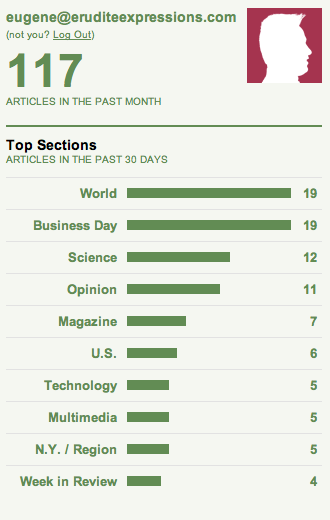
So, today is day 1 of the unveiling of the paywall, and I’m pretty sure I’ll hit my 20-article quote in the next few days. Take a look at the number of article’s I’ve read last month, broken down by section:

This number doesn’t include the articles I’ve read via the New York Times iPad app. Do I think the digital subscription is expensive? I have to agree with Felix Salmon — the digital subscription is expensive:

The NYT has decided not to make the paywall very cheap and porous in the first instance as people get used to it. $15 for four weeks might be cheap compared to the cost of a print subscription, but $195 per year is still enough money to give readers pause and to drive them elsewhere. And similarly, 20 articles per month is lower than I would have expected at launch.

However, I disagree with Felix Salmon on one point here. The paywall won’t drive me elsewhere for the news and in-depth reporting that I consistently rely from the NYT. I believe I will be able to find the articles I want to read via blogs and social media (especially following links via Twitter). If you’ve been paying attention to this blog over the last year or so, you know that I’ve linked to dozens of New York Times articles. The paywall will NOT change my blogging behavior. However, I think the paywall will change my browsing/reading behaving while I am on nytimes.com. How? I typically tend to browse articles by sections, and then click through anything that looks interesting enough to read. So, for instance, in an evening I may read five stories in the Business section, then proceed to the Science section and read a few articles there. With the paywall, I won’t have this ability/luxury, but I know I’ll find a way to access the articles I want to read.

I hope that more of you come visit this blog in the coming months because I’ll still be linking to New York Times frequently, and you’ll be able to access the NYT articles that I link here without having to worry about adding to your monthly 20-article total.

What are your thoughts on the New York Times paywall? Will you pay? If not, why not? How will you access NYT articles if you’re a devout reader but aren’t willing to subscribe to the digital subscription? Do you think the NYT paywall will fail?

###

Resources:

1) The Newsonomics of The New York Times’ Pay Fence [Nieman Lab]

2) New York Times Paywall: Built for the Digital Future? [Guardian]

Readings: Silicon Valley, Twitter Influence, Mark Armstrong on Reading, Cosmonaut Crash

A few good reads from this week:

1) “Silicon Valley Hiring Perks: Meals, iPads and a Cubicle for Spot” [New York Times] – a good piece reflecting the current state of Silicon Valley. I was surprised by how well Google is paying:

Then there are salaries. Google is paying computer science majors just out of college $90,000 to $105,000, as much as $20,000 more than it was paying a few months ago. That is so far above the industry average of $80,000 that start-ups cannot match Google salaries.

Perhaps the most telling line, representing the culture shift in Silicon Valley (how long has it been in the making?):

And there has been a psychological shift; many of the most talented engineers want to be the next Mark Zuckerberg not work for him.

2) “A Better Way to Measure Twitter Influence” [New York Times] – Do you think the most influential Twitter user is Justin Bieber or Lady Gaga? I agree with the premise of this post, that follower counts on Twitter mean less for influence than actual engagement (replies, retweets):

But it turns out that counting followers is a seriously flawed way to measure a person’s impact on Twitter. Even one of Twitter’s founders, Evan Williams, made the point to me recently: someone with millions of followers may no longer post messages frequently, while someone followed by mere tens of thousands may be a prolific poster whose messages are amplified by others.

According to research by Twitalyzer, the most influential Twitter user is Rafinha Bastos from Brazil. Yes, this is a surprise to me too.

3) “Mark Armstrong: What I Read” [The Atlantic] – Mark Armstrong, founder of long reads (one of my favorite sites on the Web), reveals his daily media/reading diet:

Most weekday mornings, the first thing I’m reading is my iPhone. I’ll start with a quick check of the Twitter app, dipping into the real-time stream and checking the latest stories that readers have shared using the #longreads hashtag. (It’s for sharing any outstanding story between 1,500 and 30,000 words.)

Also, Long Reads wouldn’t be the same if it wasn’t for the community, as Mark attests:

Twitter is also my main source for new stories that get featured on Longreads. The community is incredible when it comes to finding and sharing great stories using the #longreads hashtag: @hriefs, @michellelegro, @jaredbkeller, @sherlyholmes, @legalnomads, @katesilver, @nxthompson, @weegee, @eugenephoto, @petersm_th, all recommend excellent links—from magazines like The New Yorker and The Atlantic to regional publications doing outstanding journalism like Texas Monthly, 5280 Magazine, Atlanta Magazine, and alt-weeklies like Minneapolis City Pages and The Stranger.

I’ve bookmarked Mark’s post because I need to go through the links he has included in there more than a few times. Related: my most popular post on this blog is from last year, where I rounded up The Top Five Long Reads of 2010.

4) “Cosmonaut Crashed into Earth Crying in Rage” [NPR] – probably the most fascinating story I’ve read all week. If you’ve ever doubted that the space race wasn’t risky, read this story. If you click through the link, there is a disturbing photo at the top of the page. This is an incredible account of Vladimir Komarov, friend of the Soviet hero Yuri Gagarin (the first man to enter space). The background:

In 1967, both men [Komarov and Gagarin] were assigned to the same Earth-orbiting mission, and both knew the space capsule was not safe to fly. Komarov told friends he knew he would probably die. But he wouldn’t back out because he didn’t want Gagarin to die. Gagarin would have been his replacement.

But as detailed in the new book Starman, by Jamie Doran and Piers Bizony, Gagarin and some senior technicians had inspected the Soyuz 1 and had found 203 structural problems. Gagarin even wrote a 10-page memo on his findings, gave it to his best friend in the KGB, Venyamin Russayev, but nobody dared send it up the chain of command (to Brezhnev). So both Komarov and Gagarin knew of the dangers…but what would have happened if Komarov refused to go?

“If I don’t make this flight, they’ll send the backup pilot instead.” That was Yuri Gagarin. Vladimir Komarov couldn’t do that to his friend. “That’s Yura,” the book quotes him saying, “and he’ll die instead of me. We’ve got to take care of him.” Komarov then burst into tears.

An absolutely harrowing account. A must-read.