Reading Update

Well, it’s December 1, which means there’s just thirty days left until the arrival of the new year…

In my very first post on this blog, I explained that my goal in 2010 was to read 52 books. Little did I know how hard the challenge would be…

My circumstances were largely different in the beginning of the year (I thought I would have a lot more “free” time than I ended up having), so it shouldn’t come as a surprise that I’ll massively fail to achieve my goal. In fact, probably since September of this year, I had already changed the goal in my mind: just reach the half-way point. So, I am trying to salvage the situation, and by December 31, I am hoping to have read 26 books (as of this post, I have read twenty-one books this year).

This post isn’t about making excuses. Had my priority remained to read 52 books this year, I think I would have been able to do it. But my priorities shifted through the course of the year, and I started reading (and sharing) more long-form articles, watching a few TV series that I’ve been neglecting, and of course, consistently updating my photoblog.

I’ll do my best to post more frequently this month, including a few list-type posts in which I profile the most interesting articles/books I’ve read this year. There’s no point in procrastinating, right?

In the meantime, if you think there’s a book that I must absolutely read by the end of the year, drop me a line or leave a comment to this post. Words of encouragement are also welcome. Finally, I’d be curious to hear about your 2010 reading goals (and how far you’ve progressed). Comments are open.

###

At the moment, I am reading Stephen King’s On Writing, which a couple of people recommended after I published this post.

Readings: Google in the News

Two interesting stories in the New York Times appeared this weekend, both relating to Google:

1) “Google Grows, and Works to Retain Nimble Minds” [New York Times] – a nice explainer about Google’s unparalleled growth, and a side effect: employees who are leaving the company for smaller companies or for start-ups:

Recent departures include low-level engineers, product managers and prominent managers like Lars Rasmussen, who helped create Google Maps and Wave before he left for Facebook, and Omar Hamoui, the founder of AdMob who was vice president for mobile ads at Google and is now looking for his next project. At least 142 of Facebook’s employees came from Google.

I like this phrase used in the article: “Corporate sclerosis.” In the last five years, Google has grown from 5,000 to 23,000 employees, while its revenue has increased by more than seven-fold, from $3.2B to $23.7B. So what is Google doing to prevent employees from leaving the company?

Google is taking aggressive steps to retain employees, particularly those with start-up ambitions. Google has given several engineers who said they were leaving to start new companies the chance to start them within Google. They work independently and can recruit other engineers and use Google’s resources, like its code base and servers, according to half a dozen employees.

This is a highly innovative move, and rarely seen in other companies (I think). Of course, financial motivation is there too: this month Google gave every employee in the company a 10% raise.

Nevertheless, the biggest takeaway for me was this: if someone has the drive to do something on their own, compensation packages and promises to work on independent projects can only go so far. This was the best line in the story:

Part of Google’s problem is that the best engineers are often the ones with the most entrepreneurial thirst.

Is it that surprising that these engineers are looking for greener (but perhaps riskier) pastures?

2) “A Bully Finds a Pulpit on the Web” [New York Times] – an amazing and horrifying story of a sunglasses merchant who thrives on negative feedback to boost his Google search rankings (which leads to more people buying fake/poor merchandise from him). Not much is below this merchant: threats, intimidation, non-delivery (or fake delivery) of product.

This story left me fuming (I refuse to provide the name of the merchant). What’s interesting, and other people have pointed this out, is that Google does not appear to perform sentiment analysis; that is, a “negative” link to a website might be as beneficial as a link of praise, and Google’s algorithms (which are, in fact, a secret) don’t distinguish between them. So for instance, we have this from the NYT, where people posted complaints about the company:

Between then and now, hundreds of additional tirades have been tacked to Get Satisfaction, ComplaintsBoard.com, ConsumerAffairs.com and sites like them.

But because those web sites are reputable, if they point to the offending website, it’s essentially more “Google juice” and the merchant described in the article benefits.

One last note: the reporter, David Segal, appears to take a liking to this merchant:

It’s almost painful to say, but Mr. [Redacted] is amusing company. He is sharp and entertaining, although much of the entertainment comes from the way he flouts the conventions of courtesy, which he does with such a perverse flair that it can seem like a kind of performance art.

I thought the sympathy was undeserving, but perhaps this is a psychological phenomenon: if we tend to get close to someone (even if we do so objectively, such as reporting for the New York Times), we tend to begin liking the one we’re with to help us cope and/or help us approach the subject. Familiarity breeds good journalism, it seems.

Update (12/01/10): News of the New York Times article has made the rounds at Google headquarters, and Google has acted swiftly. In a blog post titled “Being Bad To Your Customers Is Bad for Business,” Google explains that they have modified their search rankings, incorporating user reviews in Google’s search algorithm:

Instead, in the last few days we developed an algorithmic solution which detects the merchant from the Times article along with hundreds of other merchants that, in our opinion, provide an extremely poor user experience. The algorithm we incorporated into our search rankings represents an initial solution to this issue, and Google users are now getting a better experience as a result.

Huge props to Google on this quick, worthy update.

Gregory Petsko: On Defense of the Humanities

Gregory Petsko’s open letter to George M. Philip, President of the State University of New York At Albany, is one of the most compelling pieces of writing I’ve read this year. The background: On October 1, George M. Philip, announced that the French, Italian, classics, Russian and theater programs at SUNY Albany were getting the axe.

Petsko, a professor of Chemistry and Biochemistry at Brandeis University, decided to respond. In his open letter, he writes with tact and eloquence about the importance of the humanities for any university, and how Philip’s decision was a reprehensible act. Titled “A Faustian Bargain,” Petsko makes references to Machiavelli, Dante’s Divine Comedy, Dostoyevesky’s The Brothers Karamazov, and of course, Goethe’s Faust.

First, why do humanities classes have low enrollment? Petsko argues:

You see, the reason that humanities classes have low enrollment is not because students these days are clamoring for more relevant courses; it’s because administrators like you, and spineless faculty, have stopped setting distribution requirements and started allowing students to choose their own academic programs – something I feel is a complete abrogation of the duty of university faculty as teachers and mentors. You could fix the enrollment problem tomorrow by instituting a mandatory core curriculum that included a wide range of courses.

I went to Georgia Tech, where the primary focus is on engineering and sciences. Most of my classes were in engineering, science, and math. But the most stimulating classes I took were in the Ivan Allen College of Liberal Arts. It was in an English II course that I read Calvino’s Invisible Cities and Thomas More’s Utopia. One of the best courses I took was in the Public Policy department, PST 3127: “Science, Technology, & Human Values.” This was a required course for all engineering undergraduates, with the professor choosing the theme for the course. I took a course with Hans Klein, whose course was titled “The Contemporary Environment.” It was there that I got a new appreciation for Brave New World (I re-read it), learned about Plato’s Allegory of the Cave, learned about media criticism through Noam Chomksy’s Manufacturing Consent, and so much more (PDF of the syllabus for the course). Again, this was a required course, but what I learned from that course is still with me today. The point is this: I enjoyed these mandatory courses so much, that I wanted to take other courses totally unrelated to my major. My senior year at Georgia Tech, I took a couple of courses in the Literature, Communication, and Culture department at Georgia Tech. The course that really stands out is LCC 3518: “Literary and Cultural Postmodernism,” where we read T.S. Eliot’s poetry, Thomas Pynchon’s The Crying of Lot 49, and watched a number of films. In this course we also read the first hypertext story, Michael Joyce’s Afternoon, a story. If I didn’t have exposure to these courses, my education would have been, simply, incomplete.

Moving on…

I love Petsko’s reference to one of the greatest novels ever written, The Brothers Karamazov (it’s one of the most challenging books I’ve ever read). The reference to The Grand Inquisitor is particularly brilliant:

Young people haven’t, for the most part, yet attained the wisdom to have that kind of freedom without making poor decisions. In fact, without wisdom, it’s hard for most people. That idea is thrashed out better than anywhere else, I think, in Dostoyevsky’s parable of the Grand Inquisitor, which is told in Chapter Five of his great novel, The Brothers Karamazov. In the parable, Christ comes back to earth in Seville at the time of the Spanish Inquisition. He performs several miracles but is arrested by Inquisition leaders and sentenced to be burned at the stake. The Grand Inquisitor visits Him in his cell to tell Him that the Church no longer needs Him. The main portion of the text is the Inquisitor explaining why. The Inquisitor says that Jesus rejected the three temptations of Satan in the desert in favor of freedom, but he believes that Jesus has misjudged human nature. The Inquisitor says that the vast majority of humanity cannot handle freedom. In giving humans the freedom to choose, Christ has doomed humanity to a life of suffering.

That single chapter in a much longer book is one of the great works of modern literature. You would find a lot in it to think about. I’m sure your Russian faculty would love to talk with you about it – if only you had a Russian department, which now, of course, you don’t.

You can read The Grand Inquisitor chapter at Project Gutenberg (or download it for free on the iPad/Kindle).

Petsko isn’t shy about calling out George Philip. Holding the meeting at an unconvenient time to announce the budget cuts was sleezy:

And you called that meeting for Friday afternoon on October 1st, when few of your students or faculty would be around to attend. In your defense, you called the timing ‘unfortunate’, but pleaded that there was a ‘limited availability of appropriate large venue options.’ I find that rather surprising. If the President of Brandeis needed a lecture hall on short notice, he would get one. I guess you don’t have much clout at your university.

The reference to Divine Comedy:

It seems to me that the way you went about it couldn’t have been more likely to alienate just about everybody on campus. In your position, I would have done everything possible to avoid that. I wouldn’t want to end up in the 9th Bolgia (ditch of stone) of the 8th Circle of the Inferno, where the great 14th century Italian poet Dante Alighieri put the sowers of discord. There, as they struggle in that pit for all eternity, a demon continually hacks their limbs apart, just as in life they divided others.

The Inferno is the first book of Dante’s Divine Comedy, one of the great works of the human imagination. There’s so much to learn from it about human weakness and folly. The faculty in your Italian department would be delighted to introduce you to its many wonders – if only you had an Italian department, which now, of course, you don’t.

That refrain: “which now, of course, you don’t” would repeat five times in the letter. I found its usage particularly powerful.

Petsko is spot-on that universities aren’t just about discovering new knowledge:

As for the argument that the humanities don’t pay their own way, well, I guess that’s true, but it seems to me that there’s a fallacy in assuming that a university should be run like a business. I’m not saying it shouldn’t be managed prudently, but the notion that every part of it needs to be self-supporting is simply at variance with what a university is all about. You seem to value entrepreneurial programs and practical subjects that might generate intellectual property more than you do ‘old-fashioned’ courses of study. But universities aren’t just about discovering and capitalizing on new knowledge; they are also about preserving knowledge from being lost over time, and that requires a financial investment.

This part resonated with me:

Of all the courses I took in college and graduate school, the ones that have benefited me the most in my career as a scientist are the courses in classics, art history, sociology, and English literature. These courses didn’t just give me a much better appreciation for my own culture; they taught me how to think, to analyze, and to write clearly. None of my sciences courses did any of that.

While I wouldn’t say that my science courses didn’t taught me how to analyze, I would say that the courses in humanities have made me a better thinker.

Finally, I think this was the most important passage in the entire letter:

Science unleavened by the human heart and the human spirit is sterile, cold, and self-absorbed. It’s also unimaginative: some of my best ideas as a scientist have come from thinking and reading about things that have, superficially, nothing to do with science. If I’m right that what it means to be human is going to be one of the central issues of our time, then universities that are best equipped to deal with it, in all its many facets, will be the most important institutions of higher learning in the future.

Bravo.

In the conclusion of the letter, the parable of Faust and the devil comes to light. I hope you find the time to read the entire letter.
A LOST Reflection

May 23, 2010: “The End.”

Six months ago today, the television series LOST came to its final chapter. LOST is (was) favorite show on television—far and above any other I’ve ever seen. I watched every episode religiously, and the only show to which I would tune in live (in general, I watch television shows when they come out on DVD).

I remember six months ago, just as the show ended at 11PM, how I felt. Relieved. But also shaken and deeply saddened. This was The End, and I couldn’t imagine finding another TV show to which I could cling to as strongly (it hasn’t happened yet).

After the final episode aired, I read a number of reviews and sentiments across the web. I was going to do a round-up of the best write-ups, but I never got around to it. So I thought: why not do it six months afterwards? So below I highlight two of my favorite recaps, with a few thoughts of my own. Please note: if you’ve never watched the show or saw the finale, there are SPOILERS ahead!

Continue reading

On Regrets of the Dying

Bronnie Ware describes herself as having a thirst for experiencing life from the moment she was born. Reading about her life you begin to feel that she’s experienced a lot.

For many years, Bronnie worked in palliative care. Through her work with patients facing their mortality, she has come to greater appreciation of her life and the lives of others. In this moving post, she describes how these dying patients, time and time again, cite similar regrets. These are the regrets of the dying:

1. I wish I’d had the courage to live a life true to myself, not the life others expected of me. This was the most common regret of all. When people realise that their life is almost over and look back clearly on it, it is easy to see how many dreams have gone unfulfilled. Most people had not honoured even a half of their dreams and had to die knowing that it was due to choices they had made, or not made. It is very important to try and honour at least some of your dreams along the way. From the moment that you lose your health, it is too late. Health brings a freedom very few realise, until they no longer have it.

2. I wish I didn’t work so hard.
This came from every male patient that I nursed. They missed their children’s youth and their partner’s companionship. Women also spoke of this regret. But as most were from an older generation, many of the female patients had not been breadwinners. All of the men I nursed deeply regretted spending so much of their lives on the treadmill of a work existence. By simplifying your lifestyle and making conscious choices along the way, it is possible to not need the income that you think you do. And by creating more space in your life, you become happier and more open to new opportunities, ones more suited to your new lifestyle.

3. I wish I’d had the courage to express my feelings.
Many people suppressed their feelings in order to keep peace with others. As a result, they settled for a mediocre existence and never became who they were truly capable of becoming. Many developed illnesses relating to the bitterness and resentment they carried as a result. We cannot control the reactions of others. However, although people may initially react when you change the way you are by speaking honestly, in the end it raises the relationship to a whole new and healthier level. Either that or it releases the unhealthy relationship from your life. Either way, you win.

Reading the above, did you come away with the impression: “This is me right now”? If so, is there anything that you can or are willing to do about it?

Please go to Bronnie’s blog post and read the other two regrets (on friends and happiness). I can’t conclude it better than Bronnie did: Life is a choice. It is YOUR life. Choose consciously, choose wisely, choose honestly. Choose happiness.

###

(hat tip to @bfeld)

Readings: Camera Head, Brain on Metaphors

Here are two excellent reads from this week:

1) “Sir, There’s a Camera in Your Head” [Wall Street Journal] – An Iraqi assistant professor in the photography and imaging department of NYU’s Tisch School of the Arts, Wafaa Bilal, intends to undergo surgery in coming weeks to install a camera on the back of his head. Why? It’s a commission by a museum in Qatar:

For one year, Mr. Bilal’s camera will take still pictures at one-minute intervals, then feed the photos to monitors at the museum. The thumbnail-sized camera will be affixed to his head through a piercing-like attachment.

Mr. Bilal’s camera-based work will be overseen by the Qatar Museums Authority where:

For one year, Mr. Bilal’s camera will take still pictures at one-minute intervals, then feed the photos to monitors at the museum. The thumbnail-sized camera will be affixed to his head through a piercing-like attachment.

It remains to be seen whether this project will see the light of day, as NYU administrators have raised privacy concerns (students being filmed without their consent/knowledge). Of course, Mr. Bilal isn’t new to controversial projects. In a 2008 project, Virtual Jihadi, Mr. Bilal hacked a video game to insert an avatar of himself as a suicide-bomber hunting President George W. Bush. In his 2007 work, Domestic Tension, Mr. Bilal trapped himself in a Chicago museum for a month, inviting the public to go to a website where they could “shoot” the artist remotely by firing a paintball gun at him. His other projects are interesting as well: Mona Lisa (the exploration of that enigmatic smile) and One Chair, based on Leonardo da Vinci’s The Last Supper.

2) “This is Your Brain on Metaphors” [New York Times] – this is a brilliant piece by Robert Sapolsky, a professor of Biology, Neurology and Neurosurgery at Stanford University. In this piece, Sapolsky explains how human brains are wired to understand metaphors surprisingly well. He explains:

Symbols, metaphors, analogies, parables, synecdoche, figures of speech: we understand them. We understand that a captain wants more than just hands when he orders all of them on deck. We understand that Kafka’s “Metamorphosis” isn’t really about a cockroach. If we are of a certain theological ilk, we see bread and wine intertwined with body and blood. We grasp that the right piece of cloth can represent a nation and its values, and that setting fire to such a flag is a highly charged act.

It’s interesting how our brains can be primed with sensory inputs, such as touch. For instance, I found this remarkable:

Volunteers were asked to evaluate the resumes of supposed job applicants where, as the critical variable, the resume was attached to a clipboard of one of two different weights. Subjects who evaluated the candidate while holding the heavier clipboard tended to judge candidates to be more serious, with the weight of the clipboard having no effect on how congenial the applicant was judged. After all, we say things like “weighty matter” or “gravity of a situation.”

The question is: knowing this information, how can you use it to your advantage in daily life? Next time you want someone to consider your question or idea, perhaps give them a cup of coffee or some item to hold while explaining yourself. Of course, now that you’ve read about this effect, you may be more attuned to it so that it doesn’t play as large a factor in your future decisions (I hope).

Perhaps the most interesting study profiled is that on cleanliness:

Another truly interesting domain in which the brain confuses the literal and metaphorical is cleanliness. In a remarkable study, Chen-Bo Zhong of the University of Toronto and Katie Liljenquist of Northwestern University demonstrated how the brain has trouble distinguishing between being a dirty scoundrel and being in need of a bath. Volunteers were asked to recall either a moral or immoral act in their past. Afterward, as a token of appreciation, Zhong and Liljenquist offered the volunteers a choice between the gift of a pencil or of a package of antiseptic wipes. And the folks who had just wallowed in their ethical failures were more likely to go for the wipes.

Sapolsky’s piece is one of the best short expositions I’ve read explaining how our brains are wired; the references to every day situations are particularly interesting. If you’re into neuroscience and want to learn more about the forces in our lives that shape our decisions, I cannot recommend Dan Ariely’s Predictably Irrational enough. It’s one of the best books I’ve read this year.

Vladimir Nabokov: Invitation to an Interview

Vladimir Nabokov is one of my favorite authors. His command of the English language is rivaled by few other authors.

I’ve read Nabokov’s Lolita, Pale Fire (recently profiled in my newly-created page of classics), The Luzhin Defense, Invitation to a Beheading (read my review), and portions of his autobiographical memoir Speak, Memory. I’ve learned a lot about Nabokov through those books…

But the point of this post is to highlight my incredulity of his personality after reading Nabokov’s interview with Paris Review (#40, Winter-Spring 1967). As I highlight below, Nabokov comes across as pedantic, cynical, snarky, and yes, even arrogant. I knew Nabokov held himself in high regard, but as you’ll see below (and if you read the entire interview), he may be on another level here. The most important bits (in my opinion), I bold.

Continue reading

On Facebook and Break-Ups

Recently, I’ve seen a number of posts in the blogosphere profiling when people break-up based on Facebook status updates.

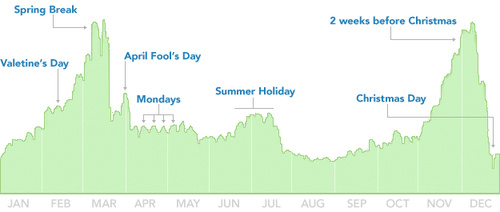
Take a look at the graph below.

This is the excerpt from Gizmodo:

You’re very likely to get dumped on Mondays, right before Spring Break, two weeks before Christmas, and at some point before the summer holidays. The good news about the whole mess is that it seems that people feel quite bad about dumping someone right on Christmas Day, so you can breathe a bit easier while unwrapping your presents.

Facebook has quickly become the largest human data set, so yes, it is very interesting to look at the bulk data generated by its users. But from all the sources I’ve read, all of them miss this very important mark:

The data depicted above does not correspond to actual break-up day; rather, the data corresponds to self-reported updates of a break-up made by Facebook users.

Why is this qualification important? Because the way the information is presented above, there are numerous confounding variables. The most notable one is time shift (delay), corresponding to how long it would take for a Facebook user to update their status on Facebook after a break-up.

Here are two scenarios I can think of when time delay is pivotal:

  • Monday Break-ups. Suppose someone gets dumped on Friday. He or she may not come to terms with the break-up that Friday, and perhaps try to reconcile the relationship throughout the weekend. So, in fact, most break-ups may occur on a Friday, Saturday, or Sunday; but the status update would come on Monday (when the user couldn’t reconcile things over the weekend, say; or perhaps, coming back to school or work the following Monday morning, Facebook is more accessible, so it’s fitting time to make the status update).
  • Christmas Day Break-ups. While it does appear that there are the least number of break-ups occurring on Christmas Day, perhaps it’s because a lot of people are away from computers (and thus Facebook) to update their status. Alternatively, it may be really embarrassing to announce your break-up on Christmas Day, so the user would wait a day or two to make the Facebook update.

That said, I think the data is useful, but it is much more interesting when looking at general trends (more break-ups occur as Spring Break and Christmas approach) rather than pinpointing break-ups on specific days of the week or holidays.

Still unconvinced? Imagine if the data set instead showed specific dates on when Facebook users entered a relationship (girlfriend/boyfriend, engagement, marriage). Would you really believe that if someone changed their status update to “Married” on a Monday morning, they actually got married on Monday? Of course not (unless they’re this couple)!

Bottom line: while the general data presented above is interesting, it’s important not to discount numerous confounding factors (time delay being the most notable one, but also: people untruthfully reporting a break-up).

###
References:

1) “Amazing Facts about Facebook and Breakups”

2) For a superb take on the importance of confounding factors, especially on Twitter, I highly recommend reading “The Confounding Variable of the Retweet.”

Writing Advice from Stephen King

Love him or hate him, Stephen King is a prolific writer. But he’s a damn good writer.

I recently posted a link on Twitter to his advice on writing, which he gave in 1986. And even though the advice seems dated, it is still perfectly applicable today. I encourage you to read the entire entry, but I highlight the most important parts below.

Stephen King makes a great point about giving advice (and who listens to it):

I am going to tell you these things again because often people will only listen – really listen – to someone who makes a lot of money doing the thing he’s talking about.

King writes that talent is absolutely essential to write well. But I like how he factors the importance of rejection into the mix:

If you’re not talented, you won’t succeed. And if you’re not succeeding, you should know when to quit. When is that? I don’t know. It’s different for each writer. Not after six rejection slips, certainly, nor after sixty. But after six hundred? Maybe. After six thousand? My friend, after six thousand pinks, it’s time you tried painting or computer programming.

Don’t rely on reference book(s) when doing the first draft:

You want to write a story? Fine. Put away your dictionary, your encyclopedias, your World Almanac, and your thesaurus. Better yet, throw your thesaurus into the wastebasket. The only things creepier than a thesaurus are those little paperbacks college students too lazy to read the assigned novels buy around exam time.

In this day, just substitute the World Almanac and encyclopedias for Wikipedia, and you’ve essentially got the same advice.

This is the kicker for me:

Any word you have to hunt for in a thesaurus is the wrong word.

Don’t be afraid to kill things if they’re bad:

When it comes to people, mercy killing is against the law. When it comes to fiction, it is the law.

You can read the entire piece in ten minutes (which is Stephen King’s intention). Highly, highly recommended.

Haruki Murakami on Writing

I recently finished reading Haruki Murakami’s The Wind-Up Bird Chronicle (I loved this book; I am still thinking about how to write a review), and it made me think about his style of writing and what things in his life have inspired him.

Many of my questions were answered in this absolutely fascinating interview with Haruki Murakami posted in Paris Review.

The entire interview is worth reading, but I highlight three of the most notable parts below…

Continue reading