Why Facebook Stock Will Continue Its Decline

From this excellent New York Times piece detailing the woes of the Facebook stock, I wanted to highlight these two paragraph:

The next test for the stock could come soon. Over 1.6 billion shares will be eligible to come on the market in several waves, starting on Thursday, when a number of shareholders are allowed to sell. Investors may fear that an influx of shares could cause prices to fall even more.

One former Facebook employee, who did not want to be named because he did not want to damage his relationship with onetime co-workers, said he expected other employees to cash in their stock options as soon as they could, and predicted that the stock’s woes could make it difficult to retain and hire talent. He no longer owns Facebook stock.

My prediction? A lot of insiders are going to unwind Facebook stock, and the effect will be a further decrease in the stock price. I am staying far away. I wouldn’t be surprised if the stock price is trading below $10/share by the beginning of 2013.

On Expanding Your Comfort Zone

Derek Sivers writes an inspiring post on how he’s been able to expand his comfort zone over the years:

I’m 40 meters underwater. It’s getting cold and dark. It’s only the third dive in my life, but I’m taking the advanced training course, and the Caribbean teacher was a little reckless, dashing ahead, leaving me alone.

The next day I’m in a government office, answering an interview, raising my right hand, becoming a citizen of Dominica.

I’m in a Muslim Indian family’s house in Staten Island, washing my feet, with the Imam waiting for my conversion ceremony. Next week they will be my family in-law. The Muslim wedding will make her extended family happy. I’ve memorized the syllables I need to say. “Ash hadu alla ilaha illallah. Ash hadu anna muhammadar rasulullah.”

We’re on a rooftop in Rio de Janiero on New Year’s Eve, celebrating with some Brazilians we met the day before. Down below on the beach, a million people are wearing all white.

I’m alone on a bicycle in a forest in Sweden. I left from Stockholm 6 hours ago, headed south, with only 50 Krona, and I’m getting hungry. I don’t know the way back.

We’re in a filthy dorm-room apartment in Guilin, China, studying at the local university. At the local grocery store, we choose from a bin of live frogs.

The India Embassy official hands me a pseudo-passport that says I am now officially a “Person of Indian Origin” – a pseudo-citizen of India.

I’m the back of a truck in Cambodia, soaking wet, hitching a ride back to Phnom Penh after an all day bike ride. The roads were flooded but we rode our bikes through anyway, Mekong River water chest-high.

That week I speak at four conferences in Cambodia, Singapore, Brunei, and Indonesia. By the 4th one, my American accent has started to morph into something kind of Asian.

Derek mentions how some people push themselves physically, but he’s been pushing himself culturally. I want (need!) to improve in both arenas.

Do check out Derek’s question at the bottom of his post and the hundreds of comments people have left in response.

The Google Doodle Profile

The BBC has a nice profile of the team behind the Google Doodles, those fun animations/interactives that take over the Google logo on the search engine’s main page every so often.

Below, two recent favorites of mine. The Gustav Klimt doodle to celebrate the artist’s 150th would-be birthday is wonderful (Jennifer Hom, one of the Google Doodle artists, explained how she made this doodle in this post):


The javelin throw doodle appeared on August 6, during the Olympics. But notice something in the air? That’s right, Google also paid homage to the Mars Curiosity rover when it landed safely on Mars:


You can search through the entire Google Doodle archive (more than a 1,000 in all) here.


Color Printing Reaches the Ultimate Resolution

This piece in Nature made my jaw drop:

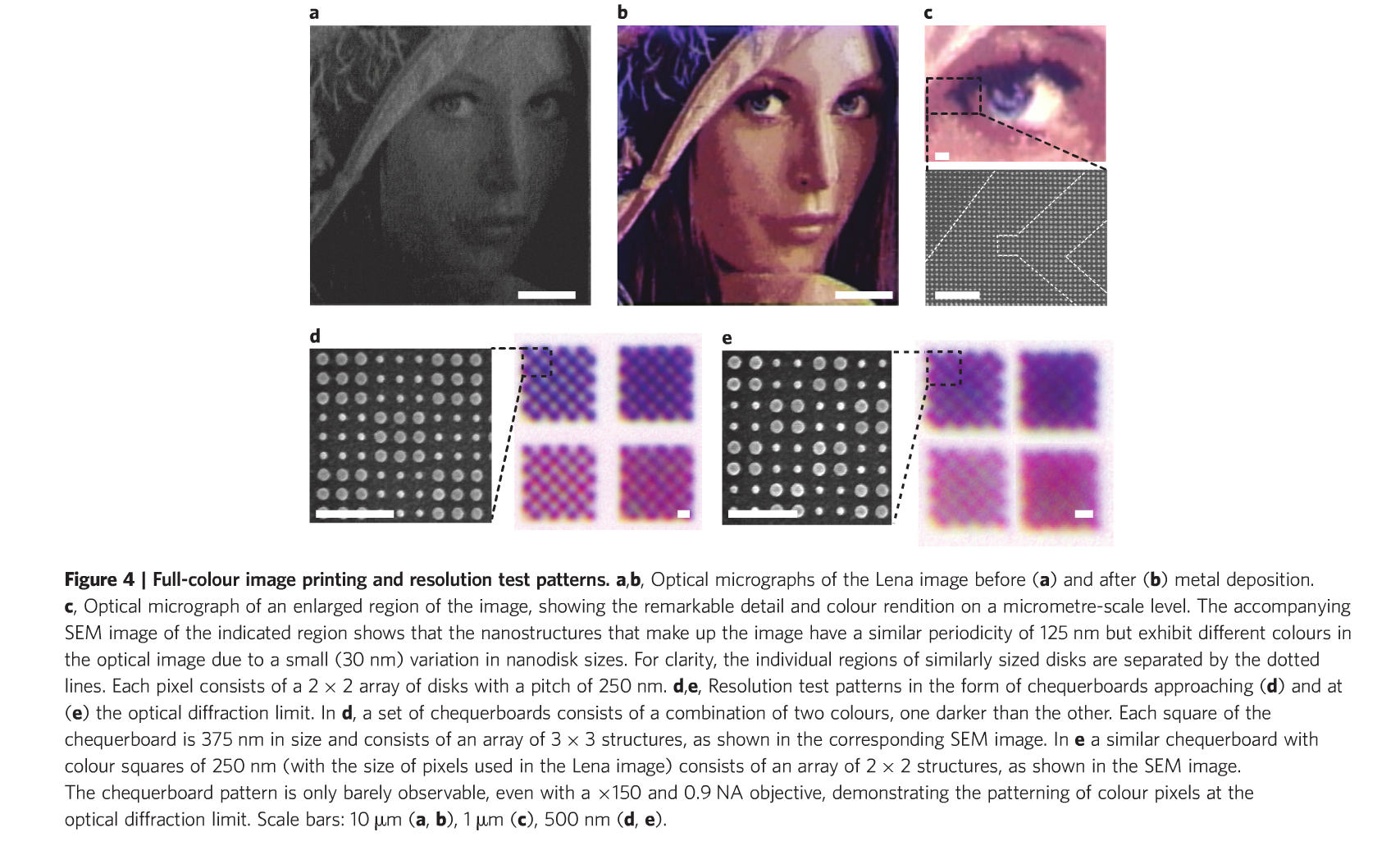
The highest possible resolution images — about 100,000 dots per inch — have been achieved, and in full-colour, with a printing method that uses tiny pillars a few tens of nanometres tall. The method, described today in Nature Nanotechnology1, could be used to print tiny watermarks or secret messages for security purposes, and to make high-density data-storage discs.

Each pixel in these ultra-resolution images is made up of four nanoscale posts capped with silver and gold nanodisks. By varying the diameters of the structures (which are tens of nanometres) and the spaces between them, it’s possible to control what colour of light they reflect. Researchers at the Agency for Science, Technology and Research (A*STAR) in Singapore used this effect, called structural colour, to come up with a full palette of colours. As a proof of principle, they printed a 50×50-micrometre version of the ‘Lena’ test image, a richly coloured portrait of a woman that is commonly used as a printing standard.

Optical Resolution Image testing with “Lena”. Click to see larger size.

That’s the summary of this paper, whose abstract describes the optical limit of resolution:

The highest possible resolution for printed colour images is determined by the diffraction limit of visible light. To achieve this limit, individual colour elements (or pixels) with a pitch of 250 nm are required, translating into printed images at a resolution of ~100,000 dots per inch (d.p.i.). However, methods for dispensing multiple colourants or fabricating structural colour through plasmonic structures have insufficient resolution and limited scalability. Here, we present a non-colourant method that achieves bright-field colour prints with resolutions up to the optical diffraction limit. Colour information is encoded in the dimensional parameters of metal nanostructures, so that tuning their plasmon resonance determines the colours of the individual pixels. Our colour-mapping strategy produces images with both sharp colour changes and fine tonal variations, is amenable to large-volume colour printing via nanoimprint lithography, and could be useful in making microimages for security, steganography, nanoscale optical filters, and high-density spectrally encoded optical data storage.

Also, I just discovered that you can read PDF papers/articles in ReadCube. Try it for the paper above here.

Everything in Writing and Life is Fiction

It seems like every writer has some advice that he can offer on how to write better, smarter, faster. So it was quite refreshing to read Keith Ridgway’s take in The New Yorker, where he readily admits he doesn’t know what’s he doing:

I have no idea what I’m doing. All the decisions I appear to have made—about plots and characters and where to start and when to stop—are not decisions at all. They are compromises. A book is whittled down from hope, and when I start to cut my fingers I push it away from me to see what others make of it. And I wait in terror for the judgements of those others—judgements that seem, whether positive or negative, unjust, because they are about something that I didn’t really do. They are about something that happened to me. It’s a little like crawling from a car crash to be greeted by a panel of strangers holding up score cards.

Something, obviously, is going on. I manage, every few years, to generate a book. And of course, there are things that I know. I know how to wait until the last minute before putting anything on paper. I mean the last minute before the thought leaves me forever. I know how to leave out anything that looks to me—after a while—forced, deliberate, or fake. I know that I need to put myself in the story. I don’t mean literally. I mean emotionally. I need to care about what I’m writing—whether about the characters, or about what they’re getting up to, or about the way they feel or experience their world. I know that my job is to create a perspective. And to impose it on the reader. And I know that in order to do that with any success at all I must in some mysterious way risk everything. If I don’t break my own heart in the writing of a book then I know I’ve done it wrong. I’m not entirely sure what that means. But I know what it feels like.

I loved this paragraph:

And I mean that—everything is fiction. When you tell yourself the story of your life, the story of your day, you edit and rewrite and weave a narrative out of a collection of random experiences and events. Your conversations are fiction. Your friends and loved ones—they are characters you have created. And your arguments with them are like meetings with an editor—please, they beseech you, you beseech them, rewrite me. You have a perception of the way things are, and you impose it on your memory, and in this way you think, in the same way that I think, that you are living something that is describable. When of course, what we actually live, what we actually experience—with our senses and our nerves—is a vast, absurd, beautiful, ridiculous chaos.

Highly recommend reading in its entirety.

On Ski Masks in China

The New York Times details a peculiar phenomenon in China, where beachgoers are shy about getting a tan at the beach, so they resort to specialty ski masks:

For legions of middle-class Chinese women — and for those who aspire to their ranks — solar protection is practically a fetish, complete with its own gear. This booming industry caters to a culture that prizes a pallid complexion as a traditional sign of feminine beauty unscathed by the indignities of manual labor. There is even an idiom, which women young and old know by heart: “Fair skin conceals a thousand flaws.”

With the pursuit of that age-old aesthetic ideal at odds with the fast-growing interest in beachgoing and other outdoor activities, Chinese women have come up with a variety of ways to reconcile the two. Face masks like Ms. Yao’s have taken this popular beach town by storm. In cities, the summertime parasol is a more familiar accouterment, many adorned with rhinestones, lace or sequins (and sometimes all three). Those who need both hands free are fond of the tinted face shield, the perfect accessory for riding a bike — or welding. The fashion-conscious favor a chiffon scarf draped over the face.

Since the masks only protect one area of the body, this is a booming business. Gloves, for example, are making a resurgence for beachgoers.

Bill Gross: Cult of Equity is Dying

This is a must-read investment letter by Bill Gross, managing director of PIMCO, on the cult of equity:

​The cult of equity is dying. Like a once bright green aspen turning to subtle shades of yellow then red in the Colorado fall, investors’ impressions of “stocks for the long run” or any run have mellowed as well. I “tweeted” last month that the souring attitude might be a generational thing: “Boomers can’t take risk. Gen X and Y believe in Facebook but not its stock. Gen Z has no money.” True enough, but my tweetering 95-character message still didn’t answer the question as to where the love or the aspen-like green went, and why it seemed to disappear so quickly. Several generations were weaned and in fact grew wealthier believing that pieces of paper representing “shares” of future profits were something more than a conditional IOU that came with risk. Hadn’t history confirmed it? Jeremy Siegel’s rather ill-timed book affirming the equity cult, published in the late 1990s, allowed for brief cyclical bear markets, but showered scorn on any heretic willing to question the inevitability of a decade-long period of upside stock market performance compared to the alternatives. Now in 2012, however, an investor can periodically compare the return of stocks for the past 10, 20 and 30 years, and find that long-term Treasury bonds have been the higher returning and obviously “safer” investment than a diversified portfolio of equities. In turn it would show that higher risk is usually, but not always, rewarded with excess return.

Gross points out that the long-term history of inflation adjusted returns from stocks shows a persistent 6.6% real return. But he argues that we should examine this real return with more scrutiny, going so far as to call the returns of the stocks a Ponzi scheme:

Yet the 6.6% real return belied a commonsensical flaw much like that of a chain letter or yes – a Ponzi scheme. If wealth or real GDP was only being created at an annual rate of 3.5% over the same period of time, then somehow stockholders must be skimming 3% off the top each and every year. If an economy’s GDP could only provide 3.5% more goods and services per year, then how could one segment (stockholders) so consistently profit at the expense of the others (lenders, laborers and government)? The commonsensical “illogic” of such an arrangement when carried forward another century to 2112 seems obvious as well. If stocks continue to appreciate at a 3% higher rate than the economy itself, then stockholders will command not only a disproportionate share of wealth but nearly all of the money in the world! Owners of “shares” using the rather simple “rule of 72” would double their advantage every 24 years and in another century’s time would have 16 times as much as the sceptics who decided to skip class and play hooky from the stock market.

Now, read the whole thing with a grain of salt, as Gross heads the largest bond fund in existence, the $270 billion Pimco Total Return Fund (so he’s got a fair amount of bias lambasting stocks). Still, the evidence he presents is eye-opening. I’ve read his investment letter twice.

New York Times Staffers Read Every Last Word of Magazines

I am enjoying this series titled “Every Last Word” in The New York Times where staffers are reading different magazines from cover to cover. Here’s the summary from the series’ beginning:

Edith Zimmerman learned that if you have something sexy or otherwise interesting to whisper, deliver it into the recipient’s left ear in Cosmopolitan.

Hugo Lindgren discovered the cost of a Maserati in Tehran in The Economist.

Greg Veis became aware of a dude in Chile with 83 tattoos of Julia Roberts in Vice.

Sheila Glaser learned what it means to be “young blood” in the art world in New York.

Adam Sternbergh was schooled in the art of proper egg-cracking in Real Simple.

Ilena Silverman found out that wealth inequality in China has become so inflammatory that the country stopped releasing numbers on it in The New Yorker.

Dean Robinson learned that there is more to learn about LeBron James in Sports Illustrated.

Wm. Ferguson gained insight on Spin’s new bimonthly format since his days as a hapless intern there.

Lauren Kern learned that private equity is kinder and gentler in real life than in the movies in Bloomberg Businessweek.

Samantha Henig discovered the true origins of lemon curd in Bon Appétit.

Jon Kelly was informed that fox hunts not longer involve hunting foxes in Vogue.

Vera Titunik identified her own behavior “type” in Psychology Today.

Joel Lovell discovered the controversy behind recreating a surfer’s wipeout for a film in Surfer.

Maya Lau learned that mice can swagger in Scientific American.

Yuri Chong realized the importance of true gilt in House Beautiful.

What was the last magazine you’ve read cover to cover?

Why Does the Mars Rover Curiosity Have 2MP Cameras?

One thing that I’ve been wondering ever since Curiosity landed on Mars is why the cameras on the rover aren’t more sophisticated. Mike Ravine, project manager for Curiosity, explains that the choice for 2MP cameras was because the camera specifications were fixed as far back as 2004:

We developed all four cameras around a common architecture so the choice of sensor was hedged across all of them. We wanted to be able to capture high frame rates, particularly with the descent camera.’ he explains. MARDI, the downwards-pointing ‘descent camera’ had just a two-minute descent to the planet’s surface, so a high frame rate was essential. The KAI-2020 chip was the smallest Kodak made capable of 720p HD video. ‘We also looked at a 4MP sensor but it would have run around half as fast. And the state of CMOS sensors wasn’t credible in 2004. They’re an interesting option now, but they weren’t then.

Additionally:

Another factor was that the same sensor had to meet the needs of four different cameras (MAHLI, the two Mastcams and MARDI, the camera tasked with capturing the rover’s descent to the planets’ surface). ‘Everything in a project like this is sensitive to price and risk, both real and perceived. The cameras differ in terms of their optics, but by building them around a single platform, we didn’t have to re-test and qualify each of them separately. This makes them more dependable and less expensive than if you have to do it four times.

###

In case you’re wondering where exactly on Mars the rover Curiosity landed, check out this post by Alexis Madrigal.

President Obama Reads News on His iPad

From this New York Times piece, we learn that Barack Obama is an avid consumer of news. In particular, President Obama enjoys reading the news on his iPad:

A writer before he was a politician, Mr. Obama is a voracious consumer of news, reading newspapers and magazines on his iPad and in print and dipping into blogs and Twitter. He regularly gives aides detailed descriptions of articles that he liked, and he can be thin-skinned about those that he does not.

He typically begins his day upstairs in the White House reading the major newspapers, including his hometown Chicago Tribune and Chicago Sun-Times, mostly on his iPad through apps rather than their Web sites. He also skims articles that aides e-mail to him, with the subject line stating the publication and the headline (like “WSJ: Moody’s Downgrades Banks”).

During the day, Mr. Obama reads newspapers on his iPad and print copies of magazines like The Economist and The New Yorker. On most Air Force One flights, he catches up on the news on his iPad.

My question: what blogs does Mr. President read? Sadly, the NYT article doesn’t disclose. It will be interesting to find out what’s on the President’s blogroll.