Redesigning the Cover of Vladimir Nabokov’s Lolita

In 2009, Venus febriculosa, a blog run by John Bertram, held a book cover competition, asking entrants to redesign Vladimir Nabokov’s classic novel Lolita. Now, Bertram is publishing an entire book of new covers for the novel, each contributed by a prominent designer. Bertram told Imprint that the idea for the contest came after stumbling across Nabokov scholar and translator Dieter E. Zimmer’s gallery of Lolita covers and realizing that they were, well, pretty bad. The contest was marginally successfully, and John Bertram adds:

I sought out well-known designers and artists who I thought would be able to embrace the challenge.

At the same time, I sensed that Nabokov scholars had their own important contributions to make toward such a study and envisioned a multidisciplinary project of images and texts that addressed what such a cover means. I was especially anxious that Lolita herself not get lost in the shuffle, so I sought advice and recommendations from Sheila Levrant de Bretteville, co-founder of the Woman’s Building in Los Angeles, and currently director of graduate studies in graphic design at the Yale School of Art. I am delighted that Sian Cook and Teal Triggs, co-founders of the Women’s Design + Research Unit, agreed to be involved as well as Ellen Pifer, whose essays about Lolita are constant reminders that at the heart of the novel is an innocent abused child. At one point I entertained the notion of only having contributions by women, but, as it is, nearly two-thirds of the covers and half of the essays are by women.

A selection of final designs are below:

Lolita cover design by Ben Wiseman

Lolita cover design by Kelly Blair

Lolita cover design by Rachel Berger

But my favorite design is the one below by Peter Mendesulnd. I think it evokes the “tip of the tongue” phenomenon that Nabokov wants the reader to feel as you read the first sentence (“Lolita, light of my life, fire of my loins. My sin, my soul. Lo-lee-ta: the tip of the tongue taking a trip of three steps down the palate to tap, at three, on the teeth. Lo. Lee. Ta.):
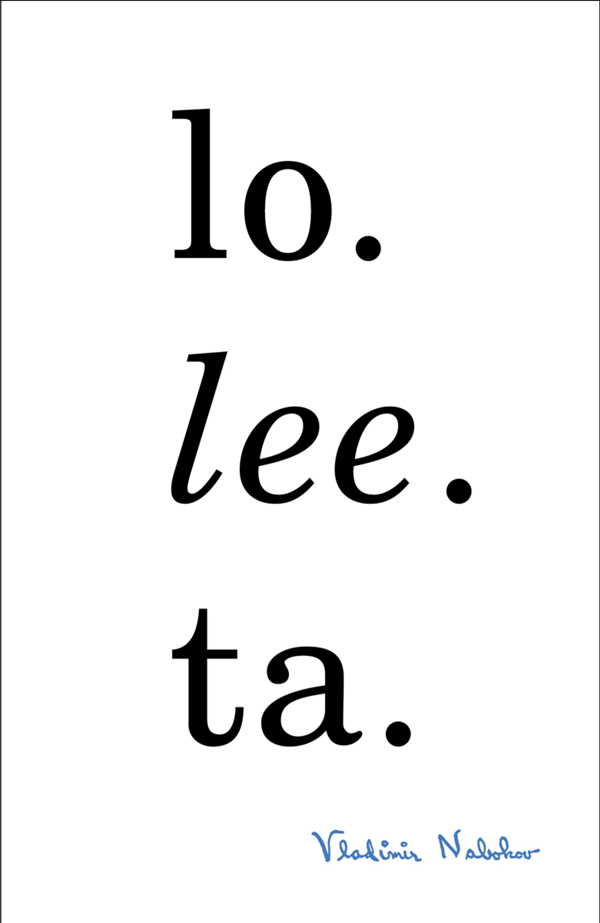
Lolita cover by Peter Mendelsund.

The version of Lolita that I own is this one (Megan Wilson for the Vintage edition), and I think it’s a great cover. But certainly, I’d love to see any of the designs featured above on my bookshelf.

###

If this topic fascinates you, then check out the following resources:

1) “Recovering Lolita” at Imprint Mag.

2) Jacket Mechanical’s two posts on book cover redesign of Lolita.

3) A Flickr set of more than 160 redesigns of the Lolita cover.

The Making and Design of Google Maps

Willem van Lencker is a user experience and visual designer at Google Maps. In this post, he shares a brief history of the design/creation process of Google Maps, a product that so many of us use daily.

Synthesizing all of this information in an approachable and aesthetically pleasing way carried obvious challenges. As the product grew and evolved, the map varied widely from one country to another, and the universal familiarity and usability that made Google Maps a success was being undermined by complexity and “feature creep.” To better understand which of these variances were useful, we audited the map styles, colors, and iconography of maps all over the world with the help of local users. We examined the leading online and offline mapping providers in each country, in addition to researching local physical signage and wayfinding. This undertaking provided us with a look at mapping as a local exercise—with cultural, ethnic, and region-specific quirks and nuances.

This is a good reminder of how people orient themselves in the West vs. East:

As Google Maps has broadened in scope, we have also had to address fundamental differences in tasks as basic as navigation and driving directions. We have found that, generally speaking, people navigate primarily by street names in Western countries and by landmarks and points of interest in the East. This is due to a combination of factors including a lack of road names (e.g. in India where locals rely on landmarks) or just a more complex street addressing system (e.g. in Japan where street numbers are assigned by date of construction, not sequentially)

Finally, it is smart of Google to use the local design elements in its maps. For example, see this image and what Google did about labeling the subway systems in different parts of the world:

As subways are often used by both tourists and locals, the local branding systems for subway stations worked best—helping guide users both on maps and as they navigate outside in the real world. Additionally, a custom body of regional road shields has been maintained, ensuring consistency and familiarity with real-world roadside markers.

On Inspiration vs. Imitation

Jessica Hische has a great post about inspiration vs. imitation. While the focus is on the design community, her advice is applicable to all kinds of creative work.

One advice that resonates is that you shouldn’t publish everything you create. Put only your best work online:

When you’re starting out and have a teeny portfolio of student work, it can be very very tempting to publish everything you’re working on, whether it’s practice or actual published work. It’s especially hard because, more often than not, the work you’re doing at your day job is less than inspiring when you are starting out. It will be really hard to resist showing off the illustration you created that was inspired heavily by one of your heroes, because in reality it is probably one of the nicest things you’ve made. But that’s the thing, every new thing you make will be (should be) the nicest thing you’ve made so far, because you’re learning and getting better with each and every new project. Resist posting the practice—the piece that you know is too close to its inspiration. Let that practice fuel original work and then publish to your heart’s content.

Some cool-headed advice on what to do if you find out your work has been ripped-off (published without permission, etc.):

Whenever I’m alerted of a possible rip-offer, I try my best to educate rather than chastise and gently nudge them to find their own voice. If you see someone ripping-off someone you know or admire, I suggest you do the same—initiate the conversation as a helpful and concerned new friend, not an angry enemy. Most of the time the offenders aren’t aware of how obvious their inspiration sources are. We’re all guilty of it when we’re starting out, but hopefully this article will remind some of you to keep that practice work out of your portfolio, which will keep the angry blog commenters off your back.

Read the full post to find Jessica’s thoughts on finding your own voice, training your eye, and diversifying your inspirations.

Jony Ive and Freedom

I’ve pre-ordered Walter Isaacson’s biography of Steve Jobs, and I can’t wait to read it. In the meantime, I’ve been following some news outlets reporting snippets from the book. This bit about the iconic designer at Apple, Jonathan (Jony) Ive, and his independence at the company, struck a chord with me:

In talking with author Walter Isaacson for the book, Jobs revealed that he viewed Ive as his “spiritual partner” at Apple. Showing his trust in Ive, the company co-founder left him more freedom than anyone else in the company — a perk that remains even after Jobs’s death.

“He [Steve Jobs] told Isaacson that Ive had ‘more operational power’ at Apple than anyone else besides Jobs himself — that there’s no one at the company who can tell Ive what to do,” the report said. “That, says Jobs, is ‘the way I set it up.'”

Ive and Jobs became close at Apple, working directly together on designing a number of the company’s core products, including the iMac, iPod, iPhone and iPad. Ive, a 44-year-old native of London, joined Apple in 1996 and has held his current job since 1997.

After I finish reading the book sometime next week, I will post a comprehensive review of my own. Stay tuned.

Milton Glaser: Ten Things I Have Learned in Life

I can’t remember who pointed me to Milton Glaser’s essay about the ten things he has learned in his life, but it’s easily one of the best things I’ve read this year. I encourage you to read the whole thing.

My favourite lessons are below:

You can only work for people that you like. This is a curious rule and it took me a long time to learn because in fact at the beginning of my practice I felt the opposite. Professionalism required that you didn’t particularly like the people that you worked for or at least maintained an arms length relationship to them, which meant that I never had lunch with a client or saw them socially. Then some years ago I realised that the opposite was true. I discovered that all the work I had done that was meaningful and significant came out of an affectionate relationship with a client. And I am not talking about professionalism; I am talking about affection. I am talking about a client and you sharing some common ground. That in fact your view of life is someway congruent with the client, otherwise it is a bitter and hopeless struggle…

On avoiding toxic people in life:

And the important thing that I can tell you is that there is a test to determine whether someone is toxic or nourishing in your relationship with them. Here is the test: You have spent some time with this person, either you have a drink or go for dinner or you go to a ball game. It doesn’t matter very much but at the end of that time you observe whether you are more energised or less energised. Whether you are tired or whether you are exhilarated. If you are more tired then you have been poisoned. If you have more energy you have been nourished. The test is almost infallible and I suggest that you use it for the rest of your life. 

I want to surround myself with people that exhilarate me, that help me blossom.

Is less more? Milton Glaser doesn’t think so:

Being a child of modernism I have heard this mantra all my life. Less is more. One morning upon awakening I realised that it was total nonsense, it is an absurd proposition and also fairly meaningless. But it sounds great because it contains within it a paradox that is resistant to understanding. But it simply does not obtain when you think about the visual of the history of the world.

I applaud Glaser for understanding the importance of how environment shapes our development, particularly our brain:

How you live changes your brain. We tend to believe that the mind affects the body and the body affects the mind, although we do not generally believe that everything we do affects the brain. I am convinced that if someone was to yell at me from across the street my brain could be affected and my life might changed. That is why your mother always said, ‘Don’t hang out with those bad kids.’ Mama was right. Thought changes our life and our behaviour.

May I suggest you go back to the David Eagleman piece and learn more about how our brain is affected by environmental stimuli?

Do you approach things in life with, would you say, mostly unquestioning acceptance or doubt? I love this one:

Doubt is better than certainty. Deeply held beliefs of any kind prevent you from being open to experience, which is why I find all firmly held ideological positions questionable. It makes me nervous when someone believes too deeply or too much. I think that being sceptical and questioning all deeply held beliefs is essential. Of course we must know the difference between scepticism and cynicism because cynicism is as much a restriction of one’s openness to the world as passionate belief is. They are sort of twins. And then in a very real way, solving any problem is more important than being right.

Yes, there is nuance to the life lesson above. If you approach something with too much doubt, too often, you will become cynical. And that’s exactly what Glaser warns about in the essay. As for me, I have always been one to doubt first, accept second. Many times it appears as though I am trying to clash with someone’s belief on purpose, and I am perceived as obstinate and annoying. But those that can see through that personality quirk become my friends.

If you read through the end, the last lesson is: tell the truth. Milton Glaser is a designer, and his basic premise is that telling the truth is important no matter what field or practice you choose to go into. These are ten lessons to cherish.