Readings: Facebook MD, Trading, Rainbow Toad, Tweeting Birds, Dominion of Melchizedek

What I’ve read online today:

(1) “How Facebook Saved My Son’s Life” [Slate] – amazing story of how Facebook friends of one mother, Deborah Kogan, recognized symptoms of the rare Kawasaki disease in her young son, all while doctors missed the initial diagnosis…

(2) “How Hard Is It To Become the Michael Jordan of Trading?” [The Big Picture] – if you’ve ever wondered the statistics on what it takes to become a professional athlete, this post provides some numbers:

The talent pool gets much more competitive at the college level. The NCAA estimates approximately 3% of HS basketball players, and 6% of HS football and baseball players make an NCAA team.

If those number look daunting, the cut is far more challenging at the professional level. In basketball, only 1.2% of NCAA senior players get drafted by an NBA team. NFL drafts 1.7% of NCAA senior football players; Baseball holds the best odds, where 8.9% of NCAA baseball players will get drafted by a Major League Baseball club — but that includes minor league farm teams.

There’s a handy chart at the bottom of the post which summarizes the statistics. Now, what does it take to become an all-star trader?

(3) “After 8 Decades, Tiny Toad Resurfaces in Asia” [New York Times] – very cool discovery of the Borneo rainbow toad (click through to see the picture):

The Borneo rainbow toad, with its long spindly legs, looks a bit like an Abstract Expressionist canvas splattered in bright green, purple and red. But when this amphibian was last seen, in 1924, the painter Jackson Pollock was just 12, and the only image of the mysterious creature was a black-and-white sketch.

(4) “First Evidence that Birds Tweet Using Grammar” [New Scientist] – fascinating evidence suggests that birds tweet using proper grammar

First, they played finches unfamiliar songs repeatedly until the birds got used to them and stopped overreacting. Then they jumbled up syllables within each song and replayed these versions to the birds.

“What we found was unexpected…” The birds reacted to only one of the four jumbled versions, called SEQ2, as if they noticed it violated some rule of grammar, whereas the other three remixes didn’t. Almost 90 per cent of the birds tested responded in this way. “This indicates the existence of a specific rule in the sequential orderings of syllables in their songs, shared within the social community.”

(5) “The Strange Tale of Alleged Fraudster Pearlasia Gamboa” [San Francisco Weekly] – probably the most bizarre story I’ve read all week. It’s about the Dominion of Melchizedek, which, according to Wikipedia, is a micronation known for facilitating large scale banking fraud in many parts of the world. The SF Weekly story profiles its president, Pearlasia Gamboa, and her confessions.

The Dominion [of Melchizedek] eventually expanded beyond its underwater seat of government to claim more land: three more tiny Pacific islands and portions of Antarctica. After annexing its polar territory, the Dominion began listing among its senior officials a figure with the surname “Penguini,” a touch that a veteran California fraud investigator describes as “cute.”

What was the point of such a lovingly detailed fiction? The Dominion of Melchizedek, according to government authorities, was intended to act as a sort of mothership for con artists worldwide, issuing fake banking licenses, passports, and other documents to lend a veneer of official authenticity to fraud schemes. “Everything about it is phony,” says John Shockey, former head of the fraud unit for the U.S. Comptroller of the Currency.

A fascinating read.
Sheryl Sandberg and the Silicon Valley Culture

In the latest issue of The New Yorker, Ken Auletta writes a detailed profile of Sheryl Sandberg, the Chief Operating Officer at Facebook. She was previously at Google, and Auletta goes in depth describing how Mark Zuckerberg wooed her to join him at Facebook. The entire piece is meticulously researched (I’d say about three months of work went into it), and worth reading in entirety. Much of the piece deals with how women are perceived in the workplace (Sandberg “blamed them [women] more for their insecurities than she blamed men for their insensitivity or their sexism”) and the challenges Sandberg faced when coming over from Google to Facebook.

Sandberg’s familiar history is particularly fascinating:

Sandberg was born in 1969, in Washington, D.C. Her family moved to North Miami Beach when she was two. Her mother, Adele, gave up studying for a Ph.D. and teaching college French in order to raise Sheryl and her two younger siblings, David and Michelle. Her father, Joel, is an ophthalmologist. After a rabbi at their synagogue asked for volunteers, Adele and Joel helped found the South Florida Conference on Soviet Jewry. “Adele did most of the work,” Joel says, but he was the president. Their home became an unofficial headquarters for Soviet Jews wanting to escape anti-Semitism, and a temporary hotel for many who had finally won the right to emigrate. On weekends, Adele says, “we schlepped the kids to rallies.”

The Sandberg children attended public school, and Sheryl was always at the top of her class. “In public schools, for a girl to be smart was not good for your social life,” Adele says. She describes her daughter as “a mother’s helper,” aiding David in tying his shoes and Michelle in taking a bath. The only time she ever rebelled, Adele recalls, was when she was in junior high school. “One day she came home from school and said, ‘Mom, we have a problem. You’re not ready to let me grow up.’ ”

“I said, ‘You’re right.’ The minute she said it, I knew she was right.”

One point raised in the piece is the relationship between work and raising a family. Sandberg is a mother, and spoke with Auletta about the challenge:

One day this spring, I spoke with Sandberg about these issues. She had rushed to the office from her son’s school wearing sweatpants, a zippered sweatshirt, and white sneakers, with her hair jammed into a ponytail. She sat under a framed photograph of her holding her baby and pulled out a Baggie containing sugar-snap peas, which she began munching as we talked. She said, “The No. 1 impediment to women succeeding in the workforce is now in the home. . . . Most people assume that women are responsible for households and child care. Most couples operate that way—not all. That fundamental assumption holds women back.” The second impediment is guilt, she said. “I feel guilty working because of my kids. I do. I feel guilty. In my TED talk, I’m talking to myself, too. I’m not just talking to other people. I have faced every one of those things myself.” Later, I asked her directly about Hewlett’s critique, and she simply said, “I feel really grateful to the people who encouraged me and helped me develop. Nobody can succeed on their own.”

Finally, I enjoyed the part about where Sandberg was to give a graduation speech at Bard College and said the following:

She described a poster on the wall at Facebook: “What would you do if you weren’t afraid?” She said that it echoed something the writer Anna Quindlen once said, which was that “she majored in unafraid” at Barnard. Sandberg went on, “Don’t let your fears overwhelm your desire. Let the barriers you face—and there will be barriers—be external, not internal. Fortune does favor the bold. I promise that you will never know what you’re capable of unless you try. You’re going to walk off this stage today and you’re going to start your adult life. Start out by aiming high. . . . Go home tonight and ask yourselves, What would I do if I weren’t afraid? And then go do it! Congratulations.”

So, what would you do if you weren’t afraid? It’s such an important question in how we guide ourselves in life: fear tends to brings us back down to Earth…

###

Related: The Face of Facebook, Mark Zuckerberg 

Readings: Beyond the Breathalyzer, Guerrilla Girls, Greek Default, Like Culture

Some interesting reads from across the web:

(1) “Beyond the Breathalyzer” [New York Times] – I thought that science was progressing in tracking genetic markings via blood samples, but there’s this:

Scientists are building sophisticated electronic and chemical sniffers that examine the puffs of exhaled air for telltale signs of cancer, tuberculosis, asthma and other maladies, as well as for radiation exposure.

Amazing.

(2) “Guerrilla Girls: Feminist Masked Avengers” [Washington Post] I had no idea about this guerrilla group, and how under-represented women are in the Metropolitan Museum.

Do women have to be naked to get into the Met. Museum? Less than 3% of the artists in the Modern Art sections are women,” the sign continues, “but 83% of the nudes are female.

(3) “Once Greece Goes…” [London Review of Books] – the piece begins with this heavy sentence and picks up from there:

The economic crisis in Greece is the most consequential thing to have happened in Europe since the Balkan wars.

Notably:

I speak of the Greek default as a sure thing because it is: the markets are pricing Greek government debt as if it has already defaulted. This in itself is a huge deal, because the euro was built on the assumption that no country in it would ever default, and as a result there is no precedent and, more important still, no mechanism for what is about to happen.

The situation in Greece looks grim indeed.

(4) “The Insidious Evils of ‘Like’ Culture” [Wall Street Journal] – this piece is a bit confusing. Does the author want us to like it or not? The author’s conclusions are stuffy: we want to be liked in person, not just online. Still, this contrarian stance is something to think about:

Just as stand-up comedians are trained to be funny by observing which of their lines and expressions are greeted with laughter, so too are our thoughts online molded to conform to popular opinion by these buttons. A status update that is met with no likes (or a clever tweet that isn’t retweeted) becomes the equivalent of a joke met with silence. It must be rethought and rewritten. And so we don’t show our true selves online, but a mask designed to conform to the opinions of those around us.

Your thoughts?

On Facebook and Break-Ups

Recently, I’ve seen a number of posts in the blogosphere profiling when people break-up based on Facebook status updates.

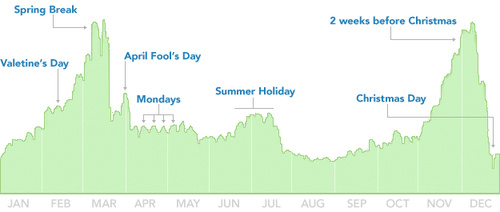
Take a look at the graph below.

This is the excerpt from Gizmodo:

You’re very likely to get dumped on Mondays, right before Spring Break, two weeks before Christmas, and at some point before the summer holidays. The good news about the whole mess is that it seems that people feel quite bad about dumping someone right on Christmas Day, so you can breathe a bit easier while unwrapping your presents.

Facebook has quickly become the largest human data set, so yes, it is very interesting to look at the bulk data generated by its users. But from all the sources I’ve read, all of them miss this very important mark:

The data depicted above does not correspond to actual break-up day; rather, the data corresponds to self-reported updates of a break-up made by Facebook users.

Why is this qualification important? Because the way the information is presented above, there are numerous confounding variables. The most notable one is time shift (delay), corresponding to how long it would take for a Facebook user to update their status on Facebook after a break-up.

Here are two scenarios I can think of when time delay is pivotal:

  • Monday Break-ups. Suppose someone gets dumped on Friday. He or she may not come to terms with the break-up that Friday, and perhaps try to reconcile the relationship throughout the weekend. So, in fact, most break-ups may occur on a Friday, Saturday, or Sunday; but the status update would come on Monday (when the user couldn’t reconcile things over the weekend, say; or perhaps, coming back to school or work the following Monday morning, Facebook is more accessible, so it’s fitting time to make the status update).
  • Christmas Day Break-ups. While it does appear that there are the least number of break-ups occurring on Christmas Day, perhaps it’s because a lot of people are away from computers (and thus Facebook) to update their status. Alternatively, it may be really embarrassing to announce your break-up on Christmas Day, so the user would wait a day or two to make the Facebook update.

That said, I think the data is useful, but it is much more interesting when looking at general trends (more break-ups occur as Spring Break and Christmas approach) rather than pinpointing break-ups on specific days of the week or holidays.

Still unconvinced? Imagine if the data set instead showed specific dates on when Facebook users entered a relationship (girlfriend/boyfriend, engagement, marriage). Would you really believe that if someone changed their status update to “Married” on a Monday morning, they actually got married on Monday? Of course not (unless they’re this couple)!

Bottom line: while the general data presented above is interesting, it’s important not to discount numerous confounding factors (time delay being the most notable one, but also: people untruthfully reporting a break-up).

###
References:

1) “Amazing Facts about Facebook and Breakups”

2) For a superb take on the importance of confounding factors, especially on Twitter, I highly recommend reading “The Confounding Variable of the Retweet.”

Readings: Titanic Sinking, The Freedom World, Zuckerberg’s Generosity

Some interesting reads this week:

1) “The Truth about the Sinking of the Titanic” [The Telegraph] – we’ve all seen the movie, but this article suggests that the reason for sinking of The Titanic is because of a “schoolboy” steering error. Louise Patten, who is coming out with a novel, Good as Gold, reveals the truth about her grandfather:

‘My grandfather was the Second Officer on the Titanic,’ Patten explains. ‘He was in his cabin when it struck the iceberg. Afterwards, he refused a direct order to go in a lifeboat, but by a fluke he was saved.’ Astonishingly, he jumped into the ocean as the boat sank, was being sucked down into the depths – but was then carried back to the surface by the force of an explosion beneath the waves and was rescued by a passing lifeboat.

So why did the steering error happen? After the First Officer, William Murdoch spotted the iceberg, he gave a “hard a-starboard” order, which was misinterpreted by Robert Hitchins, the steersman:

‘Titanic was launched at a time when the world was moving from sailing ships to steam ships. My grandfather, like the other senior officers on Titanic, had started out on sailing ships. And on sailing ships, they steered by what is known as “Tiller Orders” which means that if you want to go one way, you push the tiller the other way. [So if you want to go left, you push right.] It sounds counter-intuitive now, but that is what Tiller Orders were. Whereas with “Rudder Orders’ which is what steam ships used, it is like driving a car. You steer the way you want to go. It gets more confusing because, even though Titanic was a steam ship, at that time on the North Atlantic they were still using Tiller Orders. Therefore Murdoch [First Officer] gave the command in Tiller Orders but Hitchins [the steersman], in a panic, reverted to the Rudder Orders he had been trained in. They only had four minutes to change course and by the time Murdoch spotted Hitchins’ mistake and then tried to rectify it, it was too late.’

If you’re still confused, check out a simplified explanation at Discovery News.

2) “The Freedom World” [The Smart Set] – in my previous post, I titled my post as a must-read. Jessa Crispin has come out with a timely post regarding must-reads, and she bases her argument on Jonathan Franzen’s latest book, Freedom (which I haven’t read). This is an interesting argument:

The idea that as a literary person there are a certain set of books you must read because they are important parts of the literary conversation is constantly implied, yet quite ridiculous. Once you get done with the Musts — the Franzens, Mitchells, Vollmanns, Roths, Shteyngarts — and then get through the Booker long list, and the same half-dozen memoirs everyone else is reading this year (crack addiction and face blindness seem incredibly important this year), you have time for maybe two quirky choices, if you are a hardcore reader. Or a critic. And then congratulations, you have had the same conversations as everyone else in the literary world.

And what of the must-read books?

Of course there is no such thing as a must-read book. Maybe you should read some Tolstoy, but then again maybe not, if overly long descriptions of fields don’t really do anything for you, or if you have some problems with the whole woman-has-a-desire-and-so-must-die thing. Maybe you should check out some Jane Austen, but then again, Jane Austen is pretty boring and the whole marriage-as-life thing, I mean who really cares. There is Shakespeare, but you could spend a day arguing Hamlet versus King Lear versus Julius Caesar and never have a clear winner.

I may come back to this argument later, as I do think there are must-read books out there. Until I read Jessa Crispin’s essay, I had no idea some critics were labeling Freedom as the book of the century:

“Best book of the century” is the statement of someone who has given up. That is an incredibly pessimistic viewpoint to have, don’t you think? That 10 years into the century, this is the best we can possibly do? Or perhaps he means the last hundred years. Maybe the guy really didn’t like Ulysses; it’s hard to tell.

It’s not that the guy didn’t like Ulysses; it’s that he never actually read it.

3) “Facebook Founder to Donate $100 Million to Help Remake Newark’s Schools” [New York Times] – Zuckerberg, who recently opened up to The New Yorker, is opening up in a different way: through a very generous contribution:

The $100 million for Newark is the initial gift to start a foundation for education financed by Mr. Zuckerberg. This would be by far the largest publicly known gift by Mr. Zuckerberg, whose fortune Forbes magazine estimated last year at $2 billion.

The gift is many times larger than any the system has received, officials said — an extraordinary sum not only for a district with an $800 million annual operating budget, but also for any publicly financed government agency. It is not yet clear how the money would be used, or over what period.

This is Zuckerberg’s first major act of philanthropy, and no doubt it’s huge. He would have made the headlines had he contributed even a tenth of his $100m pledge.

The Face of Facebook: Mark Zuckerberg, Revealed

If you’re reading this post, then chances are you’re probably on Facebook. Or at least have heard of it.

The latest piece in The New Yorker, “The Face of Facebook,” offers an intimate, revealing look into the founder of Facebook, Mark Zuckerberg. It’s definitely a piece worth reading, not least because it goes on to show how Zuckerberg has changed since his younger days at Harvard. I highlight some passages which I found interesting below.

With whom is Mark friends with on Facebook? And what are Zuckerberg’s favorite artists? (More about his favorites in a moment).

According to his Facebook profile, Zuckerberg has three sisters (Randi, Donna, and Arielle), all of whom he’s friends with. He’s friends with his parents, Karen and Edward Zuckerberg. He graduated from Phillips Exeter Academy and attended Harvard University. He’s a fan of the comedian Andy Samberg and counts among his favorite musicians Green Day, Jay-Z, Taylor Swift, and Shakira.
I like this description of Mark provided by his girlfriend, Priscilla Chan, who met Mark at Harvard party:
He was this nerdy guy who was just a little bit out there. I remember he had these beer glasses that said ‘pound include beer dot H.’ It’s a tag for C++. It’s like college humor but with a nerdy, computer-science appeal.
On the inevitability of Zuckerberg becoming a billionaire:
If and when Facebook decides to go public, Zuckerberg will become one of the richest men on the planet, and one of the youngest billionaires. In the October issue of Vanity Fair, Zuckerberg is named No. 1 in the magazine’s power ranking of the New Establishment, just ahead of Steve Jobs, the leadership of Google, and Rupert Murdoch. The magazine declared him “our new Caesar.”
On Zuckerberg’s mannerisms:
When he’s not interested in what someone is talking about, he’ll just look away and say, “Yeah, yeah.” Sometimes he pauses so long before he answers it’s as if he were ignoring the question altogether. The typical complaint about Zuckerberg is that he’s “a robot.” One of his closest friends told me, “He’s been overprogrammed.” Indeed, he sometimes talks like an Instant Message—brusque, flat as a dial tone—and he can come off as flip and condescending, as if he always knew something that you didn’t.

There are revealing and embarrassing instant messages that Zuckerberg sent regarding Facebook when he was still at Harvard. Zuckerberg seems apologetic, regretful:

When I asked Zuckerberg about the IMs that have already been published online, and that I have also obtained and confirmed, he said that he “absolutely” regretted them. “If you’re going to go on to build a service that is influential and that a lot of people rely on, then you need to be mature, right?” he said. “I think I’ve grown and learned a lot.”
What is Zuckerberg’s ultimate goal?
Zuckerberg’s ultimate goal is to create, and dominate, a different kind of Internet. Google and other search engines may index the Web, but, he says, “most of the information that we care about is things that are in our heads, right? And that’s not out there to be indexed, right?” Zuckerberg was in middle school when Google launched, and he seems to have a deep desire to build something that moves beyond it. “It’s like hardwired into us in a deeper way: you really want to know what’s going on with the people around you,” he said.
Regarding favorites, such as artists and books: what Zuckerberg lists may not necessary be his favorites (I sympathize with his explanation):

I asked Zuckerberg about “Ender’s Game,” the sci-fi book whose hero is a young computer wizard.

“Oh, it’s not a favorite book or anything like that,” Zuckerberg told me, sounding surprised. “I just added it because I liked it. I don’t think there’s any real significance to the fact that it’s listed there and other books aren’t. But there are definitely books—like the Aeneid—that I enjoyed reading a lot more.”

I think The New Yorker piece paints an honest portrait of Zuckerberg. While he may have been slightly immature in his teens and earlier twenties, he has grown up considerably over the last few years. I have a feeling that if I were to meet Mark in person, we’d get along.