The Man Who Wouldn’t Die

This is an amazing story of “The Murder Trust” (notably Francis Pasqua, Daniel Kriesberg, and Tony Marino) and their devious efforts (in 1932) to make Michael Malloy drink himself to death in order to subsequently collect insurance money:

Pasqua offered to do the legwork, paying an unnamed acquaintance to accompany him to meetings with insurance agents. This acquaintance called himself Nicholas Mellory and gave his occupation as florist, a detail that one of Pasqua’s colleagues in the funeral business was willing to verify. It took Pasqua five months (and a connection with an unscrupulous agent) to secure three policies—all offering double indemnity—on Nicholas Mellory’s life: two with Prudential Life Insurance Company and one with Metropolitan Life Insurance Company. Pasqua recruited Joseph Murphy, a bartender at Marino’s, to identify the deceased as Michael Malloy and claim to be his next of kin and beneficiary. If all went as planned, Pasqua and his cohorts would split $3,576 (about $54,000 in today’s dollars) after Michael Malloy died as uneventfully and anonymously as he had lived.

But when free drinks at the bar, for three consecutive days, didn’t cause any visible changes in Malloy, the group sought to expand on their deviousness by exchanging Malloy’s whiskey and gin with shots of wood alcohol. Drinks containing just four percent wood alcohol could cause blindness, and by 1929 more than 50,000 people nationwide had died from the effects of impure alcohol. They would serve Malloy not shots tainted with wood alcohol, but wood alcohol straight up.

He weathered through it. So what next?

At this point killing Michael Malloy was just as much about pride as about a payoff—a payoff, they all griped, that would be split among too many conspirators. Murphy tried next. He let a tin of sardines rot for several days, mixed in some shrapnel, slathered the concoction between pieces of bread and served Malloy the sandwich. Any minute, they thought, the metal would start slashing through his organs. Instead, Malloy finished his tin sandwich and asked for another.

So how did the story end? Find out here.

Jeremy Lin: From Harvard to the NBA

The New York Times has a great story on Jeremy Lin, an NBA player currently with the New York Knicks. He is an Asian-American in a league devoid of them (the only other name that comes to mind is Yao Ming). He is the N.B.A.’s first American-born player of Taiwanese or Chinese descent and only the fourth Asian-American in league history.

Lin received no college scholarship offers, even though he lead his Palo Alto High School team to a 32-1 record and the California championship. At Harvard, he was twice named to the all-Ivy League first team and delivered a signature 30-point performance against 12th-ranked Connecticut. In June 2010, he went undrafted in the NBA. His defense, jump shot, and just about everything else seemed subpar compared to the NBA elites. Why is he receiving so much attention all of a sudden? Not only is he helping the Knicks overcome a mediocre season, but

[T]he Lin phenomenon transcends race or nationality. He resonates with devout Christians, because he speaks openly of his faith, a sort of Taiwanese Tim Tebow. He taps into the passions of Harvard alumni, Ivy Leaguers, New Yorkers and anyone anywhere who loves an underdog.

Below, some highlights of Lin’s ability to pass, score, and play defense:

###

Related: this piece on Jeremy Lin reminded me of the Remarkable Story of the Caltech Basketball Team.

The History of Infographics

This piece sparked my interest in exploring the history of infographics. Excluding cave paintings, the history of infographics dates back to the 1600s:

In 1626 Christopher Scheiner published the Rosa Ursina sive Sol which used a variety of graphics to reveal his astronomical research on the sun. He used a series of images to explain the rotation of the sun over time (by tracking sunspots).

In 1786, William Playfair published the first data graphs in his book The Commercial and Political Atlas. The book is filled with statistical graphs, bar charts, line graphs, and histograms, that represent the economy of 18th century England.

Perhaps most famously, the English nurse Florence Nightingale, in 1857, used information graphics persuading Queen Victoria to improve conditions in military hospitals, principally the Coxcomb chart, a combination of stacked bar and pie charts, depicting the number and causes of deaths during each month of the Crimean War.

"Diagram of the causes of mortality in the army in the East," published by Florence Nightingale.

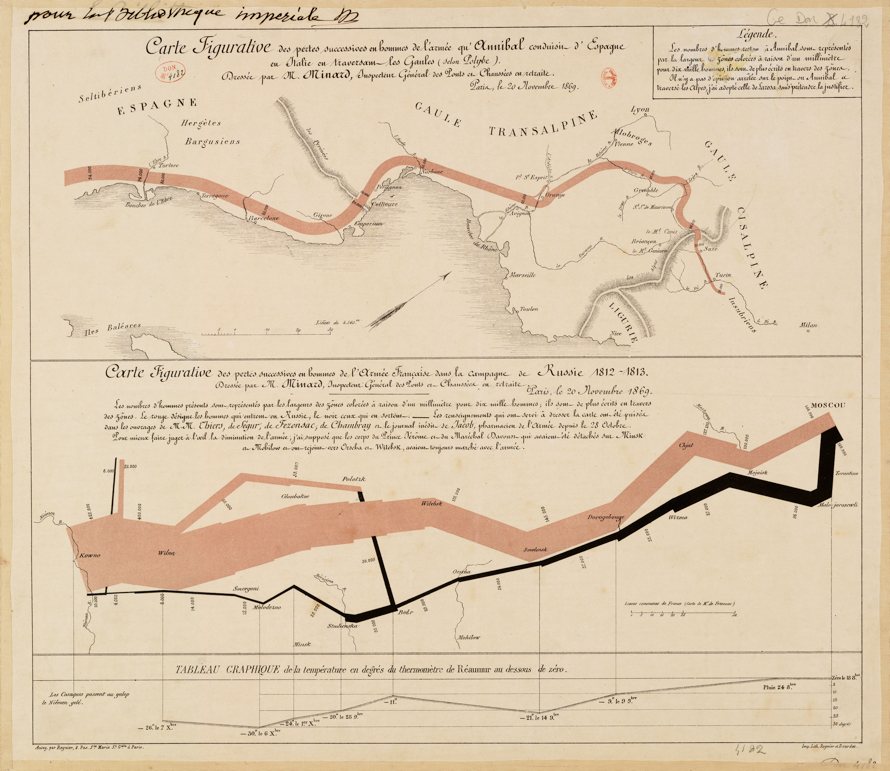
The piece in The Morning News profiles, among a few other selections, the French engineer Charles Joseph Minard, who devised a number of new and influential infographic techniques. Among the most famous of his charts from this period is the 1869 “Carte figurative des pertes successives en hommes de l’armée française dans la campagne de Russie 1812–1813 comparées à celle d’Hannibal durant la 2ème Guerre Punique.” The two diagrams, published together, show the size and attrition of the armies of Hannibal in his expedition across the Alps during the Punic wars and of Napoleon during his assault on Russia. The colored band in the diagrams indicates the army’s strength of numbers—in both charts, one millimeter in thickness represents ten thousand men. The chart of Napoleon’s march includes an indication of temperature as well.

Top: Hannibal in his expedition across the Alps during the Punic wars. Bottom: Napoleon's assault on Russia.

See this Wikipedia link for more.

World’s Richest People, Adjusted for Age

The most recent tally of the world’s wealthiest people by Forbes magazine put the Facebook founder’s net worth at $13.5 billion in 2011, ranking him 52nd in the world. But Zuckerberg’s 28.4% stake in Facebook could see his fortune rise to as much as $28.4 billion, assuming that Facebook’s valuation is $100 billion.

The telling chart below profiles the world’s richest people in age-adjusted terms (per age capita). At 27, Zuckerberg is number one on this list, with over $1B of wealth per each year of his life. In the top 100 richest people in the world, only the co-founders of Google, Larry Page and Sergey Brin, are also under 40.

(Source: The Economist)

On Mindful Eating

I’ve been reading about mindful eating, a technique whereby we slow down as we eat our food. The benefits are many: over time, we’ll eat less than our normal portions, we can lose weight, and so on. The concept of mindful eating has roots in Buddhist teachings, whereby meditation with food is complementary to breathing and sitting techniques. The New York Times profiles mindful eating, noting that it’s not a diet:

[S]uch experiments of the mouth and mind have begun to seep into a secular arena, from the Harvard School of Public Health to the California campus of Google. In the eyes of some experts, what seems like the simplest of acts — eating slowly and genuinely relishing each bite — could be the remedy for a fast-paced Paula Deen Nation in which an endless parade of new diets never seems to slow a stampede toward obesity.

Mindful eating is not a diet, or about giving up anything at all. It’s about experiencing food more intensely — especially the pleasure of it. You can eat a cheeseburger mindfully, if you wish. You might enjoy it a lot more. Or you might decide, halfway through, that your body has had enough. Or that it really needs some salad.

The article closes with the following tips:

WHEN YOU EAT, JUST EAT. Unplug the electronica. For now, at least, focus on the food.

CONSIDER SILENCE. Avoiding chatter for 30 minutes might be impossible in some families, especially with young children, but specialists suggest that greenhorns start with short periods of quiet.

TRY IT WEEKLY. Sometimes there’s no way to avoid wolfing down onion rings in your cubicle. But if you set aside one sit-down meal a week as an experiment in mindfulness, the insights may influence everything else you do.

PLANT A GARDEN, AND COOK. Anything that reconnects you with the process of creating food will magnify your mindfulness.

CHEW PATIENTLY. It’s not easy, but try to slow down, aiming for 25 to 30 chews for each mouthful.

USE FLOWERS AND CANDLES. Put them on the table before dinner. Rituals that create a serene environment help foster what one advocate calls “that moment of gratitude.”

My aim will be to start slowly: trying mindful eating for one day a week, and expanding from there.

A Replacement Bridge in San Francisco

There is a strong likelihood of a large earthquake in the San Francisco Bay Area — about a 2-in-3 chance of magnitude 6.7 or larger before 2036, according to the United States Geological Survey. This New York Times piece discusses the building of the new Bay Bridge:

Unlike more conventional suspension bridges, in which parallel cables are slung over towers and anchored at both ends in rock or concrete, the 2,047-foot suspension bridge has only a single tower and a single cable that is anchored to the road deck itself, looping from the eastern end to the western end and back again. (With a conventional design it would have been extremely difficult to create an anchorage on the eastern end, in the middle of the bay.)

The new bridge is the longest self-anchored suspension bridge in the world, and it is asymmetrical, with one side of the span longer than the other. The choice of such a design raised the cost of the project significantly. In a conventional suspension bridge, the road deck is added last, hung from suspender cables attached to the main cables. In a self-anchored design, the deck has to be built first.

The eastern span replacement of the San Francisco – Oakland Bay Bridge has been under construction since 2002. Originally scheduled to open in 2007, it is now scheduled to open to traffic in 2013 at an estimated cost of $6.3 billion. A good interactive from the NYT is here. An incredibly detailed Wikipedia article is here.

Apple Results Distorting S&P 500 Earnings

Quote of the day concerning Apple earnings from last quarter:

The world’s largest company by market capitalization said on Jan. 24 that profit in the quarter ended Dec. 31 was $13.1 billion, 36 percent more than the average analyst projection, while revenue beat forecasts by $7.3 billion, the most ever. The Cupertino, California-based company single-handedly erased a drop in S&P 500 earnings for the October-to-December period, turning a 4.2 percent decline into a 4.4 percent gain.

(source: Bloomberg)

The Largest Biometric System in the World

It has been called “the biggest social project on the planet.”

A major problem in India is that few poor people can prove their identity: they have no passport, no driving licence, no proof of address. They live in villages where many share the same name. These people cannot open bank accounts, and no one wants to lend them money. India has no equivalent of Social Security numbering, and just thirty-three million Indians, out of 1.2 billion, pay income tax.

But India’s relatively new program, the unique identity (UID) authority, will enroll approximately 400 million people by the end of this year. The scheme is voluntary, but the poor are enthusiastic about it. This Economist piece has some details, which relies on maintaining a huge database containing biometric information (ten fingerprints and an iris scan) of each of India’s residents:

For the poor, having a secure online identity alters their relationship with the modern world. No more queueing for hours in a distant town and bribing officials with money you don’t have to obtain paperwork that won’t be recognised if you move to another state looking for work. A pilot project just begun in Jharkhand, an eastern state, will link the new identities to individuals’ bank accounts. Those to whom the government owes money will soon be able to receive it electronically, either at a bank or at a village shop. Ghost labourers staffing public-works schemes, and any among India’s 20m government employees, should turn into thin air. The middlemen who steal billions should more easily be bypassed or caught.

That is just the start. Armed with the system, India will be able to rethink the nature of its welfare state, cutting back on benefits in kind and market-distorting subsidies, and turning to cash transfers paid directly into the bank accounts of the neediest. Hundreds of millions of the poor must open bank accounts, which is all to the good, because it will bind them into the modern economy. Care must be taken so mothers rather than feckless fathers control funds for their children. But most poor people, including anyone who wants to move around, will be better off with cash welfare paid in full. Vouchers for medical or education spending could follow.

The scheme based on biometrics is not without criticism, however. Nevertheless, the cost of enrolling each person into this program is about $2, so India’s program could be a model for other poor nations.

Robert Walser on the Artistic Individual

The passage below is from Robert Walser’s Berlin Stories, which have been translated into English for the first time by Susan Bernofsky, and just published in a new edition by New York Review Classics. Walser arrived in Berlin from Switzerland in 1905 and wrote hundreds of short reflections about the city’s charms. This passage on the successful artist is excellent:

The artist who is crowned with success lives in the metropolis as if in an enchanting Oriental dream. He hastens from one elegant household to the affluent next, sits down unhesitatingly at the opulently laden dining tables, and while chewing and slurping provides the entertainment. He passes his days in a virtual state of intoxication. And his talent? Does an artist such as this neglect his talent? What a question! As if one might cast off one’s gifts without so much as a by-your-leave. On the contrary. Talent unconsciously grows stronger when one throws oneself into life. You mustn’t be constantly tending and coddling it like a sickly something. It shrivels up when it’s too timidly cared for.

The artistic individual is nonetheless permitted to pace up and down, like a tiger, in his cave of artistic creation, mad with desire and worry over achieving some output of beauty. As no one sees this, there is no one to hold it against him. In company, he should be as breezy, affable, and charming as he can manage, neither too self-important nor too unimportant either. One thing he must never forget: he is all but required to pay court to beautiful, wealthy women at least a little.

Featured in full here.

Why French Parents are Superior

Pamela Druckerman is an American mother living in Paris with her British husband and two kids. In her book, Bringing Up Bébé: One American Mother Discovers the Wisdom of French Parenting, she offers her thoughts on parenting and comparing how French and Americans parents differ in their techniques and temperaments. The Wall Street Journal has a great excerpt, citing why French parents are superior to American parents:

The French, I found, seem to have a whole different framework for raising kids. When I asked French parents how they disciplined their children, it took them a few beats just to understand what I meant. “Ah, you mean how do we educate them?” they asked. “Discipline,” I soon realized, is a narrow, seldom-used notion that deals with punishment. Whereas “educating” (which has nothing to do with school) is something they imagined themselves to be doing all the time.

One of the keys to this education is the simple act of learning how to wait. It is why the French babies I meet mostly sleep through the night from two or three months old. Their parents don’t pick them up the second they start crying, allowing the babies to learn how to fall back asleep. It is also why French toddlers will sit happily at a restaurant. Rather than snacking all day like American children, they mostly have to wait until mealtime to eat. (French kids consistently have three meals a day and one snack around 4 p.m.)

The author’s impression of the way the French perceive American kids and parents:

[M]ost French descriptions of American kids include this phrase “n’importe quoi,” meaning “whatever” or “anything they like.” It suggests that the American kids don’t have firm boundaries, that their parents lack authority, and that anything goes. It’s the antithesis of the French ideal of thecadre, or frame, that French parents often talk about. Cadre means that kids have very firm limits about certain things—that’s the frame—and that the parents strictly enforce these. But inside the cadre, French parents entrust their kids with quite a lot of freedom and autonomy.

One final point, according to the article: when comparing beliefs of college-educated mothers in the U.S. and France, the American moms said that encouraging one’s child to play alone was of average importance. But the French moms said it was very important. Being alone forces kids to find creative ways to entertain themselves, an essential skill in deferred gratification.

###

See also: Why Chinese Mothers are Superior.