Curiosity Rover’s 17 Cameras

The Mars Curiosity rover made a safe landing on Mars in the early hours of August 6 (I stayed up and watched the event live). I knew the complexity of the rover, and Wired provides a good overview of Curiosity’s 17 cameras on board:

First up is the Mars Decent Imager (MARDI), which recently beamed back an amazing video of the rover’s nail-biting descent. MARDI turned on during the final few minutes of the “Seven Minutes of Terror” and recorded a full-color high-definition movie as the ground rushed up to meet the rover. With this film (and the coming high-def version), you get to experience what the wild ride down to the surface looked like.

MARDI is a 2-megapixel wide-angle camera mounted toward the front on the port side of Curiosity. The camera came to life just after the spacecraft’s heat shield jettisoned, taking images of a roughly 2 by 2.5-mile square, with a resolution of about 8 feet per pixel. The final fully-in-focus images came when the rover was about 15 feet off the ground. In addition to a thrilling film, MARDI will provide scientists the opportunity to know exactly where Curiosity landed and learn a bit about the surrounding area.

Of course, a telephoto lens is also included:

One of the biggest requests that scientists had for Curiosity was the addition of a telephoto lens. The previous rovers, Spirit and Opportunity, could see details about as well as a person would on Mars. But MastCam’s right camera has a 100-mm focal-length lens that provides three times the resolution of previous Mars rover cameras. It can distinguish between a football and a basketball from seven football fields away. While the left camera, with its 34-mm lens, can’t see as well, it will provide much wider views – about 15 degrees versus the right camera’s five degree field-of-view.

The raw images from Curiosity are being uploaded on the JPL site.

A Brief History of Sleep

From a very interesting Wall Street Journal piece on sleep, we learn some history about how humans used to get two sleeping chunks at night:

So why is sleep, which seems so simple, becoming so problematic? Much of the problem can be traced to the revolutionary device that’s probably hanging above your head right now: the light bulb. Before this electrically illuminated age, our ancestors slept in two distinct chunks each night. The so-called first sleep took place not long after the sun went down and lasted until a little after midnight. A person would then wake up for an hour or so before heading back to the so-called second sleep.

It was a fact of life that was once as common as breakfast—and one which might have remained forgotten had it not been for the research of a Virginia Tech history professor named A. Roger Ekirch, who spent nearly 20 years in the 1980s and ’90s investigating the history of the night. As Prof. Ekirch leafed through documents ranging from property records to primers on how to spot a ghost, he kept noticing strange references to sleep. In “The Canterbury Tales,” for instance, one of the characters in “The Squire’s Tale” wakes up in the early morning following her “first sleep” and then goes back to bed. A 15th-century medical book, meanwhile, advised readers to spend their “first sleep” on the right side and after that to lie on their left. A cleric in England wrote that the time between the first and second sleep was the best time for serious study.

The time between the two bouts of sleep was a natural and expected part of the night, and depending on your needs, was spent praying, reading, contemplating your dreams or having sex. The last one was perhaps the most popular. A noted 16th-century French physician named Laurent Joubert concluded that plowmen, artisans and others who worked with their hands were able to conceive more children because they waited until after their first sleep, when their energy was replenished, to make love.

The phrase is “segmented sleep” and it can be reproduced:

Studies show that this type of sleep is so ingrained in our nature that it will reappear if given a chance. Experimental subjects sequestered from artificial lights have tended to ease into this rhythm. What’s more, cultures without artificial light still sleep this way. In the 1960s, anthropologists studying the Tiv culture in central Nigeria found that group members not only practiced segmented sleep, but also used roughly the same terms to describe it.

Fascinating.

Comparing Usain Bolt’s Record to 116 Years of Olympic History

Usain Bolt set an Olympic record last night after he ran the 100 meter race in 9.63 seconds. The New York Times has a brilliant interactive showing how Bolt’s performance compares to other Olympic runners in history:

Usain Bolt interactive shows how his 9.63 seconds in the 100m dash compares historically. Click on the photo to watch the video.

Based on the athletes’ average speeds, if every Olympic medalist raced each other, Usain Bolt (the London version) would win, with a wide distribution of Olympians behind him. Jesse Owens raced the 100m in 10.3 seconds in 1934. Carl Lewis did it in 9.92 seconds in 1988.

The question is: when will we see a sub-9.5 second time for the 100m sprint? And will we ever see a sub-9 second time in the 100 meter race?

Update (8/8/12): You can watch the video below:

###

Note: while you’re at it, you should also check out the NYT interactives on the 100 meter swim and the long jump.

The Most Ruthless Takedown of the TED Ecosystem

Evgeny Morozov has a scathing piece in The New Republic claiming that TED is no longer a responsible curator of ideas “worth spreading.” Instead it has become something ludicrous, and a little sinister. His takedown is ruthless, and begins with a recent book published by TED:

Khanna’s contempt for democracy and human rights aside, he is simply an intellectual impostor, emitting such lethal doses of banalities, inanities, and generalizations that his books ought to carry advisory notices. Take this precious piece of advice from his previous book—the modestly titledHow to Run the World—which is quite representative of his work: “The world needs very few if any new global organizations. What it needs is far more fresh combinations of existing actors whocoordinate better with one another.” How this A-list networking would stop climate change, cyber-crime, or trade in exotic animals is never specified. Khanna does not really care about the details of policy. He is a manufacturer of abstract, meaningless slogans. He is, indeed, the most talented bullshit artist of his generation.

Morozov is a brilliant tactician with words, and dishes out paragraph after paragraph like the following:

As is typical of today’s anxiety-peddling futurology, the Khannas’ favorite word is “increasingly,” which is their way of saying that our unstable world is always changing and that only advanced thinkers such as themselves can guide us through this turbulence. In Hybrid Reality, everything is increasingly something else: gadgets are increasingly miraculous, technology is increasingly making its way into the human body, quiet moments are increasingly rare. This is a world in which pundits are increasingly using the word “increasingly” whenever they feel too lazy to look up the actual statistics, which, in the Khannas’ case, increasingly means all the time.

The main argument against TED made by Morozov:

Today TED is an insatiable kingpin of international meme laundering—a place where ideas, regardless of their quality, go to seek celebrity, to live in the form of videos, tweets, and now e-books. In the world of TED—or, to use their argot, in the TED “ecosystem”—books become talks, talks become memes, memes become projects, projects become talks, talks become books—and so it goes ad infinitum in the sizzling Stakhanovite cycle of memetics, until any shade of depth or nuance disappears into the virtual void. Richard Dawkins, the father of memetics, should be very proud. Perhaps he can explain how “ideas worth spreading” become “ideas no footnotes can support.”

I don’t agree with a lot of Morozov writes, but he makes some great points about “techno babble” and how we can be easily swayed by some ideas that are fairly obvious.

A Cautionary Tale about iCloud

Mat Honan, technology writer based in San Francisco, got hacked over the weekend. He describes his experience in a blog post (it is quite a story):

At 4:50 PM, someone got into my iCloud account, reset the password and sent the confirmation message about the reset to the trash. My password was a 7 digit alphanumeric that I didn’t use elsewhere. When I set it up, years and yearsago, that seemed pretty secure at the time. But it’s not. Especially given that I’ve been using it for, well, years and years…

The backup email address on my Gmail account is that same .mac email address. At 4:52 PM, they sent a Gmail password recovery email to the .mac account. Two minutes later, an email arrived notifying me that my Google Account password had changed. 

At 5:00 PM, they remote wiped my iPhone

At 5:01 PM, they remote wiped my iPad

At 5:05, they remote wiped my MacBook Air.

A few minutes after that, they took over my Twitter. Because, a long time ago, I had linked my Twitter to Gizmodo’s they were then able to gain entry to that as well. 

Honan confirmed with the hacker and Apple that it happened when the hacker got in touch with Apple tech support and via “some clever social engineering” let the hacker bypass the security questions. I want to know more details about this clever social engineering. Because I have an iCloud account of my own and it shouldn’t be this simple to have the password reset. I wonder if Apple will make a formal acknowledgement of the issue and provide some guidance on how iCloud will be made more secure.

The Positive Power of Negative Thinking

An interesting contrarian op-ed in The New York Times about the power of negative thinking:

Or take affirmations, those cheery slogans intended to lift the user’s mood by repeating them: “I am a lovable person!” “My life is filled with joy!” Psychologists at the University of Waterloo concluded that such statements make people with low self-esteem feel worse — not least because telling yourself you’re lovable is liable to provoke the grouchy internal counterargument that, really, you’re not.

Even goal setting, the ubiquitous motivational technique of managers everywhere, isn’t an undisputed boon. Fixating too vigorously on goals can distort an organization’s overall mission in a desperate effort to meet some overly narrow target, and research by several business-school professors suggests that employees consumed with goals are likelier to cut ethical corners.

Though much of this research is new, the essential insight isn’t. Ancient philosophers and spiritual teachers understood the need to balance the positive with the negative, optimism with pessimism, a striving for success and security with an openness to failure and uncertainty. The Stoics recommended “the premeditation of evils,” or deliberately visualizing the worst-case scenario. This tends to reduce anxiety about the future: when you soberly picture how badly things could go in reality, you usually conclude that you could cope. Besides, they noted, imagining that you might lose the relationships and possessions you currently enjoy increases your gratitude for having them now. Positive thinking, by contrast, always leans into the future, ignoring present pleasures.

The author of the op-ed, Oliver Burkeman, may simply be promoting his upcoming book, The Antidote: Happiness for People Who Can’t Stand Positive Thinking.

A Man Walks Into a Bank

Patrick Combs received a fake check in the mail for $95,093.35. As a joke, he went to his ATM and deposited it, thinking that it would bounce in a day or two. But it didn’t, as he describes in this great piece for The Financial Times:

But seven long days later the lottery-like amount was still there and I visited the bank where an employee told me that the funds were now all available for cash withdrawal. All $95,093.35 was mine for the taking. All I had to do was ask. Windfall money begs us to take it and run. But I restrained myself. And gave the bank another two excruciatingly long weeks to do their job, catch up with their mistake, and bounce the cheque. But at the end of three hellish weeks, during which I hourly resisted the urge to take the money and run to Mexico, where it would be worth twice as much, I was told by my branch manager, “You’re safe to start spending the money, Mr Combs. A cheque cannot bounce after 10 days. You’re protected by the law.”

So he decided to withdraw the money… What happened next was pretty interesting. The comments, however, disparage Mr. Combs:

Not funny. Mr. Coombs is a consumer ‘shoe bomber’. Because he could not restrain himself from doing something deliberately stupid, there will be endless paragraphs added to banking terms and conditions as the lawyers try to plan for every imaginable glitch in the use of atms. This kind of idiotic behaviour eventually makes life more tiresome for millions of others. Grow up.

You withdrew the money. A dishonest act. All business’s make mistakes. It would have been more amusing if you had notified them of your mistake first showing some honesty. The world can do without people like you. It moved into the area of appearing like attempted fraud on your part and not at all funny. How you bleat about them getting cross. You would have been calm of course if it had been your money?

What do you think Mr. Combs should have done? Is he deserving of the cash? Or was it a morally wrong thing to do?

Usain Bolt Repeats as 100 Meter Gold Medalist at the London Olympics

What a race in the men’s 100m final today at the London 2012 Olympics! I stayed away from Twitter and the Internet because I wanted to watch the race on NBC in primetime without seeing any spoilers. Usain Bolt did not disappoint and repeated as the 100m gold medalist from four years ago in Beijing. Here is Michael Wilbon on the historic race:

The race had everything except a world record, and that’s something Bolt simply doesn’t seem interested in at the moment. He still didn’t explode through the finish tape. He looked right, then left, to see who was on him. When the answer was “no one,” Bolt pulled up for a step. One step, when you consider his stride at 6-foot-5, is the difference between 9.63 and 9.53, which would have been a world record.

What seems to please him more than a world record is the drama he can create. Bolt could have come out and pronounced himself fit before the Games began, but didn’t. He probably could have beaten Blake if he’d wanted to, but why when you love the attention, perhaps even crave it? How many world-class athletes admit, as Bolt did Sunday night, to needing the crowd’s adoration before a race to take away the jitters? Having heard the ovation, bigger than what any British sprinter received all night, Bolt said to himself, “Game time!”

He had plantains, hash browns and fruit for breakfast, then chicken and rice, pork, “a chicken wrap from McDonald’s for lunch. … It had some vegetables, so don’t judge me,” he said.

You can hang on every utterance with Bolt, even when he says he might take on the 400 after these Olympics, because Bolt’s the biggest star in the Olympic universe. Michael Phelps is more decorated, but Phelps has no interest in entertaining, which is what stars do. Bolt doesn’t have to try, he just does it. He is, as Richard Pryor would have said, “a natural born star.” It requires nothing extra in his day. Bolt opens his mouth and a star comes out.

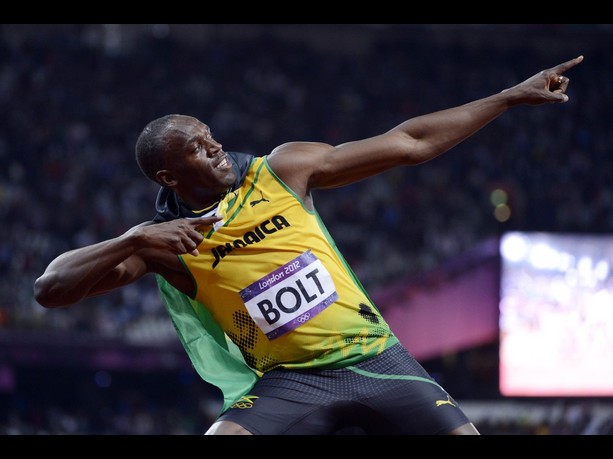
Bolt’s (in)famous celebration tonight:

Jamaica’s Usain Bolt celebrates his 100m gold medal at the London 2012 Olympic Games. Photo credit: Robert Deutsch, USA TODAY Sports.

Ding Zui: Substitute Criminals in China

In China, the rich and powerful can hire body doubles to do their prison time for them. Geoffrey Sant reports for Slate:

The practice of hiring “body doubles” or “stand-ins” is well-documented by official Chinese media. In 2009, a hospital president who caused a deadly traffic accident hired an employee’s father to “confess” and serve as his stand-in. A company chairman is currently charged with allegedly arranging criminal substitutes for the executives of two other companies. In another case, after hitting and killing a motorcyclist, a man driving without a license hired a substitute for roughly $8,000. The owner of a demolition company that illegally demolished a home earlier this year hired a destitute man, who made his living scavenging in the rubble of razed homes, and promised him $31 for each day the “body double” spent in jail. In China, the practice is so common that there is even a term for it: ding zui. Ding means “substitute,” and zui means “crime”; in other words, “substitute criminal.”

What’s more:

Incredibly, substitutes could be hired even for executions. Nineteenth-century traveler Julius Berncastle, the Qing Dynasty author De Fu, and the legal scholar John Bruce Norton each described substitute executions as regular events. This 1883 report from the Board of Punishments demanded an inquiry into how a youth named Wang Wen-shu “was wrongly convicted” and “was on the point of being executed as a substitute for one Hu T’ian, whose alias he was falsely declared to be.” T. T. Meadows, the British diplomat who convinced Western nations to copy China’s system of civil-service exams, argued that the phenomenon of substitute executions was not as surprising as it might seem. If a family is starving, wouldn’t many parents accept execution in exchange for enough money to save their children?

Some imperial Chinese officials who admitted to the use of substitute criminals justified its effectiveness. After all, the real criminal was punished by paying out the market value of his crime, while the stand-in’s punishment intimidated other criminals, keeping the overall crime rate low. In other words, a “cap-and-trade” policy for crime.

Pretty wild.

###

(hat tip: @SteveSilberman)

On Joy of Missing Out

After Caterina Fake wrote about the Fear of Missing Out (FOMO) last year, it became a wildly popular post with many in the blogosphere chiming in and lamenting on having the same fear. So it was quite refreshing to read Anil Dash’s antidote titled “JOMO!” (Joy of Missing Out). Anil posits:

So often, we point the finger at our technologies for creating the fears, the insecurities, the tensions that arise in our social lives as they get increasingly run by social software. But if tech is to blame for our feelings (and I’m not sure I want to concede that point), then certainly we can make apps and sites and software that makes us joyously celebrate for the good time that our friends and loved ones and even complete strangers are having when they go about living their lives.

I’ve been to amazing events. I still am fortunate enough to get to attend moments and celebrations that are an incredible privilege to witness. But increasingly, my default answer to invitations is “no”. No, I’m not going to go. And when well-intentioned hosts inevitably point out “You’re going to regret not coming!” I won’t say it out loud, but I’ll probably think, “No, I really won’t.”

A must-read post. I am not at Anil’s stage yet (I believe FOMO trumps JOMO for me), but I suspect myself and those around me will transition to the JOMO stage as we get older.