The Five Types of Laughter

Haha. Colin Nissan’s piece “The Gift of Laughter” in The New Yorker made me chortle:

Laughing triggers the release of chemicals in your brain, creating feelings of happiness that can often linger long enough for someone to set off your singing trout plaque again. There’s such a strong belief in the medical benefits of laughter that scientists created a gas out of it—one that millions of dentists successfully administer each year to ease their patients’ discomfort during above-the-clothes fondling.

Laughter has proven to be useful in other ways, too. It can make an awkward silence a lot less awkward, like when you’re in a terrible marriage or an elevator. We have laughter to thank for our unique human ability to laugh at ourselves, and, more important, at people with cell-phone holsters. And what would tickling be like without laughter? It would be like trying to tickle a bunch of unticklish people, and if you’ve ever wiggled your fingers across one of them, it’s a goddam nightmare.

There are five types of laughter to choose from. You can giggle, chuckle, howl, chortle, and, in extreme cases when you’re wearing a monocle, even guffaw. Assess the situation and carefully decide which type is appropriate, because the wrong laughter can send the wrong signals and encourage your boss to keep doing his Arnold Schwarzenegger impression.

The ending is kind of weak, but the beginning and middle are LOL-worthy.

###
(hat tip: Chris Sacca)

The History of the Escape Key

The New York Times provides some fascinating history behind the “Escape” key, ubiquitous on computer keyboards:

The key was born in 1960, when an I.B.M. programmer named Bob Bemer was trying to solve a Tower of Babel problem: computers from different manufacturers communicated in a variety of codes. Bemer invented the ESC key as way for programmers to switch from one kind of code to another. Later on, when computer codes were standardized (an effort in which Bemer played a leading role), ESC became a kind of “interrupt” button on the PC — a way to poke the computer and say, “Cut it out.”

Why “escape”? Bemer could have used another word — say, “interrupt” — but he opted for “ESC,” a tiny monument to his own angst. Bemer was a worrier. In the 1970s, he began warning about the Y2K bug, explaining to Richard Nixon’s advisers the computer disaster that could occur in the year 2000. Today, with our relatively stable computers, few of us need the panic button. But Bob Frankston, a pioneering programmer, says he still uses the ESC key. “There’s something nice about having a get-me-the-hell-out-of-here key.”

Will the keyboard come with computers in ten to fifteen years?

A Doctor’s Experience With the Afterlife

Newsweek has published a first person account from a neurosurgeon, Dr. Eben Alexander, who found himself in a coma and experienced a journey to the afterlife. Taking this with a grain of salt. I liked the vivid imagery, however:

A sound, huge and booming like a glorious chant, came down from above, and I wondered if the winged beings were producing it. Again, thinking about it later, it occurred to me that the joy of these creatures, as they soared along, was such that they had to make this noise—that if the joy didn’t come out of them this way then they would simply not otherwise be able to contain it. The sound was palpable and almost material, like a rain that you can feel on your skin but doesn’t get you wet.

Seeing and hearing were not separate in this place where I now was. I could hear the visual beauty of the silvery bodies of those scintillating beings above, and I could see the surging, joyful perfection of what they sang. It seemed that you could not look at or listen to anything in this world without becoming a part of it—without joining with it in some mysterious way. Again, from my present perspective, I would suggest that you couldn’t look at anything in that world at all, for the word “at” itself implies a separation that did not exist there. Everything was distinct, yet everything was also a part of everything else, like the rich and intermingled designs on a Persian carpet … or a butterfly’s wing.

It gets stranger still. For most of my journey, someone else was with me. A woman. She was young, and I remember what she looked like in complete detail. She had high cheekbones and deep-blue eyes. Golden brown tresses framed her lovely face. When first I saw her, we were riding along together on an intricately patterned surface, which after a moment I recognized as the wing of a butterfly. In fact, millions of butterflies were all around us—vast fluttering waves of them, dipping down into the woods and coming back up around us again. It was a river of life and color, moving through the air. The woman’s outfit was simple, like a peasant’s, but its colors—powder blue, indigo, and pastel orange-peach—had the same overwhelming, super-vivid aliveness that everything else had. She looked at me with a look that, if you saw it for five seconds, would make your whole life up to that point worth living, no matter what had happened in it so far. It was not a romantic look. It was not a look of friendship. It was a look that was somehow beyond all these, beyond all the different compartments of love we have down here on earth. It was something higher, holding all those other kinds of love within itself while at the same time being much bigger than all of them.

Without using any words, she spoke to me. The message went through me like a wind, and I instantly understood that it was true. I knew so in the same way that I knew that the world around us was real—was not some fantasy, passing and insubstantial.

The message had three parts, and if I had to translate them into earthly language, I’d say they ran something like this:

“You are loved and cherished, dearly, forever.”“You have nothing to fear.”

“There is nothing you can do wrong.”

Lots of dissenting opinions in the comments, obviously.

Apple’s Tribute to Steve Jobs, One Year Later

Apple.com has a beautiful tribute to Steve Jobs, who died one year ago today. Click on the screenshot below to watch the video.

Remembering Steve Jobs, one year after his death.

Here is what I wrote one year ago today after I learned of Steve’s passing. Here are all the Steve Jobs posts on this blog. Here is the video on YouTube (unless it gets pulled).

Moneyball and What Makes People “Go Batshit Crazy”

I watched Moneyball last night. I read Michael Lewis’s book several years, and it’s still one of the best sports books I’ve ever read. I thought the movie wouldn’t have anything new to offer. Boy, was I wrong.

You don’t need to know about OBP, WHIP, or OPS to get caught up in this drama. Moneyball is a classic underdog story that just happens to have baseball as its backdrop. There are too many excellent quotes in the film, but I wanted to highlight just one. It happens near the end of the movie, when Billy Beane (played by Brad Pitt), the general manager of the Oakland A’s, travels to Boston. While at Fenway Park, Beane is propositioned by John Henry, the principal owner of the Red Sox. Here’s what Henry tells Beane:

For forty-one million, you built a playoff team. You lost Damon, Giambi, Isringhausen, Pena and you won more games without them than you did with them. You won the exact same number of games that the Yankees won, but the Yankees spent one point four million per win and you paid two hundred and sixty thousand. I know you’ve taken it in the teeth out there, but the first guy through the wall. It always gets bloody, always. It’s the threat of not just the way of doing business, but in their minds it’s threatening the game. But really what it’s threatening is their livelihoods, it’s threatening their jobs, it’s threatening the way that they do things. And every time that happens, whether it’s the government or a way of doing business or whatever it is, the people are holding the reins, have their hands on the switch. They go batshit crazy. I mean, anybody who’s not building a team right and rebuilding it using your model, they’re dinosaurs. They’ll be sitting on their ass on the sofa in October, watching the Boston Red Sox win the World Series. 

That’s what I call a money quote.

Investing Gangnam Style

This is a really interesting piece in The Economist that underscores investor confidence and stock mania:

A MID-SIZED sized Korean semiconductor firm named DI makes products with distinctly un-sexy names like “Monitoring Burn-in Tester” and “Wafer Test Board”. It has lost money in each of the past four quarters. And there have been no changes to its fundamentals that might explain why its share price should shoot up from 2,000 to 5,700 won (from $1.80 to $5.12) in the space of just three weeks—including another 15% gain today.

But DI’s chairman and main shareholder, Park Won-ho is no ordinary mortal. He is the father of Park Jae-sang, better known as PSY (as in “psycho”). “Gangnam Style”, if you haven’t heard, is now number one in Britain’s pop charts and number two in America. Local retail investors—referred with the derogatory gaemi-deul (“ants”) by professionals—are piling into DI shares because of it.

Quite how they expect the horse-dancing YouTube phenomenon of 2012 to help DI sell more of its Wafer Test Boards is a mystery. But convoluted investor logic is of course not a new thing. DI is merely the latest example of Korea’s “theme stock”—the local equivalent of the 17th-century Dutch tulip, Pets.com and the like going into 1999, or the Chinese walnut.

Wikipedia has almost 200 (!) references for the article on Gangnam Style. My favorite section is the song’s presence in academia:

According to a blog post published on the Harvard Business Review by Dae Ryun Chang, Professor of Marketing at Yonsei University, one primary factor that has contributed to “Gangnam Style”s international success is the song’s intentional lack of a copyright. This allows people to easily adopt, re-stylize and then spread the song.[6] Brian Gozun, Dean of the Ramon V. del Rosario College of Business at De La Salle University, writes that the absence of a copyright and the use of crowd-sourcing are just some of the more innovative ways that Psy has marketed his song.

Dan Freeman, Marketing professor at the University of Delaware, remarks that Psy’s achievement is an anomaly which counters the typical trend of successful international artists, because foreign music poses a difficult challenge due to language issues, making it unlikely for a song to catch on “when you don’t even understand the words”. Freeman asserts that Psy owes his success in the United States to YouTube, because of YouTube’s effectiveness in reaching a broad market.

David Bell, marketing professor at the Wharton School of the University of Pennsylvania, suggests that “Gangnam Style” lacks a certain aggressive attitude that many find offensive in the rap genre, and “Gangnam Style” is like a classic rap video from a few years ago with girls and cars—”not as offensive and in your face, but with a humorous edge”. Bell argues that it is Psy’s accessible image, not his message, that has made the song so popular.

As per The Economist piece, this entry would be incomplete without the video:

Really? Jerry Seinfeld Writes a Letter to New York Times

Jerry Seinfeld was really upset about Neil Genzlinger’s recent piece about the “R” word. So Seinfeld penned an awesome letter to the editor, calling Neil’s piece “vacuous” and that Neil “crumbled a civilization”:

Really, Neil? Really? You’re upset about too many people saying, “Really?”? I mean, really.

O.K., fine, when it’s used in scripted media, it is a little lazy. But comedy writers are lazy. You’re not fixing that.

So, here’s the bottom line.

If you’re a writer, fine, don’t use it. But in conversation it is fun to say.

I did a “Saturday Night Live Weekend Update” segment titled “Really!?!” with Seth Meyers a few years ago. It was a blast and the audience loved it.

Your example with the girl in the office and the bad clothes? It is definitely much more fun to look at her and just say, “Really?” than to actually talk about the stupid outfit. Really, it is.

What I do not say or write, as you did in the part about responses to Einstein’s theories, is “wrap my head around it.”

Are you kidding? No, no, no, Neil. No sir.

Hilarious. And an instant classic.

A Rebellious Spring Break in Libya

Last year, Chris Jeon, a 21-year-old UCLA math major, left his $9,000-a-month internship at BlackRock, a financial firm in San Francisco, in search of “real experience.”  He wound up fighting with the rebels in Libya. Men’s Journal describes Chris’s desperation and ultimate decision to leave his job (and school) to pursue a spontaneous idea.

On the nonchalant entry into Libya:

The rebels guarding the border were playing FIFA soccer on a PlayStation when he arrived. Jeon waved at them. They glanced at his passport and went back to their video game. “OK, cool,” Jeon said, and simply walked into Libya.

This comes across as careless:

Jeon didn’t speak Arabic and hadn’t done much research on the region, but he’d read the Wikipedia page on Libya and watched a bunch of YouTube videos documenting the war.

On bonding through music:

He [Jeon] was becoming part of the katiba, the Libyan word for brigade. He still didn’t speak much Arabic, but that didn’t seem to matter. There was a cheap Casio keyboard in the town house and when they weren’t on patrol, Jeon taught a skinny 17-year-old named Akram how to play Beethoven. In exchange, Akram showed him how to assemble and break down an AK-47. After two days, the Casio was covered in gun grease, but Akram could play “F ür Elise” and Jeon could field-strip the gun in less than 90 seconds.

And in the midst of rebel fighting, Jeon discovered true happiness:

A couple of days later, the katiba drove into the desert and fired cannons at loyalist positions. Jeon helped load the ammunition. “My lips were cracked and bleeding, I hadn’t brushed my teeth in days, and my face was peeling, but it didn’t matter,” Jeon says. “I was totally happy – happier than I’d ever been.”

Joshua Davis, the author of “Arab Spring Break,” joined Chris on his return trip to Libya. An interesting read overall, though the brazenness and recklessness of Jeon isn’t without criticism.

Mark Zuckerberg Visits Russia, Avoids Wearing Hoodie

The New York Times details Mark Zuckerberg’s recent trip to Russia, where he met Prime Minister Dmitri Medvedev. The big story here is that Zuckerberg didn’t wear his hoodie and instead looked professional in a suit and tie…

But on a more interesting note, this paragraph intrigued me:

More Russians are online today than Germans, making Russia the largest Internet market in Europe. Russians also, strangely, have spent more freely relative to their income than Americans on virtual products, like special powers for online games, making their country a useful market for testing revenue streams other than advertising.

I don’t have a guess as to why virtual products are so popular in Russia.

On another note, check out the bottom of the article for a hilarious correction:

An earlier version of this article misstated the surname of Mark Zuckerberg as Zuckerman at one point.

Wyoming and Yellowstone via Instagram

I just recently returned from a fifteen-day road trip out West. Along the way, I ate amazing barbecue food in Kansas City, saw the most gorgeous sunset in rural Kansas, crossed paths with celebrity mechanics in Colorado, and made way too many photography pit stops while getting to the ultimate destination, Yellowstone National Park (where we spent seven days). I have been slowly editing the images I have taken in and around the park with my primary cameras (Canon 7D and Canon 5D Mark II) as individual posts on my photoblog, Erudite Expressions; that Yellowstone gallery is now complete. Here, I wanted to highlight some of the mobile photographs I captured during this trip, most of which were taken with Instagram on my iPhone.

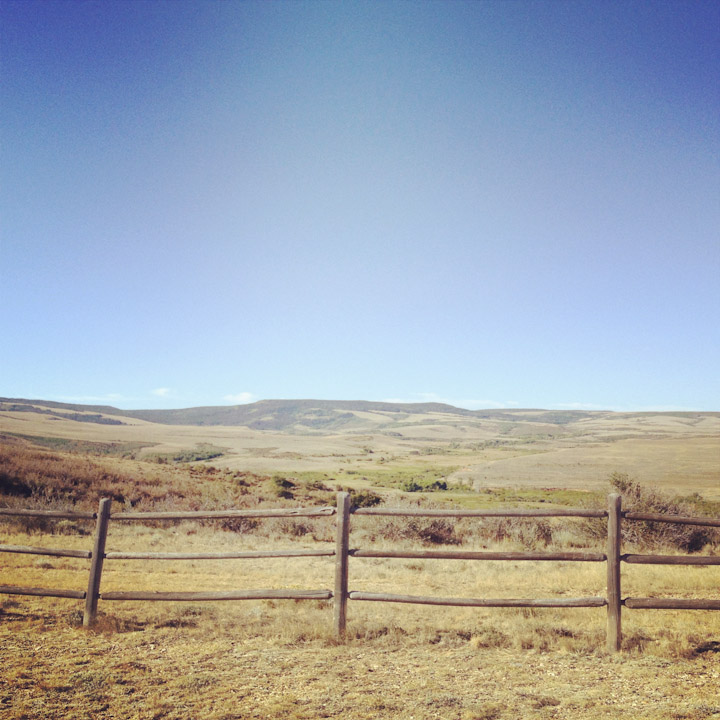
Stopping in rural Wyoming

Stopping in Rural Wyoming.

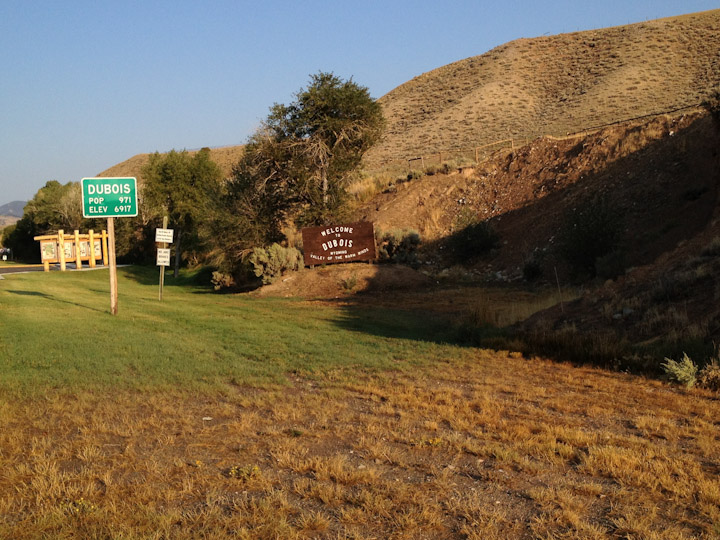
One of the most fruitful stops was this unassuming place called Cowboy Cafe in the town of Dubois, WY. Don’t let the tiny size fool you: the food here is spectacular. We met a group of people inside who said they’ve been coming to Dubois for fifteen years, and for every year they come, they have their breakfast, lunch, and dinner here. The TripAdvisor reviews aren’t wrong here. This hole-in-the-wall is a must when stopping in Dubois (or perhaps even making a special visit out of your trip if you’re in the Jackson Hole/Grand Teton area). The pies here, made daily, are to die for.
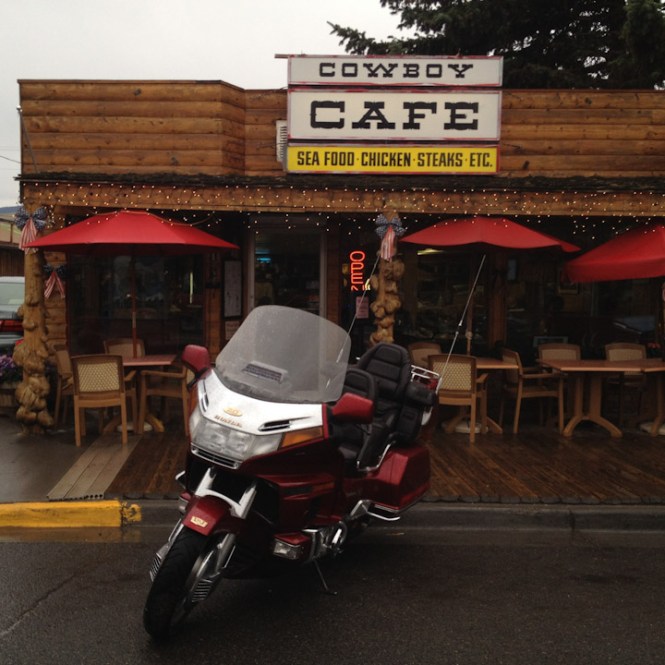
Cowboy Cafe

Cowboy Cafe in Dubois, WY.

A horse farm in Dubois, WY.

Tire tracking in Dubois, WY.

Population: less than 1,000. Amazing small town atmosphere.

Perhaps a better view of this scene on my photoblog, but…

The Tetons.

Fall approaching in Yellowstone National Park.

Crystal clear lake.

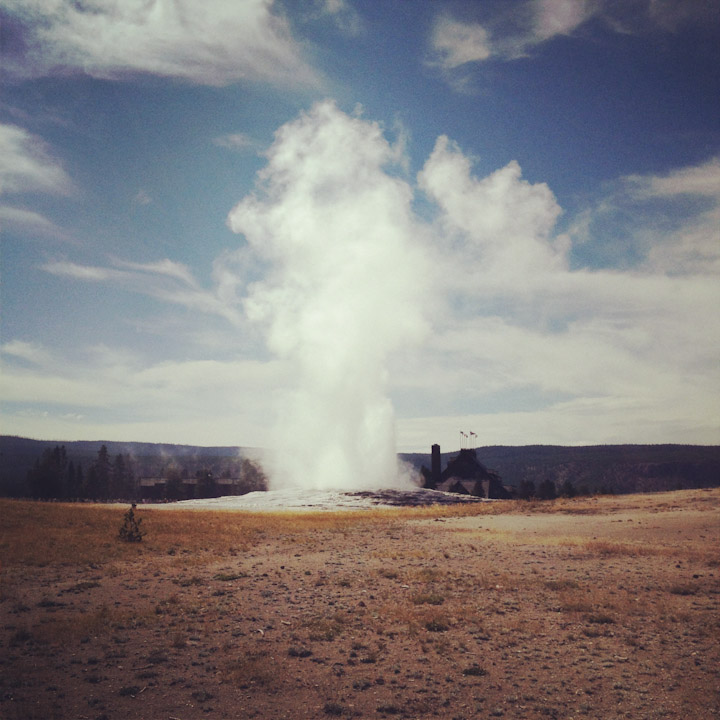
The most popular feature of Yellowstone National Park (also presented here in long exposure form)

The world-famous Old Faithful geyser.

Because of the wind gusts, it was a not-so-uncommon occurrence with people losing their hats at the park. Here, I document a white hat lost in the Grand Prismatic Spring area. Compare to the photo of “The Red Hat” lost at Mammoth.

The Lost Hat.

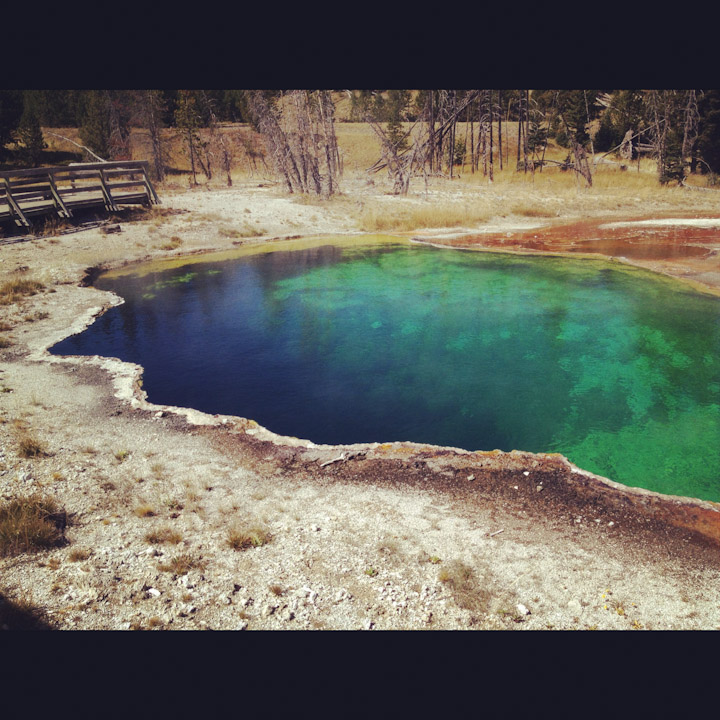
A hot spring at the West Thumb Basin (next to Yellowstone Lake):

At the West Thumb Basin.
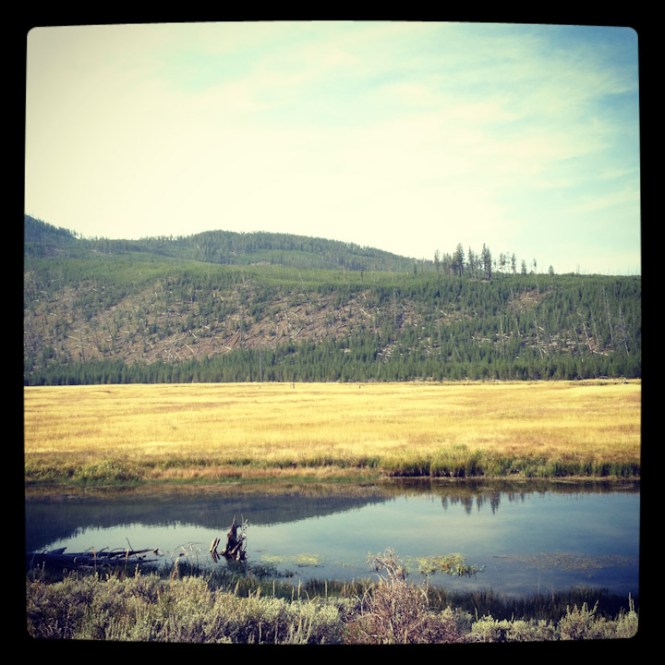
Fall colors at Yellowstone.

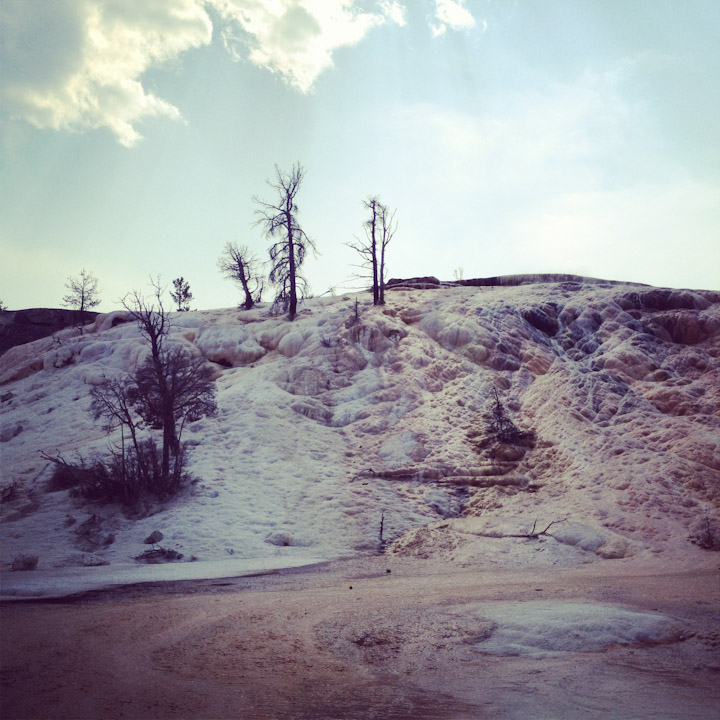
An out-of-this world scene at Mammoth Hot Springs (compare to this photograph):

Mammoth.

We spent a few days in West Yellowstone, Montana. Among other things, the town is famous for these decorated bison found on its streets. You can read more about this initiative here.

Buffalo statue at West Yellowstone, Montana.

Sunset in West Yellowstone, MT.

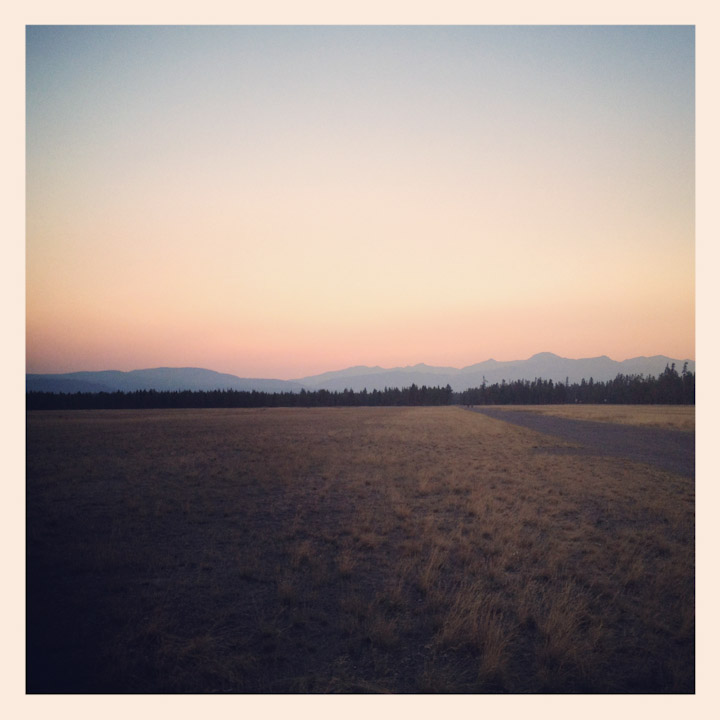
I took a late evening bike ride to the far edge of the city of West Yellowstone. I wound up on this rural road and saw an incredible sunset in the distance:
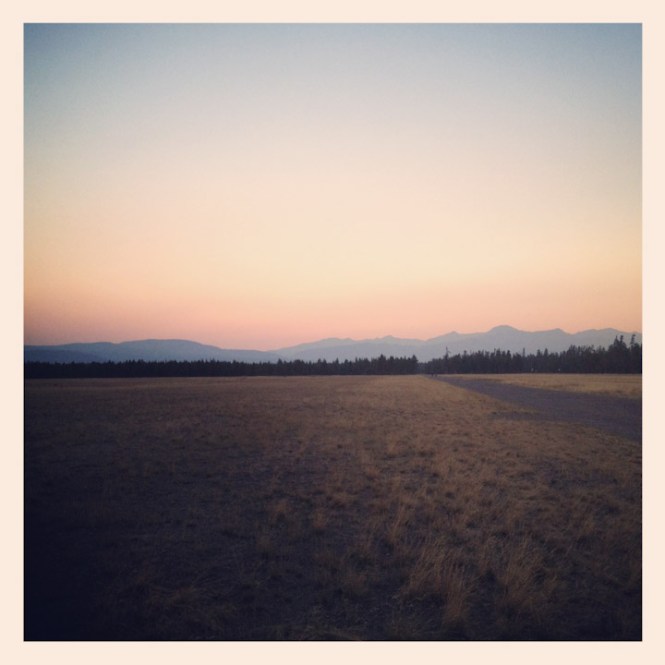
End of the road. Remains of the day.

On the way back from Yellowstone, we took a different road: I-90 in Montana to I-25. We stopped in historic Sheridan, WY:

Old railroad. Sheridan, WY.
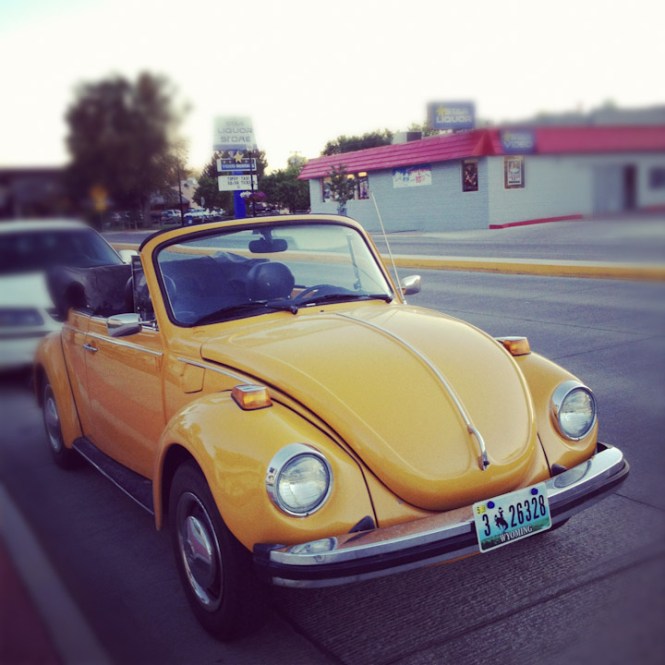
Exploring Sheridan, WY.

This was a peculiar sight. The word pharmacy spelled in Russian Polish on the back wall in Sheridan, WY:

Pharmacy.

And what would a trip to Wyoming be without a stop in one of its greatest store specializing in barbed wire?

The best store in all of Wyoming.

I have dozens of more mobile photos that I captured on this trip, but the significant ones I’ve profiled in this blog post. If you’re still curious to see more photos, I highly recommend checking out my Yellowstone Gallery and reading through the captions of each individual post. This was an amazing road trip, if my photos are any indication :).