
Wyoming and Yellowstone via Instagram

I just recently returned from a fifteen-day road trip out West. Along the way, I ate amazing barbecue food in Kansas City, saw the most gorgeous sunset in rural Kansas, crossed paths with celebrity mechanics in Colorado, and made way too many photography pit stops while getting to the ultimate destination, Yellowstone National Park (where we spent seven days). I have been slowly editing the images I have taken in and around the park with my primary cameras (Canon 7D and Canon 5D Mark II) as individual posts on my photoblog, Erudite Expressions; that Yellowstone gallery is now complete. Here, I wanted to highlight some of the mobile photographs I captured during this trip, most of which were taken with Instagram on my iPhone.
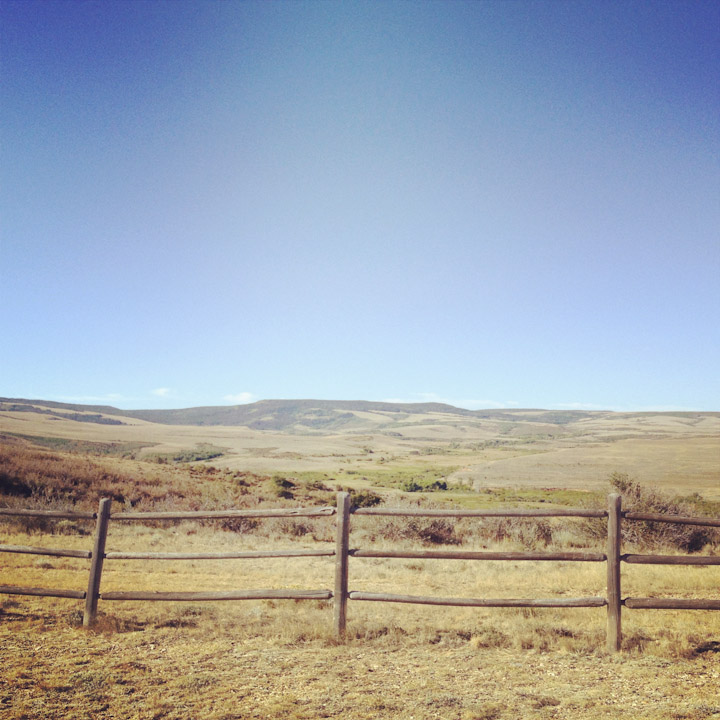
Stopping in rural Wyoming

Stopping in Rural Wyoming.

One of the most fruitful stops was this unassuming place called Cowboy Cafe in the town of Dubois, WY. Don’t let the tiny size fool you: the food here is spectacular. We met a group of people inside who said they’ve been coming to Dubois for fifteen years, and for every year they come, they have their breakfast, lunch, and dinner here. The TripAdvisor reviews aren’t wrong here. This hole-in-the-wall is a must when stopping in Dubois (or perhaps even making a special visit out of your trip if you’re in the Jackson Hole/Grand Teton area). The pies here, made daily, are to die for.

Cowboy Cafe

Cowboy Cafe in Dubois, WY.

A horse farm in Dubois, WY.

Tire tracking in Dubois, WY.
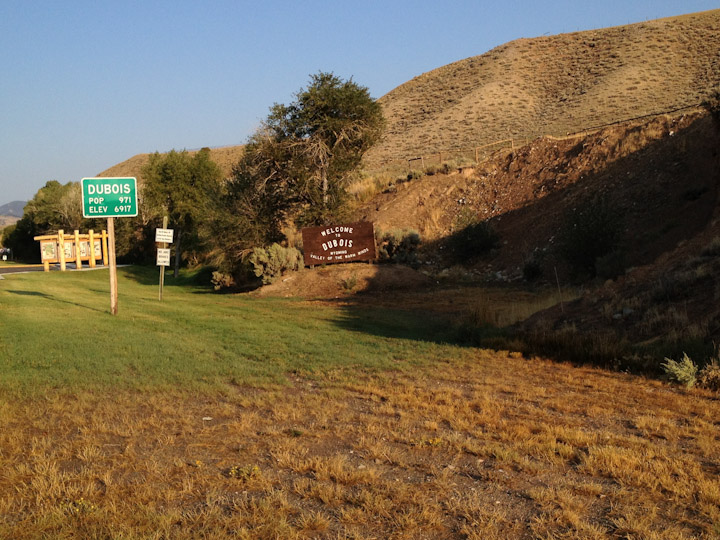
Population: less than 1,000. Amazing small town atmosphere.

Perhaps a better view of this scene on my photoblog, but…

The Tetons.

Fall approaching in Yellowstone National Park.

Crystal clear lake.

The most popular feature of Yellowstone National Park (also presented here in long exposure form)

The world-famous Old Faithful geyser.

Because of the wind gusts, it was a not-so-uncommon occurrence with people losing their hats at the park. Here, I document a white hat lost in the Grand Prismatic Spring area. Compare to the photo of “The Red Hat” lost at Mammoth.

The Lost Hat.

A hot spring at the West Thumb Basin (next to Yellowstone Lake):

At the West Thumb Basin.

Fall colors at Yellowstone.

An out-of-this world scene at Mammoth Hot Springs (compare to this photograph):
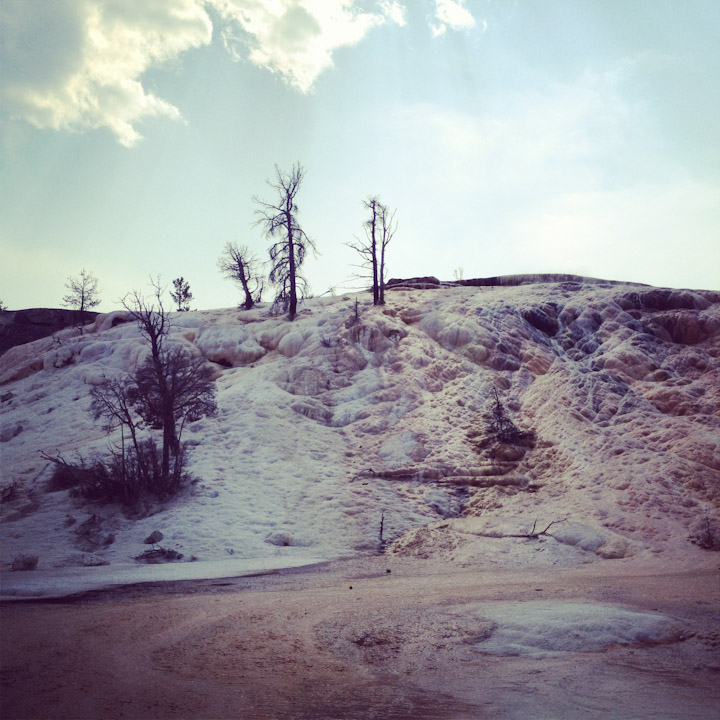
Mammoth.

We spent a few days in West Yellowstone, Montana. Among other things, the town is famous for these decorated bison found on its streets. You can read more about this initiative here.

Buffalo statue at West Yellowstone, Montana.

Sunset in West Yellowstone, MT.

I took a late evening bike ride to the far edge of the city of West Yellowstone. I wound up on this rural road and saw an incredible sunset in the distance:

End of the road. Remains of the day.

On the way back from Yellowstone, we took a different road: I-90 in Montana to I-25. We stopped in historic Sheridan, WY:

Old railroad. Sheridan, WY.
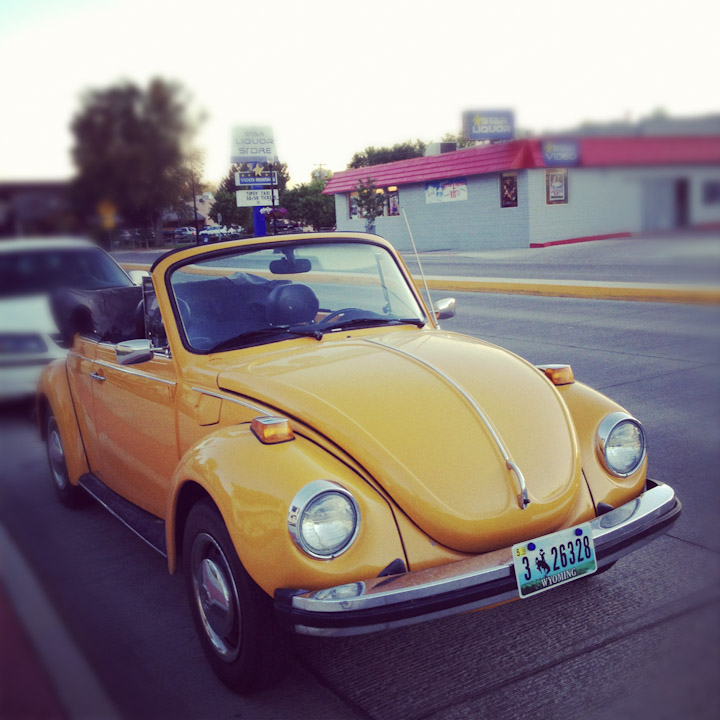
Exploring Sheridan, WY.

This was a peculiar sight. The word pharmacy spelled in Russian Polish on the back wall in Sheridan, WY:
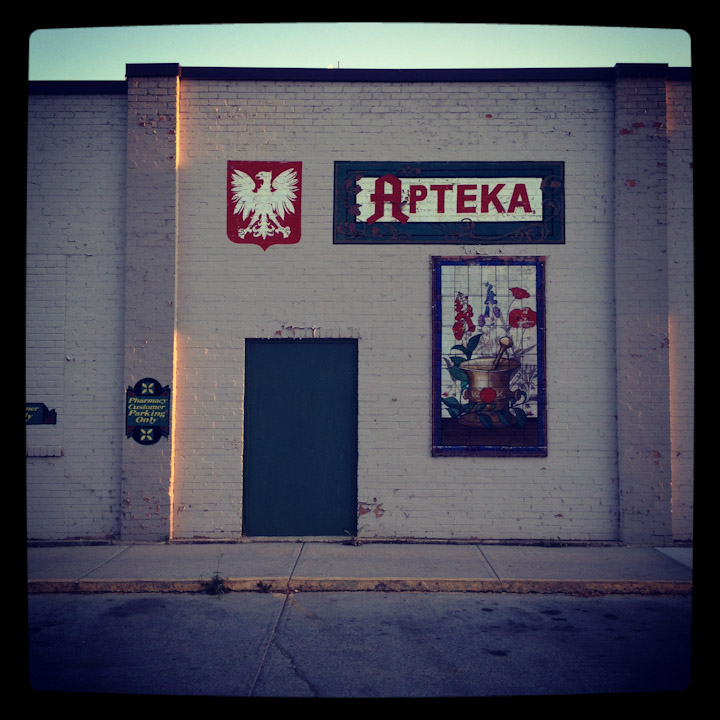
Pharmacy.

And what would a trip to Wyoming be without a stop in one of its greatest store specializing in barbed wire?

The best store in all of Wyoming.

I have dozens of more mobile photos that I captured on this trip, but the significant ones I’ve profiled in this blog post. If you’re still curious to see more photos, I highly recommend checking out my Yellowstone Gallery and reading through the captions of each individual post. This was an amazing road trip, if my photos are any indication :).

The Winners of the 2012 MacArthur Genius Grant

A solid list with which to get familiar: this year’s winners of the MacArthur genius grant. I must admit that I’ve heard of only two people on this year’s list: David Finkel (writer at The Washington Post) and Junot Díaz, whose poignant novel The Brief Wondrous Life of Oscar Wao I read earlier this year. On to the list:

— Natalia Almada, 37, Mexico City. Documentary filmmaker who captures complex and nuanced views of Mexican history, politics and culture.

— Uta Barth, 54, Los Angeles. Conceptual photographer who explores the nature of vision and the difference between seen reality and how a camera records it.

— Claire Chase, 34, Brooklyn, N.Y. Arts entrepreneur who engages audiences in the appreciation of contemporary classical music and opens new avenues of artistic expression through her International Contemporary Ensemble.

— Raj Chetty, 33, Cambridge, Mass. Economist at Harvard University who studies how policy decisions affect real-world behavior.

— Maria Chudnovsky, 35, New York. Mathematician at Columbia University whose work is deepening the connections between graph theory and other major branches of mathematics, such as linear programming and geometry.

— Eric Coleman, 47, Denver. Geriatrician at University of Colorado School of Medicine who is improving health care by focusing on patient transitions from hospitals to homes and care facilities.

— Junot Díaz, 43, Cambridge, Mass. Fiction writer at MIT who uses raw, vernacular dialogue and spare, unsentimental prose to draw readers into the various and distinct worlds that immigrants must straddle.

— David Finkel, 56, Washington, D.C. Washington Post journalist whose long-form newswriting has transformed readers’ understanding of military service and sacrifice.

— Olivier Guyon, 36, Tucson, Ariz. Optical physicist and astronomer at University of Arizona who designs telescopes and other astronomical instrumentation that play a critical role in the search for Earth-like planets outside this solar system.

— Elissa Hallem, 34, Los Angeles. Neurobiologist at University of California, Los Angeles, who explores the physiology and behavioral consequences of odor detection in invertebrates and identifies interventions that may eventually reduce the scourge of parasitic infections in humans.

— An-My Le, 52, Annandale-on-Hudson, N.Y. Photographer at Bard College who approaches the subjects of war and landscape from new perspectives to create images rich with layers of meaning.

— Sarkis Mazmanian, 39, Pasadena. Medical microbiologist at the California Institute of Technology who studies the role intestinal bacteria may play in a broad range of human diseases.

— Dinaw Mengestu, 34, Washington, D.C. Writer whose novels and nonfiction pieces enrich understanding of the little-explored world of the African diaspora in America.

— Maurice Lim Miller, 66, Oakland. Social services innovator who designs projects that reward and track self-sufficiency among residents of low-income neighborhoods in Oakland, San Francisco and Boston.

— Dylan C. Penningroth, 41, Evanston, Ill. Historian at Northwestern University who is unearthing evidence from scattered archives to shed light on shifting concepts of property ownership and kinship among African American slaves and their descendants.

— Terry Plank, 48, New York. Geochemist at Columbia University who probes the usually invisible but remarkably powerful thermal and chemical forces deep below the Earth’s crust that drive the motion of tectonic plate collisions.

— Laura Poitras, 48, New York. Documentary filmmaker revealing the consequences of military conflict abroad in documentaries that portray the lives and intimate experiences of families and communities largely inaccessible to the American media.

— Nancy Rabalais, 62, Chauvin, La. Marine ecologist at the Louisiana Universities Marine Consortium who documents the environmental and economic consequences of dead zones in the Gulf of Mexico.

— Benoit Rolland, 58, Boston. Stringed-instrument bow maker who experiments with new designs and materials to create violin, viola and cello bows that rival prized 19th century bows and meet the artistic demands of today’s musicians.

— Daniel Spielman, 42, New Haven, Conn. Computer scientist at Yale University who connects theoretical and applied computing to resolve issues in code optimization theory with real-world implications.

— Melody Swartz, 43, Lausanne, Switzerland. Bioengineer who enhances understanding of the dynamic processes of tissue vascularization and immune responses to tumor invasion using concepts and methods from biophysics, cell culture, molecular genetics, engineering and immunology.

— Chris Thile, 31, New York. Mandolinist and composer who is creating a new musical aesthetic and a distinctly American canon for the mandolin through a lyrical fusion of traditional bluegrass orchestrations with a range of styles and genres.

— Benjamin Warf, 54, Boston. Pediatric neurosurgeon at Children’s Hospital of Boston who is revolutionizing treatment of hydrocephalus and other intra-cranial diseases in young children and advancing standards of and access to health care in both the developed and poorest regions of the world.

“Be So Good They Can’t Ignore You”

In a 2007 episode of the Charlie Rose show, Rose was interviewing the actor and comedian Steve Martin about his memoir Born Standing Up. They talked about the realities of Martin’s rise. In the last five minutes of the interview, Rose asks Martin his advice for aspiring performers. Steve Martin said:

Nobody ever takes note of [my advice], because it’s not the answer they wanted to hear. What they want to hear is ‘Here’s how you get an agent, here’s how you write a script,’ . . . but I always say, ‘Be so good they can’t ignore you.’ 

Cal Newport has a great piece in Lifehacker today in which we get a sample of his recently released book, So Good They Can’t Ignore You. When you’re done reading the excerpt, check out my post summarizing Cal Newport’s speech on career advice at this year’s World Domination Summit.

Is the PC Over?

Jeff Atwood responds to MG Siegler’s post whose argument is that the PC is over:

I have an iPhone 5, and I can personally attest that it is crazy faster than the old iPhone 4 I upgraded from. Once you add in 4G, LTE, and 5 GHz WiFi support, it’s so fast that – except for the obvious size limitations of a smaller screen – I find myself not even caring that much if I get the “mobile” version of websites any more. Even before the speed, I noticed the dramatically improved display. AnandTech says that if the iPhone 5 display was a desktop monitor, it would be the best one they had ever tested. Our phones are now so damn fast and capable as personal computers that I’m starting to wonder why I don’t just use the thing I always have in my pocket as my “laptop”, plugging it into a keyboard and display as necessary.

So maybe MG Siegler is right. The PC is over … at least in the form that we knew it. We no longer need giant honking laptop and desktop form factors for computers any more than we need entire rooms and floors of a building to house mainframes and minicomputers.

They’re both right and wrong. Yes, we can do sophisticated tasks on our phones, and yes, my iPhone and iPad have become technologies which I use for browsing photos, sending email, checking out blogs. But the desktop remains the core for something that I can’t do on an iPad or iPhone: photo editing. Even as mobile versions of Photoshop and other photo software products exist, they pale in comparison to being able to edit images on the big screen (I have a 27 inch iMac). I am still waiting for the retina display iMac, one that will allow me to see the 5,616 × 3,744 resolution images coming from my Canon 5D Mark II without downsizing. I believe we’ll be there in one to two years.

Gary Shteyngart Hates American Airlines

A very short op-ed in The New York Times by Gary Shteyngart titled “A Trans-Atlantic Trip Turns Kafkaesque”:

The aircraft was indeed an interesting one. One of the overhead baggage compartments was held together with masking tape. Halfway across the Atlantic you decided to turn Flight 121 back because your altimeter wasn’t working. Some of us were worried for our safety, but your employees mostly shrugged as if to say, Ah, there goes that altimeter again.

And so you took us to Merrie England for a spell.

At Heathrow, fire trucks met us because we landed “heavy,” i.e., still full of fuel we never got to spend over the Atlantic. At the terminal, a woman in a spiffy red American Airlines blazer was sent to greet us. But the language she spoke — Martian — was not easily understood, versed as we were in Spanish, English, Russian and Urdu.

Is it ironic that the piece feels Kafkaesque? Honestly, I didn’t find it very convincing. Heathrow is the worst airport in the world? I thought that was absurd.

You should skip this op-ed and read Super Sad True Love Story instead. It’s actually one of the best books I’ve read this year.

Fractal Kitties: They Exist

Fun post at Scientific American explaining how fractal kitties can explain Julia sets:

Julia sets for polynomials of degree two are well-understood, although they’re often fractals rather than simple shapes such as circles. The story gets a lot more complicated as the degree increases because higher-degree polynomials are difficult to factor. (The much-maligned quadratic formula—the reason why we can easily discern the roots of degree two polynomials—is our friend!) A little bit is known about the possible shapes for Julia sets of degree 3 and 4 polynomials, but the shapes of the Julia sets of arbitrary polynomials are not yet understood.

Lindsey is a graduate student in mathematics at Cornell University. Her advisor is John Smillie, but Thurston was an unofficial second advisor, and it was his idea to start this research project. “I was sitting in his house, and he was staring off into space and asked, ‘I wonder if Julia sets can be made into shapes,’” she says. Thurston had been working on understanding the Mandelbrot set better, and looking at the shapes of Julia sets was a related pursuit. The Mandelbrot set, one of the most famous fractals, is closely related to Julia sets of degree two polynomials: imagine the polynomial z2+c, where c can be any complex number. The number c is in the Mandelbrot set if 0 is in the filled Julia set of z2+c.

Fractal Kitty!

The math may get hairy at times…but then again, so do the images. Ha!

Joe Biden, Server Extraordinaire

This is a hilarious parody in The New Yorker on Joe Biden becoming your dinner server:

Hey, chief. There’s the guy. How you doin’? Got your friends here, party of six. Lady in the hat. Great to see you. My name is Joe Biden and I’ll be your server tonight. Lemme tell you a story. (He pulls up a chair and sits.)

Folks, when I was six years old my dad came to me one night. My dad was a car guy. Hard worker, decent guy. Hadn’t had an easy life. He climbed the stairs to my room one night and he sat on the edge of my bed and he said to me, he said, “Champ, your mom worked hard on that dinner tonight. She worked hard on it. She literally worked on it for hours. And when you and your brothers told her you didn’t like it, you know what, Joey? That hurt her. It hurt.” And I felt (lowers voice to a husky whisper) ashamed. Because lemme tell you something. He was right. My dad was right. My mom worked hard on that dinner, and it was delicious. Almost as delicious as our Chicken Fontina Quesadilla with Garlicky Guacamole. That’s our special appetizer tonight. It’s the special. It’s the special. (His voice rising) And the chef worked hard on it, just like my mom, God love her, and if you believe in the chef’s values of hard work and creative spicing you should order it, although if you don’t like chicken we can substitute shrimp for a small upcharge.

Thank you. Thank you. Now, hold on. There’s something else you need to know.

Our fish special is halibut with a mango-avocado salsa and Yukon Gold potatoes, and it’s market-priced at sixteen-ninety-five. Sounds like a lot of money, right? Sounds like “Hey, Joe, that’s a piece of fish and a little topping there, and some potatoes.” “Bidaydas,” my great-grandmother from County Louth would have called ’em. You know what I’m talking about. Just simple, basic, sitting-around-the-kitchen-table-on-a-Tuesday-night food. Nothin’ fancy, right? But, folks, that’s not the whole story. If you believe that, you’re not . . . getting . . . the whole . . . story. Because lemme tell you about these Yukon Gold potatoes. These Yukon Gold potatoes are brushed with extra-virgin olive oil and hand-sprinkled with pink Himalayan sea salt, and then José, our prep guy. . . . Well. Lemme tell you about José. (He pauses, looks down, clears his throat.) 

You should finish the piece here. The ending cracked me up.

The Cats of St. Petersburg’s Hermitage Museum

Sally McGrane writes a wonderfully quirky piece on the cats of the Hermitage Museum, certainly the most famous museum in St. Petersburg and perhaps all of Russia (I visited it in 2007).

First, the obligatory history:

There have been cats in the palace since Peter the Great’s daughter, Empress Elizabeth, issued a decree, in 1745, that the biggest cats, capable of catching mice, be sent immediately from Kazan to the court of her imperial majesty. Catherine the Great is thought to have favored Russian Blues as indoor palace cats; under the last Czar, the royal family’s pet cats, who were left behind in the palace, fared better than the dogs, who were taken along to Yekaterinburg with the family to their deaths. During the three-year siege of Leningrad, all of the animals in the city died—except for the rats, said to have been so numerous as to form a gray, moving mass in the streets. When the blockade was lifted, Haltunen said, as we continued our walk beneath the museum, Russians sent their cats to the city to help fight the vermin.

On the variation of the cat names:

Stepping into the little cat hospital, a cozy, cluttered space that the oldest and sickest cats call home, Haltunen greeted Irina Popovetz, one of the volunteers who looks after the cats. Then she greeted Kusya (“Oh, this one has no tail!”), Jacqueline (“Look how fat we are!”), Sofiko (“You are very old!), and Assol, a tabby named for an impoverished literary heroine who waited at the seaside for a man sailing a ship with scarlet sails to come for her.

The cats aren’t allowed in the galleries, but that hasn’t stopped them from proliferating around the Museum:

The cats themselves, who are no longer afraid of people, have a positive effect on staff morale, she said. “People here become kinder, because they have the possibility to show this kindness,” said Haltunen, as we made our way back outside, where an orange cat was asleep in the sun beneath a classical statue. “It is very good when you have the possibility to show your best qualities.”

Earlier this year, Hermitage Museum even dedicated an entire day to the cats dubbed “Day of the Hermitage Cat.” Since April 21 fell on a Saturday, this must have been the ultimate Caturday of the year.

Do you know of any other examples where a public place is inhabited by animals, but the people not only accept it, but love it?

Parul Sehgal on the Power of Books and Reading Rapaciously

In honor of the National Book Festival last weekend, The Big Reads blog asked literary critic Parul Sehgal to reflect on the power of books in her life. An editor at The New York Times Book Review, Ms. Sehgal previously worked as the books editor at NPR.org, and as a senior editor at Publishers Weekly. It’s a short column, and these were two of my favorite quotes:

Some of us read rapaciously and with mysterious agendas of our own. And I’d hazard that the more we—or our communities—have been disenfranchised or humiliated, the harder we’ll read when we come to books. Because we’re not just reading, are we? We’re spying. We’re reading ourselves into societies and narratives that have excluded us. We’re trying to get inside your head.

Also, this:

We read first for distraction then consolation then for company. And finally to be worthy of the company we kept.

###

(hat tip: Andrew Sullivan)

World’s Biggest Ferris Wheel Coming to Staten Island

In three years, there will be a reason to visit Staten Island if you’re ever in New York City. By 2015, Staten Island will be home to the biggest Ferris Wheel in the world:

The New York Wheel will be a short walk from the Staten Island Ferry, which links the city’s least populous borough with Manhattan, Mayor Michael Bloomberg’s office said today in a news release. It will stand 625 feet (190 meters) high, exceeding by 84 feet the Singapore Flyer, according to city officials. It will also beat by 75 feet a planned wheel in Las Vegas.

BFC Partners, a Brooklyn-based developer, will construct Harbor Commons, a 350,000-square-foot retail complex featuring 100 designer outlets and a 120,000-square-foot hotel south of the ballpark, where an affiliate of the New York Yankees plays.

Interestingly, the designer and manufacturer of the New York Wheel includes members of the team that built the 443-foot London Eye observation wheel.

One thing I suspect, however: someone in Dubai will pour money to out-build this wheel before anyone gets to experience a ride on it.