The Positive Power of Negative Thinking

An interesting contrarian op-ed in The New York Times about the power of negative thinking:

Or take affirmations, those cheery slogans intended to lift the user’s mood by repeating them: “I am a lovable person!” “My life is filled with joy!” Psychologists at the University of Waterloo concluded that such statements make people with low self-esteem feel worse — not least because telling yourself you’re lovable is liable to provoke the grouchy internal counterargument that, really, you’re not.

Even goal setting, the ubiquitous motivational technique of managers everywhere, isn’t an undisputed boon. Fixating too vigorously on goals can distort an organization’s overall mission in a desperate effort to meet some overly narrow target, and research by several business-school professors suggests that employees consumed with goals are likelier to cut ethical corners.

Though much of this research is new, the essential insight isn’t. Ancient philosophers and spiritual teachers understood the need to balance the positive with the negative, optimism with pessimism, a striving for success and security with an openness to failure and uncertainty. The Stoics recommended “the premeditation of evils,” or deliberately visualizing the worst-case scenario. This tends to reduce anxiety about the future: when you soberly picture how badly things could go in reality, you usually conclude that you could cope. Besides, they noted, imagining that you might lose the relationships and possessions you currently enjoy increases your gratitude for having them now. Positive thinking, by contrast, always leans into the future, ignoring present pleasures.

The author of the op-ed, Oliver Burkeman, may simply be promoting his upcoming book, The Antidote: Happiness for People Who Can’t Stand Positive Thinking.
A Man Walks Into a Bank

Patrick Combs received a fake check in the mail for $95,093.35. As a joke, he went to his ATM and deposited it, thinking that it would bounce in a day or two. But it didn’t, as he describes in this great piece for The Financial Times:

But seven long days later the lottery-like amount was still there and I visited the bank where an employee told me that the funds were now all available for cash withdrawal. All $95,093.35 was mine for the taking. All I had to do was ask. Windfall money begs us to take it and run. But I restrained myself. And gave the bank another two excruciatingly long weeks to do their job, catch up with their mistake, and bounce the cheque. But at the end of three hellish weeks, during which I hourly resisted the urge to take the money and run to Mexico, where it would be worth twice as much, I was told by my branch manager, “You’re safe to start spending the money, Mr Combs. A cheque cannot bounce after 10 days. You’re protected by the law.”

So he decided to withdraw the money… What happened next was pretty interesting. The comments, however, disparage Mr. Combs:

Not funny. Mr. Coombs is a consumer ‘shoe bomber’. Because he could not restrain himself from doing something deliberately stupid, there will be endless paragraphs added to banking terms and conditions as the lawyers try to plan for every imaginable glitch in the use of atms. This kind of idiotic behaviour eventually makes life more tiresome for millions of others. Grow up.

You withdrew the money. A dishonest act. All business’s make mistakes. It would have been more amusing if you had notified them of your mistake first showing some honesty. The world can do without people like you. It moved into the area of appearing like attempted fraud on your part and not at all funny. How you bleat about them getting cross. You would have been calm of course if it had been your money?

What do you think Mr. Combs should have done? Is he deserving of the cash? Or was it a morally wrong thing to do?

Usain Bolt Repeats as 100 Meter Gold Medalist at the London Olympics

What a race in the men’s 100m final today at the London 2012 Olympics! I stayed away from Twitter and the Internet because I wanted to watch the race on NBC in primetime without seeing any spoilers. Usain Bolt did not disappoint and repeated as the 100m gold medalist from four years ago in Beijing. Here is Michael Wilbon on the historic race:

The race had everything except a world record, and that’s something Bolt simply doesn’t seem interested in at the moment. He still didn’t explode through the finish tape. He looked right, then left, to see who was on him. When the answer was “no one,” Bolt pulled up for a step. One step, when you consider his stride at 6-foot-5, is the difference between 9.63 and 9.53, which would have been a world record.

What seems to please him more than a world record is the drama he can create. Bolt could have come out and pronounced himself fit before the Games began, but didn’t. He probably could have beaten Blake if he’d wanted to, but why when you love the attention, perhaps even crave it? How many world-class athletes admit, as Bolt did Sunday night, to needing the crowd’s adoration before a race to take away the jitters? Having heard the ovation, bigger than what any British sprinter received all night, Bolt said to himself, “Game time!”

He had plantains, hash browns and fruit for breakfast, then chicken and rice, pork, “a chicken wrap from McDonald’s for lunch. … It had some vegetables, so don’t judge me,” he said.

You can hang on every utterance with Bolt, even when he says he might take on the 400 after these Olympics, because Bolt’s the biggest star in the Olympic universe. Michael Phelps is more decorated, but Phelps has no interest in entertaining, which is what stars do. Bolt doesn’t have to try, he just does it. He is, as Richard Pryor would have said, “a natural born star.” It requires nothing extra in his day. Bolt opens his mouth and a star comes out.

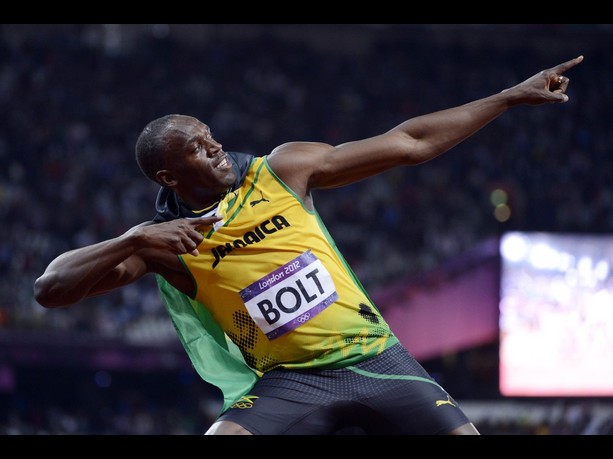
Bolt’s (in)famous celebration tonight:

Jamaica’s Usain Bolt celebrates his 100m gold medal at the London 2012 Olympic Games. Photo credit: Robert Deutsch, USA TODAY Sports.

Ding Zui: Substitute Criminals in China

In China, the rich and powerful can hire body doubles to do their prison time for them. Geoffrey Sant reports for Slate:

The practice of hiring “body doubles” or “stand-ins” is well-documented by official Chinese media. In 2009, a hospital president who caused a deadly traffic accident hired an employee’s father to “confess” and serve as his stand-in. A company chairman is currently charged with allegedly arranging criminal substitutes for the executives of two other companies. In another case, after hitting and killing a motorcyclist, a man driving without a license hired a substitute for roughly $8,000. The owner of a demolition company that illegally demolished a home earlier this year hired a destitute man, who made his living scavenging in the rubble of razed homes, and promised him $31 for each day the “body double” spent in jail. In China, the practice is so common that there is even a term for it: ding zui. Ding means “substitute,” and zui means “crime”; in other words, “substitute criminal.”

What’s more:

Incredibly, substitutes could be hired even for executions. Nineteenth-century traveler Julius Berncastle, the Qing Dynasty author De Fu, and the legal scholar John Bruce Norton each described substitute executions as regular events. This 1883 report from the Board of Punishments demanded an inquiry into how a youth named Wang Wen-shu “was wrongly convicted” and “was on the point of being executed as a substitute for one Hu T’ian, whose alias he was falsely declared to be.” T. T. Meadows, the British diplomat who convinced Western nations to copy China’s system of civil-service exams, argued that the phenomenon of substitute executions was not as surprising as it might seem. If a family is starving, wouldn’t many parents accept execution in exchange for enough money to save their children?

Some imperial Chinese officials who admitted to the use of substitute criminals justified its effectiveness. After all, the real criminal was punished by paying out the market value of his crime, while the stand-in’s punishment intimidated other criminals, keeping the overall crime rate low. In other words, a “cap-and-trade” policy for crime.

Pretty wild.

###

(hat tip: @SteveSilberman)

On Joy of Missing Out

After Caterina Fake wrote about the Fear of Missing Out (FOMO) last year, it became a wildly popular post with many in the blogosphere chiming in and lamenting on having the same fear. So it was quite refreshing to read Anil Dash’s antidote titled “JOMO!” (Joy of Missing Out). Anil posits:

So often, we point the finger at our technologies for creating the fears, the insecurities, the tensions that arise in our social lives as they get increasingly run by social software. But if tech is to blame for our feelings (and I’m not sure I want to concede that point), then certainly we can make apps and sites and software that makes us joyously celebrate for the good time that our friends and loved ones and even complete strangers are having when they go about living their lives.

I’ve been to amazing events. I still am fortunate enough to get to attend moments and celebrations that are an incredible privilege to witness. But increasingly, my default answer to invitations is “no”. No, I’m not going to go. And when well-intentioned hosts inevitably point out “You’re going to regret not coming!” I won’t say it out loud, but I’ll probably think, “No, I really won’t.”

A must-read post. I am not at Anil’s stage yet (I believe FOMO trumps JOMO for me), but I suspect myself and those around me will transition to the JOMO stage as we get older.

The Reach of Cosmopolitan Magazine

I’ve never read anything in Cosmpolitan Magazine, but I did appreciate Edith Zimmerman’s piece “99 Ways to Be Naughty in Kazakhstan” in The New York Times profiling the breadth and reach of the magazine:

The repetition can be a little numbing, but it may help explain how Cosmo, which is the best-selling monthly magazine in the United States, has morphed into such a global juggernaut. (“If all the Cosmo readers from around the world came together,” read a recent piece in Cosmo South Africa, “this group would form the 16th-largest country in the world.”) Through those 64 editions, the magazine now spreads wild sex stories to 100 million teens and young women (making it closer to the 12th-largest country, actually) in more than 100 nations — including quite a few where any discussion of sex is taboo. And plenty of others where reading a glossy magazine still carries cachet. (“Many girls consider a hard copy of Cosmo to be an important accessory,” says Maya Akisheva, the editor of Cosmo Kazakhstan.) As the brand proudly points out, in 2011 alone, these readers spent $1.4 billion on shoes, $400 million on cars, $2.5 billion on beauty products and $1.5 billion on fragrance and bought 24 million pairs of jeans.

Who knew Cosmo Kazakhstan was a thing?! Read the entire article here.

The World’s Highest-Paid DJs

Forbest has a “special report” on the world’s highest paid DJs. Dutch born DJ Tiesto tops the list with earnings of $22 million, who makes an average nightly gross of $250,000. Grammy-winning California native Skrillex ranks second with $15 million, followed by Scandinavian trio Swedish House Mafia, which recently disbanded despite pulling in an estimated $14 million. French DJ David Guetta claims the No. 4 spot with $13.5 million:

Though these Electronic Cash Kings hail from all over the globe, they’ve got at least one thing in common: they all make the bulk of their money by touring. Often toting nothing more than a USB stick and a pair of Pioneer CDJs, their production costs are often negligible, unlike rockers and pop stars who typically take home just one-third of gross ticket sales.

Our estimates include earnings from these live shows—for many artists, that often means more than $100,000 for a night’s work—and from recorded music sales, endorsements, merchandise sales and, in the case of DJ Pauly D, television…

The collective total for the top 10 DJs is more than $125 million, or greater than the payroll of the Los Angeles Lakers.

Racing Against History in the 100-Meter Freestyle

The New York Times has a really good interactive comparing the various milestones in the men’s 100-meter freestyle swim. Based on the athletes’ average speeds, if every Olympic medalist ever raced each other, France’s Alain Bernard (from the 2008 Olympic Games, with a time of 47.21 seconds) would win, with a wide distribution of Olympians behind him, including the 2012 London Olympics winner, Nathan Adrian, with a time of 47.52 seconds.

Other swimmers profiled in the interactive:

Alfréd Hajós: Hungary’s first Olympic gold medalist, Hajós swam in 55-degree open water, in the Bay of Zea outside Piraeus, Greece. He also won the 1,200-meter swim.

Johnny Weissmuller (United States): The first swimmer to break a minute in the Olympics. Later went on to play Tarzan in “Tarzan the Ape Man,” which made him internationally famous.

Mark Spitz (United States): Won seven gold medals in the 1972 Games in Munich; nearly withdrew from the 100-meter event because he wasn’t sure if he would win. (He did, setting a world record.)

Alexander Popov (Russia): One of only three athletes with three medals in this event; the first person in 68 years to win back-to-back golds after Weissmuller did it in 1928.

The two and a half minute video is worth seeing in entirety.

Comparing China and India in the Olympic Games

Tyler Cowen and Kevin Grier write a good Olympics piece titled “How to Boost Your Medal Count in Seven Easy Steps.” The predictions at the end of the piece are excellent, but the most interesting part to me was the reasoning of how China and India will perform in the (future) Olympic Games:

Will China and India, the two countries with populations over 1 billion, dominate the Olympics of the future, especially as they become wealthier?

To date, their Olympic performances are almost polar opposites. China has become an Olympic powerhouse while India has underperformed. From 1960 to 2000, China won 80 gold medals, while India won only two. Over those 11 Olympiads, India only won eight total medals while China won over 200. While China has grown faster and is richer than India, the difference in wealth can’t begin to account for the chasm between their Olympic results.

In their book Poor Economics, MIT economists Abhijit V. Banerjee and Esther Duflo attribute India’s dismal Olympic performance at least partly to very poor child nutrition. They document that rates of severe child malnutrition are much higher in India than in sub-Saharan Africa, even though most of sub-Saharan Africa is significantly poorer than India.

Even the significant segment of the Indian population that grows up healthy is at a disadvantage relative to China. The Chinese economic development model has focused on investment in infrastructure; things like massive airports, high-speed rail, hundreds of dams, and, yes, stadiums, world-class swimming pools, and high-tech athletic equipment. And while India is a boisterous democracy, China continues to be ruled by a Communist party, which still remembers the old Cold War days when athletic performance was a strong symbol of a country’s geopolitical clout.

We’re about a week into the 2012 Olympic Games. What’s your over/under for total medals for China and India?

Stocks Perform Better If Women Are On Company Boards

Heather Perlberg  for Bloomberg reports:

Shares of companies with a market capitalization of more than $10 billion and with women board members outperformed comparable businesses with all-male boards by 26 percent worldwide over a period of six years, according to a report by the Credit Suisse Research Institute, created in 2008 to analyze trends expected to affect global markets.

Net income growth for companies with women on their boards has averaged 14 percent over the past six years, compared with 10 percent for those with no female director, according to the Credit Suisse study, which examined all the companies in the MSCI ACWI Index.

The analysis doesn’t apply to IPOs, as evidenced by Facebook’s decline. Facebook appointed Chief Operating Officer Sheryl Sandberg as its first female director about a month after its May initial public offering; the stock is down nearly 50% since the $38 initial public offering in May.