The Anar Foundation Uses Lenticular Printing to Target a Message Only for Children

The ANAR Foundation is a Spanish organization which helps kids in risk of abuse. They Operate a unique phone number – 116 111 – where minors at risk can get aid and consultation.

Anar did a campaign advertising the number, but they faced a potential problem: they didn’t want adults (i.e., possible aggressors) to see that a kid was even looking at the ad.

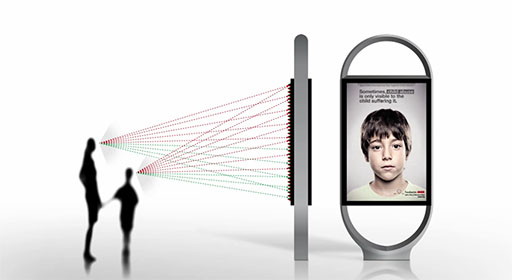
So they came up with a nifty solution. They used Lenticular printing on street signs. Lenticular printing is a technology in which Lenticular lenses (a technology that is also used for 3D displays) are used to produce printed images with an illusion of depth, or the ability to change or move as the image is viewed from different angles.

In this case, the image seen by an adult is innocuous, while the one seen by the average ten year old kid displays the phone number:

The ad appears different based on the height of the viewer.

The ad appears differently based on the height of the viewer.

anar-lenticular-06

The bloody lip, and the phone number, is visible only to kids in a height range typical for a ten year old.

In case this is confusing, watch the video that explains how lenticular imaging works:

Fascinating.

###

(via Creativity Online)

The People You Meet at McDonald’s

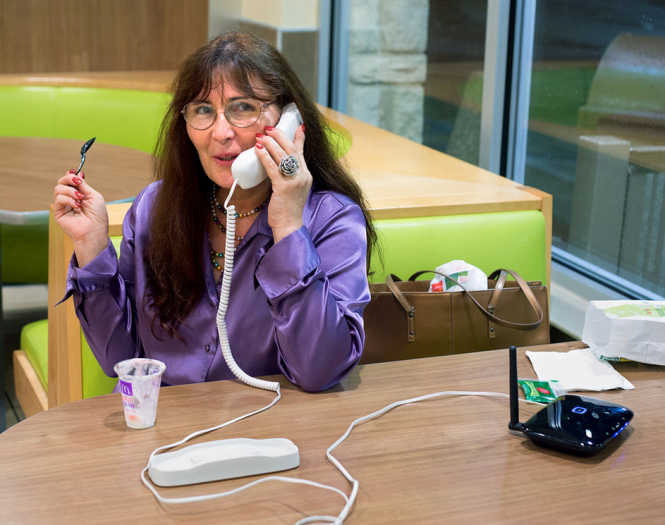
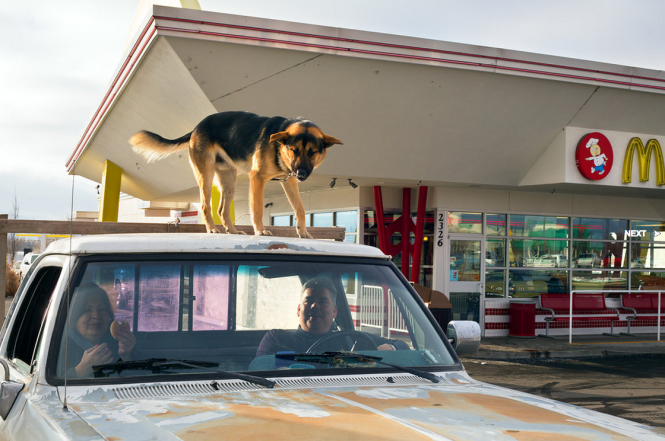
Vance Evans, a 66-year-old retiree from Bakersfield, California, “has been eating double cheeseburgers at McDonald’s since he flipped them himself as a teenager.” In a photo essay titled “The People You Meet at McDonald’s,” photographer Nolan Conway presents a menagerie of the people that visits the Golden Arches:

mcd6
mcd5
mcd4
mcd3 mcd2
mcd1

Mr. Conway has visited almost 150 McDonald’s restaurants in 22 states. See the entire gallery here.

I’m looking forward to seeing more of this series. Would be interesting to see project extend beyond the U.S. borders as well.


The Uner Tan Syndrome, or The Case of The Bear Walking Family

I’d never heard of the Uner Tan Syndrome before reading this article. It is named after a Turkish scientist who discovered a family who walk on all fours:

The subject of bear crawling hibernated for many decades until a couple of Turkish doctors, in 2004, made a discovery that was more science fiction than science. In a rural village, they happened upon a group of siblings who had never stood up. Members of a family with 19 children, all of whom bear-walked in their infancy, these five brothers and sisters had never lifted up off their hands. They had walked like bears all their life. The siblings actually wrist-walked, with their palms pressed flat against the ground. (Think of someone doing the downward-facing dog yoga pose while walking.) No one had ever seen an adult human move like this before.

The siblings were able to stand upright if they really concentrated on it, an early report on them noted, “but they become unsteady if they try to walk bipedally, and soon go down onto their hands.” They were quadrupeds. To help support the family, the lone male bear crawler ranged as far as a mile from home collecting cans and bottles. While bear-crawling, he was indefatigable. “This contrasts markedly with normal adult humans,” the report noted, “who find such a gait—if and when they try it—tiring and uncomfortable even after practice.”


I’d also never heard of the term “reverse evolution,” but that is the phrase that was used in this academic paper on the syndrome.

###

More: a documentary on the bear-walking family.

Marc Maron’s Quest for the Perfect Fitting Jeans

Marc Maron, author of Attempting Normalgoes on a quest to find the perfect fitting jeans. In the process, he receives an uncanny advice from a Levi’s store clerk:

So I went to the Levi’s store in San Francisco because I had heard that good jeans were back. That they were making them the way they used to. They may cost a lot more, but if you want some emotional time travel and believe that denim in its raw form can make you feel whole, it’s going to be worth the purchase of that two-legged vessel to a simpler time.

The clerk helping me was a chubby fellow with a handlebar mustache. I have no patience for contemporary handlebar mustaches. They anger me. They look indulgent and ridiculous. If you have a handlebar mustache, that is pretty much all you are. You are a delivery system for a handlebar mustache. I saw a guy in Brooklyn once with a handlebar mustache, pierced ears, a fedora hat and jodhpurs. He was a collage of sartorial attempts at evading himself. It looked as if he were interrupted during a shave in the mid-1850s and had to grab some clothes and dress quickly while being chased through a time tunnel.

Desperate and stupid are good descriptions when you get to the part of what he actually did to make the pants try to fit. Made me laugh.

Last of a Breed: Postal Workers Who Decipher Bad Handwriting

Have you ever wondered who deciphers the illegible handwriting on envelopes sent by the United States Post Office? I have. The New York Times profiles Melissa Stark, “the last of the breed”:

Ms. Stark is one of the Postal Service’s data conversion operators, a techie title for someone who deciphers unreadable addresses, and she is one of the last of a breed. In September, the post office will close one of its two remaining centers where workers try to read the scribble on envelopes and address labels that machines cannot. At one time, there were 55 plants around the country where addresses rejected by machines were guessed at by workers aided with special software to get the mail where it was intended.

Computers have made this job virtually obsolete, and yet:

But for now, this center operates 365 days a year, 24 hours a day. More than 700 workers stare at images of letters, packages, change-of-address cards and other mail, trying to figure out where they are supposed to go. It is not easy work. With software, a knowledge of geography and more than a little intuition, an operator has exactly 90 seconds to move each piece of mail.

Interesting.

A $75 Horse Bet Turns into a $1.5 Million Payoff

A cool story of Conor Murphy, a man who used to shovel manure for a living but got lucky with a bet, and now owns his own ranch:

Mr. Murphy, 29, knew his horses well. He was able to tell which ones were on their toes and which ones needed a little more care. He also knew his way around a betting window. On a hunch, he bet $75 on five of his favorites. It was the sort of desperate stab that only a man who loves horses would make.

Haruki Murakami on the Spirit of the Boston Marathon

If you’re as much a fan of Haruki Murakami as I am, then you know how much of an avid runner he is. He’s run more than two dozen marathons in his life. But the Boston Marathon is his favorite. Writing in The New Yorker, he reflects on the spirit of the Marathon with the April 2013 bombings in mind:

What’s great about marathons in general is the lack of competitiveness. For world-class runners, they can be an occasion of fierce rivalry, sure. But for a runner like me (and I imagine this is true for the vast majority of runners), an ordinary runner whose times are nothing special, a marathon is never a competition. You enter the race to enjoy the experience of running twenty-six miles, and you do enjoy it, as you go along. Then it starts to get a little painful, then it becomes seriously painful, and in the end it’s that pain that you start to enjoy. And part of the enjoyment is in sharing this tangled process with the runners around you. Try running twenty-six miles alone and you’ll have three, four, or five hours of sheer torture. I’ve done it before, and I hope never to repeat the experience. But running the same distance alongside other runners makes it feel less grueling. It’s tough physically, of course—how could it not be?—but there’s a feeling of solidarity and unity that carries you all the way to the finish line. If a marathon is a battle, it’s one you wage against yourself.

Running the Boston Marathon, when you turn the corner at Hereford Street onto Boylston, and see, at the end of that straight, broad road, the banner at Copley Square, the excitement and relief you experience are indescribable. You have made it on your own, but at the same time it was those around you who kept you going. The unpaid volunteers who took the day off to help out, the people lining the road to cheer you on, the runners in front of you, the runners behind. Without their encouragement and support, you might not have finished the race. As you take the final sprint down Boylston, all kinds of emotions rise up in your heart. You grimace with the strain, but you smile as well.

I love Murakami’s message on how to cope with the pain, and how to remember the victims of the Boston bombings:

For me, it’s through running, running every single day, that I grieve for those whose lives were lost and for those who were injured on Boylston Street. This is the only personal message I can send them. I know it’s not much, but I hope that my voice gets through. I hope, too, that the Boston Marathon will recover from its wounds, and that those twenty-six miles will again seem beautiful, natural, free.

Murakami’s What I Talk About When I Talk About Running is one of the best books I’ve read on the subject.
Data Science of the Facebook World

The ever insightful Stephen Wolfram has another graph-heavy post, this time compiling data on Facebook analytics:

More than a million people have now used our Wolfram|Alpha Personal Analytics for Facebook. And as part of our latest update, in addition to collecting some anonymized statistics, we launched a Data Donor program that allows people to contribute detailed data to us for research purposes.

A few weeks ago we decided to start analyzing all this data. And I have to say that if nothing else it’s been a terrific example of the power of Mathematica and the Wolfram Language for doing data science. (It’ll also be good fodder for the Data Science course I’m starting to create.)

We’d always planned to use the data we collect to enhance our Personal Analyticssystem. But I couldn’t resist also trying to do some basic science with it.

I’ve always been interested in people and the trajectories of their lives. But I’ve never been able to combine that with my interest in science. Until now. And it’s been quite a thrill over the past few weeks to see the results we’ve been able to get. Sometimes confirming impressions I’ve had; sometimes showing things I never would have guessed. And all along reminding me of phenomena I’ve studied scientifically in A New Kind of Science.

So what does the data look like? Here are the social networks of a few Data Donors—with clusters of friends given different colors. (Anyone can find their own network usingWolfram|Alpha—or the SocialMediaData function in Mathematica.)

It’s a pretty fascinating read.

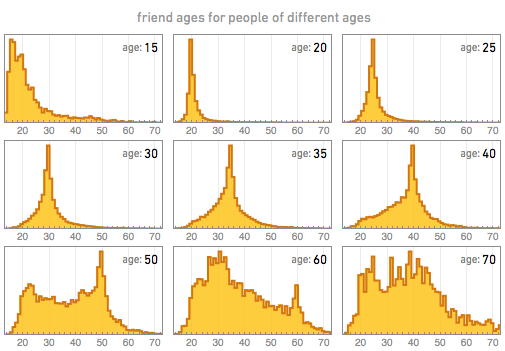
My favorite graph was this one of the distribution of  your Facebook friends’ age versus your age:

The age of your Facebook friends versus your age.

The age of your Facebook friends versus your age.

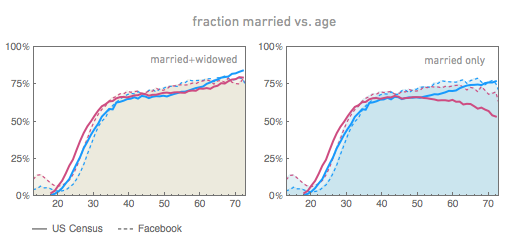
It’s also quite interesting how the marriage statistics from Facebook line up with the official Census data:

Facebook marriage age vs. Census data.

Facebook marriage age vs. Census data.

For a lot more analysis, read Stephen Wolfram’s entire post.

The Gmail of 2013 is Terrible

This is a very good post explaining what is wrong with the 2013 version of Gmail. Summary: I feel like Gmail went from being Photoshop to Draw Something.

1. I can’t easily delete my signatures. You know when you’re messaging back and forth with people, you sometimes strip out your email signatures to reduce clutter and make it more readable and less formal? Now you have to click on three tiny dots and then do it. And sometimes I forget because it’s hidden from view. This is crappy. It’s not user friendly.

2. I can’t easily change my email subject. Sometimes you’re replying or forwarding an email and you need to modify the subject. For example, you want to modify an email to send to someone else. It takes 3 clicks!! You first click on type of response. Edit subject. And then click into the subject. This is stupid.

Read the rest of the post here. The author’s conclusion:

You’re making something more basic and harder to use in favor of minimal design. This isn’t search. You can’t reduce a full-email platform down to a message box. If I wanted that, I’d use Facebook which supports email now.

For me, the new compose window is poorly designed. I just want to go back to the 2012 version of Gmail, you know?

Teens and Promposals

The New York Post leads: Teens are engaging in over-the-top prom proposals as a competitive sport — but have these public displays of popping the question gone too far?

At $100 a pop, the centerfield video board at Yankee Stadium has seen seven promposals so far this season.

Some students are even renting plane banners to pop the prom question, which can cost upward of $1,000 in the New York area.

“It started last year — I’ve been in the business six years, and we had never sold a prom banner before then,” says Remy Colin of Aerial Messages in Daytona Beach, Fla.

Finetuxedos.com, headquartered in White Plains, even launched its first annual “Best Promposal” contest this year (to help Sandy-affected students afford tuxes), after staffers noticed an unprecedented number of “prom proposal” queries in its search engine.

Yes, absolutely.