The Man Who Was Superman For One Day

Superman for a day.

Superman for a day.

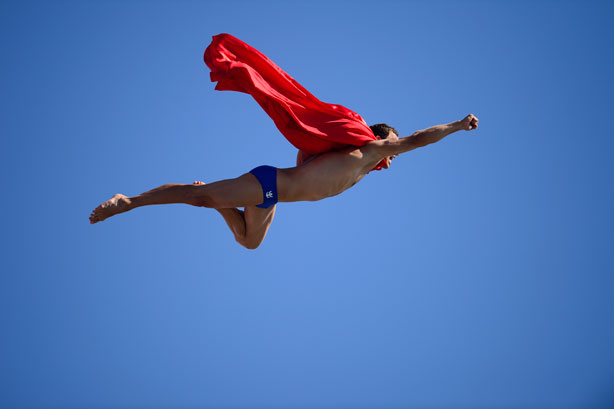
The above photo of Michal Navratil plummeting from a height of 27 meters (88.6 feet) at the High Diving World Championships in Barcelona in his Superman suit went viral a few days ago (I saw it on SportsCenter, for example). The 28-year-old Czech did an interview with Esquire about his lofty profession of cliff diver.

ESQUIRE:  How did you get started with cliff diving?  When did you do it for the first time?Michael Navratil: I started with my first twenty meter when I was 18 years old in the European Championships, in Switzerland, and there I did my first somersault from that height. Afterwards I kept progressing in height and quality of the diving, and five years later I went for the first competition from 28 meters, Marmeeting in Amalfi coast (Italy).

ESQUIRE:  How do you build up to such intense heights?  Is there a learning curve as you go higher and higher?

MN:  Definitely, your body needs to get used to the pressure of the impact progressively. Every meter that you go higher, the impact is stronger and harder, so I had to prepare myself physically and mentally. The higher you go, the more every meter makes a difference.

ESQUIRE:  Have you ever been hurt?

MN:  Yes a few times!  Five years ago I went to work on a show in China, and I was doing it three times a day. My mind was strong but my body was tired and in one of the high dives from 26 meters I twisted my ankle under water and for ten days I couldn’t step on it… But in two weeks I was diving again, landing head first for a while. Every impact is a lesson on how to protect yourself from the water. Another bad injury was learning to do a handstand from 15 meters, also in China. I was short on my landing and was coughing blood for a week! Still two days after this crash I dived from 20 meters and in another three days I went up to 26 meters, even though my body was injured I was learning a new competition dive and my mind was ready for it. Last bad injury was last year in Boston Red Bull Series stop, I tried a new dive ending in a blind entry three times, and I injured my lower back and my heels badly; I was in pain for the next three months and it really affected my results towards the end of the season.

Read the rest of the interview here.

Becoming Better Through Practice, Leading to Transformation

This post by @saulofhearts titled “I Was A Pretty Strange Kid: Or, How I Became An Expert in the Things That Scared Me” is timely for me. It’s about becoming better at things through practice, iteration, failing, and persevering. Here’s a passage on improving his dating skills:

Around that same time, I decided to get serious about my dating life. I’d grown up in a pretty repressed environment — thirteen years of Catholic school, a virtually non-existent dating life, and a family who never talked about sex, much less suggested I have it.

In college, I went straight into a long-term relationship. While my college friends were dating casually and having one-night stands, I was happily monogamous.

When my girlfriend and I broke up, I thought it would be just a matter of time before I ended up in another relationship. I’m not a virgin, right? I know what I’m doing….

What I didn’t realize was that my long-term monogamous relationship had covered up the fact that I was terrible with women.

I didn’t know how to ask a girl out, or meet someone new at a party.

So what did I do? I went on a billion dates. I set up an OK Cupid profile, sent out a bunch of messages, and arranged to have dinner with some of the girls that I clicked with.

I was scared as hell, terrible at making small talk — was it OK to mention Burning Man? weed? sex? — and most of the dates were awkward.

But over time, I got better. And I continued to challenge myself.

I went to workshops: tantric yoga, cuddle parties, an S&M club. I grewcomfortable talking about subjects that would have embarrassed my 10-year-old self.

This is the key takeaway that I need to repeat, repeat, repeat:

We’re not defined by the identity that we grew up with. We’re not defined by the expectations other people have of us.

It’s time to start becoming a better human.

A Brief History of the Children’s Food Menu

Michele Humes has an interesting post at Slate profiling the brief history of the kid’s menu at restaurants across America:

Depending on where you stand vis-à-vis childrearing, the golden age of youth dining in America either began or ended with the Volstead Act. ​In the century leading up to the dry laws, children rarely ate out. A child had to be relatively well-off in order to dine in public, and a guest at a hotel to boot. (Restaurants not attached to hotels didn’t tend to serve children, reasoning that they got in the way of boozy grown-up fun.) But the lucky boy or girl who could tick these boxes was assured of a pretty good time. When the English novelist Anthony Trollope toured the United States in 1861 (his two volumes of crotchety travelogue were later published as North America), he was astonished to see 5-year-old “embryo senators” who ordered dinner with sublime confidence and displayed “epicurean delight” at the fish course.

Prohibition spelled the end for 5-year-old epicures. Taking effect in January 1920, the dry laws forced the hospitality industry to rethink its policy on children: Could it be that this untapped market could help offset all that lost liquor revenue? The Waldorf-Astoria in New York thought so, and in 1921 it became one of the first establishments to beckon to children with a menu of their very own. But even as restaurants began to invite children in, it was with a new limitation: They could no longer eat what their parents ate.

The earliest children’s menus didn’t look so different from the playful ones we know today. The Waldorf-Astoria put Little Jack Horner on the cover of their pink-and-cream booklet; as he brandishes his plummy thumb, a dish runs away with a spoon. But then there was the food—the bland, practically monastic food, appearing all the more austere for the teddy bear picnic taking place overleaf. Here was flaked chicken over boiled rice; here were mixed green vegetables in butter; here was a splat of prune whip. And the one dish that appeared without exception—the chicken nugget of the Jazz Age—was a plain broiled lamb chop.

Read the rest here.

A Bookish Meditation

I love this short piece written by Gaby Gulo titled “Dear Reader.” In it, if I am interpreting correctly, she anthropomorphizes what’s it like for a book to be neglected, passed over, ignored:

I am a book. Not a poem on a single sheet, not a sheaf of notes, not a paperclipped pile of papers. I am a book.

I am a book with writing, still being written. I have been glanced at, passed over, picked up. I have been many books for many people.

I was the book you didn’t pick up. My cover was too tattered, the font old-fashioned. My hardbound pages were too thick for sand and salt. You picked a paperback instead.

I was the book you picked up but never opened. You saw me on a strange bookshelf, touched me on a whim. You thought my jacket interesting, but other things came along and you forgot I was interesting too, once.

I was the book you opened but never read. I was gifted to you, and you obliged the giver by hastily flipping through a few pages. My words were unfamiliar, my sentences complex. Politeness only goes so far.

I was the book you read partway. You stuck bits of paper, receipts, coffee-stained napkins in my pages to mark your place when you returned. You didn’t. You picked apart my paragraphs with close readings and left me smudged with pencil.

And then the transition, short but poignant, which hits directly in the gut:

Then you. You stroked my spine with curiosity, traced the letters of my title with callused fingers. You picked me up, opened me, read me slowly and carefully. You brushed away the bits of paper, rubbed out the smudges. You lingered over my lines and marked them only with your fingertips. My stories and stanzas were enough to keep you warm.

You carried me with your hands, fell asleep with me on your chest. To you, my rough-cut pages were perfect for turning, my worn cover comforting. You read me chapter by chapter, found shades of meaning in my white spaces. You savored the writing in my beginning and middle, appreciated the blank pages of my end.

Beautiful, poetic writing.

Brief Bits of Wisdom and Life Advice from Woody Allen

In the September issue of Esquire, Woody Allen, who will be 78 years old later this year, narrates some of the things he’s learned in his life. It’s a wonderful collection. Presented in almost in its entirety here:

What people who don’t write don’t understand is that they think you make up the line consciously — but you don’t. It proceeds from your unconscious. So it’s the same surprise to you when it emerges as it is to the audience when the comic says it. I don’t think of the joke and then say it. I say it and then realize what I’ve said. And I laugh at it, because I’m hearing it for the first time myself.

Without fear, you’d never survive.

My dad didn’t even teach me how to shave — I learned that from a cabdriver. But the biggest lesson he imparted is that if you don’t have your health, you have nothing. No matter how great things are going for you, if you have a toothache, if you have a sore throat, if you’re nauseated, or, God forbid, you have some serious thing wrong with you — everything is ruined.

Marshall McLuhan predicted books would become art objects at some point. He was right. [Editor’s note: see this.]

My mother taught me a value — rigid discipline. My father didn’t earn enough, and my mother took care of the money and the family, and she had no time for lightness. She always saw the glass a third full. She taught me to work and not to waste time.

I never see a frame of anything I’ve done after I’ve done it. I don’t even remember what’s in the films. And if I’m on the treadmill and I’m surfing the channels and suddenly Manhattan or some other picture comes on, I go right past it. If I saw Manhattan again, I would only see the worst. I would say: “Oh, God, this is so embarrassing. I could have done this. I should have done that.” So I spare myself.

In the shower, with the hot water coming down, you’ve left the real world behind, and very frequently things open up for you. It’s the change of venue, the unblocking the attempt to force the ideas that’s crippling you when you’re trying to write.

If you’re born with a gift, to behave like it’s an achievement is not right.

I love Mel Brooks. And I’ve had wonderful times working with him. But I don’t see any similarities between Mel and myself except, you know, we’re both short Jews. That’s where it ends. His style of humor is completely different. But Bob Hope? I’m practically a plagiarist.

We took a tour of the Acropolis late in the morning, and I looked down upon the theater and felt a connection. I mean, this is where Oedipus debuted. It’s amazing for someone who’s spent his life in show business or worked in dramatic art to look down at the theater where, thousands of years ago, guys like Mike Nichols and Stephen Sondheim and David Mamet were in togas, thinking,Gee, I can’t get this line to work. You know, I’ve been working on it all night. And that actor, he doesn’t know how to deliver it. Sophocles and Euripides and Aristophanes. The costumes are late, and we gotta go on!

It’s been said about marriage “You have to know how to fight.” And I think there’s some wisdom to that. People who live together get into arguments. When you’re younger, those arguments tend to escalate, or there’s not any wisdom that overrides the argument to keep in perspective. It tends to get out of hand. When you’re older, you realize, “Well, this argument will pass. We don’t agree, but this is not the end of the world.” Experience comes into play.

Back when I started, when I opened Take the Money and Run, the guys at United Artists accumulated the nation’s criticisms into a pile this big and I read them all. Texas, Oklahoma, California, New England… That’s when I realized that it’s ridiculous. I mean, the guy in Tulsa thinks the picture’s a masterpiece, and the guy in Vermont thinks it’s the dumbest thing he’s ever seen. Each guy writes intelligently. The whole thing was so pointless. So I abandoned ever, ever reading any criticisms again. Thanks to my mother, I haven’t wasted any time dwelling on whether I’m brilliant or a fool. It’s completely unprofitable to think about it.

You can only do so much, and then you’re at the mercy of fortune.

Me sitting down for dinner with Ingmar Bergman felt like a house painter sitting down with Picasso.

This last bit of wisdom is particularly eloquent and is a reminder of the fleeting nature of life:

It’s just an accident that we happen to be on earth, enjoying our silly little moments, distracting ourselves as often as possible so we don’t have to really face up to the fact that, you know, we’re just temporary people with a very short time in a universe that will eventually be completely gone. And everything that you value, whether it’s Shakespeare, Beethoven, da Vinci, or whatever, will be gone. The earth will be gone. The sun will be gone. There’ll be nothing. The best you can do to get through life is distraction. Love works as a distraction. And work works as a distraction. You can distract yourself a billion different ways. But the key is to distract yourself.

The Mystery of Nick Beef, Revealed

For the history buffs and those versed in the John F. Kennedy association, The New York Times has a pithy but fascinating piece on the grave site next to Lee Harvey Oswald. The marker simply reads NICK BEEF. It actually belongs to a man named Patric Abedin, who bought the plot of land for $175.

Affable, with gray-black hair slicked back, save for a stray curl or two, he sips tea at a cozy table at the Jack bistro in Greenwich Village, not far from his Manhattan apartment. With evident pride in possessing one of the more distinctive conversation starters in American discourse, he confirms that he owns the burial plot beside Lee Harvey Oswald’s.

As for his notoriety among the conspiracy cognoscenti, he says, he came by it innocently, even accidentally. But now, with the 50th anniversary of the Kennedy assassination less than four months away, he has decided to reveal himself, sort of, to The New York Times.


And one more paragraph of interest:

It was said that since the cemetery refuses to provide directions to Oswald’s grave — at the family’s request, a spokeswoman for the cemetery said — two reporters had bought the plot so that the curious could ask instead for Nick Beef. It was also said that Nick Beef was a New York stand-up comic who used references to the grave in his act.

Amazing story. And what a downer at the end, huh?

A Craigslist Missed Connection for the Ages

This is one of the best Craigslist missed connections I’ve ever read. It starts out rather ordinarily: on the Q train headed into Manhattan. But if you keep on reading, it’s like a love’s labor lost, sixty years in the making (or losing, depending on your perspective). Presented in its entirety:

I saw you on the Manhattan-bound Brooklyn Q train. 

I was wearing a blue-striped t-shirt and a pair of maroon pants. You were wearing a vintage red skirt and a smart white blouse. We both wore glasses. I guess we still do.

You got on at DeKalb and sat across from me and we made eye contact, briefly. I fell in love with you a little bit, in that stupid way where you completely make up a fictional version of the person you’re looking at and fall in love with that person. But still I think there was something there.

Several times we looked at each other and then looked away. I tried to think of something to say to you — maybe pretend I didn’t know where I was going and ask you for directions or say something nice about your boot-shaped earrings, or just say, “Hot day.” It all seemed so stupid.

At one point, I caught you staring at me and you immediately averted your eyes. You pulled a book out of your bag and started reading it — a biography of Lyndon Johnson — but I noticed you never once turned a page.

My stop was Union Square, but at Union Square I decided to stay on, rationalizing that I could just as easily transfer to the 7 at 42nd Street, but then I didn’t get off at 42nd Street either. You must have missed your stop as well, because when we got all the way to the end of the line at Ditmars, we both just sat there in the car, waiting.

I cocked my head at you inquisitively. You shrugged and held up your book as if that was the reason.

Still I said nothing.

We took the train all the way back down — down through Astoria, across the East River, weaving through midtown, from Times Square to Herald Square to Union Square, under SoHo and Chinatown, up across the bridge back into Brooklyn, past Barclays and Prospect Park, past Flatbush and Midwood and Sheepshead Bay, all the way to Coney Island. And when we got to Coney Island, I knew I had to say something.

Still I said nothing.

And so we went back up.

Up and down the Q line, over and over. We caught the rush hour crowds and then saw them thin out again. We watched the sun set over Manhattan as we crossed the East River. I gave myself deadlines: I’ll talk to her before Newkirk; I’ll talk to her before Canal. Still I remained silent.

For months we sat on the train saying nothing to each other. We survived on bags of skittles sold to us by kids raising money for their basketball teams. We must have heard a million mariachi bands, had our faces nearly kicked in by a hundred thousand break dancers. I gave money to the beggars until I ran out of singles. When the train went above ground I’d get text messages and voicemails (“Where are you? What happened? Are you okay?”) until my phone ran out of battery.

I’ll talk to her before daybreak; I’ll talk to her before Tuesday. The longer I waited, the harder it got. What could I possibly say to you now, now that we’ve passed this same station for the hundredth time? Maybe if I could go back to the first time the Q switched over to the local R line for the weekend, I could have said, “Well, this is inconvenient,” but I couldn’t very well say it now, could I? I would kick myself for days after every time you sneezed — why hadn’t I said “Bless You”? That tiny gesture could have been enough to pivot us into a conversation, but here in stupid silence still we sat.

There were nights when we were the only two souls in the car, perhaps even on the whole train, and even then I felt self-conscious about bothering you. She’s reading her book, I thought, she doesn’t want to talk to me. Still, there were moments when I felt a connection. Someone would shout something crazy about Jesus and we’d immediately look at each other to register our reactions. A couple of teenagers would exit, holding hands, and we’d both think: Young Love.

For sixty years, we sat in that car, just barely pretending not to notice each other. I got to know you so well, if only peripherally. I memorized the folds of your body, the contours of your face, the patterns of your breath. I saw you cry once after you’d glanced at a neighbor’s newspaper. I wondered if you were crying about something specific, or just the general passage of time, so unnoticeable until suddenly noticeable. I wanted to comfort you, wrap my arms around you, assure you I knew everything would be fine, but it felt too familiar; I stayed glued to my seat.

One day, in the middle of the afternoon, you stood up as the train pulled into Queensboro Plaza. It was difficult for you, this simple task of standing up, you hadn’t done it in sixty years. Holding onto the rails, you managed to get yourself to the door. You hesitated briefly there, perhaps waiting for me to say something, giving me one last chance to stop you, but rather than spit out a lifetime of suppressed almost-conversations I said nothing, and I watched you slip out between the closing sliding doors.

It took me a few more stops before I realized you were really gone. I kept waiting for you to reenter the subway car, sit down next to me, rest your head on my shoulder. Nothing would be said. Nothing would need to be said.

When the train returned to Queensboro Plaza, I craned my neck as we entered the station. Perhaps you were there, on the platform, still waiting. Perhaps I would see you, smiling and bright, your long gray hair waving in the wind from the oncoming train.

But no, you were gone. And I realized most likely I would never see you again. And I thought about how amazing it is that you can know somebody for sixty years and yet still not really know that person at all.

I stayed on the train until it got to Union Square, at which point I got off and transferred to the L.

Spectacular. I wonder if the author of this masterpiece will come forward and get a book deal or something.
On Reading, Forgetting, and Re-Reading

Editor’s note: this post was originally published on Medium.

fleeting

###

A couple of months ago, while I was in line waiting to get a Caffè Americano at my local coffee shop, the barista inquired about my reading habits. I noted my favorite science fiction novels:Slaughterhouse-Five and Brave New World. The barista then asked me about Fahrenheit 451, which I read early in my youth. “The ending was amazing, wasn’t it?” she inquired. At this point, a mild shock came over me, my cheeks reddened, and I muttered “Yeah, definitely.” The truth is: I’ve read the novel, but have forgotten almost the entire plot—ending included.

Ian Crouch, writing in a recent piece in The New Yorker, likened reading and forgetting with the following anecdote:

This forgetting has serious consequences—but it has superficial ones as well, mostly having to do with vanity. It has led, at times, to a discomfiting situation, call it the Cocktail Party Trap (though this suggests that I go to many cocktail parties, which is itself a fib). Someone mentions a book with some cachet that I’ve read—a lesser-known work of a celebrated writer, say Eliot’s “Daniel Deronda,” to take an example from my shelf—and I smile knowingly, and maybe add, “It’s wonderful,” or some such thing. Great so far, I’m part of the in-crowd—and not lying; I did read it. But then there’s a moment of terror: What if the person summons up a question or comment with any kind of specificity at all? Basically, what if she aims to do anything other than merely brag about having read “Daniel Deronda”?

My very brief encounter at the coffee shop still didn’t sway my mind on re-reading. Yes, I felt embarrassed about the episode, but the embarrassment did not deter my pride (re-reading is silly!). But about a month ago, things started to unravel. It began with my friend Steven’s suggestion to read John Steinbeck’s classic, East of Eden. I’ve long considered this novel to be in my top five books I’ve ever read: for the story, for the writing, for the allegory. I distinctly remember, how one summer before my junior year of high school, I spent four days, non-stop, engrossed in the novel (I’m a slow reader, I admit). But after Steven suggested reading the novel, I replied in the most glowing way possible: “A sublime selection. For anyone deliberating on whether to read this magnum opus: do it, and you will be better for it.”

And yet. I didn’t re-read East of Eden.

It was only during the discussion of the novel that someone by the name of Blake struck me as extremely profound. “Eugene, the first time you read East of Eden was in your teenage years. That was half a lifetime ago. Think about that.” And Blake is right. When put in that context, so much has transpired in my life over the past fifteen years, that I’ve had an epiphany: re-reading should be a pleasure in its own right. I shouldn’t feel guilt in re-reading; on the contrary, I should take comfort and joy in rediscovering a book which enlightened me so much in the past.

Ian Crouch notes:

If we are cursed to forget much of what we read, there are still charms in the moments of reading a particular book in a particular place. What I remember most about Malamud’s short-story collection “The Magic Barrel” is the warm sunlight in the coffee shop on the consecutive Friday mornings I read it before high school. That is missing the more important points, but it is something. Reading has many facets, one of which might be the rather indescribable, and naturally fleeting, mix of thought and emotion and sensory manipulations that happen in the moment and then fade.

I recollect not only when I read East of Eden, but how: in my room, in the downstairs basement curled up with a warm blanket, outside on the patio with butterflies floating in the distance. It is perhaps more wonderful to remember the sensory associations with reading than the plot.

And so, when 1984 was announced as the next book we were going to read in book club, I wasn’t going to make any excuses: I was going to re-read this novel. And I am glad I did. There were so many specifics from the novel which I didn’t remember that it felt like reading the novel for the first time.

My obstinate attitude on re-reading took more than ten years to come around. If you currently rationalize re-reading like I used to, I encourage you to consider re-reading not only as a remedy to forgetting, but as a profoundly new, joyous experience.


Brunete, Spain: A Lesson for Dog Owners Who Don’t Clean up After Their Pets

This is a great story of how one town in Spain, just outside of Madrid, chose to deal with dog owners who don’t clean up after their dogs: send the poop to the guilty owner’s doorsteps in unmarked packages. The idea began with the mayor, who called it a “direct marketing” effort:

After nearly two years in office, he said, he had visited with some 220 citizens in their homes, and the subject of dog owners was the one constant complaint. As spring approached this year, when children started going to the parks again, he decided to try what many here are calling “direct marketing.”

The dog owners got their packages — white boxes bearing the seal of this town and labeled “lost and found” — within hours.

Signing for the curious parcels, they must have been intrigued, though surely unsuspecting.

So far, the boxes seem to be extremely effective compared with Brunete’s earlier campaign, which involved a remote control specimen (very lifelike) that was used around town to get people’s attention. It followed. It banged into shoes. And it generally drew laughs. There was some improvement in behavior. But it did not last long.

And as far as how effective the campaign has been?

Delivering 147 boxes of the real stuff seems to have produced a far more lasting effect in this town of about 10,000 residents. The mayor guesses a 70 percent improvement even now, several months after the two-week campaign.

The sting operation worked because dogs are registered in this city:

The sting operation worked like this: Volunteers were instructed to watch for negligent dog owners and then to approach their dogs to pet them. After a few flattering remarks about the beauty of said dog, they asked what breed it was. Then they asked the dog’s name.

Back at city hall, where more than 500 residents have their pets registered, that was enough information to get to an address.

So this is a case of private shaming, but it seems to have worked in this town. I wonder if it could work in a city like New York.

On Selling and Storytelling

What is the one of the most important elements in selling a particular commodity? Sure, usefulness/practicality matters. But what’s even more important is the story behind the product. The emotional connection that people make to stories cannot be discounted. Ty Montague reminds us of this narrative in The Harvard Business Review:

Back in the summer of 2006, New York Times Magazine columnist Rob Walker was mulling the question of what makes one object more valuable than another. What makes one pair of shoes more valuable than another pair if they both deliver on the functional basics of comfort, durability, and protection? Why does one piece of art cost $8,000,000 and another, $100? What makes one toasterworth $20 and another worth nearly $400 if they both make toast? As Walker turned these questions over in his mind he concluded that it is not the objects themselves, but the context, the provenance of the objects, that generates value. In other words, the value isn’t contained in the objects themselves, but in the story or the meaning that the objects represent to the owner.

Walker decided to test this conclusion in a simple and direct way. With the help of a friend, he began buying random, worthless, or low-value objects at tag sales and thrift shops. The cost of the objects ranged from one to four dollars. An old wooden mallet. A lost hotel room key. A plastic banana. These were true castoffs with little or no intrinsic worth.

Next, Walker asked some unknown writers to each write a short story that contained one of the objects. The stories weren’t about the objects, per se; but they helped to place them in a human context, to give them new meaning.

When Walker put the objects, along with their accompanying stories, up for sale on eBay, the results were astonishing. On average, the value of the objects rose 2,700%. That’s not a typo: 2,700%. A miniature jar of mayonnaise he had purchased for less than a dollar sold for $51.00. A cracked ceramic horse head purchased for $1.29 sold for $46.00. The value of these formerly abandoned or forsaken objects suddenly and mysteriously skyrocketed when they were accompanied by a story.

You can see the results of that fascinating project here. It is time that we all learn to tell better stories.