Karen Cheng Learns to Dance in One Year

Karen Cheng didn’t know how to dance but was willing to learn. In this post on her website, she describes the process she went through to become a dancer in one year:

People who watch me dance today sometimes assume I’ve been dancing for many years. I made this video so you could see the awkward body that started just one year ago.

Here’s my secret: I practiced everywhere. At bus stops. In line at the grocery store. At work — Using the mouse with my right hand and practicing drills with my left hand. You don’t have to train hardcore for years to become a dancer. But you must be willing to practice and you better be hungry.

This isn’t a story about dancing, though. It’s about having a dream and not knowing how to get there — but starting anyway. Maybe you’re a musician dreaming of writing an original song. You’re an entrepreneur dying to start your first venture. You’re an athlete but you just haven’t left the chair yet.

When you watch someone perform, you’re seeing them at the top of their game. When they score the winning point or sell their company for millions — you’re seeing them in their moment of glory. What you don’t see is the thousands of hours of preparation. You don’t see the self doubt, the lost sleep, the lonely nights spent working. You don’t see the moment they started. The moment they were just like you, wondering how they could ever be good.

The incredible transformation in the quality of her dancing may be seen in this time lapse video:


I think this is a solid testament that while practice may not make you perfect, it will make you very good at something.

World Domination Summit 2013: The Blog Posts

This past weekend, I attended the third annual World Domination Summit. I am still processing my thoughts, compiling notes, and thinking how I am going to blog about such a big event. In the meantime, however, I thought I’d highlight some of the posts by other conference attendees that resonated with me:

1) Todd Henry’s “It was Beautiful”:

The beauty of WDS isn’t the programming, or the venue (which was amazing), or the “networking” like at most conferences. The beauty is that there are several thousand people all gathered in one place, centered on one ideal. The encouragement could be scooped out of the air with a spoon and swallowed whole. Not “Oh – great! You should go do your thing, and best of luck (because honestly, you’ll need it since you’re about to fall flat on your face!)” encouragement, but the kind that is real, trustworthy, and rooted in deep experience. One of the speakers, Tess Vigeland, shared her story of leaving her “dream job” as host of Marketplace Money to start over, and was honest enough to say that it was difficult, painful, and uncertain. Not the kind of fare you typically get at conferences where the goal is polish rather than gut-level realism.

2) Matt Fangman’s recap of World Domination Summit 2013 (there’s also this great lede: “When people would ask me what WDS was about, I really couldn’t tell them”):

I’ve been to conferences about technology, creativity and community before. Why was this one different? I think it’s simple. Faith. If it’s possible to boil WDS down to one word, it is faith.

Faith in ourselves—That we can and should live a life of meaning and take the risks necessary to walk that path.

Faith in each other—That we can connect with others on their own journey and share and encourage each other along the way.

Faith in the world—That it’s open and receptive to our dreams and not quite as scary as we think it is.

3) “To Those Who Believe” by Joseph Peterson, who attended WDS2013 because his kind friend Anna bought a ticket in his name at the end of WDS2012:

Now I’m reeling from my own WDS weekend, trying to process everything I experienced in Portland. And with the clarity of being on this end of the experience, I see the spark of inspiration Anna saw. She was someone who was in a position to make a difference in the life of someone she believed in, and luckily, she was the kind of person to act on it. Last weekend it felt like I just met 3,000 more of ‘that kind’ of person, and I can gratefully say I am the better for it.

4) Andy Traub’s recap was excellent, and these two points I found most salient:

Diversity is required
When there is no diversity there is no beauty. I spoke with a yoga instructor for an hour about marriage, parenting and faith. I spoke with a man and his life partner about their restaurant winning new restaurant of the year and how they were paying their workers a livable wage and giving full benefits. I struggled to understand a man through his heavy accent as he told his story of wanting to see his poetry published. I love a blue sky but a rainbow beats it every time. (Tweet This) The diversity of experiences, perspectives and origins created a beautiful community. If we are all the same there’s not much to talk about.

There is beauty in weakness and unfulfilled dreams
Some of the speakers were midstream. Their story was not finished. They were in the gray. They were figuring it out. I liked those speakers the most. They were so human, vulnerable and honest. They were so brave to share their struggles with us. We are drawn to one another through our weaknesses much more than our strengths.

5) Rebecca Beaton’s “How To Dominate the World.” I met Rebecca at the tail end of WDS (after-after party), and I like what she has to say about building a tribe:

I had never been in a group of people before where I felt such immediate, deep, genuine connections; and I do not doubt that the difference here was that the majority of people at this conference were living lives of self-expression, passion, purpose, meaning, creativity, adventure & freedom. The amount of self-love and self-acceptance that comes with living your life in this way leads to genuine openness and less judgement towards others.

6) Jackie Lea Shelley shares a post titled “How to Change a Life” where a number of things come together beginning with the inaugural WDS in 2011 for an intimate friendship with authors Joshua Fields Millburn and Ryan Nicodemus (The Minimalists):

That is the pure truth. Had it not been for @julien‘s tweet, had it not been for @jfm‘s essay, had it not been for @chrisguillebeau deciding to hold the World’s Best Conference, had it not been for @AJLeon and @melissaleon and the Misfits, I would not be the @jackinessity that sits here today, chronicling the journey.

The truth is, Joshua and Ryan didn’t just change my life. They also saved it.

7) One of my favorite stories from last year’s World Domination Summit was Rami’s $100 bet (as profiled in this post). After I read his post, I knew he would be successful in getting his book published within a year. I also knew that had he achieved his goal, he would be on stage at #WDS2013 to claim his $100 prize. And he did just that. This year, Rami’s got another amazing story to tell, to the tune of recruiting some 20 people to write books of their own!

So it looks like by WDS2014, if everyone follows through, there will be 20 more finished books in this world. I’ve never been more proud of my fellow human beings, at taking on such an incredible challenge.

Seriously. It’s going to be a wild ride. I really hope they all win the bets they’ve placed with me. I may end up owing a lot of people some money, but man will it be worth it.

8) One of the most inspiring moments from World Domination Summit was a performance by Steve  Schalchlin, a musician who’s discovered music while as a way of coping with a diagnosis of HIV. When an experimental drug worked for him, he called music his savior. Writing in a blog humbly titled Living in the Bonus Round, he shares his thoughts about World Domination Summit in two posts:

I went to the website, hoping it wasn’t some weird religious thing. (It wasn’t). Well, then, what exactly was it? There were videos and they resembled the TED Talks. Motivational and inspirational speakers talking about self-empowerment, etc. Okay, I like that.
 
Even more, no commercial sponsors. No corporate donors logos allowed. Double really? He turns down money? In fact, there was a video from last year. A donor insisted on giving him money, anonymously, and rather than keep it, he gave each of the 1000 attendees an envelope with $100 in it. What? He gave away $100,000 that he could have kept for himself?
 
Who IS this guy? 
 
I also checked another page: “If you are a manager or agent or a performer and you would like to submit for an appearance, the answer is we don’t take submissions. We will find you.”
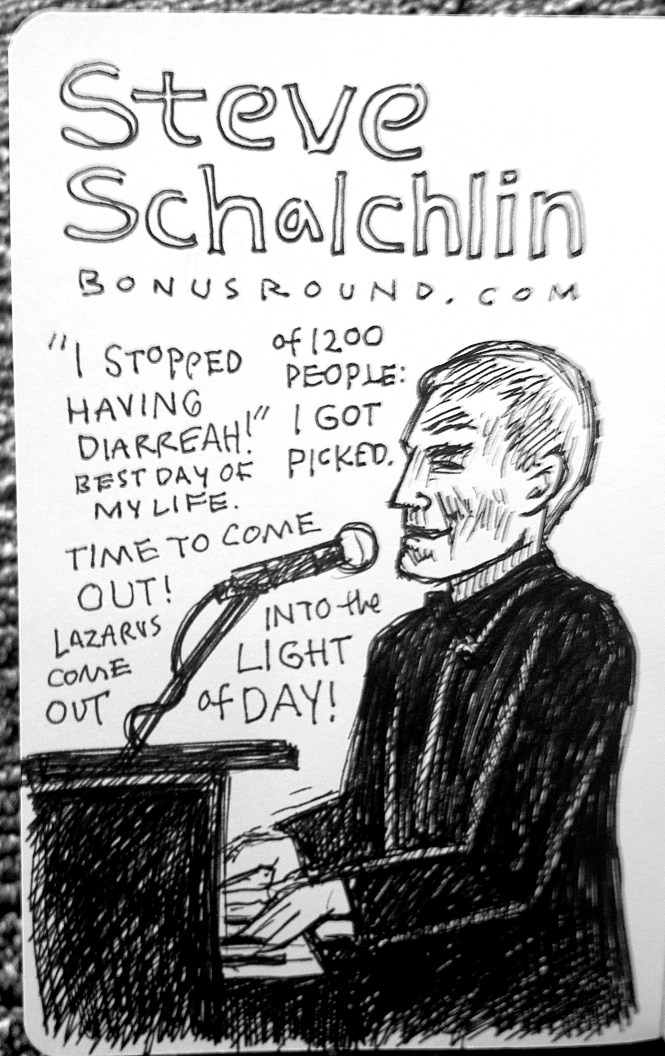
Sketch courtesy of @rohdesign.

Sketch courtesy of @rohdesign.

Steve’s performance at WDS was raw, emotional, and beautiful. One of the songs he performed was “Somebody’s Friend,” and it resonated with me deeply. The video from WDS isn’t available yet, but here he is on stage in NYC a week prior, singing this very song.

9) Sarah K. Peck’s excellent post likens WDS not to the college experience, but to an extended family. Her post is well worth the read:

The college metaphor, however, doesn’t quite fit. Because, more than college, the community at WDS is like a family to me. New faces approached me nervously, wondering how they were going to meet everyone and do it all. “You’re not,” I told newcomers, “It’s improbable that you’ll meet all 3,000 people.” But there are so many wonderful souls with “yes” attitudes that meeting a handful of them – five, ten, fifteen – and staying in touch with them over the years is the perfect thing to do at a conference like this. Start a few conversations. Connect with people and tell them you story. Share a lunch. Compare notes on the speakers. Talk about what you’re working on (or struggling with, or proud of). Say hi in person to someone you’ve been listening to online.

For those of you who came for the first time, over the next year I bet you’ll find the magic keeps happening. It doesn’t necessarily happen in the form of a job opening that falls in your email inbox the next day (although perhaps that might happen!)—but sparks start. Seeds are planted. A few months later, as you’re working through more of your world domination plans (or quiet, far-less-glamorous plans to stock your savings or launch a product), you’ll remember someone you met or recall a piece of advice or a story that will hit you and make you smile. You’ll email a friend you met and say, shyly, “Hey, can I bother you to ask a question?” And then you’ll notice that things start happening a little quicker. A little more urgently. With joy.

And then there’s this bit of wisdom: that it’s okay to have a day job, even if the majority of the people you meet at WDS appear to have blazed a path of their own:

Not everyone quits their job. I think this is really important to say. Sometimes WDS feels like a club for job-quitters, and it’s not always the right time for you or the right thing for you to do. Your life is not everyone else’s life. Sometimes it seems so hard to watch everyone quitting their jobs or starting their dreams and you wonder, “when is it going to be my turn?” Something that’s often overlooked in the shiny-internet-spaces is how long it can take to build an idea, a project, a community, a following, or a dream. There can be a distinct separation of time between knowing what you want to do and putting it to reality. It is not a bad thing to be practical and pragmatic (keeping your day job to pay the bills for a while can actually be a smart move, for example)–up to a point.

I’ve been following Sarah’s blog for over a year, and like me, she’s one of the folks who’s come to every WDS since 2011. The conference this year was six times as big as the one in 2011, but I made it a goal to find Sarah and give her a hug at the conference after her incredible effort to raise more than $30,000 for Charity:Water. And she did it!

10)

###

Note: this post will be updated a few more times until I profile between five and ten blog posts.

Desert Bus: The Worst Video Game Ever Created

I’d never heard of Desert Bus before, so I read with fascination this piece in The New Yorker touting it as the worst game ever created. It is remarkable how the game was able to pivot many years after its release and become a major fundraiser for Child’s Play, a charity that donates video games and consoles to children’s wards in hospitals around the world

The drive from Tucson, Arizona, to Las Vegas, Nevada, takes approximately eight hours when travelling in a vehicle whose top speed is forty-five miles per hour. In Desert Bus, an unreleased video game from 1995 conceived by the American illusionists and entertainers Penn Jillette and Teller, players must complete that journey in real time. Finishing a single leg of the trip requires considerable stamina and concentration in the face of arch boredom: the vehicle constantly lists to the right, so players cannot take their hands off the virtual wheel; swerving from the road will cause the bus’s engine to stall, forcing the player to be towed back to the beginning. The game cannot be paused. The bus carries no virtual passengers to add human interest, and there is no traffic to negotiate. The only scenery is the odd sand-pocked rock or road sign. Players earn a single point for each eight-hour trip completed between the two cities, making a Desert Bus high score perhaps the most costly in gaming.

Fascinating and worth reading in entirety.

The Purpose of Nostalgia

A nice New York Times piece summarizing the purpose of nostalgia:

Most people report experiencing nostalgia at least once a week, and nearly half experience it three or four times a week. These reported bouts are often touched off by negative events and feelings of loneliness, but people say the “nostalgizing” — researchers distinguish it from reminiscing — helps them feel better.

To test these effects in the laboratory, researchers at Southampton induced negative moods by having people read about a deadly disaster and take a personality test that supposedly revealed them to be exceptionally lonely. Sure enough, the people depressed about the disaster victims or worried about being lonely became more likely to wax nostalgic. And the strategy worked: They subsequently felt less depressed and less lonely.

Nostalgic stories aren’t simple exercises in cheeriness, though. The memories aren’t all happy, and even the joys are mixed with a wistful sense of loss. But on the whole, the positive elements greatly outnumber the negative elements, as the Southampton researchers found by methodically analyzing stories collected in the laboratory as well as in a magazine named Nostalgia.

I’ll forever associate nostalgia with this Mad Men bit on “The Carousel”:

Adrift: A Love Letter to the San Francisco Fog

Almost three years since Simon Christen released “The Unseen Sea” (still one of my favourite timelapse videos), he now unveils his most recent project, Adrift. It is a visual love letter to the fog of San Francisco.

In his own words, Simon writes:

“Adrift” is a love letter to the fog of the San Francisco Bay Area. I chased it for over two years to capture the magical interaction between the soft mist, the ridges of the California coast and the iconic Golden Gate Bridge. This is where “Adrift” was born.

The weather conditions have to be just right for the fog to glide over the hills and under the bridge. I developed a system for trying to guess when to make the drive out to shoot, which involved checking the weather forecast, satellite images and webcams multiple times a day. For about 2 years, if the weather looked promising, I would set my alarm to 5am, recheck the webcams, and then set off on the 45-minute drive to the Marin Headlands.

I spent many mornings hiking in the dark to only find that the fog was too high, too low, or already gone by the time I got there. Luckily, once in a while the conditions would be perfect and I was able to capture something really special. Adrift is a collection of my favorite shots from these excursions into the ridges of the Marin Headlands.

Stunning.

###

(hat tip: @Colossal)

Sonkers, Grunts, Slumps, and Crumbles

I had no idea that there were so many variations of pie in the United States until I read this interesting New York Times piece:

A big, deep, soupy mess of warm fruit or soft sweet potato, the sonker was made to feed everyone who happened to be working at the farm on any given summer day. Like the many other players in the loose-knit team of dishes based on cooked fruit and bread, it began as a way to stretch fruit that was perhaps past its glory or make use of economical fillings like wild blackberries.

A big pan of sonker was easy to haul to the church supper or the event in the South known as the “covered dish.” It is less fussy than a traditional round pie, and easier to serve to a crowd.

At this point, the astute reader is probably thinking this sounds like a cobbler with a funny name. But what is a cobbler, really? Is it the freewheeling cousin of the crisp? The Southern answer to the thrifty New England brown Betty? A pan dowdy with integrity? A pie for lazy people?

If you are looking for clarity, I apologize. Unlike a classic pie, which everyone can pretty much agree on, the broader category of baked fruit desserts like cobblers and crisps is at once specific and general. These dishes are so regional that people within the same county will disagree on the proper form, but so accessible and varied in interpretation that no one has a lock. A proper cobbler (or a crisp or a Betty or a sonker) is what you grew up eating.

I’ll take a side of cobbler, sonker down, crumbling my way to food heaven, please.

###

Related: Wikipedia’s list of pies, tarts, and flans.

“Marriage is Not a Political Act; It’s a Human One.”

A beautiful, must-read reflection from Andrew Sullivan following today’s Supreme Court decisions on marriage equality:

Marriage is not a political act; it’s a human one. It is based on love, before it is rooted in law. Same-sex marriages have always existed because the human heart has always existed in complicated, beautiful and strange ways. But to have them recognized by the wider community, protected from vengeful relatives, preserved in times of illness and death, and elevated as a responsible, adult and equal contribution to our common good is a huge moment in human consciousness. It has happened elsewhere. But here in America, the debate was the most profound, lengthy and impassioned. This country’s democratic institutions made this a tough road but thereby also gave us the chance and time to persuade the country, which we did. I understand and respect those who in good conscience fought this tooth and nail. I am saddened by how many failed to see past elaborate, ancient codes of conduct toward the ultimate good of equal human dignity…


The Most Intellectual Jokes Reddit Knows

This is a great thread on Reddit: the best intellectual jokes the members of the site know.

Here are three of my favorites:

1) It’s hard to explain puns to kleptomaniacs because they always take things literally.

The response is equally awesome: “I don’t get it but I’m stealing this one.” 

2) Q: What does the “B” in Benoit B. Mandelbrot stand for?

A: Benoit B. Mandelbrot.

3) Two chemists walk into a bar. The first says, “Can I have a glass of H2O.”

The second chemist says “Can I have a glass of water too.”

The first chemist broke down in tears – his assassination attempt had failed.

I also enjoyed the counterresponse to this joke:

A photon checks into a hotel and the bellhop asks him if he has any luggage. The Photon replies “No I’m traveling light”. One redditor’s response: “

I object to this on the grounds that photons experience no time within their own reference frame and therefore could not possibly respond. The best they could do is give a wave.”

Lots more nerdery here.

###

(hat tip: @legalnomads

Google Brain Teasers Useless for Hiring

This is an interesting interview with Laszlo Bock, senior VP of operations at Google, and the disclosure of some hiring findings at the company.

This is a revelation, and I would bet it is similar across various industries:

Years ago, we did a study to determine whether anyone at Google is particularly good at hiring. We looked at tens of thousands of interviews, and everyone who had done the interviews and what they scored the candidate, and how that person ultimately performed in their job. We found zero relationship. It’s a complete random mess, except for one guy who was highly predictive because he only interviewed people for a very specialized area, where he happened to be the world’s leading expert.

And finally, an admission that those brain teasers are useless in hiring!

A. On the hiring side, we found that brainteasers are a complete waste of time. How many golf balls can you fit into an airplane? How many gas stations in Manhattan? A complete waste of time. They don’t predict anything. They serve primarily to make the interviewer feel smart.

On Coffee and Creativity

I’ve been drinking one to two cups of coffee in the mornings over the last few months. But as Maria Konnikova explains, I shouldn’t expect the caffeine to boost my creativity:

When we drink a caffeinated beverage, the caffeine quickly crosses the blood-brain barrier—an interface of sorts between the brain and the body’s circulatory system, designed to protect the central nervous system from chemicals in the blood that might harm it—and proceeds to block the activity of a substance called adenosine. Normally, a central function of adenosine is to inhibit the release of various chemicals into the brain, lowering energy levels and promoting sleep, among other regulatory bodily functions. When it’s blocked, we’re less likely to fall asleep on our desks or feel our focus drifting. According to a recent review of some hundred studies, caffeine has a number of distinct benefits. Chief among them are that it boosts energy and decreases fatigue; enhances physical, cognitive, and motor performance; and aids short-term memory, problem solving, decision making, and concentration.

But all of that comes at a cost. Science is only beginning to unravel the full complexity behind different forms of creative accomplishment; creativity is notoriously difficult to study in a laboratory setting, and the choice of one approach over another limits the way that creativity can be measured. Still, we do know that much of what we associate with creativity—whether writing a sonnet or a mathematical proof—has to do with the ability to link ideas, entities, and concepts in novel ways. This ability depends in part on the very thing that caffeine seeks to prevent: a wandering, unfocussed mind.

Bummer!