Apple and the Law of Large Numbers

This is a good but flawed New York Times piece which reflects on Apple’s staggering growth. This week, Apple stock hit a record high of $526 per share. The bulk of the piece focuses on the so-called Law of Large Numbers in assessing Apple’s growth:

Apple is so big, it’s running up against the law of large numbers.

Also known as the golden theorem, with a proof attributed to the 17th-century Swiss mathematician Jacob Bernoulli, the law states that a variable will revert to a mean over a large sample of results. In the case of the largest companies, it suggests that high earnings growth and a rapid rise in share price will slow as those companies grow ever larger.

If Apple’s share price grew even 20 percent a year for the next decade, which is far below its current blistering pace, its $500 billion market capitalization would be more than $3 trillion by 2022. That is bigger than the 2011 gross domestic product of France or Brazil.

Unfortunately, the writer of the piece (and its editors) don’t fully grasp the meaning of “Law of Large Numbers.” That law states that if you perform an experiment enough times, the average of results will approximate the expected value of the random variable. Here’s the rub: you can use this law to predict the behavior of experiments where you can deduce (or solve for) the expected value. For instance, if you toss a fair coin enough times, the Law of Large Numbers implies that the coin will land on heads (approximately) equal number of times as tails. Similarly, if you toss a fair six-sided die enough times, and look at the face value, the result should approach the expected value of 3.5 (the average of 1 + 2 + 3 + 4 + 5 + 6).  But you can’t use the Law of Large Numbers for experiments where you can’t deduce the expected value. Who’s to say that Apple’s earnings or share price should follow a certain reversion to the mean? What if we’re witnessing a novel company that is going to break all kinds of records? I think this is the case here.

The New York Times piece then attempts to justify the Law of Large Numbers by citing examples such as the fall of Cisco systems from a record $557 billion market capitalization to close to $100 billion today. Again, the major assumption there is that stocks tend to behave in a similar fashion, and that history repeats itself.

###

Disclosure: I am long AAPL.

E-Books Can’t Burn

Another pro-ebook argument, this time courtesy of Tim Parks at New York Review of Books:

Only the sequence of the words must remain inviolate. We can change everything about a text but the words themselves and the order they appear in. The literary experience does not lie in any one moment of perception, or any physical contact with a material object (even less in the “possession” of handsome masterpieces lined up on our bookshelves), but in the movement of the mind through a sequence of words from beginning to end. More than any other art form it is pure mental material, as close as one can get to thought itself. Memorized, a poem is as surely a piece of literature in our minds as it is on the page. If we say the words in sequence, even silently without opening our mouths, then we have had a literary experience—perhaps even a more intense one than a reading from the page. It’s true that our owning the object—War and Peace or Moby Dick—and organizing these and other classics according to chronology and nation of origin will give us an illusion of control: as if we had now “acquired” and “digested” and “placed” a piece of culture. Perhaps that is what people are attached to. But in fact we all know that once the sequence of words is over and the book closed what actually remains in our possession is very difficult, wonderfully difficult to pin down, a richness (or sometimes irritation) that has nothing to do with the heavy block of paper on our shelves.

The e-book, by eliminating all variations in the appearance and weight of the material object we hold in our hand and by discouraging anything but our focus on where we are in the sequence of words (the page once read disappears, the page to come has yet to appear) would seem to bring us closer than the paper book to the essence of the literary experience. Certainly it offers a more austere, direct engagement with the words appearing before us and disappearing behind us than the traditional paper book offers, giving no fetishistic gratification as we cover our walls with famous names. It is as if one had been freed from everything extraneous and distracting surrounding the text to focus on the pleasure of the words themselves. In this sense the passage from paper to e-book is not unlike the moment when we passed from illustrated children’s books to the adult version of the page that is only text. This is a medium for grown-ups.

I am not in complete agreement with the argument (especially the part I bolded above). For instance, there is something intangible that makes me want to read the classics in a hardcover versus an e-book… And what about the sense of smell? I love opening up old editions and partaking in the reading experience: sight, smell, and touch.

Anatomy of an Idea

Author Steven B. Johnson was perusing his Twitter feed last year and stumbled across someone mentioning his book to a friend (while and also recommending something called “Seeing Like A State.”). From there, Steven B. Johnson tracked down the book, started reading it, and ended up writing a blog post summarizing his thoughts on how his ideas get developed:

1. The discovery process is remarkably social, and the social interactions come in amazingly diverse forms. Sometimes it’s overhearing a conversation on Twitter between two complete strangers; sometimes it’s the virtual book club of something like Findings; sometimes it’s going out to lunch with a friend and bouncing new ideas off them. It’s the social life of information, in John Seely Brown and Paul Duguid’s wonderful phrase — we just have so many more ways of being social now.

2. I find it interesting that there are certain kinds of questions that I now send out by default to Twitter, not Google. The more subtle and complex the question, the more likely it’ll go to Twitter. But if it’s simply trying to find a citation or source, I’ll use Google. So trying to figure out who wrote Seeing Like A State was a Google query, but wondering about the origins of the Internet made more sense on Twitter. (I should add that the responses I’m looking for on Twitter are links to longer discussions, not 140 character micro-essays.)

3. Priming is everything. All these new tools are incredible for making rapid-fire discoveries and associations, but you need a broad background of knowledge to prime you for those discoveries. I’m not sure I would have jumped down that wonderful rabbit hole of the French railway design if I hadn’t seen that map in grad school two decades ago. Same goes for the Hayek and the internet history as well. I had enough pre-existing knowledge to know that they belonged in the story, so when something about them got in my sights, I was ready to pounce on it.     

4. Very few of the key links came from the traditional approach of reading a work and then following the citations included in the endnotes. The reading was still critical, of course, but the connective branches turned out to lie in the social layer of commentary outside of the work.

5. It’s been said it a thousand times before, by me and many others, but it’s worth repeating again: people who think the Web is killing off serendipity are not using it correctly.

6.  Finally, this simple, but amazing fact: almost none of this–Twitter, blogs, PDFs, eBooks, Google, Findings–would have been intelligible to a writer fifteen years ago. 

I haven’t yet read Johnson’s Where Good Ideas Come From, but I did read his Mind Wide Open and can recommend it.

The Rise of V for Vendetta

First published in 1982, the comic series V for Vendetta charted a masked vigilante’s attempt to bring down a fascist British government and its complicit media. Many of the demonstrators are expected to wear masks based on the book’s central character.

The BBC asked Alan Moore, author of V for Vendetta, for his thoughts on how his creation had become an inspiration and identity to Anonymous and other protesters around the world.

At the start of the 1980s when the ideas that would coalesce into V for Vendetta were springing up from a summer of anti-Thatcher riots across the UK coupled with a worrying surge from the far-right National Front, Guy Fawkes’ status as a potential revolutionary hero seemed to be oddly confirmed by circumstances surrounding the comic strip’s creation: it was the strip’s artist, David Lloyd, who had initially suggested using the Guy Fawkes mask as an emblem for our one-man-against-a-fascist-state lead character.

When this notion was enthusiastically received, he decided to buy one of the commonplace cardboard Guy Fawkes masks that were always readily available from mid-autumn, just to use as convenient reference.

To our great surprise, it turned out that this was the year (perhaps understandably after such an incendiary summer) when the Guy Fawkes mask was to be phased out in favour of green plastic Frankenstein monsters geared to the incoming celebration of an American Halloween.

It was also the year in which the term “Guy Fawkes Night” seemingly disappeared from common usage, to be replaced by the less provocative ‘bonfire night’.

On Failing vs. Forgetting

Bryan Caplan writes:

According to the human capital model, failing (i.e., never knowing) course material should have exactly the same career consequences as forgetting (i.e., no longer knowing) course material.  Either way, you lack the skills – and the labor market should treat you accordingly.

According to the signaling model, in contrast, the consequences of failing and forgetting can totally diverge. When you fail to learn useless material, you send a bad signal.  When you demonstrate mastery of useless material, you send a good signal – whether or not retain what you learned.  Employers naturally snub people who fail, yet smile upon those who merely forget.

Caplan is right on both accounts. But what he neglects to consider is, for instance, employers’ interpretation of the signal. If someone failed their computer science courses, for example, it’s highly unlikely they’ll do well as a computer scientist. On the other hand, if someone studied computer science in undergrad, did quite well, but chose to go into another field upon graduation (and consequently forgot most of what he learned in those CS courses), is that equivalent to the student who failed most of his courses? Absolutely not. Why? Because the person who has mastered the courses previously has a very likely chance of re-learning the material. What’s more, he’ll do so quicker because he has familiarity with the material better than the person who failed.

It comes down to this: in most cases, the person who forgets is a better candidate than the one who failed.

Warren Buffett: Don’t Invest in Gold

In his most recent letter to shareholders, Warren Buffett is bullish on stocks and bearish on commodities such as gold. He explains that gold is an asset that will never produce anything, but is purchased in the buyer’s hope that someone else — who also knows that the asset will be forever unproductive — will pay more for it in the future. Citing historical perspective and an analogy to boot, Buffett explains how investing in gold is a bad idea:

This type of investment requires an expanding pool of buyers, who, in turn, are enticed because they believe the buying pool will expand still further. Owners arenot inspired by what the asset itself can produce — it will remain lifeless forever — but rather by the belief that others will desire it even more avidly in the future.

The major asset in this category is gold, currently a huge favorite of investors who fear almost all other assets, especially paper money (of whose value, as noted, they are right to be fearful). Gold, however, has two significant shortcomings, being neither of much use nor procreative. True, gold has some industrial and decorative utility, but the demand for these purposes is both limited and incapable of soaking up new production. Meanwhile, if you own one ounce of gold for an eternity, you will still own one ounce at its end.

What motivates most gold purchasers is their belief that the ranks of the fearful will grow. During the past decade that belief has proved correct. Beyond that, the rising price has on its own generated additional buying enthusiasm, attracting purchasers who see the rise as validating an investment thesis. As “bandwagon” investors join any party, they create their own truth — for a while.

Over the past 15 years, both Internet stocks and houses have demonstrated the extraordinary excesses that can be created by combining an initially sensible thesis with well-publicized rising prices. In these bubbles, an army of originally skeptical investors succumbed to the “proof ” delivered by the market, and the pool of buyers — for a time — expanded sufficiently to keep the bandwagon rolling. But bubbles blown large enough inevitably pop. And then the old proverb is confirmed once again: “What the wise man does in the beginning, the fool does in the end.”

Today the world’s gold stock is about 170,000 metric tons. If all of this gold were melded together, it would form a cube of about 68 feet per side. (Picture it fitting comfortably within a baseball infield.) At $1,750 per ounce — gold’s price as I write this — its value would be about $9.6 trillion. Call this cube pile A.

Let’s now create a pile B costing an equal amount. For that, we could buy all U.S. cropland (400 million acres with output of about $200 billion annually), plus 16 Exxon Mobils (the world’s most profitable company, one earning more than $40 billion annually). After these purchases, we would have about $1 trillion left over for walking-around money (no sense feeling strapped after this buying binge). Can you imagine an investor with $9.6 trillion selecting pile A over pile B?

Beyond the staggering valuation given the existing stock of gold, current prices make today’s annual production of gold command about $160 billion. Buyers — whether jewelry and industrial users, frightened individuals, or speculators — must continually absorb this additional supply to merely maintain an equilibrium at present prices.

A century from now the 400 million acres of farmland will have produced staggering amounts of corn, wheat, cotton, and other crops — and will continue to produce that valuable bounty, whatever the currency may be. Exxon Mobil will probably have delivered trillions of dollars in dividends to its owners and will also hold assets worth many more trillions (and, remember, you get 16 Exxons). The 170,000 tons of gold will be unchanged in size and still incapable of producing anything. You can fondle the cube, but it will not respond.

See the complete letter here.

The History of Infographics

This piece sparked my interest in exploring the history of infographics. Excluding cave paintings, the history of infographics dates back to the 1600s:

In 1626 Christopher Scheiner published the Rosa Ursina sive Sol which used a variety of graphics to reveal his astronomical research on the sun. He used a series of images to explain the rotation of the sun over time (by tracking sunspots).

In 1786, William Playfair published the first data graphs in his book The Commercial and Political Atlas. The book is filled with statistical graphs, bar charts, line graphs, and histograms, that represent the economy of 18th century England.

Perhaps most famously, the English nurse Florence Nightingale, in 1857, used information graphics persuading Queen Victoria to improve conditions in military hospitals, principally the Coxcomb chart, a combination of stacked bar and pie charts, depicting the number and causes of deaths during each month of the Crimean War.

"Diagram of the causes of mortality in the army in the East," published by Florence Nightingale.

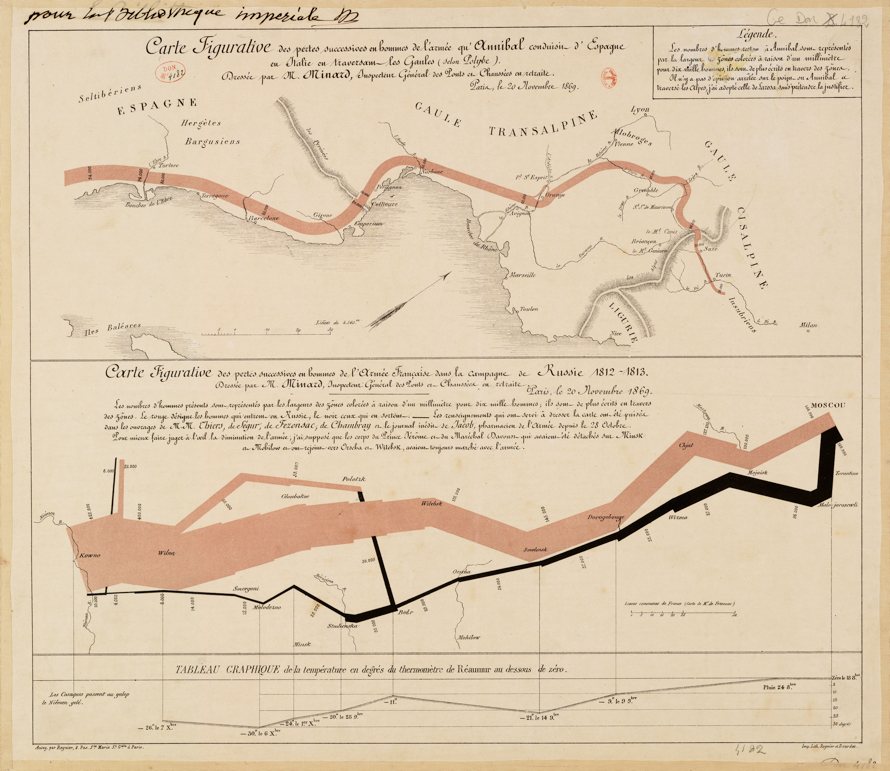
The piece in The Morning News profiles, among a few other selections, the French engineer Charles Joseph Minard, who devised a number of new and influential infographic techniques. Among the most famous of his charts from this period is the 1869 “Carte figurative des pertes successives en hommes de l’armée française dans la campagne de Russie 1812–1813 comparées à celle d’Hannibal durant la 2ème Guerre Punique.” The two diagrams, published together, show the size and attrition of the armies of Hannibal in his expedition across the Alps during the Punic wars and of Napoleon during his assault on Russia. The colored band in the diagrams indicates the army’s strength of numbers—in both charts, one millimeter in thickness represents ten thousand men. The chart of Napoleon’s march includes an indication of temperature as well.

Top: Hannibal in his expedition across the Alps during the Punic wars. Bottom: Napoleon's assault on Russia.

See this Wikipedia link for more.

Nye Lavalle, Mortgage Sleuth

From my own personal experience and 20 years of research and investigation, nothing — and I mean nothing — that a bank, lender, loan servicer or their lawyer says or puts on paper can be trusted and accepted as true.

The quote above comes from Nye Lavalle, who after his personal experience of losing his home to foreclosure, set out to learn all he could about the mortgage industry, traveling nationwide to dig into records. In 2003, he compiled a dossier of practices at Fannie Mae.

For two years, he corresponded with Fannie executives and lawyers. Fannie later hired a Washington law firm to investigate his claims. In May 2006, that firm, using some of Mr. Lavalle’s research, issued a confidential, 147-page report corroborating many of his findings.

And there, apparently, is where it ended. There is little evidence that Fannie Mae’s management or board ever took serious action. Known internally as O.C.J. Case No. 5595, in reference to the company’s Office of Corporate Justice, this 2006 report suggests just how deep, and how far back, our mortgage and foreclosure problems really go.

“It is axiomatic that the practice of submitting false pleadings and affidavits is unlawful,” said the report, a copy of which was obtained by The New York Times. “With his complaint, Mr. Lavalle has identified an issue that Fannie Mae needs to address promptly.”

What Fannie Mae knew about abusive foreclosure practices, and when it knew it, are crucial questions as Congress and the Obama administration weigh the future of the company and its cousin, Freddie Mac. These giants eventually blew themselves apart and, so far, they have cost taxpayers $150 billion. But before that, their size and reach — not only through their own businesses, but also through the vast amount of work they farm out to law firms and loan servicers — meant that Fannie and Freddie shaped the standards for the entire mortgage industry.

Almost all of the abuses that Mr. Lavalle began identifying in 2003 have since come to widespread attention. The revelations have roiled the mortgage industry and left Fannie, Freddie and big banks with potentially enormous legal liabilities. More worrying is that the kinds of problems that Mr. Lavalle flagged so long ago, and that Fannie apparently ignored, have evicted people from their homes through improper or fraudulent foreclosures.

According to the report, Fannie held about two million mortgage notes in its offices in Herndon, Va., in 2005 — a fraction of the 15 million loans it actually owned or guaranteed. Various third parties owned the rest of the notes. At that time, Fannie typically destroyed 40 percent of the notes once the mortgages were paid off. It returned the rest to the respective lenders, only without marking the notes as canceled. According to Mr. Lavalle, Fannie Mae lacked a centralized system for reporting lost notes. And so the the potential for confusion and abuse became rampant. The piece explains that anyone who gains control of a note can, in theory, try to force the borrower to pay it, even if it has already been paid.  Or that someone might try to force homeowners to pay the same mortgage twice. Or that loans could be improperly pledged as collateral by some other institution, even though the loans have been paid. All of these things happened during and and after the financial crisis of 2006-2008. It’s refreshing to read that there were some people who took matters into their own hands and fought for the consumer.

Graffiti Artist to Make $200 Million from Facebook Stock

Facebook announced its IPO yesterday, in an effort to raise $5 billion (perhaps more), which will be the largest internet public offering ever. Many people who hold Facebook shares are poised to become millionaires overnight. The New York Times reports a story of one David Choe, a graffiti artist who painted murals on the walls of Facebook’s first offices in Palo Alto, California. He chose to be paid in stock rather than in cash. Now, he’s poised to become an ultra-millionaire, to the tune of $200 million or more.

Many “advisers” to the company at that time, which is how Mr. Choe would have been classified, would have received about 0.1 to 0.25 percent of the company, according to a former Facebook employee. That may sound like a paltry amount, but a stake that size is worth hundreds of millions of dollars, based on a market value of $100 billion. Mr. Choe’s payment is valued at roughly $200 million, according to a number of people who know Mr. Choe and Facebook executives.

Sounds like Choe has won the lottery (by comparison, a $380 million Mega Millions jackpot in 2011 had a cash payout of $240 million, the largest in the history of the American lottery).

On a final note, what is the artist’s advice for living? “Always double down on 11. Always.”

Jonathan Franzen on E-Books

Jonathan Franzen, author of Freedom and The Corrections, expresses his thoughts on e-books:

The technology I like is the American paperback edition of Freedom. I can spill water on it and it would still work! So it’s pretty good technology. And what’s more, it will work great 10 years from now. So no wonder the capitalists hate it. It’s a bad business model.

I think, for serious readers, a sense of permanence has always been part of the experience. Everything else in your life is fluid, but here is this text that doesn’t change.

Will there still be readers 50 years from now who feel that way? Who have that hunger for something permanent and unalterable? I don’t have a crystal ball.

But I do fear that it’s going to be very hard to make the world work if there’s no permanence like that. That kind of radical contingency is not compatible with a system of justice or responsible self-government.

I understand where Franzen is coming from, and I used to be in the same camp as he is now (i.e., I wouldn’t read any e-books). But ever since I finished reading Walter Isaacson’s biography of Steve Jobs on my iPhone, I’ve become more warm toward reading books on digital devices (I have still yet to get a Kindle, however).

Franzen goes on:

Maybe nobody will care about printed books 50 years from now, but I do. When I read a book, I’m handling a specific object in a specific time and place. The fact that when I take the book off the shelf it still says the same thing – that’s reassuring.

Someone worked really hard to make the language just right, just the way they wanted it. They were so sure of it that they printed it in ink, on paper. A screen always feels like we could delete that, change that, move it around. So for a literature-crazed person like me, it’s just not permanent enough.

Yes, the concept of being reassured that the text hasn’t changed is wonderful. But he neglects dynamic titles that can be updated over the years (think introductions and forewords to texts). My feeling is that Franzen’s thoughts on e-books will become more malleable (i.e., sympathetic) in the next few years. It certainly takes time, as was the case with me.