The History of Infographics

This piece sparked my interest in exploring the history of infographics. Excluding cave paintings, the history of infographics dates back to the 1600s:

In 1626 Christopher Scheiner published the Rosa Ursina sive Sol which used a variety of graphics to reveal his astronomical research on the sun. He used a series of images to explain the rotation of the sun over time (by tracking sunspots).

In 1786, William Playfair published the first data graphs in his book The Commercial and Political Atlas. The book is filled with statistical graphs, bar charts, line graphs, and histograms, that represent the economy of 18th century England.

Perhaps most famously, the English nurse Florence Nightingale, in 1857, used information graphics persuading Queen Victoria to improve conditions in military hospitals, principally the Coxcomb chart, a combination of stacked bar and pie charts, depicting the number and causes of deaths during each month of the Crimean War.

"Diagram of the causes of mortality in the army in the East," published by Florence Nightingale.

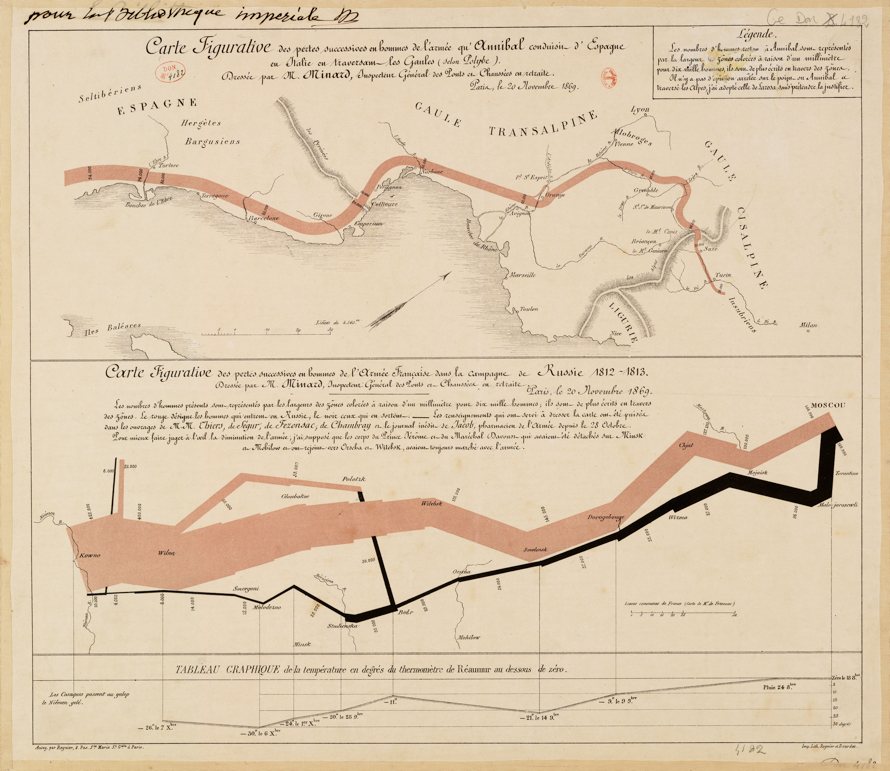
The piece in The Morning News profiles, among a few other selections, the French engineer Charles Joseph Minard, who devised a number of new and influential infographic techniques. Among the most famous of his charts from this period is the 1869 “Carte figurative des pertes successives en hommes de l’armée française dans la campagne de Russie 1812–1813 comparées à celle d’Hannibal durant la 2ème Guerre Punique.” The two diagrams, published together, show the size and attrition of the armies of Hannibal in his expedition across the Alps during the Punic wars and of Napoleon during his assault on Russia. The colored band in the diagrams indicates the army’s strength of numbers—in both charts, one millimeter in thickness represents ten thousand men. The chart of Napoleon’s march includes an indication of temperature as well.

Top: Hannibal in his expedition across the Alps during the Punic wars. Bottom: Napoleon's assault on Russia.

See this Wikipedia link for more.

World’s Richest People, Adjusted for Age

The most recent tally of the world’s wealthiest people by Forbes magazine put the Facebook founder’s net worth at $13.5 billion in 2011, ranking him 52nd in the world. But Zuckerberg’s 28.4% stake in Facebook could see his fortune rise to as much as $28.4 billion, assuming that Facebook’s valuation is $100 billion.

The telling chart below profiles the world’s richest people in age-adjusted terms (per age capita). At 27, Zuckerberg is number one on this list, with over $1B of wealth per each year of his life. In the top 100 richest people in the world, only the co-founders of Google, Larry Page and Sergey Brin, are also under 40.

(Source: The Economist)

On Mindful Eating

I’ve been reading about mindful eating, a technique whereby we slow down as we eat our food. The benefits are many: over time, we’ll eat less than our normal portions, we can lose weight, and so on. The concept of mindful eating has roots in Buddhist teachings, whereby meditation with food is complementary to breathing and sitting techniques. The New York Times profiles mindful eating, noting that it’s not a diet:

[S]uch experiments of the mouth and mind have begun to seep into a secular arena, from the Harvard School of Public Health to the California campus of Google. In the eyes of some experts, what seems like the simplest of acts — eating slowly and genuinely relishing each bite — could be the remedy for a fast-paced Paula Deen Nation in which an endless parade of new diets never seems to slow a stampede toward obesity.

Mindful eating is not a diet, or about giving up anything at all. It’s about experiencing food more intensely — especially the pleasure of it. You can eat a cheeseburger mindfully, if you wish. You might enjoy it a lot more. Or you might decide, halfway through, that your body has had enough. Or that it really needs some salad.

The article closes with the following tips:

WHEN YOU EAT, JUST EAT. Unplug the electronica. For now, at least, focus on the food.

CONSIDER SILENCE. Avoiding chatter for 30 minutes might be impossible in some families, especially with young children, but specialists suggest that greenhorns start with short periods of quiet.

TRY IT WEEKLY. Sometimes there’s no way to avoid wolfing down onion rings in your cubicle. But if you set aside one sit-down meal a week as an experiment in mindfulness, the insights may influence everything else you do.

PLANT A GARDEN, AND COOK. Anything that reconnects you with the process of creating food will magnify your mindfulness.

CHEW PATIENTLY. It’s not easy, but try to slow down, aiming for 25 to 30 chews for each mouthful.

USE FLOWERS AND CANDLES. Put them on the table before dinner. Rituals that create a serene environment help foster what one advocate calls “that moment of gratitude.”

My aim will be to start slowly: trying mindful eating for one day a week, and expanding from there.

A Replacement Bridge in San Francisco

There is a strong likelihood of a large earthquake in the San Francisco Bay Area — about a 2-in-3 chance of magnitude 6.7 or larger before 2036, according to the United States Geological Survey. This New York Times piece discusses the building of the new Bay Bridge:

Unlike more conventional suspension bridges, in which parallel cables are slung over towers and anchored at both ends in rock or concrete, the 2,047-foot suspension bridge has only a single tower and a single cable that is anchored to the road deck itself, looping from the eastern end to the western end and back again. (With a conventional design it would have been extremely difficult to create an anchorage on the eastern end, in the middle of the bay.)

The new bridge is the longest self-anchored suspension bridge in the world, and it is asymmetrical, with one side of the span longer than the other. The choice of such a design raised the cost of the project significantly. In a conventional suspension bridge, the road deck is added last, hung from suspender cables attached to the main cables. In a self-anchored design, the deck has to be built first.

The eastern span replacement of the San Francisco – Oakland Bay Bridge has been under construction since 2002. Originally scheduled to open in 2007, it is now scheduled to open to traffic in 2013 at an estimated cost of $6.3 billion. A good interactive from the NYT is here. An incredibly detailed Wikipedia article is here.

Apple Results Distorting S&P 500 Earnings

Quote of the day concerning Apple earnings from last quarter:

The world’s largest company by market capitalization said on Jan. 24 that profit in the quarter ended Dec. 31 was $13.1 billion, 36 percent more than the average analyst projection, while revenue beat forecasts by $7.3 billion, the most ever. The Cupertino, California-based company single-handedly erased a drop in S&P 500 earnings for the October-to-December period, turning a 4.2 percent decline into a 4.4 percent gain.

(source: Bloomberg)

The Largest Biometric System in the World

It has been called “the biggest social project on the planet.”

A major problem in India is that few poor people can prove their identity: they have no passport, no driving licence, no proof of address. They live in villages where many share the same name. These people cannot open bank accounts, and no one wants to lend them money. India has no equivalent of Social Security numbering, and just thirty-three million Indians, out of 1.2 billion, pay income tax.

But India’s relatively new program, the unique identity (UID) authority, will enroll approximately 400 million people by the end of this year. The scheme is voluntary, but the poor are enthusiastic about it. This Economist piece has some details, which relies on maintaining a huge database containing biometric information (ten fingerprints and an iris scan) of each of India’s residents:

For the poor, having a secure online identity alters their relationship with the modern world. No more queueing for hours in a distant town and bribing officials with money you don’t have to obtain paperwork that won’t be recognised if you move to another state looking for work. A pilot project just begun in Jharkhand, an eastern state, will link the new identities to individuals’ bank accounts. Those to whom the government owes money will soon be able to receive it electronically, either at a bank or at a village shop. Ghost labourers staffing public-works schemes, and any among India’s 20m government employees, should turn into thin air. The middlemen who steal billions should more easily be bypassed or caught.

That is just the start. Armed with the system, India will be able to rethink the nature of its welfare state, cutting back on benefits in kind and market-distorting subsidies, and turning to cash transfers paid directly into the bank accounts of the neediest. Hundreds of millions of the poor must open bank accounts, which is all to the good, because it will bind them into the modern economy. Care must be taken so mothers rather than feckless fathers control funds for their children. But most poor people, including anyone who wants to move around, will be better off with cash welfare paid in full. Vouchers for medical or education spending could follow.

The scheme based on biometrics is not without criticism, however. Nevertheless, the cost of enrolling each person into this program is about $2, so India’s program could be a model for other poor nations.

Robert Walser on the Artistic Individual

The passage below is from Robert Walser’s Berlin Stories, which have been translated into English for the first time by Susan Bernofsky, and just published in a new edition by New York Review Classics. Walser arrived in Berlin from Switzerland in 1905 and wrote hundreds of short reflections about the city’s charms. This passage on the successful artist is excellent:

The artist who is crowned with success lives in the metropolis as if in an enchanting Oriental dream. He hastens from one elegant household to the affluent next, sits down unhesitatingly at the opulently laden dining tables, and while chewing and slurping provides the entertainment. He passes his days in a virtual state of intoxication. And his talent? Does an artist such as this neglect his talent? What a question! As if one might cast off one’s gifts without so much as a by-your-leave. On the contrary. Talent unconsciously grows stronger when one throws oneself into life. You mustn’t be constantly tending and coddling it like a sickly something. It shrivels up when it’s too timidly cared for.

The artistic individual is nonetheless permitted to pace up and down, like a tiger, in his cave of artistic creation, mad with desire and worry over achieving some output of beauty. As no one sees this, there is no one to hold it against him. In company, he should be as breezy, affable, and charming as he can manage, neither too self-important nor too unimportant either. One thing he must never forget: he is all but required to pay court to beautiful, wealthy women at least a little.

Featured in full here.

Why French Parents are Superior

Pamela Druckerman is an American mother living in Paris with her British husband and two kids. In her book, Bringing Up Bébé: One American Mother Discovers the Wisdom of French Parenting, she offers her thoughts on parenting and comparing how French and Americans parents differ in their techniques and temperaments. The Wall Street Journal has a great excerpt, citing why French parents are superior to American parents:

The French, I found, seem to have a whole different framework for raising kids. When I asked French parents how they disciplined their children, it took them a few beats just to understand what I meant. “Ah, you mean how do we educate them?” they asked. “Discipline,” I soon realized, is a narrow, seldom-used notion that deals with punishment. Whereas “educating” (which has nothing to do with school) is something they imagined themselves to be doing all the time.

One of the keys to this education is the simple act of learning how to wait. It is why the French babies I meet mostly sleep through the night from two or three months old. Their parents don’t pick them up the second they start crying, allowing the babies to learn how to fall back asleep. It is also why French toddlers will sit happily at a restaurant. Rather than snacking all day like American children, they mostly have to wait until mealtime to eat. (French kids consistently have three meals a day and one snack around 4 p.m.)

The author’s impression of the way the French perceive American kids and parents:

[M]ost French descriptions of American kids include this phrase “n’importe quoi,” meaning “whatever” or “anything they like.” It suggests that the American kids don’t have firm boundaries, that their parents lack authority, and that anything goes. It’s the antithesis of the French ideal of thecadre, or frame, that French parents often talk about. Cadre means that kids have very firm limits about certain things—that’s the frame—and that the parents strictly enforce these. But inside the cadre, French parents entrust their kids with quite a lot of freedom and autonomy.

One final point, according to the article: when comparing beliefs of college-educated mothers in the U.S. and France, the American moms said that encouraging one’s child to play alone was of average importance. But the French moms said it was very important. Being alone forces kids to find creative ways to entertain themselves, an essential skill in deferred gratification.

###

See also: Why Chinese Mothers are Superior.

Nye Lavalle, Mortgage Sleuth

From my own personal experience and 20 years of research and investigation, nothing — and I mean nothing — that a bank, lender, loan servicer or their lawyer says or puts on paper can be trusted and accepted as true.

The quote above comes from Nye Lavalle, who after his personal experience of losing his home to foreclosure, set out to learn all he could about the mortgage industry, traveling nationwide to dig into records. In 2003, he compiled a dossier of practices at Fannie Mae.

For two years, he corresponded with Fannie executives and lawyers. Fannie later hired a Washington law firm to investigate his claims. In May 2006, that firm, using some of Mr. Lavalle’s research, issued a confidential, 147-page report corroborating many of his findings.

And there, apparently, is where it ended. There is little evidence that Fannie Mae’s management or board ever took serious action. Known internally as O.C.J. Case No. 5595, in reference to the company’s Office of Corporate Justice, this 2006 report suggests just how deep, and how far back, our mortgage and foreclosure problems really go.

“It is axiomatic that the practice of submitting false pleadings and affidavits is unlawful,” said the report, a copy of which was obtained by The New York Times. “With his complaint, Mr. Lavalle has identified an issue that Fannie Mae needs to address promptly.”

What Fannie Mae knew about abusive foreclosure practices, and when it knew it, are crucial questions as Congress and the Obama administration weigh the future of the company and its cousin, Freddie Mac. These giants eventually blew themselves apart and, so far, they have cost taxpayers $150 billion. But before that, their size and reach — not only through their own businesses, but also through the vast amount of work they farm out to law firms and loan servicers — meant that Fannie and Freddie shaped the standards for the entire mortgage industry.

Almost all of the abuses that Mr. Lavalle began identifying in 2003 have since come to widespread attention. The revelations have roiled the mortgage industry and left Fannie, Freddie and big banks with potentially enormous legal liabilities. More worrying is that the kinds of problems that Mr. Lavalle flagged so long ago, and that Fannie apparently ignored, have evicted people from their homes through improper or fraudulent foreclosures.

According to the report, Fannie held about two million mortgage notes in its offices in Herndon, Va., in 2005 — a fraction of the 15 million loans it actually owned or guaranteed. Various third parties owned the rest of the notes. At that time, Fannie typically destroyed 40 percent of the notes once the mortgages were paid off. It returned the rest to the respective lenders, only without marking the notes as canceled. According to Mr. Lavalle, Fannie Mae lacked a centralized system for reporting lost notes. And so the the potential for confusion and abuse became rampant. The piece explains that anyone who gains control of a note can, in theory, try to force the borrower to pay it, even if it has already been paid.  Or that someone might try to force homeowners to pay the same mortgage twice. Or that loans could be improperly pledged as collateral by some other institution, even though the loans have been paid. All of these things happened during and and after the financial crisis of 2006-2008. It’s refreshing to read that there were some people who took matters into their own hands and fought for the consumer.

Best Super Bowl Trivia

This Sunday, the Giants will face the Patriots in Super Bowl XLVI. Everyone will watch or care about the game for different reasons: there’s Madonna at the halftime show, the gambler who wants to cover the spread, the nonchalant fan, the ones in it for the commercials, and of course, the die-hard fans of the Giants and the Pats.

But Ken Jennings (the 74-time Jeopardy! champion and the author of books Maphead and Brainiac) argues that no one appreciates the Super Bowl as a whole the way a trivia buff does. So he compiled a top ten list of best Super Bowls in trivia history:

10. Super Bowl XIX

In beating the Dolphins, the 49ers became the only team ever to win the Super Bowl at home (sort of — Stanford Stadium is less than 30 miles from Candlestick). But this game is mostly of note to fans of movie trivia, since a fictional San Francisco-Miami championship was a major plot point in Ace Ventura: Pet Detective and Any Given Sunday. Oh, and Teri Hatcher was a 49ers cheerleader in 1985, and got almost as many ABC-TV close-ups during this game as she did during the third season of Desperate Housewives.

9. Super Bowl XLV

In 20 years, will anyone remember that the Packers won Super Bowl XLV? I doubt it. But will they remember Christina Aguilera mangling the national anthem by singing “What so proudly we watched, at the twilight’s last reaming”? Absolutely. Will they remember Lindsay Lohan’s $100 million lawsuit of E*Trade, for featuring a substance-abusing baby named Lindsay in one of their ads? I hope so. Will they remember Bryan Bulaga, the 21-year-old Green Bay lineman who became the youngest starter in Super Bowl history? Okay, probably not.

8. Super Bowl XXIX

This was the highest-scoring Super Bowl in history (49ers over Chargers 49-26) and a record fifth-straight Super Bowl for one player: backup Chargers QB Gale Gilbert, who had been signed from the Bills during the offseason. It’s also the game that Jerry was forced to attend with his nemesis Newman in the Seinfeld episode “The Label Maker.” But the highlight for me was the bizarre Disney synergy exercise of a halftime show, “Indiana Jones and the Temple of the Forbidden Eye,” in which an Indy look-alike (Harrison Ford refused to participate) rescued the stolen Vince Lombardi Trophy from a jungle lair whose dangers included frenzied temple worshipers, the evil Eye of Mara, and Patti LaBelle singing “New Attitude.”

7. Super Bowl IV

The first Super Bowls weren’t quite ready for prime time. (Even literally! Super Bowl XII was the first evening game.) In the very first AFL-NFL championship, for example, the first touchdown was scored by a hastily suited-up (and hungover) Packers reserve named Max McGee, and the second-half kickoff had to be rekicked because the TV cameras had missed it. Super Bowl IV’s halftime show was the first one headlined by a big celebrity: Miss Carol Channing. The on-field accomplishments were just as dubious: This was the game that marked the beginning of the Minnesota Vikings’ 0-4 Super Bowl record that, amazingly, still doesn’t include a single first-half score.

6. Super Bowl XXXVIII

This Patriots-Panthers showdown been called the greatest Super Bowl of all time, and you probably remember it as a classic quarterback duel. Tom Brady’s 32 completions are still a Super Bowl record, as is Jake Delhomme’s 85-yard pass to Muhsin Muhammad. But only trivia fans remember the record scoreless 27 minutes that opened the first half. And the British streaker who tried to crash the second-half kickoff in a G-string but got clobbered by linebacker Matt Chatham. And a terrible Bud Light commercial about a farting horse. With all that going on, the “wardrobe malfunction” seems like almost an afterthought.

5. Super Bowl XXIII

The first Bud Bowl! And a halftime show that was a stadium-wide 3-D card trick performed by a magician named — I wish I were making this up — “Elvis Presto.” For me the trivia MVPs of the game were Mike Cofer, the 49ers kicker who made a 41-yard field goal only to miss a 19-yarder (!) on the next drive, and legendary Canadian comedian John Candy. As the story goes, with the 49ers down three with three minutes to go, Montana calmed down a nervous huddle by pointing into the crowd and asking, “Isn’t that John Candy?” Then he proceeded to march the team 92 yards downfield for the game-winning touchdown to John Taylor. Cool customer.

 For the trivia and sports fan in you, the complete list is worth reading.