Jonathan Franzen on E-Books

Jonathan Franzen, author of Freedom and The Corrections, expresses his thoughts on e-books:

The technology I like is the American paperback edition of Freedom. I can spill water on it and it would still work! So it’s pretty good technology. And what’s more, it will work great 10 years from now. So no wonder the capitalists hate it. It’s a bad business model.

I think, for serious readers, a sense of permanence has always been part of the experience. Everything else in your life is fluid, but here is this text that doesn’t change.

Will there still be readers 50 years from now who feel that way? Who have that hunger for something permanent and unalterable? I don’t have a crystal ball.

But I do fear that it’s going to be very hard to make the world work if there’s no permanence like that. That kind of radical contingency is not compatible with a system of justice or responsible self-government.

I understand where Franzen is coming from, and I used to be in the same camp as he is now (i.e., I wouldn’t read any e-books). But ever since I finished reading Walter Isaacson’s biography of Steve Jobs on my iPhone, I’ve become more warm toward reading books on digital devices (I have still yet to get a Kindle, however).

Franzen goes on:

Maybe nobody will care about printed books 50 years from now, but I do. When I read a book, I’m handling a specific object in a specific time and place. The fact that when I take the book off the shelf it still says the same thing – that’s reassuring.

Someone worked really hard to make the language just right, just the way they wanted it. They were so sure of it that they printed it in ink, on paper. A screen always feels like we could delete that, change that, move it around. So for a literature-crazed person like me, it’s just not permanent enough.

Yes, the concept of being reassured that the text hasn’t changed is wonderful. But he neglects dynamic titles that can be updated over the years (think introductions and forewords to texts). My feeling is that Franzen’s thoughts on e-books will become more malleable (i.e., sympathetic) in the next few years. It certainly takes time, as was the case with me.

Whoopensocker! Dictionary of American Regional English is Complete

The Guardian notes that the Dictionary of American Regional English (fun acronym: DARE) is finally completed, after 50 years of work:

From whoopensocker to upscuddle, strubbly to swivet, 50 years after it was first conceived the Dictionary of American Regional English is finally about to reach the end of the alphabet.

The fifth volume of the dictionary, covering “slab” to “zydeco”, is out in March from Harvard University Press. It completes a project begun in 1962 at the University of Wisconsin-Madison, when Fred Cassidy was appointed chief editor of a dictionary of American dialects. Cassidy spent several years crafting a 1,600-question survey covering all aspects of daily life, and in 1965, 80 fieldworkers set out in “word wagons” to 1,002 communities across the US, interviewing 2,777 people over six years. This information has been mapped by editors over the last 40 years with written materials dating from the colonial period to the present, creating a 60,000-entry dictionary that its chief editor says gives the lie to the popular myth that American English has become homogenised by the media and the mobility of America’s population.

From DARE’s site:

DARE can tell you where people might live if their favorite card games are euchre, five hundred, schafskopf, sheepshead, or sixty-three; or where Americans eat apple pandowdy, lutefisk, or rivel; or where people are from if they live in dog trots, railroad flats, salt boxes, or shotgun houses.

The language of our everyday lives is captured inDARE, along with expressions our grandparents used but our children will never know. Based on interviews with thousands of Americans across the country, as well as on newspapers, histories, novels, diaries, letters, government documents, and other written sources, the Dictionary of American Regional English presents our language in its infinite variety. 

For the serious word lover, this dictionary is a must on your bookshelf. You can pre-order the dictionary here.

###

(via WSJ)

Why Young People go into Finance, Law, and Consulting

Tyler Cowen has a simple theory why young people tend to go into law, finance, and consulting:

The age structure of achievement is being ratcheted upward, due to specialization and the growth of knowledge.  Mathematicians used to prove theorems at age 20, now it happens at age 30, because there is so much to learn along the way.  If you are a smart 22-year-old, just out of Harvard, you probably cannot walk into a widget factory and quickly design a better machine.  (Note that in “immature” economic sectors, such as social networks circa 2006, young people can and do make immediate significant contributions and indeed they dominated the sector.)  Yet you and your parents expect you to earn a high income — now — and to affiliate with other smart, highly educated people, maybe even marry one of them.  It won’t work to move to Dayton and spend four years studying widget machines.

You will seek out jobs which reward a high “G factor,” or high general intelligence.  That means finance, law, and consulting.  You are productive fairly quickly, you make good contacts with other smart people, and you can demonstrate that you are smart, for future employment prospects.

Combined with the fact that these jobs tend to be higher-paying than anything else available, and we’ve got a recipe for young people to pass opportunities in technology, public service, and the like. This New York Times piece sheds some data on percentage of people from Ivy League schools that directly entered finance jobs. For example, those graduating from Harvard were more likely to enter finance than any other career (in fact, 17 percent of new grads did so in 2010, which is down from 28% in 2008, just before the financial crisis).

The Cult and Culture of Stanley Kubrick’s The Shining

This is an interesting New York Times piece exploring the cult and culture of Stanley Kubrick’s film, The Shining:

Three decades on, scholars and fans are still trying to decipher this puzzle of a film directed by Stanley Kubrick. To them it’s only ostensibly about an alcoholic father, Jack Torrance (Jack Nicholson) going more than stir crazy while his wife, Wendy (Shelley Duvall), and son, Danny, try to cope in an isolated hotel, the Overlook. Mr. Kubrick was famously averse to offering explanations of his films — “I have found it always the best policy to allow the film to speak for itself,” he once wrote — which has led to a mind-boggling array of theories about just what he was up to.

The hotel’s hedge maze, many Kubrick authorities agree, is a reference to the myth of the Minotaur; others have drawn convincing connections between the Overlook’s well-stocked pantry and the confectionery cottage in Hansel and Gretel. The more one views the film — and many of these scholars admit to viewing it hundreds of times — the more symbols and connections appear. 

“Room 237,” the first full-length documentary by the director Rodney Ascher, examines several of the most intriguing of these theories. It’s really about the Holocaust, one interviewee says, and Mr. Kubrick’s inability to address the horrors of the Final Solution on film. No, it’s about a different genocide, that of American Indians, another says, pointing to all the tribal-theme items adorning the Overlook Hotel’s walls. A third claims it’s really Kubrick’s veiled confession that he helped NASA fake the Apollo Moon landings.

When Mr. Ascher first began discussing the project with his friend Tim Kirk, who would later become the film’s producer, the two were simply hoping to find enough fans and theories to flesh out a series of short films, maybe something to post on YouTube. “On paper it seems like a very specific niche,” Mr. Ascher said, speaking at the oldest standing Bob’s Big Boy, in Burbank, not far from a campus of the New York Film Academy, where he teaches a class in editing. “The Secret Meanings of ‘The Shining’ — we should be able to wrap that up pretty quick. But the thing kept growing and growing.” By the time the two were done, “Room 237,” which had its premiere at the Sundance Film Festival on Monday, was nearly two hours long.

What they had stumbled upon was a subculture of Kubrick fans that has been expanding over the last several years. The group includes professors and historians, fanboys and artists, many of whom have posted their theories online accompanied by maps, videos, and pages-long explications pleading their cases. The Liverpudlian filmmaker Rob Ager’s video analyses of “The Shining” have garnered hundreds of thousands of YouTube hits; the voluminous online essays of Kevin McLeod, a k a “mstrmnd,” range from the film’s marketing materials to its many uses of artificial light.

This is rather peculiar:

The documentary’s biggest leap of faith comes with Jay Weidner, who posits that Mr. Kubrick helped NASA fake the Apollo Moon landings, then used “The Shining” to both confess his involvement — and brag about it. Mr. Weidner is at work on a DVD about the Kubrick-Apollo connection, his second, and cites as evidence a sweater worn by Danny with “Apollo 11” on it, and the hexagonal design on the hotel hallway carpet pattern, which he argues is a dead ringer for the aerial view of the Apollo launching pad. “The entire substory of ‘The Shining,’ ” Mr. Weidner said in an interview, “is the story of Kubrick making the Apollo footage and then trying to hide it from his wife, and then her finding out about it.”

In case you are wondering, Room 237 is a reference to a haunted room in the hotel, though the NYT piece attests that we still won’t learn what The Shining is after watching the film.

###

Related: Wikipedia has an extensive section of The Shining in popular culture.

Do-It-Yourself Tiny Homes

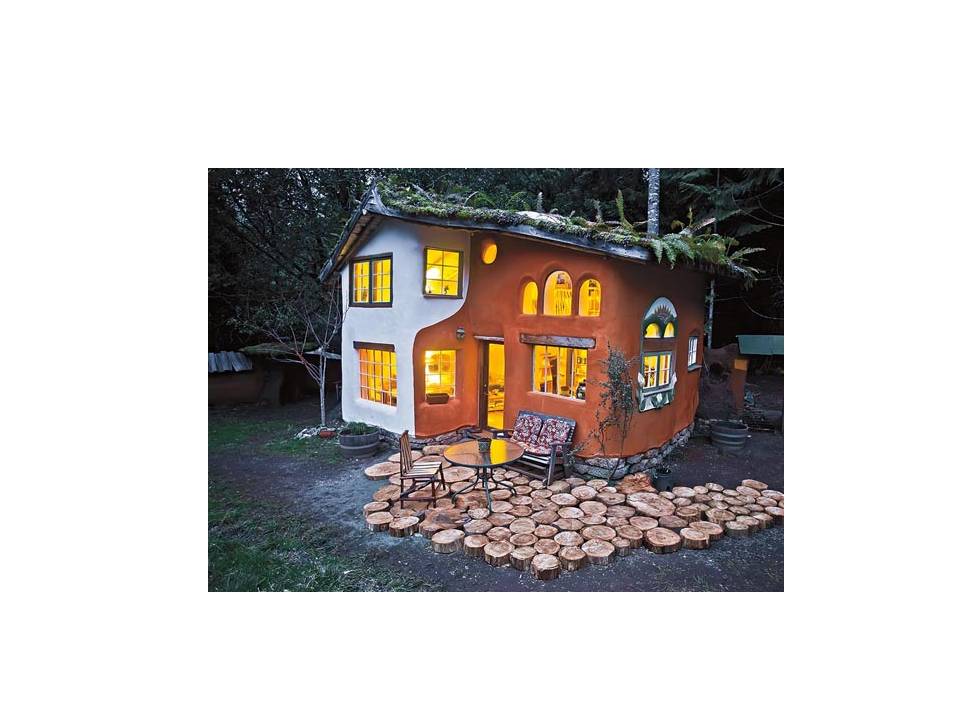
The WSJ notes that of the most intriguing trends in homebuilding these days is do-it-yourself tiny homes. And there are books aplenty to match this enthusiasm. Among the first on the market this year is Lloyd Kahn’s Tiny Homes, essentially a photo book that preaches the benefits of a “grassroots movement to scale things back.” It has already sold 5,200 copies in the U.S. and Canada since going on sale earlier this month.

If you didn’t read the article first, what would you think of the image below (full slideshow is here)? I kept looking at it for a while, trying to decide whether this is a real house or a doll house…

The money quote from the author of Tiny Homes, Lloyd Khan:

What I’m saying with this new book is don’t get a mortgage, don’t pay high rent, and don’t go into debt…If you’re young enough or you’re just starting out and don’t want to work 12 hours a day, here’s an alternative.

Good trivia: Lloyd Kahn made his first splash in publishing by editing the “shelter” section of the Whole Earth Catalog in the late 1960s, a collection of tools and ideas later much praised by the late Steve Jobs.

Best Tennis Ever

Are we witnessing the best of men’s tennis today? After Djokovic’s victory at the 2012 Australian Open, Jason Gay thinks so (and it’s hard to disagree):

Conventional superlatives fail. Once-a-lifetime? Symphony of brilliance? Wicked good? It all sounds cheesy, inadequate. But what’s happening in the men’s game is as close as sports gets to unadulterated joy, the kind of outrageous viewer experience that leaves the audience gasping, as if anaerobic, as it did Sunday morning, in the men’s final of the Australian Open.

To be clear, when I say men’s tennis, I am really talking about the interactions of three players. Maybe four, if we want to be generous and include Andy Murray, who has yet to win a Grand Slam, and keeps grabbing for that glory, only to pull the doorknob off in his hand. The unquestioned top three are world No. 1 Novak Djokovic, Rafael Nadal and Roger Federer. Between them, they have won 31 Slams, and Djokovic is still shopping in aisle one. They are as formidable and as entangled a trio as tennis has ever witnessed—as silly as it is to get into generational comparisons, it’s fair to say that the great three of Borg, McEnroe and Connors (26 combined Slams) are on the run, in their flowing hair and short-shorts.

These days are like those good old days. This past week there were early mornings, depending on where you lived, and your ability to have woken up in darkness to watch the spectacle. Reasonable people reasonably used a DVR, but Sunday’s 5-7, 6-4, 6-2, 6-7(5), 7-5 epic, won by Djokovic over Nadal, wasn’t designed to be breezed over via remote control. This was a match that accelerated and de-accelerated and accelerated again; that both men locked up and let escape; that left a pair of champions droop-shouldered and wobbly. It lasted a boiled egg under six hours, beating the second-longest Grand Slam final by 59 minutes. It was briefly delayed by rain. It ended with Djokovic yanking at his collar, stripping off his shirt, and unleashing a primal yell—Fred Stolle meets Freddie Mercury.

I am starting to get more into tennis as a fan. Perhaps 2012 will be the year I see a professional match live (for the first time ever). The U.S. Open in the fall sounds pretty good right about now.

Visualizing 2011

One of my favorite websites I discovered in the year 2011 was visualizing.org, a compendium of visually stunning infographics and videos in which creative people make sense of complex issues through data and design.

Below are a few of my favorite visualizations:

1) Notabilia, a beautiful visualization of the 100 Longest Articles for Deletion (AfD) on Wikipedia:

Like a garden, an online encyclopedia needs constant weeding. Unlike a garden, an online encyclopedia has thousands of potential gardeners. Over years Wikipedia has developed guidelines and policies to help editors collectively decide whether topics are suitable for inclusion or not. All articles, especially new ones, are reviewed by the community to determine if they meet Wikipedia’s notability guidelines. Any editor can nominate an article for deletion and, if this nomination is legitimate, a community discussion takes place where any fellow gardeners editors have the opportunity to make their voices heard. The usual process is to have a week-long discussion during which community members can discuss in favor or against keeping the article. At the end of this period an administrator reviews the discussion and speaks the final verdict.

We analyzed and visualized Article for Deletion (AfD) discussions in the English Wikipedia. The visualization above represents the 100 longest discussions that resulted in the deletion of the respective article. AfD discussions are represented by a thread starting at the bottom center. Each time a user joins an AfD discussion and recommends to keep, merge, or redirect the article a green segment leaning towards the left is added. Each time a user recommends to delete the article a red segment leaning towards the right is added. As the discussion progresses, the length of the segments as well as the angle slowly decay.

What decides whether consensus is reached is the administrator closing the AfD discussion, not a headcount. As a result, the proportion of Keeps and Deletes may be at odds with the final decision, as illustrated by the above visualization. AfD discussions also take a variety of shapes depending on how they evolve over time.

2) 7 Days of Earthquakes in Japan – a visualization of the quakes associated with the Tohuku 2011 earthquake off the coast of Japan.

3) Breaking bin Laden – how a single tweet about bin Laden’s death spread virally on Twitter.

Visualizing’s 2011 in review is well worth seeing.

What Software is Used at Facebook?

Andrei Alexandrescu, a self-professed hacker and current employee at Facebook, is interviewed by Server Side Magazine and answers what software/tools they use at Facebook. It’s a Linux world, with a lot of tools developed in-house:

Each Facebook engineer gets a choice of MacBook or Windows laptop, plus the invariable 30′ monitor (yum). But development is not really happening on the laptop itself; to get any work done, engineers connect to a remote Linux machine (each engineer has one assigned) using a variety of protocols over ssh (plain terminal, nx, vnc, and probably more).

There’s freedom in choosing editors, so the usual suspects – emacs and vim – are quite popular, with some Eclipse and others here and there. I personally prefer emacs via nx, the combo works quite swimmingly even over a slow connection.

We also have a lot of cool organizational tools, many developed in house. That sounds a bit NIHish, but the history behind it is that we tried hard to make off-the-shelf tools work at the scale and quality we need them to, failed, and had to write our own.

The tools use our own technologies (talk about dog food) so they work, look, and integrate beautifully. Best part, if someone doesn’t like something, well, they can just fix it. (To wit, our email and calendar software is off-the-shelf and is the most unpleasant tool to deal with. Get this – we have a few people “specialized” in sending large meeting invites out, because there are bugs that require peculiar expertise to work around. Not to mention that such invites come with “Do not accept from an iPhone lest you corrupt the invite for everyone!”)

Anyway, back to our tool chain. Once an engineer makes a code change that passes unit tests and lint, they submit for review a so-called “diff” via our Phabricator system, which we open sourced.

The reviewers are selected partly manually, partly automatically; virtually not one line of code is committed without having been inspected by at least one (other) engineer. Phabricator is great at this flow, making diff analysis, comment exchange, and revision updates very handy. I’d recommend it.

Once the diff has been approved, the author uploads it to our central git repository. We love git; when I joined two years ago, we were just starting to migrate from svn to git, and today we virtually all use git. Some of us (including myself) wrote a few popular git scripts that integrate with our workflow.

To build C++ code we have our own build system driving a build farm. I don’t do front-end work, so I don’t know many details in that area; in broad strokes, we use the recently-released HipHop Virtual Machine (HHVM) for development, and the static HipHop compiler for the production site.

We have quite a few more browser-based tools for improving workflow, such as task management, discussions, wiki, peer review, recruiting and interviewing, analytics, systems management, and many many more. Really for pretty much any typical need “there’s an app for that”. And if there isn’t, there’s a vast infrastructure allowing you to build one quickly.

Read the full interview to find out about the D programming language…

The World’s Longest Running Lab Experiment

The longest running lab experiment in the world is over three quarters of a century long…and is still going. From Popular Science:

The pitch-drop experiment-really more of a demonstration-began in 1927 when Thomas Parnell, a physics professor at the University of Queensland in Australia, set out to show his students that tar pitch, a derivative of coal so brittle that it can be smashed to pieces with a hammer, is in fact a highly viscous fluid. It flows at room temperature, albeit extremely slowly. Parnell melted the pitch, poured it into a glass funnel, let it cool (for three years), hung the funnel over a beaker, and waited.

Eight years later, a dollop of the pitch fell from the funnel’s stem. Nine years after that, another long black glob broke into the beaker. Parnell recorded the second drop but did not live to see the third, in 1954. By then, his experiment had been squirreled away in a dusty corner of the physics department.

The pitch-drop experiment might have fallen into obscurity (or a wastebasket) had it not been for John Mainstone, who joined the physics department at UQ in 1961. One day a colleague said, “I’ve got something weird in this cupboard here” and presented Mainstone with the funnel, beaker and pitch, all housed under a bell jar. Mainstone asked the department head to display it for the school’s science and engineering students, but he was told that nobody wanted to see it. Finally, around 1975, Mainstone persuaded the department to take the bell jar out for the world to see.

To this day, no one person has actually witnessed the moment a drop of pitch has detached and fallen. But that may change. Why? The experiment is now broadcast on a live webcam. John Mainstone is betting that the next drop will happen in 2013. Just don’t hold your breath.

Blue Marble: The Most Amazing High Definition Image of Earth

The most amazing high definition image of Earth.

Earlier this week, NASA unveiled an image titled “Blue Marble” and dubbed it the most amazing high definition image of Earth. The image was captured with the Visible/Infrared Imager Radiometer Suite (VIIRS) instrument aboard NASA’s most recently launched Earth-observing satellite, Suomi NPP. This composite image uses a number of swaths of the Earth’s surface taken on January 4, 2012.

The full resolution image is a stunning 8,000×8,000 pixels! I have taken NASA’s image and made some minor edits: a global curves adjustment, a saturation boost, and sharpened the image. Click on the image above to download the full resolution image. Makes for a great wallpaper!