The Science of Fat

This is a fascinating article in Outside Magazine on fat and muscle.

Not everything about fat is bad, of course. Fat tissue under the skin, known as subcutaneous fat—the kind that makes young people look succulent and ripe—is essentially padding that protects the body from injury, and it also helps fight infection and heal wounds. “Sub-q” fat produces an important hormone called adiponectin, which appears to help control metabolism and protect against certain cancers, notably breast cancer.

The bad news is that, as we age, we gradually lose this good fat, which is one reason why our hands get bonier. Instead, men and women alike tend to build up blobby fat on our midsections. Over the past decade or so, Kirkland and other scientists have discovered that this so-called visceral fat infiltrates our vital organs, bathing them in a nasty chemical stew that wreaks havoc in the body. Visceral fat produces an array of cell-signaling proteins called cytokines, including interleukin-6 (IL-6), which causes chronic inflammation, and TNF-alpha, for tumor necrosis factor, which has been linked to cancer.

Kirkland and other researchers have come to believe that, in addition to the problems associated with diabetes and heart disease, fat may actually help accelerate the aging process. In a 2008 experiment, scientists at the Albert Einstein College of Medicine at Yeshiva University surgically removed abdominal fat from obese lab rats and found that the rodents lived significantly longer than their chubby cousins. In a more recent study, not yet published, the Einstein team found that surgical fat removal prevented some colorectal cancers in mice that were genetically predisposed to those tumors.

I had no idea there was such a system in place in the human body:

One newly discovered myokine even tries to convert fat itself into an energy-consuming system like muscle. In 2012, a Harvard-based team identified a hormone called irisin, secreted during exercise, that tricks plain, blobby, “white” fat—and even deep visceral fat—into acting like “brown” fat, a far less common form that is dense with mitochondria and burns energy just like muscle does. Bruce Spiegelman, the Harvard scientist who led the team that discovered irisin, is now looking for a drug compound that might trigger its release.

Worth reading in entirety.

###

(via Paul Kedrosky)
Future Plans for Mars Travel

The Economist summarizes current plans for missions to Mars:

Six decades later, on February 27th, Dennis Tito, an American investment manager and space enthusiast who, in 2001, became the world’s first space tourist, unveiled his own plan. Inspiration Mars is a more modest affair. If all goes to plan, in January 2018 a single, small spaceship, carrying two crew members, will blast off for a 501-day trip to Mars and back. If it arrives safely, there are no plans to land. Instead, the idea is merely to fly around the planet and then head back to Earth. Unlike von Braun’s project, little government involvement will be necessary. Mr Tito hopes to pay for Inspiration Mars with a mix of his own money, donations from the public and the sale of media rights.

That is not to say that Mr Tito’s plan is timid. On the contrary: it is eye-wateringly (or, as one colleague puts it, “bowel-looseningly”) bold. Although endless studies have been done on how it might be possible to ferry humans to Mars, no one has ever attempted it. Mr Tito’s launch date is fixed, for it is designed to take advantage of a rare period of orbital proximity between Mars and Earth. If he misses his deadline, another opportunity will not present itself until 2031. That gives the team just under five years to design the mission, specify a spacecraft, find a rocket to launch it on, select a crew and carry out all the necessary checks and double-checks. And, without the financial muscle of a nation-state behind him, all this must be done on a budget.

Also:

And other non-profit foundations are interested, such as Mars One, a Dutch group that has been advertising for volunteers for a one-way trip, whose crew would end up stranded on Mars, although it has nevertheless received plenty of applicants.

All this interest implies that sending people to Mars is merely a matter of political will and a bit of ingenious engineering. It is not. It is extremely difficult and dangerous, a fact that Mr Tito mentioned repeatedly in his press conference.

So dangerous, in fact, that The Economist initially called the Mars One “a suicide mission.” They’ve since issued a correction in the piece.

Andrew Mason’s Honest Letter to his Employees

Andrew Mason was fired as CEO of Groupon yesterday. He penned one of the most humble/honest letters to his employees. There’s no PR shilling here:

People of Groupon,

After four and a half intense and wonderful years as CEO of Groupon, I’ve decided that I’d like to spend more time with my family. Just kidding – I was fired today. If you’re wondering why… you haven’t been paying attention. From controversial metrics in our S1 to our material weakness to two quarters of missing our own expectations and a stock price that’s hovering around one quarter of our listing price, the events of the last year and a half speak for themselves. As CEO, I am accountable.

You are doing amazing things at Groupon, and you deserve the outside world to give you a second chance. I’m getting in the way of that. A fresh CEO earns you that chance. The board is aligned behind the strategy we’ve shared over the last few months, and I’ve never seen you working together more effectively as a global company – it’s time to give Groupon a relief valve from the public noise.

For those who are concerned about me, please don’t be – I love Groupon, and I’m terribly proud of what we’ve created. I’m OK with having failed at this part of the journey. If Groupon was Battletoads, it would be like I made it all the way to the Terra Tubes without dying on my first ever play through. I am so lucky to have had the opportunity to take the company this far with all of you. I’ll now take some time to decompress (FYI I’m looking for a good fat camp to lose my Groupon 40, if anyone has a suggestion), and then maybe I’ll figure out how to channel this experience into something productive.

If there’s one piece of wisdom that this simple pilgrim would like to impart upon you: have the courage to start with the customer. My biggest regrets are the moments that I let a lack of data override my intuition on what’s best for our customers. This leadership change gives you some breathing room to break bad habits and deliver sustainable customer happiness – don’t waste the opportunity!

I will miss you terribly.

Love,

Andrew

Wonderful.

Andrew, if you’re reading: get in touch with me about losing those 40 pounds. I did it last year and have kept the weight off.

Ang Lee and the Uncertainty of Success

Jeff J. Lin writes a great post on the success of director Ang Lee (most recently of Life of Pi fame). The highlight is that Ang Lee went through a period of six years of where he had nothing, being rejected over and over:

From age 30 to 36, he’s living in an apartment in White Plains, NY trying to get something — anything — going, while his wife Jane supports the family of four (they also had two young children) on her modest salary as a microbiologist. He spends every day at home, working on scripts, raising the kids, doing the cooking. That’s a six-year span — six years! — filled with dashed hopes and disappointments. “There was nothing,” he told The New York Times. “I sent in script after script. Most were turned down. Then there would be interest, I’d rewrite, hurry up, turn it in and wait weeks and weeks, just waiting. That was the toughest time for Jane and me. She didn’t know what a film career was like and neither did I.” It got so discouraging that Lee reportedly contemplated learning computer science so he could find a job during this time, but was scolded by his wife when she found out, telling him to keep his focus.

Put yourself in his shoes. Imagine starting something now, this year, that you felt you were pretty good at, having won some student awards, devoting yourself to it full time…and then getting rejected over and over until 2019. That’s the middle of the term of the next President of the United States. Can you imagine working that long, not knowing if anything would come of it? Facing the inevitable “So how’s that film thing going?” question for the fifth consecutive Thanksgiving dinner; explaining for the umpteeth time this time it’s different to parents that had hoped that film study meant you wanted to be a professor of film at a university.

The uncertainty of success. So this advice is worthwhile:

If you’re an aspiring author, director, musician, startup founder, these long stretches of nothing are a huge reason why it’s important to pick something personally meaningful, something that you actually love to do.

Add to that: a photographer.

A Hodgepodge: Games People Play

Over the weekend, The New York Times ran a series of op-eds on “Games People Play.”

My favorite quotes (with links to the originals) below.

Francine Prose on solitaire and the “fireworks” on your computer:

No wonder so many writers (including myself) play more solitaire than we should. All I have to do is complete a decent paragraph to feel I’ve earned the right to take a break and play a few games. Like many sports, it’s right on the border between addiction and pastime. That’s why teaching someone to play computer solitaire can feel like the equivalent of a giving a junkie that first shot, though the toll it takes isn’t in money or health, but in time, the writer’s most precious gift.

Of course, there are moments when I think: what a ridiculous waste! I keep resolving to quit. But how could I ever give up that little burst of hope whenever a new game deals itself out, or the lightly adrenalized buzz of seeing the cards, when I’ve won, bounce in joyous cascades across the screen and set off computer solitaire’s version of fireworks?

Pico Iyer on the ping-pong culture in Japan:

In Japan, Ping-Pong is how you keep your wits about you and your reflexes, limbs and senses intensely sharp. Almost every afternoon for nine years, I’ve walked 15 minutes uphill to our local health club, here in suburban Nara, or taken a bus to an ancient gymnasium in a nearby park, to engage in furious bouts of table tennis with a group of 30 or so Japanese neighbors who teach me about engagement in their retirement years as once they did with co-workers or family members.

I soon begin sweating even on mid-February days while some of my pals are swathed in jackets, mufflers and gloves and our breath condenses in front of us, indoors. When it hits 100 degrees in the old wooden space in July, I slip away discreetly after 90 minutes, while my aged friends continue for up to four hours. “Pico-san,” they say, next time they see me. “What’s up? You’re the youngest by 20 years and you’re the first to stop.” “I’m the only non-Japanese,” I want to say.

James Atlas on the “love-love” of tennis:

 By the end of two hours, I’m dripping as if I’ve just exited a Navajo sweat lodge. Why do we put ourselves through this ordeal week after week? Our exertions have changed nothing in our lives. But it’s not about athletic prowess; it’s about forgiveness. To forgive the teammate who double faults (a small number when you consider how many faults most of us commit in a day); the opponent who, having sensed that you’re about to poach, slams a wicked passing shot down the line; above all, to forgive yourself for the netted volley, the backhand that went long, the drop shot that failed to drop. And, having forgiven, to persist. I cite the tennis enthusiast Samuel Beckett: “Ever tried. Ever failed. No matter. Try again. Fail again. Fail better.”

Charles A. Murray on the diversity of poker (it is America):

A poker table is America the way that television commercials portray it but it seldom is. A normal table of 10 at Charles Town has at least two or three Asians, one or two blacks, maybe a Latino, another one or two players who hail from some other part of the world, and maybe four or five plain-vanilla whites like me. Age is distributed from young guns in their 20s who raise relentlessly to geezers like me who are too tight and passive.

And last, but not least, Jason Lucero on the fluidity of ultimate frisbee:

It’s fluid in the way basketball and hockey are fluid — fast-paced and constantly evolving between offense and defense. But even in its most contested moments, the culture of the game requires civility. It’s only a matter of time until professional football players carry handguns during games. In ultimate, there is no bullying — no hard fouls to earn respect, retaliatory fouls to show even less respect, none of it. We don’t have or need referees — we play with a commitment to fairness. Our hippie forefathers reasoned well: ultimate is a game; it should be fun and only fun. It is.

If I had to pick a favorite of the five, it’s probably Pico Iyer’s piece, simply because the dialogue made me laugh out loud. But all of these are a quick read and worth reading.

On the Oral History of Pulp Fiction

Mark Seal, writing for Vanity Fair, profiles the oral history of Pulp Fiction (which I consider to be the best film Quentin Tarantino has made/directed):

Made for $8.5 million, it earned $214 million worldwide, making it the top-grossing independent film at the time. Roger Ebert called it “the most influential” movie of the 1990s, “so well-written in a scruffy, fanzine way that you want to rub noses in it—the noses of those zombie writers who take ‘screenwriting’ classes that teach them the formulas for ‘hit films.’ ”

Pulp Fiction resuscitated the career of John Travolta, made stars of Samuel L. Jackson and Uma Thurman, gave Bruce Willis new muscle at the box office, and turned Harvey and Bob Weinstein, of Miramax, into giants of independent cinema. Harvey calls it “the first independent movie that broke all the rules. It set a new dial on the movie clock.”

I enjoyed this paragraph on the naming of Pulp Fiction:

“Like a lot of guys who had never made films before, I was always trying to figure out how to scam my way into a feature,” Tarantino tells me. Though he was indisputably king of all movie knowledge at Video Archives, the suburban-L.A. store where he worked, in Hollywood he was a nobody. Surrounded by videos, which he watched incessantly, he hit upon an idea for recycling three of the oldest bromides in the book: “The ones you’ve seen a zillion times—the boxer who’s supposed to throw a fight and doesn’t, the Mob guy who’s supposed to take the boss’s wife out for the evening, the two hit men who come and kill these guys.” It would be “an omnibus thing,” a collection of three caper films, similar to stories by such writers as Raymond Chandler and Dashiell Hammett in 1920s and 1930s pulp magazines. “That is why I called it Pulp Fiction,” says Tarantino.

Too many good quotes to count within the article.

###

(via DF)

A Physicist Proposes to his Physicist Girlfriend

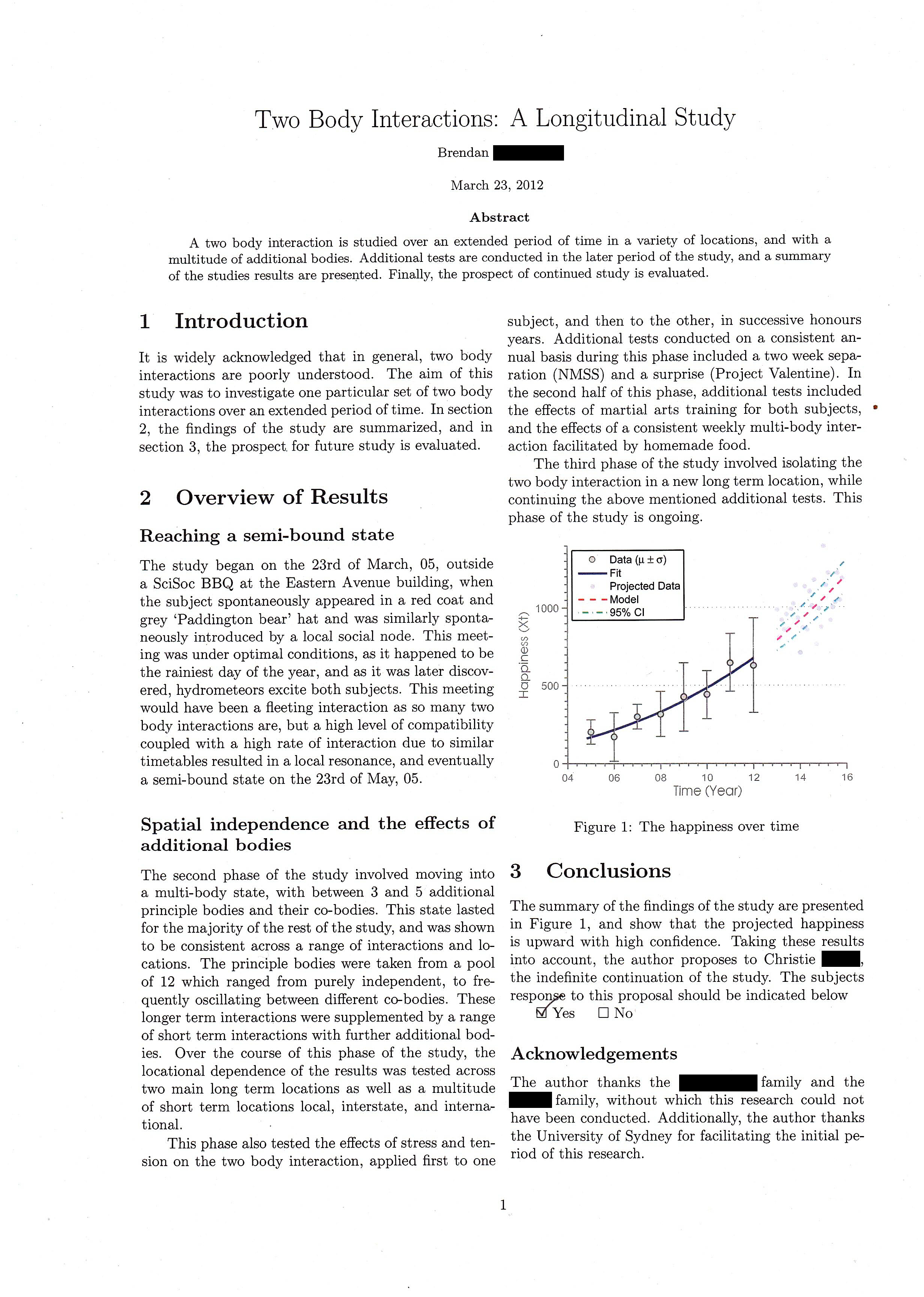
A redditor named “bogus_wheel” (a physicist by profession) received a proposal from her physicist boyfriend via an academic paper titled “Two Body Interactions: A Longitudinal Study.” You can read it below:

two_body_interactionsVery cute (and she said yes).

Two questions: where are the references and is it possible to replicate this study?

Joshua Topolsky on Google Glass: Awesome, Self-Conscious

Joshua Topolsky, editor of The Verge, had a chance to try out the new Google Glass, a $1,500 wearable computer. He recounts his impressions:

But what’s it actually like to have Glass on? To use it when you’re walking around? Well, it’s kind of awesome.

Think of it this way — if you get a text message or have an incoming call when you’re walking down a busy street, there are something like two or three things you have to do before you can deal with that situation. Most of them involve you completely taking your attention off of your task at hand: walking down the street. With Glass, that information just appears to you, in your line of sight, ready for you to take action on. And taking that action is little more than touching the side of Glass or tilting your head up — nothing that would take you away from your main task of not running into people.

It’s a simple concept that feels powerful in practice.

The same is true for navigation. When I get out of trains in New York I am constantly jumping right into Google Maps to figure out where I’m headed. Even after more than a decade in the city, I seem to never be able to figure out which way to turn when I exit a subway station. You still have to grapple with asking for directions with Glass, but removing the barrier of being completely distracted by the device in your hand is significant, and actually receiving directions as you walk and even more significant. In the city, Glass make you feel more powerful, better equipped, and definitely less diverted.

Joshua Topolsky looking like a modern day robot.

Joshua Topolsky looking like a modern day robot.

How long do you think this effect will persist when others start wearing Google Glass?

I will admit that wearing Glass made me feel self-conscious, and maybe it’s just my paranoia acting up (or the fact that I look like a huge weirdo), but I felt people staring at me. Everyone who I made eye contact with while in Glass seemed to be just about to say “hey, what the hell is that?” and it made me uncomfortable.

Interesting observations.

Why Is the School Bus Yellow?

A brief history of why the school bus is yellow, in this week’s New York Times:

The answer is Frank W. Cyr, a professor at Teachers College, Columbia University, who became known as the “father of the yellow school bus” for research he led in the 1930s.

Dr. Cyr, who died at 95 in 1995, had traveled the country, surveying pupil transportation in an era when school buses cost $2,000 apiece but differedwidely from manufacturer to manufacturer and jurisdiction to jurisdiction. Some states had safety standards; some left the task to local school districts. “In many cases, standards have been set up by more or less hit-and-miss methods,” according to an account that Dr. Cyr oversaw.

Then, in the spring of 1939, he called together educators, school bus manufacturers and paint experts for a conference that approved the nation’s first school bus safety standards — 42 pages covering everything from axles, batteries and emergency brakes to the inside height of the passenger compartment to, yes, the color that the world saw outside. The standards were published in a booklet with a yellow cover: the yellow was the color the group had chosen.

Nowadays, the color of the school bus is a standardized “national school bus yellow.”

William Gibson in 1996: The Web is Larval, a City

In 1996, in those early days of the Web, William Gibson penned a wonderful op-ed for The New York Times oddly titled “The Net is a Waste of Time”:

I stay in. Hooked. Is this leisure — this browsing, randomly linking my way through these small patches of virtual real-estate — or do I somehow imagine that I am performing some more dynamic function? The content of the Web aspires to absolute variety. One might find anything there. It is like rummaging in the forefront of the collective global mind. Somewhere, surely, there is a site that contains . . . everything we have lost?

The finest and most secret pleasure afforded new users of the Web rests in submitting to the search engine of Alta Vista the names of people we may not have spoken aloud in years. Will she be here? Has he survived unto this age? (She isn’t there. Someone with his name has recently posted to a news group concerned with gossip about soap stars.) What is this casting of the nets of identity? Do we engage here in something of a tragic seriousness?

The best part is this, and I would venture to say the Web is still developing:

The Web is new, and our response to it has not yet hardened. That is a large part of its appeal. It is something half-formed, growing. Larval. It is not what it was six months ago; in another six months it will be something else again. It was not planned; it simply happened, is happening. It is happening the way cities happened. It is a city.

Read the entire thing.

And if you don’t know who William Gibson is, I think Neuromancer is a good place to start. You can also follow him on Twitter.