Touch: The Future of Computing

Jeff Atwood got his hands on the newly released tablet Microsoft Surface RT. He reviews his experience with the device in his provocatively titled post “Do You Wana Touch” But it is his take on the future of computing which I thought was worth highlighting here:

love computers, always have, always will. My strategy with new computing devices is simple: I buy ’em all, then try living with them.The devices that fall away from me over time – the ones that gather dust, or that I forget about – are the ones I eventually get rid of. So long, Kindle Fire! I knew that the Nexus 7 was really working for me when I gave mine to my father as a spontaneous gift while he was visiting, then missed it sorely when waiting for the replacement to arrive.

As I use these devices, I’ve grown more and more sold on the idea that touch is going to dominate the next era of computing. This reductionism is inevitable and part of the natural evolution of computers. Remove the mouse. Remove the keyboard. Remove the monitor. Reducing a computer to its absolute minumum leads us inexorably, inevitably to the tablet (or, if a bit smaller, the phone). All you’re left with is a flat, featureless slate that invites you to touch it. Welcome to the future, here’s your … rectangle.

He rationalizes:

I’ve stopped thinking of touch as some exotic, add-in technology contained in specialized devices. I belatedly realized that I love to touch computers. And why not? We constantly point and gesture at everything in our lives, including our screens. It’s completely natural to want to interact with computers by touching them. That’s why the more unfortunate among us have displays covered in filthy fingerprints.

I don’t disagree. I love my iPhone and iPad. But I also love my MacBook Air, on which I am composing this post. Will we see a touch MacBook Air (with an uncompromised keyboard) from Apple in a few years? After reading Jeff’s post, I want to say yes.

Apple’s Tribute to Steve Jobs, One Year Later

Apple.com has a beautiful tribute to Steve Jobs, who died one year ago today. Click on the screenshot below to watch the video.

Remembering Steve Jobs, one year after his death.

Here is what I wrote one year ago today after I learned of Steve’s passing. Here are all the Steve Jobs posts on this blog. Here is the video on YouTube (unless it gets pulled).

John Gruber’s iPhone 5 Review

I am very happy with my iPhone 4S, so I don’t think I will be upgrading to the new iPhone 5. Still, I enjoyed this thorough review of the iPhone 5 from John Gruber. Bottom line? The phone is nice:

iPhone 5 in my hand, this talk of micron-precision, fine watch craftsmanship, and the computerized selection of best-match inlays sounds not the least bit bullshitty or blustery. It simply sounds like an explanation of the level of obsession that it takes to create a mass-produced device that feels this, well, nice. It even feels as though they’ve put some serious work into the iPhone’s one historical weak spot: the home button.

The iPhone remains the flagship of Apple’s entire product line. It exhibits not merely the highest degree of fit and finish of any smartphone, but the highest degree of fit and finish for anything Apple has ever made. When first you hold it — where by you I mean “you, who, like me, is intimately familiar with the feel and heft of an iPhone 4 or 4S” — you will be struck by how light it feels, yet in a premium, not chintzy way. Within a week, it will feel normal, and your old iPhone 4/4S will feel like a brick.

On Apple choosing to offer only one version (in terms of screen size) of the iPhone:

In an ideal world, perhaps Apple would offer two iPhone sizes — like they do with products such as MacBook Pros, MacBook Airs, and iMacs. A smaller one with the classic 3.5-inch display, and a larger (say, 4.5-inch?) one for people who want that. On the logistics side, this doesn’t align with Apple’s interests — economies of scale and the marketing simplicity of just one new iPhone per year.

But there’s another factor. I believe many people would choose poorly. Bigger looks better. It’s like the old chestnut about TV sets in big box stores — side-by-side, standing in the store, people tend to choose TVs that are oversaturated, the ones with the boldest colors, rather than the ones with the better, more accurate colors. I can’t help but think that many people would choose the big-ass iPhone in my hypothetical two-sizes scenario, and later regret it with tired thumbs sore from stretching. (My thumbs feel sore just by looking at photos like this one of the LG Optimus G.) Design is making decisions, and Apple has always decided what the best size is for an iPhone display.

If you can afford the iPhone 5, John concludes, you should buy it.

On Buying Apple Products vs. Apple Stock

With Apple hitting an all-time high of $665/share yesterday, I thought it was worth looking again at the table I encountered comparing buying an Apple product or spending the equivalent amount buying Apple stock.

Kyle Conroy had the table updated on April 1, 2012. I pulled the raw data myself and have updated the numbers. I’ve added an extra column: closing share price of Apple on the release date of the product.

The table is found after the jump. Two quick stats: 1) if you spent $1,300 or more buying Apple stock after 2002, you’d have over $100,000 today and 2) There are only five products (out of 430+ listed in the table!) that you could have bought in the last 15 years which would have not made a bigger return had you chosen to instead spend that money by buying Apple stock.

Continue reading

Apple Becomes Most Valuable Company in History

Earlier today, shares of Apple stock reached a high of $664.75/share. With 937.41M shares oustanding, this gave the company, briefly, a market capitalization of $623.14 billion. According to Bloomberg, that compares with Microsoft’s $620.6 billion, the record intraday value reached by the company on December 30, 1999 during the Internet heyday.

More $AAPL related articles I’ve read this morning:

1) Should Apple buy Sprint?

2) “Japan’s Dimwitted Smartphones” (or how the iPhone conquered Japan)

Apple’s Pixel Revolution

John Gruber pens an excellent post on pixel resolution, and surmises how the new Apple MacBook Pro with retina display is the best computer Apple’s ever made:

Today’s pre-retina Mac displays are excellent, especially when judged by historical standards. Brighter, more vibrant colors, and — again, by historical standards — smaller, sharper pixels. A regular 15-inch MacBook Pro ships with a 1440 × 900 pixel display at about 110 pixels per inch, and can be configured with a 1680 × 1050 display at about 130 pixels per inch. Both the 11- and 13-inch MacBooks Air sport resolutions of roughly 130 pixels per inch. Far beneath the retina threshold, but much nicer than our sub-100-PPI displays of the 90s, to say nothing of the mere 72 PPI display on the original 1984 Macintosh.

But we went from 72 PPI in 1984 to 132 PPI in 2012 gradually — a few more pixels per inch every few years. Along the way there was never a moment of celebration, no single great leap forward pixel-density-wise. Even the shift from bulky CRTs to slim flatscreen LCDs didn’t bring about a significant upgrade in terms of pixel size.

But now this. The 15-inch MacBook Pro With Retina Display. This is a boom. A revolution in resolution. The display I’ve been craving ever since I first saw high-resolution laser printer output.

In the footnotes, John Gruber notes that the 15-inch MacBook Pro puts him in a dilemma: it’s too big a laptop to lug around as a travel companion. I’m in the same position. I played around with the retina MacBook Pro when it came out, but I much prefer my 13-inch non-retina MacBook Air for its weight and portability. But when Apple releases the 13-inch retina MacBook Air, I am going to have a hard time holding out upgrading…

A Cautionary Tale about iCloud

Mat Honan, technology writer based in San Francisco, got hacked over the weekend. He describes his experience in a blog post (it is quite a story):

At 4:50 PM, someone got into my iCloud account, reset the password and sent the confirmation message about the reset to the trash. My password was a 7 digit alphanumeric that I didn’t use elsewhere. When I set it up, years and yearsago, that seemed pretty secure at the time. But it’s not. Especially given that I’ve been using it for, well, years and years…

The backup email address on my Gmail account is that same .mac email address. At 4:52 PM, they sent a Gmail password recovery email to the .mac account. Two minutes later, an email arrived notifying me that my Google Account password had changed. 

At 5:00 PM, they remote wiped my iPhone

At 5:01 PM, they remote wiped my iPad

At 5:05, they remote wiped my MacBook Air.

A few minutes after that, they took over my Twitter. Because, a long time ago, I had linked my Twitter to Gizmodo’s they were then able to gain entry to that as well. 

Honan confirmed with the hacker and Apple that it happened when the hacker got in touch with Apple tech support and via “some clever social engineering” let the hacker bypass the security questions. I want to know more details about this clever social engineering. Because I have an iCloud account of my own and it shouldn’t be this simple to have the password reset. I wonder if Apple will make a formal acknowledgement of the issue and provide some guidance on how iCloud will be made more secure.

Ken Segall on the New Apple Genius Ads

Ken Segall, former Apple ad guy, doesn’t like the new Apple “Genius” ads that aired during the Olympics. I’m with him. They are cheesy, of poor quality, and don’t portray Apple and its users in good light. In a blog post “New Mac Ads: Landing with a Serious Thud,” Ken decided to “talk with himself” to rationalize the ads:

“Ken, you’re missing the obvious. Clearly these ads are targeted at first-timers, not for you.”

That’s a seemingly logical defense. It’s also a horrible one. How many great campaigns have you seen that appeal to one target group, but turn off everyone else? There’s no excuse for a campaign like that. Apple’s momentum is fueled by the enthusiasm of its core customers. The last thing it wants is to win new customers at the cost of looking ridiculous to its enthusiastic supporters.

“But how can one campaign appeal to both crowds?”

How soon we forget. If it pleases the court, I present Exhibit A: the now-legendary Mac vs. PC campaign, which delivered 66 fantastic ads over a period of four years. Like the new campaign, Mac vs. PC was also aimed at switchers, but guess what — it was a massive hit with every level of Mac owner, from novice to pro. Those ads actually galvanized the Mac crowd to heavy up on the preaching. And look at the iPad ads. They’re hugely attractive to people who never got the technology bug. But they’re also alluring to those who have been using computers for years. Hmm. Maybe it can be done? To defend the new Mac ads by saying “Hey, they’re not aimed at you” is just a naive view of advertising.

“The Apple Genius idea is really rich. What’s your problem?”

Actually, I agree. The “idea” is pretty good. I’m not convinced it’s worthy of an ongoing campaign, but there is some good comedy in the basic concept. The problem is, a good idea is only half of the winning formula in advertising. The other half is execution — and that’s where this campaign went south.

“Be honest now. That Genius guy is perfectly cast.”

You’re kidding, right? He does an excellent job of fitting the stereotype of an Apple Store Genius, but that’s not necessarily a good thing. These spots are actually cast as if they’re sitcoms — with exaggerated characters like the father-to-be in Labor Day, or the passenger in Mayday, or the sleezy PC store owner in Basically. The spots try to make their points through comedy alone, with little sense of authenticity in characters or situations.

“I laughed out loud more than once.”

I did think that concept of Mayday was funny. But the smiles were mighty hard to come by after that. If you’re going to go the sitcom route — and that’s a very big “if” — you’ll need some writers who are up to the task. The script for Basically just makes me squirm. It’s like going to open mike night at the local comedy club.

“I did wonder if it was a good idea to make customers seem so clueless.”

Therein lies another problem with this campaign. In the effort to show that the Genius is the most helpful guy in the world, Apple has created customers who, shall we say, are on the dim side. In past ads, Apple has shown “ordinary people doing extraordinary things,” simply because Apple products are so easy to use. Now we have thick people who want to be better, but need a Genius to help. Not exactly flattering.

“These ads are very unexpected. Isn’t that what Apple’s all about?”

It’s great to be unexpected. But if you’re not true to the brand, being unexpected just makes you look silly. The Mac vs. PC campaign was unexpected, but its cleverness was in sync with the Apple brand. Absolutely, these ads are very unexpected for Apple — just not of the quality we’re used to.

It’s the best takedown of the ads I’ve read yet, and from a guy who knows what’s he talking about.

How Should Apple Spend Its $117 Billion in Cash?

What could Apple buy with its cash hoard of $117 billion? Andrew Ross Sorkin, editor of the Dealbook at The New York Times, offers six suggestions:

1) NUANCE This is the one no-brainer on the list. Nuance, based in Burlington, Mass., provides much of the speech recognition technology behind Apple’s Siri and dictation functions. Right now, Apple has merely licensed it and integrated it into both its mobile devices like iPhones and iPads as well as its new Macintosh operating system. Most users think it is Apple technology, but those services wouldn’t work without Nuance.

2) RESEARCH IN MOTION Yes, this one may be a head-scratcher, considering that the iPhone seems to have eaten RIM’s BlackBerry for breakfast — and lunch. But with a marke value of $3.7 billion it is a relative bargain and could be had for four weeks’ worth of Apple’s spare cash).

Such a deal would instantly put Apple into the enterprise market, giving it access to corporate and government customers that require RIM’s highly secure servers. Apple could build access into RIM’s network directly into future iPhones and maybe even create an iPhone with BlackBerry’s famous keyboard, which for many of us would create the ultimate smartphone.

3) SPRINT Yes, the phone company. This might seem the most out-there idea. But it solves many of Apple’s biggest problems.

Such a deal would give Apple its own wireless network, which it could upgrade to become the ultimate high-speed wireless carrier in the country. It could eventually use the network to bypass the cable operators to deliver content directly to the home on multiple devices, including the product that everyone speculates is on its way: a TV device.

With a stock market value of $13.5 billion, Sprint can be purchased for a song. Apple could easily spend four times more than that — say, $50 billion — to build out the Sprint network and turn it into a showcase for the next generation mobile technology. Apple could still offer its devices on other carriers, but its premium product would exist on its own network.

All good ideas. But the best one offered is Twitter.

An Interview with Designer Jonathan Mak

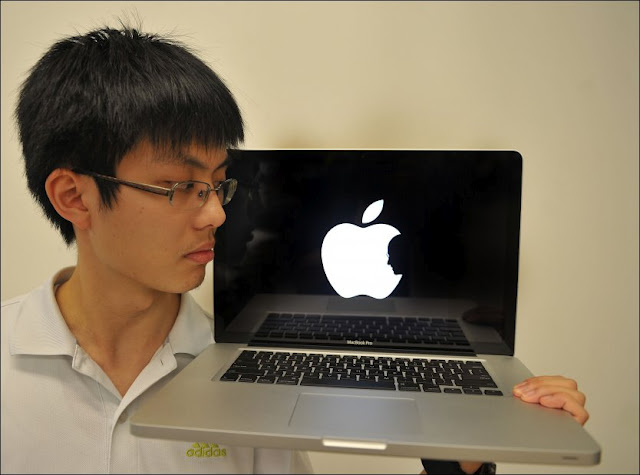
You’re probably familiar with the student artist from Hong Kong named Jonathan Mak Long. Last October, shortly after the death of Steve Jobs, Mak dreamed up a little tribute—an Apple symbol subtly embedded with Jobs’s silhouette, seen below:

Jonathan Mak with the now iconic Steve Jobs tribute logo.

Recently, Mak interviewed with Evan Osnos at The New Yorker. It’s a great interview:

I am twenty years old, was born and raised in Hong Kong, and seldom travelled. (My current student-exchange program in Germany marks my second trip beyond Asia.) My mother is a teacher, and my father works as a translator. They do not have a background in visual creativity, but they are the main reason for my interest in language, which has been tremendously helpful to my growth as a designer.

Like almost everybody else, I loved doodling and making things when I was young, but I never quite left that phase. I continued to create, such as writing a class newspaper, trying my hand at songwriting, and even recording my own podcast. Graphic design began as simply part of my compulsion to create, but, as I got increasingly comfortable with the medium, my love for it grew, and it has not stopped since.

The bulk of the interview is focused on design in China:

Discussing Chinese design is tricky. On one hand, you have the cream of the crop—contemporary graphics effortlessly combined with just enough Chinese motifs to differentiate them from the West. But at the same time, we have countless adverts that are flamboyant, sickly sweet, and just hyperbolic all around, often with jarring color combinations and tragic abuse of effect filters. “That is so ‘mainland,’ ” a Hong Konger might snort in derision. I am sometimes guilty of this reaction, but I am trying to see the other side of this issue.

Click through the interview to see the design he made for Coca-Cola, China.