On Our Feelings After Facebook Use

I’ve been reading a number of different studies that are in opposite camps about Facebook: on the one hand, Facebook helps us feel more social; on the other hand, Facebook depresses us. So which is it?

Maria Konnikova, writing in The New Yorker, summarizes that the answer isn’t black and white:

The key to understanding why reputable studies are so starkly divided on the question of what Facebook does to our emotional state may be in simply looking at what people actually do when they’re on Facebook. “What makes it complicated is that Facebook is for lots of different things—and different people use it for different subsets of those things. Not only that, but they are alsochanging things, because of people themselves changing,” said Gosling. A 2010 study from Carnegie Mellon found that, when people engaged in direct interaction with others—that is, posting on walls, messaging, or “liking” something—their feelings of bonding and general social capital increased, while their sense of loneliness decreased. But when participants simply consumed a lot of content passively, Facebook had the opposite effect, lowering their feelings of connection and increasing their sense of loneliness.

I would argue that “liking” things on Facebook has become the generic, zombie-like action that isn’t particularly social. Commenting on photos and posts, however, are examples of actively engaging with content.

How Facebook is Making us Lonely and Unhappy

What is the connection with being active on social networks and being lonely? A lot more than you think. Watch this video below titled “The Innovation of Loneliness”:


Beautifully done. And I hope you didn’t miss the underlying message. It’s even more pernicious than that: not only are we becoming more lonely with  frequent use of Facebook, we’re also feeling terrible about it as a consequence.

How to Love Facebook Again

Jessica Hische published a great post explaining how she fell in love with Facebook, then started to hate it, and the process she went through to love it again. It helped that her future husband became an employee of Facebook, but her number one advice is to be selective in the friending.

  1. Only friend people you actually want to be friends with.
    This sounds dumb, but is amazingly hard to adhere to. As mentioned above, I only friend people that I would be happy to see if they stopped by for an unexpected visit. If you follow this rule, there are a lot of Facebook services (like check-ins) that you will feel a lot more comfortable using.

  2. Set your privacy settings to a level that makes you happy.Facebook isn’t a leather-bound diary you stuff under your mattress. It’s a public place. Privacy is the thing people complain most about on Facebook, especially since the launch of Graph Search—which makes all public content on Facebook a lot easier to find (note the emphasis on public—if you’ve marked posts or photos as only viewable by friends, these won’t show up when non-friends search for things). Truthfully, Facebook would be a very boring place if every person had his or her privacy settings all the way up. Searches that are now possible because of Graph Search (like “restaurants my friends have been to in Portland” or “friends of friends who used to live in Brooklyn and who now live in San Francisco”) wouldn’t be possible, and this new tool would be a whole lot less useful.Yes, Facebook isn’t “free”—we pay for it by sharing personal data about ourselves—but all other “free” services (like all of Google’s products) operate similarly, they’re just better at making us feel good about how they sell our information to advertisers (I mean, how amazing were those commercials with the dad and the guy who gets married? They make me cry every single time.) I do get a kick out of the Facebook sidebar advertisements and how amazingly off they can be (rehab and egg donation in the same sidebar? Who do you think I am, Facebook?!).After spending a lot of time with the people that help make Facebook what it is, I can say that I haven’t met a single employee that didn’t think they were making the world a better and more connected place by working there.

  3. Don’t mix business with pleasure.I choose Facebook to be my friends-and-family-only social network, but some people have found it to be incredibly beneficial if used as a business network. My only advice is to use separate social networks for friends and for business. This doesn’t mean that you aren’t going to befriend work peers on Facebook if you choose it as your “friends only” zone, it just means that the person you present there is you. I’m a very open person and don’t think that my professional self is different from my personal self, but there are still things that people that know me in real life would care to read about that total strangers would not. I share almost everything that pops into my brain with my Twitter followers, but sometimes if I need some real friend advice about a personal matter, I’ll only ask on Facebook. It’s my opinion that Twitter is an amazing work-centric network, and Facebook is best used for personal interactions, but every person is different. I don’t advocate one over the other, I think that the two work in tandem to create a well-rounded online social experience.

  4. Don’t be afraid to hide people.Hiding is one of the most wonderful things Facebook has introduced. If someone starts showing up in my newsfeed that I don’t regularly talk to or see in real life—like a friend from high school that I would love to reconnect with when I’m home for the holidays but don’t want to see frequent updates from—I will hide them. I can still check in on them when they pop into my head on a rainy day or I can message them over Thanksgiving when I’m back home, but I’m not flooded with their baby pictures on a daily basis. Hiding people (checking or unchecking “show posts in news feed” when you hover over the friendship button) will change your life. You have control over who shows up in your newsfeed.

  5. One word: stickers.Now on Facebook, you can use these things called stickers, which are like elaborate emoji, and they will cause you so much delight you will never want to use traditional text messaging again. There are days when Russ and I communicate only in “Pusheen”.

Worth reading.

“The Facebook Experience Has Failed”

An articulate blog post on why Facebook is on the decline (or why you should consider it to be so):

While the social network is in a way similar to real world associations, the way sharing works on Facebook is completely disconnected from reality. In the real world, you don’t have information that you need to share with every single person you know.

But that’s how it works on Facebook, unless you jump through hoops to make lists and share selectively.

I don’t agree that Facebook gets worse the more you use it (on the contrary), but I think this this observation is astute (but sad):

The way Facebook advertising works, it bumps the spamming potential of a ‘Like’ up a notch. A ‘Like’ on a product or service will make a paid story visible not just to the person who liked it, but also to their friends.

Inevitably, there is an entire industry working non-stop creating low quality, emotionally appealing content that gets ‘likes’ from gullible users.


Data Science of the Facebook World

The ever insightful Stephen Wolfram has another graph-heavy post, this time compiling data on Facebook analytics:

More than a million people have now used our Wolfram|Alpha Personal Analytics for Facebook. And as part of our latest update, in addition to collecting some anonymized statistics, we launched a Data Donor program that allows people to contribute detailed data to us for research purposes.

A few weeks ago we decided to start analyzing all this data. And I have to say that if nothing else it’s been a terrific example of the power of Mathematica and the Wolfram Language for doing data science. (It’ll also be good fodder for the Data Science course I’m starting to create.)

We’d always planned to use the data we collect to enhance our Personal Analyticssystem. But I couldn’t resist also trying to do some basic science with it.

I’ve always been interested in people and the trajectories of their lives. But I’ve never been able to combine that with my interest in science. Until now. And it’s been quite a thrill over the past few weeks to see the results we’ve been able to get. Sometimes confirming impressions I’ve had; sometimes showing things I never would have guessed. And all along reminding me of phenomena I’ve studied scientifically in A New Kind of Science.

So what does the data look like? Here are the social networks of a few Data Donors—with clusters of friends given different colors. (Anyone can find their own network usingWolfram|Alpha—or the SocialMediaData function in Mathematica.)

It’s a pretty fascinating read.

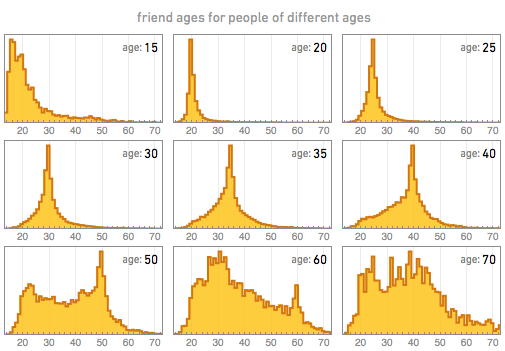
My favorite graph was this one of the distribution of  your Facebook friends’ age versus your age:

The age of your Facebook friends versus your age.

The age of your Facebook friends versus your age.

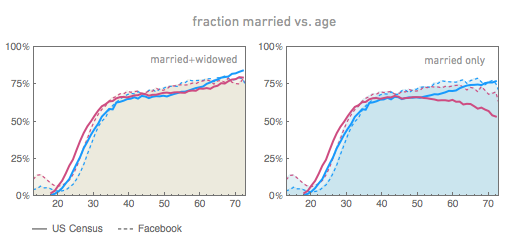
It’s also quite interesting how the marriage statistics from Facebook line up with the official Census data:

Facebook marriage age vs. Census data.

Facebook marriage age vs. Census data.

For a lot more analysis, read Stephen Wolfram’s entire post.

Facebook is Blowing it With Its Mobile Advertisements

Andrew Leonard pens a very good rant on the annoying, intrusive ads Facebook is delivering to users of the mobile version of the app:

And now she’s in my phone. And guess what? In Facebook’s mobile app, there is no option to hide all sponsored ads from a particular advertiser. Your only choice is the basic option you have with any kind of post — you can mark it as spam. Supposedly, reporting posts as spam will decrease the likelihood that you see them, but I’m afraid I’ve seen zero positive change in the frequency or content of Facebook’s sponsored story ads, despite what Facebook claims. Instead I am getting more of the ads I don’t want on my phone, after years of telling Facebook I don’t like exactly those types of ads. This is not an encouraging trend line.

By the time the first trickle of caffeine had woken up my synapses, I realized that I was done. I had reached my tipping point. I no longer want to check Facebook on my phone.

Does Facebook really think so little of me? Am I not man enough to seek my own romantic path without Facebook’s help?

And the money quote:

I’m sorry, Mark Zuckerberg, but my iPhone screen is just not big enough for those breasts.

As a user of the app on my iPhone, I’ve noticed these annoying ads as well. I haven’t quite reached the tipping point of quitting the service, but I am irked enough to highlight others’ reactions to it and am not surprised with Mr. Leonard’s decision.

The Unfair San Francisco Housing and Rental Market

Writing in the London Review of Books, Rebecca Solnit expresses her discontent at the unstable housing market in San Francisco, driven by new money from the tech boom (Google, Facebook, etc.):

At the actual open houses, dozens of people who looked like students would show up with chequebooks and sheaves of resumés and other documents and pack the house, literally: it was like a cross between being at a rock concert without a band and the Hotel Rwanda. There were rumours that these young people were starting bidding wars, offering a year’s rent in advance, offering far more than was being asked. These rumours were confirmed. Evictions went back up the way they did during the dot-com bubble. Most renters have considerable protection from both rent hikes and evictions in San Francisco, but there are ways around the latter, ways that often lead to pitched legal battles, and sometimes illegal ones. Owners have the right to evict a tenant to occupy the apartment itself (a right often abused; an evicted friend of mine found a new home next door to his former landlord and is watching with an eagle eye to see if the guy really dwells there for the requisite three years). Statewide, the Ellis Act allows landlords to evict all tenants and remove the property from the rental market, a manoeuvre often deployed to convert a property to flats for sale. As for rent control, it makes many landlords restless with stable tenants, since you can charge anything you like on a vacant apartment – and they do.

A Latino who has been an important cultural figure for forty years is being evicted while his wife undergoes chemotherapy. One of San Francisco’s most distinguished poets, a recent candidate for the city’s poet laureate, is being evicted after 35 years in his apartment and his whole adult life here: whether he will claw his way onto a much humbler perch or be exiled to another town remains to be seen, as does the fate of a city that poets can’t afford. His building, full of renters for most or all of the past century, including a notable documentary filmmaker, will be turned into flats for sale. A few miles away, friends of friends were evicted after twenty years in their home by two Google attorneys, a gay couple who moved into two separate units in order to maximise their owner-move-in rights. Rental prices rose between 10 and 135 per cent over the past year in San Francisco’s various neighbourhoods, though thanks to rent control a lot of San Franciscans were paying far below market rates even before the boom – which makes adjusting to the new market rate even harder. Two much-loved used bookstores are also being evicted by landlords looking for more money; 16 restaurants opened last year in their vicinity. On the waterfront, Larry Ellison, the owner of Oracle and the world’s sixth richest man, has been allowed to take control of three city piers for 75 years in return for fixing them up in time for the 2013 America’s Cup; he will evict dozens of small waterfront businesses as part of the deal.

Evictions, foreclosures, and legal loopholes. This doesn’t sound like a city I’d want to inhabit. A must-read for perspective.
The Twenty Year Game of Tag

The Wall Street Journal has a bizarre story of four grown men who’ve been playing a game of tag for 23 years:

It started in high school when they spent their morning break darting around the campus of Gonzaga Preparatory School in Spokane, Wash. Then they moved on—to college, careers, families and new cities. But because of a reunion, a contract and someone’s unusual idea to stay in touch, tag keeps pulling them closer. Much closer.

The game they play is fundamentally the same as the schoolyard version: One player is “It” until he tags someone else. But men in their 40s can’t easily chase each other around the playground, at least not without making people nervous, so this tag has a twist. There are no geographic restrictions and the game is live for the entire month of February. The last guy tagged stays “It” for the year.

I guess this game beats Facebook pokes, but:

The participants say tag has helped preserve friendships that otherwise may have fizzled. Usually, though, the prospect of 11 months of ridicule overrides brotherhood.

Weird.

The Hoodie Phenomenon

Tim Maly, in a thoughtful essay titled “Mark Zuckerberg’s Hoodie,” ponders the role of privacy and social behavior as the hoodie has gone mainstream:

People who know they’re being watched change their behaviour. In a world awash in surveillance devices, hoodies are an element of fashion driven by an architectural condition. They are a response to the constant presence of cameras overhead. People who don’t want to be watched wear them. People who want to be the kind of people who don’t want to be watched wear them. People who want to look like the kind of people who don’t want to be watched wear them.

Through a series of vignettes, Maly brings us from 2005 to present day:

It is January 13, 2013 and Mark Zuckerberg is promising a revolution. He’s on stage, wearing his hoodie. He seems comfortable. His colleague Tom Stocky is trying to help a hypothetical girl find a date. He runs a query and gets a list of men who are friends of friends and single. It’s a veritable cornucopia of potential men. He narrows them down to people in San Francisco. Then down to people in San Francisco who are from India. His hypothetical woman is sure to be pleased.

Just don’t wear that hoodie to a first date, you know?

Alex Payne: Alone, Together, Technology

This is a must-read personal post by Alex Payne, in which he reflects the influence of technology in his life following a divorce with his wife:

I owe my life to technology.

I first realized it in my early twenties. Everything important around me at the time, I’d found on Craigslist: my girlfriend, my job, my apartment. It was a powerful realization: I could sit down with my laptop and, in a matter of hours or days, change my world in both superficial and fundamental ways.

That was years ago. Technology specializes over time. The life I just finished packing up wasn’t courtesy of Craigslist. It wouldn’t be, now. The modern web has six sites for everything, branded and polished and localized and full of options. House from Redfin. Cars negotiated online before ever walking into a dealership. Wife from OkCupid. Wedding invitations by email. Date-night dinners booked on OpenTable. Fast and friction-free.

I spent four years telling anyone who asked how we met that OkCupid’s matching algorithms must have been off. “We were only a seventysomething percent match, with like a twelve percent chance of being enemies. Guess they need to work some bugs out!” The joke’s on me, of course. I emailed the right person at OkCupid to apologize for the years of disparagement.

I could blame technology. Maybe stitching together a durable life takes physical work, needle callouses.

I think this was the second best line in the piece:

Maybe technology made it all too easy to slide into a life I wasn’t meant to have.

And the best:

I will owe the next part of my life to technology, but I will owe it more to experience.

Amen.

Again, a must-read in its entirety.