From a Reddit Response to Big Budget Film

I love reading stories like this. One day James Erwin was browsing Reddit.com and stumbled upon an interesting hypothetical question: Could I destroy the entire Roman Empire during the reign of Augustus if I traveled back in time with a modern U.S. Marine infantry battalion or MEU [Marine Expeditionary Unit]? He clicked through, answered some questions, and the rest, they say, is history:

It’s common for random questions to appear on Reddit’s front page, like “Is there a magnet capable of pulling the iron out of your body?” or “What is the most awkward thing you could say to a cashier while purchasing condoms?” That day, as Erwin scanned Reddit, a question caught his eye. It was posed by someone calling themselves The_Quiet_Earth: “Could I destroy the entire Roman Empire during the reign of Augustus if I traveled back in time with a modern U.S. Marine infantry battalion or MEU [Marine Expeditionary Unit]?” Erwin clicked on the question and a lively comment thread unfurled. Hundreds of people were whipping hypotheticals back and forth, gaming out the implications of a marines-versus-Romans smackdown. What’s the range of a Roman spear? How would the Romans react to a helicopter? What would happen when the Americans ran out of bullets?

Erwin, who studied history at the University of Iowa, had been posting on Reddit for about five months. He used the alias Prufrock451, a dual reference to the schlubby protagonist of a T. S. Eliot poem and the Ray Bradbury novel Fahrenheit 451. Prufrock451′s contributions were all over the map. One day he wrote about the historical roots of the civil war in Liberia; another day he told a funny story about a shooting range in Iowa. He also uploaded a few pictures of European forts that he thought looked cool and a quote by Voltaire. In his atypicalness—Prufrock451 was pretty clearly a quirky character—he was entirely typical of a habitual Reddit user, and like many other redditors, as they are called, he found the site addictive. More than just a creative outlet or time-killer, Reddit was a game. The object was to amass points—”Reddit karma.” Every time Erwin saw his karma level increase, he felt a little squirt of adrenaline. “People are sweating to make you laugh or make you think or make you hate them,” Erwin says. “It’s the human condition, plus points.”

Now, in response to The_Quiet_Earth’s question about time-traveling marines, Erwin started typing. He posted his answer in a series of comments in the thread. Within an hour, he was an online celebrity. Within three hours, a film producer had reached out to him. Within two weeks, he was offered a deal to write a movie based on his Reddit comments. Within two months, he had taken a leave from his job to become a full-time Hollywood screenwriter.

So what was Erwin’s financial gain from this personal endeavor?

Erwin won’t disclose what the deal is worth, but he is now a member of the Writers Guild of America, West, and the guild compensation for an original screenplay plus treatment for a movie with a budget above $5 million is $119,954. According to Kolbrenner, Rome Sweet Rome is “definitely a big-budget movie,” but whether that means $30 million or $150 million will depend on Erwin’s script.

Read the full story here.

The Charlemagne Riddle and Pedigree Collapse

Robert Krulwich recounts a story/riddle about a guy who discovered he was related to Charlemagne the Great. But was he? He went to class one day, where the teacher had a lesson on genealogy:

The teacher says if you count your direct ancestors backward through time, the further back you go, obviously, the more ancestors you have. But when you do the numbers, something queer happens.

Go back to A.D. 800, he said, and the number of direct ancestors is, well, puzzling. You start with two grandparents, then four great-grandparents, then on to eight, 16, etc., and by the time you get to A.D. 800, the number averages to about 562,949,953,421,321. That’s a lot of people. In fact, that’s more people than have ever lived.

So if you go far back enough in history, everyone is related to Charlemagne. This answer is justified with the so-called pedigree collapse:

Without pedigree collapse, a person’s ancestor tree is a binary tree, formed by the person, the parents (2), the grandparents (4), great-grandparents (8), and so on. However, the number of individuals in such a tree grows exponentially and will eventually become impossibly high. For example, a single individual alive today would, over 30 generations going back to the High Middle Ages, have 230 or roughly a billion ancestors, more than the total world population at the time.

This apparent paradox is explained by shared ancestors. Instead of consisting of all unique individuals, a single individual may occupy multiple places in the tree. This typically happens when the parents of an ancestor are cousins (sometimes unbeknownst to themselves). For example, the offspring of two first cousins has at most only six great-grandparents instead of the normal eight. This reduction in the number of ancestors is pedigree collapse. It collapses the ancestor tree into a directed acyclic graph.

In some cultures, cousins were encouraged or required to marry to keep kin bonds, wealth and property within a family (endogamy). Among royalty, the frequent requirement to only marry other royals resulted in a reduced gene pool in which most individuals were the result of extensive pedigree collapse

So next time someone says they’re a direct descendant of someone, say, who was born before 1600, be highly, highly skeptical.

The Man Who Wouldn’t Die

This is an amazing story of “The Murder Trust” (notably Francis Pasqua, Daniel Kriesberg, and Tony Marino) and their devious efforts (in 1932) to make Michael Malloy drink himself to death in order to subsequently collect insurance money:

Pasqua offered to do the legwork, paying an unnamed acquaintance to accompany him to meetings with insurance agents. This acquaintance called himself Nicholas Mellory and gave his occupation as florist, a detail that one of Pasqua’s colleagues in the funeral business was willing to verify. It took Pasqua five months (and a connection with an unscrupulous agent) to secure three policies—all offering double indemnity—on Nicholas Mellory’s life: two with Prudential Life Insurance Company and one with Metropolitan Life Insurance Company. Pasqua recruited Joseph Murphy, a bartender at Marino’s, to identify the deceased as Michael Malloy and claim to be his next of kin and beneficiary. If all went as planned, Pasqua and his cohorts would split $3,576 (about $54,000 in today’s dollars) after Michael Malloy died as uneventfully and anonymously as he had lived.

But when free drinks at the bar, for three consecutive days, didn’t cause any visible changes in Malloy, the group sought to expand on their deviousness by exchanging Malloy’s whiskey and gin with shots of wood alcohol. Drinks containing just four percent wood alcohol could cause blindness, and by 1929 more than 50,000 people nationwide had died from the effects of impure alcohol. They would serve Malloy not shots tainted with wood alcohol, but wood alcohol straight up.

He weathered through it. So what next?

At this point killing Michael Malloy was just as much about pride as about a payoff—a payoff, they all griped, that would be split among too many conspirators. Murphy tried next. He let a tin of sardines rot for several days, mixed in some shrapnel, slathered the concoction between pieces of bread and served Malloy the sandwich. Any minute, they thought, the metal would start slashing through his organs. Instead, Malloy finished his tin sandwich and asked for another.

So how did the story end? Find out here.

The History of Infographics

This piece sparked my interest in exploring the history of infographics. Excluding cave paintings, the history of infographics dates back to the 1600s:

In 1626 Christopher Scheiner published the Rosa Ursina sive Sol which used a variety of graphics to reveal his astronomical research on the sun. He used a series of images to explain the rotation of the sun over time (by tracking sunspots).

In 1786, William Playfair published the first data graphs in his book The Commercial and Political Atlas. The book is filled with statistical graphs, bar charts, line graphs, and histograms, that represent the economy of 18th century England.

Perhaps most famously, the English nurse Florence Nightingale, in 1857, used information graphics persuading Queen Victoria to improve conditions in military hospitals, principally the Coxcomb chart, a combination of stacked bar and pie charts, depicting the number and causes of deaths during each month of the Crimean War.

"Diagram of the causes of mortality in the army in the East," published by Florence Nightingale.

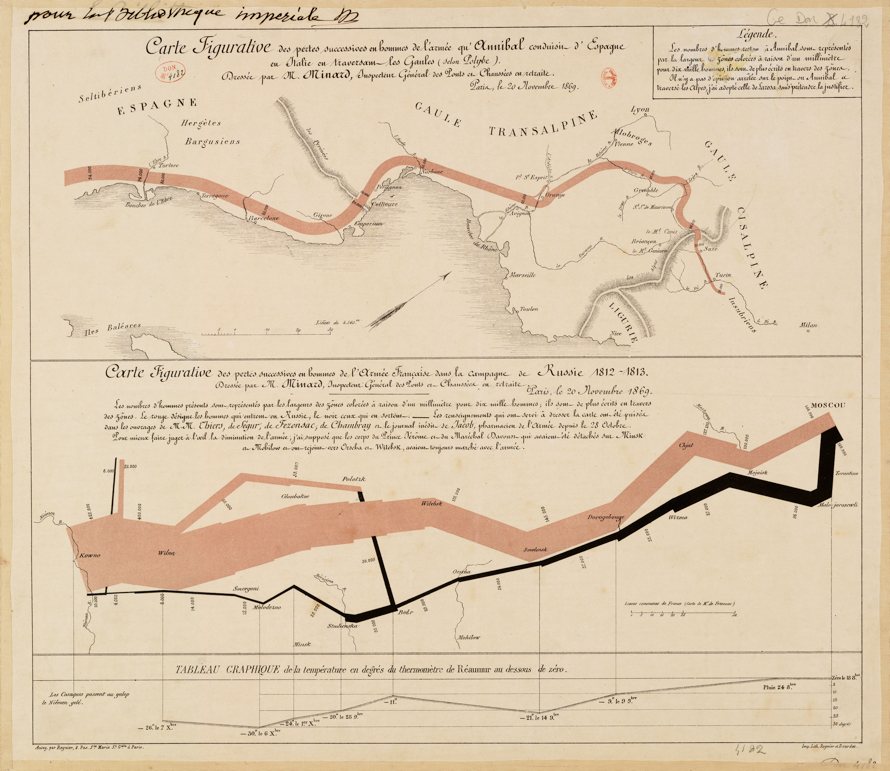
The piece in The Morning News profiles, among a few other selections, the French engineer Charles Joseph Minard, who devised a number of new and influential infographic techniques. Among the most famous of his charts from this period is the 1869 “Carte figurative des pertes successives en hommes de l’armée française dans la campagne de Russie 1812–1813 comparées à celle d’Hannibal durant la 2ème Guerre Punique.” The two diagrams, published together, show the size and attrition of the armies of Hannibal in his expedition across the Alps during the Punic wars and of Napoleon during his assault on Russia. The colored band in the diagrams indicates the army’s strength of numbers—in both charts, one millimeter in thickness represents ten thousand men. The chart of Napoleon’s march includes an indication of temperature as well.

Top: Hannibal in his expedition across the Alps during the Punic wars. Bottom: Napoleon's assault on Russia.

See this Wikipedia link for more.

Ten Wisdoms from Thomas Jefferson

In 1825, Thomas Jefferson was asked by a father to supply a few words of wisdom to his young son, Thomas Jefferson Smith (who had recently been named after Thomas Jefferson). The president responded with a handwritten letter, at the end of which was the following 10-point list of advice for the youngster titled “A Decalogue of Canons for Observation in Practical Life.” Following were Thomas Jefferson’s ten bits of wisdom:

1. Never put off till tomorrow what you can do to-day.
2. Never trouble another for what you can do yourself.
3. Never spend your money before you have it.
4. Never buy what you do not want, because it is cheap; it will be dear to you.
5. Pride costs us more than hunger, thirst and cold.
6. We never repent of having eaten too little.
7. Nothing is troublesome that we do willingly.
8. How much pain have cost us the evils which have never happened.
9. Take things always by their smooth handle.
10. When angry, count ten, before you speak; if very angry, an hundred.

The advice is as applicable today as it was almost two hundred years ago.

###

(via Lists of Note)

On YouTube

John Seabrook’s New Yorker piece “Streaming Dreams” explores, in-depth, the development and growth of YouTube. It’s well worth the read.

On the first video ever uploaded to YouTube:

On the evening of April 23, 2005, Karim uploaded the first video to YouTube—an eighteen-second clip of him, standing in front of the elephant enclosure at the San Diego Zoo, wearing an ill-fitting hiking jacket. He says, “The cool thing about these guys is that they have really, really, really long trunks, and that’s cool,” smirks a little, and ends with “And that’s pretty much all there is to say.” Civilization would never be the same.

On the immensity and growth of YouTube:

Today, it has eight hundred million unique users a month, and generates more than three billion views a day. Forty-eight hours of new video are uploaded to the site every minute. According to Nielsen, it drew eight times more video viewers last year than Hulu, which is jointly owned by NBCUniversal, News Corporation, and the Walt Disney Company, among others. It is the first truly global media platform on earth.

There is the premise of users and consumers in the piece. I am strictly a consumer: I’ve never uploaded a single video to YouTube.

Social Media During the Reformation, or How Luther Went Viral

It’s hard to put the words “social media” and “Reformation” together, yet this brilliant piece in The Economist explains how Martin Luther’s 95 Theses went viral.

Although they were written in Latin, the “95 Theses” caused an immediate stir, first within academic circles in Wittenberg and then farther afield. In December 1517 printed editions of the theses, in the form of pamphlets and broadsheets, appeared simultaneously in Leipzig, Nuremberg and Basel, paid for by Luther’s friends to whom he had sent copies. German translations, which could be read by a wider public than Latin-speaking academics and clergy, soon followed and quickly spread throughout the German-speaking lands. Luther’s friend Friedrich Myconius later wrote that “hardly 14 days had passed when these propositions were known throughout Germany and within four weeks almost all of Christendom was familiar with them.”

The unintentional but rapid spread of the “95 Theses” alerted Luther to the way in which media passed from one person to another could quickly reach a wide audience. “They are printed and circulated far beyond my expectation,” he wrote in March 1518 to a publisher in Nuremberg who had published a German translation of the theses. But writing in scholarly Latin and then translating it into German was not the best way to address the wider public. Luther wrote that he “should have spoken far differently and more distinctly had I known what was going to happen.” For the publication later that month of his “Sermon on Indulgences and Grace”, he switched to German, avoiding regional vocabulary to ensure that his words were intelligible from the Rhineland to Saxony. The pamphlet, an instant hit, is regarded by many as the true starting point of the Reformation.

You probably learned in your world history class that the 95 Theses were a precursor to the Reformation. So why did Luther’s message spread?

Unlike larger books, which took weeks or months to produce, a pamphlet could be printed in a day or two. Copies of the initial edition, which cost about the same as a chicken, would first spread throughout the town where it was printed. Luther’s sympathisers recommended it to their friends. Booksellers promoted it and itinerant colporteurs hawked it. Travelling merchants, traders and preachers would then carry copies to other towns, and if they sparked sufficient interest, local printers would quickly produce their own editions, in batches of 1,000 or so, in the hope of cashing in on the buzz. A popular pamphlet would thus spread quickly without its author’s involvement.

As with “Likes” and retweets today, the number of reprints serves as an indicator of a given item’s popularity. Luther’s pamphlets were the most sought after; a contemporary remarked that they “were not so much sold as seized”. His first pamphlet written in German, the “Sermon on Indulgences and Grace”, was reprinted 14 times in 1518 alone, in print runs of at least 1,000 copies each time. Of the 6,000 different pamphlets that were published in German-speaking lands between 1520 and 1526, some 1,700 were editions of a few dozen works by Luther. In all, some 6m-7m pamphlets were printed in the first decade of the Reformation, more than a quarter of them Luther’s.

Another interesting point is that the spread of Luther’s message wasn’t limited to printed media:

It was not just words that travelled along the social networks of the Reformation era, but music and images too. The news ballad, like the pamphlet, was a relatively new form of media. It set a poetic and often exaggerated description of contemporary events to a familiar tune so that it could be easily learned, sung and taught to others. News ballads were often “contrafacta” that deliberately mashed up a pious melody with secular or even profane lyrics. They were distributed in the form of printed lyric sheets, with a note to indicate which tune they should be sung to. Once learned they could spread even among the illiterate through the practice of communal singing.

The piece is interesting throughout, and has a very good conclusion: Today’s social-media systems do not just connect us to each other: they also link us to the past.

###

Question for the reader: what other events/messages in history, do you think, spread virally in a similar fashion? I can think of a few.

Vision of the Internet from 1982

An archived article at The New York Times from 1982 envisages the internet:

The report suggests that one-way and two-way home information systems, called teletext and videotex, will penetrate deeply into daily life, with an effect on society as profound as those of the automobile and commercial television earlier in this century.

It conjured a vision, at once appealing and threatening, of a style of life defined and controlled by videotex terminals throughout the house.

As a consequence, the report envisioned this kind of American home by the year 1998: ”Family life is not limited to meals, weekend outings, and oncea-year vacations. Instead of being the glue that holds things together so that family members can do all those other things they’re expected to do – like work, school, and community gatherings -the family is the unit that does those other things, and the home is the place where they get done. Like the term ‘cottage industry,’ this view might seem to reflect a previous era when family trades were passed down from generation to generation, and children apprenticed to their parents. In the ‘electronic cottage,’ however, one electronic ‘tool kit’ can support many information production trades.”

I’ve never heard of the “videotex” industry before:

The study focused on the emerging videotex industry, formed by the marriage of two older technologies, communications and computing. It estimated that 40 percent of American households will have two-way videotex service by the end of the century. By comparison, it took television 16 years to penetrate 90 percent of households from the time commercial service was begun. 

Some incredibly prescient predictions here:

The home will double as a place of employment, with men and women conducting much of their work at the computer terminal. This will affect both the architecture and location of the home. It will also blur the distinction between places of residence and places of business, with uncertain effects on zoning, travel patterns and neighborhoods.

Home-based shopping will permit consumers to control manufacturing directly, ordering exactly what they need for ”production on demand.”

Interesting to dig up archive articles like this, no?