Space Shuttle Endeavour Crosses Los Angeles

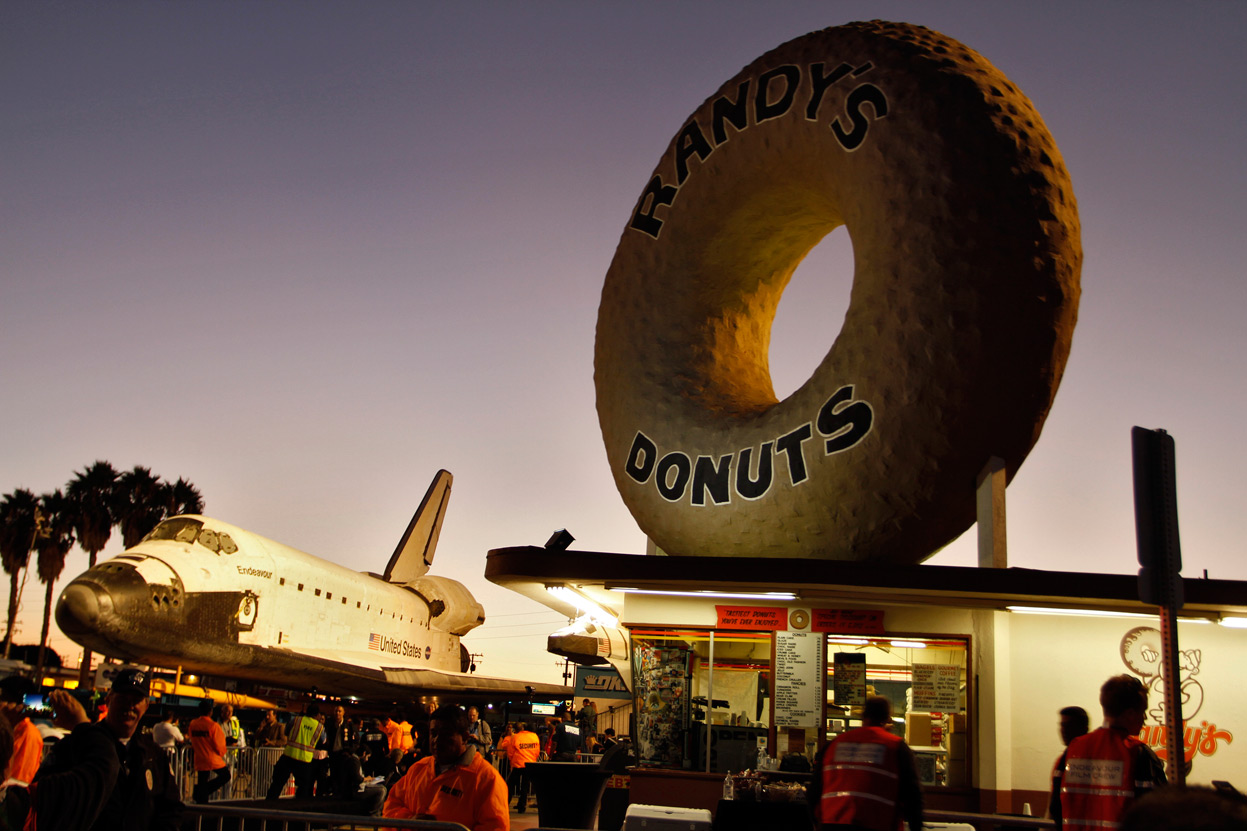
The Atlantic’s In Focus blog has a superb gallery of photos showing how Space Shuttle Endeavour has made its way through Los Angeles on its way to its final destination, California Science Center. This is an urban feast for the eyes:

Stopping by Randy’s Donuts in Los Angeles.

Traversing city streets in L.A.

Shuttle Crossing!

See the full gallery here.

I, of course, have a special connection to Shuttle Endeavour after having witnessed its last launch into space last year. You can read about my experience here.

Faking It: Manipulated Photography Before Photoshop

Take a look at the photograph below. Do you think it is real or fake? Or it is simply a matter of perception?

The New York Times considers this photograph, and a few others, in this piece about an exhibition focusing on manipulated photography at the Metropolitan Museum of Art:

A technical problem in the 19th century, for example, was that photographic emulsions were disproportionately sensitive to blue and violet light, resulting almost always in overexposed skies. So like many other landscape photographers, Carlton E. Watkins inserted properly exposed clouds from a different negative into the blank sky in a grand view of cliffs along the Columbia River in Oregon that he shot in 1867. In the exhibition you can compare one print without and one with the interloping clouds. Though artificially produced, the print with clouds looks more natural.

But, you might ask, is tweaking to achieve more realistic effects in the same category as flimflam? At about the same time that Watkins was photographing out West, the journeyman studio photographer William H. Mumler made a name for himself selling “spirit photographs,” in which ghostly visitors appeared in portraits of real people. If you look at his prints now, it is hard to believe that anyone could have been deceived by them, but many were, until the law intervened and charged him with fraud and larceny.

Mia Fineman, the organizer of the exhibition, claims that her goal is to make viewers understand that “a different view of photography prevailed among the intelligentsia for most of the 20th century.” Take a look at this photograph, for example:


Mary Todd Lincoln with the spirit husband, Abraham Lincoln.

Photographed by William Mumler, such a “spirit photograph” fooled many people in its heyday. So ferocious was the case against him that he was taken to court for fraud, with noted showman P. T. Barnum testifying against him. Though found not guilty, his career was over, and he died in poverty.

If you’re in New York, or visiting there in the next couple of months, the exhibition Faking It is something worth checking out.

Exploring Monsters University

Monsters University is unlike any university website I’ve visited. Established in 1313 following a land grant from the city of Monstropolis, Monsters University has “grown from a small local center of learning to a leading global institution of higher education.” I particularly enjoyed this letter from President Victoria Gross:

While we have built a campus known for its diversity, academic disciplines and excellence, MU is also an institution that lives by its intellectual curiosity, as we foster a willingness to challenge what is blindly accepted, and seek what is quantitatively true. We are a unique group of educators and students who, by the rigors of exhaustive focus and effort, demand more from ourselves. Because excellence is a word that is not awarded by inclusion into this fabled institution, it’s a word that must be earned, protected, and treasured. 

Our advancements in the academic fields of Scaring, Science, Engineering, and Business are, of course, now legendary. And the range of disciplines and their interrelationships throughout our campus has created a unique mix of intellectual and cultural perspectives, perspectives that not only define us, but drive us to be better. 

At MU we also dedicate ourselves to ethical and responsible uses of financial, physical, and environmental resources. We continually remind ourselves to care for the fragile tapestry of our environment and to temper our needs for power with our desire to make our world a more sustainable place for all our future generations. 

Our undergraduates pursue bachelor’s degrees ranging from Canister Design to Cognitive Neuroscience. Our graduates have gone on to shape our world in the fields of Power, Science, and Literature. And while the awards, patents, and accolades help to reinforce our goals, it is the pure impulse of intellectual desire that drives us. 

Our interdisciplinary opportunities in molecular pharmacology and physiology, and our master’s program in acting and directing through the MU Repertory Consortium all have helped establish MU as one of the most diverse academic environments in the world. 

But what really makes us special, what makes us unique, are the diverse groups of monsters that teach and learn in the halls of our beautiful campus. Monsters of all varieties, from the wide-eyed freshman just cutting his fangs to the seasoned post-grad student, create a diversity of culture that makes MU one of the most unique educational environments in the world. 

I remember one particular student, freshly admitted into the Semantics department, who would gnash his mandibles wildly and swing his enormously spiked tail at the first provocation or challenge, no matter how insignificant. Little could be done to temper his behavior, and we all thought he would not last long under the rigors of MU’s difficult Semantics program. But years later, I was pleased to see him graduate and even more pleased when he approached me, a bit sheepishly, after graduation and told me this: 

“There is a difference between being a Monster, and behaving monstrously.” 

That difference is MU. 

We are a place where learning is fluid and ever-changing, where the river of knowledge pushes us in unconventional and unexpected directions. Yet, we also remain anchored by the centuries of traditions that have proved essential in developing our academic foundations. 

I am proud to belong to an academic community that continually pushes its students towards excellence, a community that is not content to rest on its past accomplishments but is ever looking forward to a future of new designs and possibilities.
There’s a lot more to explore here. Click around and find out what books they’re reading!

And if you’ve never seen the cartoon, it’s worth it. One of my favorites.

###

(hat tip: @openculture)

How To Win The New Yorker Caption Contest

Robert Mankoff offers two tips on how to win The New Yorker’s Caption Contest:

  1. Be funnier.
  2. Enter more.

Since there are approximately 5,000 entries per every contest, your probability of winning is modeled by this simple equation:

X = 1-(4,999/5,000)^n

Where X is your chance of winning over time, and n is how many times you enter. If you enter the contest for 1,000 times, probabilistically speaking, your chances of winning the contest at least once go up to 20%.

This was a surprise to me, however:

By the way, contrary to conventional wisdom, your odds will also be better if you’re a woman. While some research, using college students as subjects, showed that men were marginally better at generating funny captions than women, for our contest it goes in the other direction. Yes, guys do enter more frequently; eighty-four per cent of all entrants are men. But only seventy-seven per cent of the winners are. For gals, the figures are sixteen and twenty-three per cent. Sisterhood is powerful in our contest, at least marginally so.

Mankoff clearly is invoking the “Gladwell principle” of 10,000 hours here:

While entering more, man or woman, helps, you’ll need an extra element to realistically have a shot. Which brings us back (and about time, too) to No. 1: being funnier. Interestingly, entering more helps you on that score as well. Why? Because if you have any talent for anything, and that includes captioneering, you get better by doing more of it. That was certainly true for Roger Ebert, who finally won after a hundred and seven tries, and although the evidence is only anecdotal, being pretty much restricted to the anecdote you’re reading, I see the more entries/higher level of funniness trend throughout the contest.

So, do more work, both by entering more contests and by spending more time generating captions for each contest. Interviews with winners show that they often do just that, by devising lots of captions for each contest, then tweaking, editing, and finally culling to submit the best one.

Now, shouldn’t you be thinking of more captions?

On Buffalo Mozzarella

I had no idea buffalo mozzarella existed, much less that it was virtually impossible to obtain in the United States. So I read this New York Times Magazine piece with interest:

Why, then, is it so impossible to get truly fresh buffalo mozzarella in the United States? Well, there are all kinds of reasons.

Consider, first off, the conditions in Italy, which are basically perfect. Water buffalo have lived in the hills around Naples for around 1,000 years. (To be clear: these are not the big, brown, wild, hairy bison of the American prairies; they’re the smooth, dark, curly-horned beasts you might expect to see in a documentary about rice farming in China.) One Italian cheesemaker told me that the animals first came to Italy when Hannibal used them to carry his war treasure back from Asia — a story that is historically dubious but does manage to capture the cheese’s almost mythic exoticism. After so many centuries of practice, modern Italians have buffalo dairying down to a science: animal genetics, human expertise, farming infrastructure — it’s all in place and perfectly integrated. If you walk into a shop in Naples and ask for mozzarella, you will get a ball of buffalo milk that probably congealed only hours before. (For the vastly inferior cow’s-milk version — the default in American stores — you have to ask by a whole different name: fior di latte.)

Italy is a quintessentially Old World country — a quilt of microregions, each fiercely loyal to its own traditions and cuisines — which means that it’s perfectly natural to expect your cheese to have been made locally that day. This expectation has been woven so deeply into the fabric of daily life, by so many generations of cheese eaters, that the market for it is guaranteed. And Italy is small enough that, if you do move a fresh product from one major city to the next, it takes only a couple of hours.

The conditions in the United States are the opposite of that. Our water-buffalo herds are sparse and, for the purposes of dairying, practically feral. They’re difficult to acquire and expensive to raise. They produce only a fraction of the milk you get from a typical dairy cow, and they are so psychologically fragile that it’s hard to even get that much out of them.

Read the rest of the piece to learn about Craig Ramini, “.the latest American adventurer hellbent on making fresh buffalo mozzarella.”

Mo Yan: Winner of the 2012 Nobel Prize in Literature

Mo Yan has won the 2012 Nobel Prize for Literature. This NPR piece on Mo Yan’s writing caught my attention:

Among the works highlighted by the Nobel judges were Red Sorghum, The Garlic Ballads, and Big Breasts & Wide Hips. As NPR’s Lynn Neary reports on Morning Edition, “He’s said to be so prolific that he wrote Life and Death Are Wearing Me Out — which is a 500,000-word epic — in just 43 days. He wrote it with a brush — not a computer — because he says a computer would have slowed him down because he can’t control himself when he’s online; he always has to search up more information.”

I’ve placed Life and Death Are Wearing Me Out on my to-read list.

Science Has Just Made Jurassic Park Impossible

If you’ve ever wondered whether Jurassic Park can ever become a reality, rest assured: it can’t. According to a new study, the half-life of DNA is less than a thousand years old, so finding a perfectly preserved DNA sample that’s millions of years old is, by probabilistic measures, quite negligible.

Palaeogeneticists led by Morten Allentoft at the University of Copenhagen and Michael Bunce at Murdoch University in Perth, Australia, examined 158 DNA-containing leg bones belonging to three species of extinct giant birds called moa. The bones, which were between 600 and 8,000 years old, had been recovered from three sites within 5 kilometres of each other, with nearly identical preservation conditions including a temperature of 13.1 ºC. The findings are published in Proceedings of the Royal Society B.

By comparing the specimens’ ages and degrees of DNA degradation, the researchers calculated that DNA has a half-life of 521 years. That means that after 521 years, half of the bonds between nucleotides in the backbone of a sample would have broken; after another 521 years half of the remaining bonds would have gone; and so on.

You can read more here.

Michael Crichton Explains The Gell-Mann Amnesia Effect

The Gell-Mann Amnesia effect has shown up in my timeline today. I had no idea what it meant, but now I know:

Briefly stated, the Gell-Mann Amnesia effect is as follows. You open the newspaper to an article on some subject you know well. In Murray’s case, physics. In mine, show business. You read the article and see the journalist has absolutely no understanding of either the facts or the issues. Often, the article is so wrong it actually presents the story backward—reversing cause and effect. I call these the “wet streets cause rain” stories. Paper’s full of them.

In any case, you read with exasperation or amusement the multiple errors in a story, and then turn the page to national or international affairs, and read as if the rest of the newspaper was somehow more accurate about Palestine than the baloney you just read. You turn the page, and forget what you know.

That’s Michael Crichton’s explanation.

###

(via Paul Kedrosky)

Why Are Elevator Rides So Awkward?

The BBC has a short piece on the psychology of elevator crowding, which leads to awkward moments (almost for everyone):

Conversations that have been struck up in the lobby tend to be extinguished quite quickly in the thick atmosphere of the office elevator. We walk in and usually turn around to face the door.

If someone else comes in, we may have to move. And here, it has been observed that lift-travellers unthinkingly go through a set pattern of movements, as predetermined as a square dance.

On your own, you can do whatever you want – it’s your own little box.

If there are two of you, you take different corners. Standing diagonally across from each other creates the greatest distance.

When a third person enters, you will unconsciously form a triangle (breaking the analogy that some have made with dots on a dice). And when there is a fourth person it’s a square, with someone in every corner. A fifth person is probably going to have to stand in the middle.

Want to make the elevator experience even more awkward? Do what Julien Smith suggests in this Homework Assignment post:

Although there is nothing inherently complex about this assignment, I assure you that, for most, it will be among the most difficult things you do.

Society aligns itself in certain ways. Your body reacts certain ways to stimulus inside society to keep everyone in line, to keep everyone moving in the same direction, to make sure that everyone feels comfortable.

Facing in the right directions has deep implications for people’s sense of personal space and comfort. By performing this assignment you are going against all of those things. It isn’t going to be easy. But that’s ok. You should do it anyway.

For this exercise, find any elevator in a crowded place this weekend.

When the door opens, wait until everyone else has entered or exited. Be sure to be the last person to enter, and when you do, face in the opposite direction as everyone else.

I haven’t been brave enough to take upon this homework assignment just yet, even if I get inside an elevator five days a week.

Is Our Universe a Giant Simulation?

The physics paper of the week is “Constraints on the Universe as a Numerical Simulation” by Silas Beane and company at University of Bonn in Germany. Their fundamental question: is the universe just a giant simulation, in which we are all puppets? From their abstract:

Observable consequences of the hypothesis that the observed universe is a numerical simulation performed on a cubic space-time lattice or grid are explored. The simulation scenario is first motivated by extrapolating current trends in computational resource requirements for lattice QCD into the future. Using the historical development of lattice gauge theory technology as a guide, we assume that our universe is an early numerical simulation with unimproved Wilson fermion discretization and investigate potentially-observable consequences. Among the observables that are considered are the muon g-2 and the current differences between determinations of alpha, but the most stringent bound on the inverse lattice spacing of the universe, b^(-1) >~ 10^(11) GeV, is derived from the high-energy cut off of the cosmic ray spectrum. The numerical simulation scenario could reveal itself in the distributions of the highest energy cosmic rays exhibiting a degree of rotational symmetry breaking that reflects the structure of the underlying lattice.

Could you fathom the possibility that our entire cosmos is running on a vastly powerful computer? I cannot.

###

(via Technology Review)