What Mike Tyson Is Reading

Writing in The Wall Street Journal, Mike Tyson wants you to be aware of his erudite side:

I’m currently reading “The Quotable Kierkegaard,” edited by Gordon Marino, a collection of awesome quotes from that great Danish philosopher. (He wanted his epitaph to read: “In yet a little while / I shall have won; / Then the whole fight / Will all at once be done.”) I love reading philosophy. Most philosophers are so politically incorrect—challenging the status quo, even challenging God. Nietzsche’s my favorite. He’s just insane. You have to have an IQ of at least 300 to truly understand him. Apart from philosophy, I’m always reading about history. Someone very wise once said the past is just the present in funny clothes. I read everything about Alexander, so I downloaded “Alexander the Great: The Macedonian Who Conquered the World” by Sean Patrick. Everyone thinks Alexander was this giant, but he was really a runt. “I would rather live a short life of glory than a long one of obscurity,” he said. I so related to that, coming from Brownsville, Brooklyn.

What did I have to look forward to—going in and out of prison, maybe getting shot and killed, or just a life of scuffling around like a common thief? Alexander, Napoleon, Genghis Khan, even a cold pimp like Iceberg Slim—they were all mama’s boys. That’s why Alexander kept pushing forward. He didn’t want to have to go home and be dominated by his mother. In general, I’m a sucker for collections of letters. You think you’ve got deep feelings? Read Napoleon’s love letters to Josephine. It’ll make you think that love is a form of insanity. Or read Virginia Woolf’s last letter to her husband before she loaded her coat up with stones and drowned herself in a river. I don’t really do any light reading, just deep, deep stuff. I’m not a light kind of guy.

I prefer to read the deep, deep stuff as well. Mike Tyson, you have (marginally) redeemed yourself.
Facebook Knows Your Thoughts Even When You Don’t Share

A fascinating post on Slate explains how your unfinished thoughts on Facebook may be monitored by Facebook’s algorithms. Have you ever composed a status update, only decided to not click on publish? Gmail and other email clients do store your drafts, but it is unexpected (and not wholly beneficial) why Facebook would do that too.  The two people behind the “self-censorship” study are Sauvik Das, a Ph.D. student at Carnegie Mellon and summer software engineer intern at Facebook, and Adam Kramer, a Facebook data scientist. Slate summarizes:

It is not clear to the average reader how this data collection is covered by Facebook’s privacy policy. In Facebook’s Data Use Policy, under a section called “Information we receive and how it is used,” it’s made clear that the company collects information you choose to share or when you “view or otherwise interact with things.” But nothing suggests that it collects content you explicitly don’t share. Typing and deleting text in a box could be considered a type of interaction, but I suspect very few of us would expect that data to be saved. When I reached out to Facebook, a representative told me that the company believes this self-censorship is a type of interaction covered by the policy.

In their article, Das and Kramer claim to only send back information to Facebook that indicates whether you self-censored, not what you typed. The Facebook rep I spoke with agreed that the company isn’t collecting the text of self-censored posts. But it’s certainly technologically possible, and it’s clear that Facebook is interested in the content of your self-censored posts. Das and Kramer’s article closes with the following: “we have arrived at a better understanding of how and where self-censorship manifests on social media; next, we will need to better understand what and why.” This implies that Facebook wants to know what you are typing in order to understand it. The same code Facebook uses to check for self-censorship can tell the company what you typed, so the technology exists to collect that data it wants right now.

Revealing and very troubling, especially how prevalent the behavior is. From the paper:

We found that 71% of the 3.9 million users in our sample self-censored at least one post or comment over the course of 17 days, confirming that self-censorship is common. Posts are censored more than comments (33% vs. 13%).

The Best Books Bill Gates Read in 2013

I am a fan of the end-of-year lists, and this one from Bill Gates on the best books he’s read this year, is excellent:

  • The Box, by Marc Levinson. You might think you don’t want to read a whole book about shipping containers. And Levinson is pretty self-aware about what an unusual topic he chose. But he makes a good case that the move to containerized shipping had an enormous impact on the global economy and changed the way the world does business. And he turns it into a very readable narrative. I won’t look at a cargo ship in quite the same way again.
  • The Most Powerful Idea in the World, by William Rosen. A bit like The Box, except it’s about steam engines. Rosen weaves together the clever characters, incremental innovations, and historical context behind this invention. I’d wanted to know more about steam engines since the summer of 2009, when my son and I spent a lot of time hanging out at the Science Museum in London.
  • Harvesting the Biosphere, by Vaclav Smil. There is no author whose books I look forward to more than Vaclav Smil. Here he gives as clear and as numeric a picture as is possible of how humans have altered the biosphere. The book is a bit dry and I had to look up a number of terms that were unfamiliar to me, but it tells a critical story if you care about the impact we’re having on the planet.
  • The World Until Yesterday, by Jared Diamond. It’s not as good as Diamond’s Guns, Germs, and Steel. But then, few books are. Diamond finds fascinating anecdotes about what life is like for hunter-gatherers and asks which ones might apply to our modern lifestyles. He doesn’t make some grand pronouncement or romanticize tribal life. He just wants to find the best practices and share them.
  • Poor Numbers, by Morten Jerven. Jerven, an economist, spent four years digging into how African nations get their statistics and the challenges they face in turning them into GDP estimates. He makes a strong case that a lot of GDP measurements we thought were accurate are far from it. But as I argue in my longer review, that doesn’t mean we know nothing about what works in development.

What are the best books you’ve read this year?

On Having Fun at Work

I am an advocate of making work fun, and this New York Times piece is a good primer on the movement:

Despite the sobering economic shocks of recent years, the Fun at Work movement seems irrepressible. Major companies boast of employing Chief Fun Officers or Happiness Engineers; corporations call upon a burgeoning industry of happiness consultants, who’ll construct a Gross Happiness Index for your workplace, then advise you on ways to boost it. (Each week, Warby Parker asks “everyone to tell their happiness rating on a scale of zero to 10,” Mr. Blumenthal explained.)

Countless self-help bloggers offer tips for generating cheer among the cubicles (“Buy donuts for everyone”; “Hang movie posters on your walls, with employees’ faces replacing those of the real movie stars”). It’s all shudderingly reminiscent of David Brent, Ricky Gervais’s wince-inducing character from the British version of “The Office”; or of the owner of the nuclear power plant in “The Simpsons” who considers distracting attention from the risk of lethal meltdowns by holding Funny Hat Days. 

However, I appreciated reading conflicting evidence as well:

The attempt to impose happiness is self-sabotaging. Psychologists have shown that positive-thinking affirmations make people with low self-esteem feel worse; that patients with panic disorders can become more anxious when they try to relax; and that an ability to experience negative emotions, rather than struggling to exclude them, is crucial for mental health. 

Man is What He Hides

In “We Are What We Hide,” a piece about the (seemingly) double lives of Norman Rockwell, Ernest Hemingway, and J.D. Salinger, Lee Siegel concludes with, what I think, one of the best paragraphs I’ve read this week:

The miserable, repressed, cheerily idealizing Norman Rockwell is not so strange, after all. Rather, the law of opposites is a universal condition. The psyche is a clock with at least four hands that move in different directions simultaneously. We live amid the riot of our own secret counterpoints, some of which complete and fulfill our human promise, some of which betray it. As Malraux, the Resistance hero, adventurer, diplomat, and novelist, who is said to have suffered from Tourette’s syndrome, once wrote: “Man is not what he thinks he is; he is what he hides.”

I agree with this:

But the law of opposites is too rich, too weird, too universal to be classified and dismissed as a character defect.

Worth reading.

Errol Morris on the Abraham Lincoln Portraits

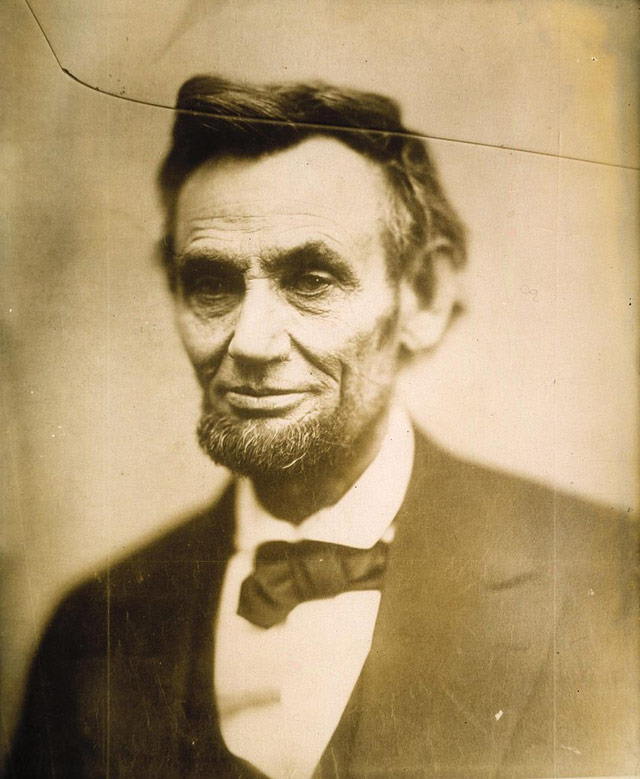
I spent the better half of the afternoon reading Errol Morris’s fascinating series “The interminable, Everlasting Lincolns” in The New York Times, in which he sets to establish how the last known photographs (portraits) of Abraham Lincoln came to be. The prologue sets the tone with a vivid dream that Lincoln presumably had a few days before his assassination, but it’s in Part I where Errol Morris comes firing:

The story of the crack, along with the original April 9 date, was printed in The New York Times on Feb. 12, 1922. O-118 was captioned: “The President Sat for This Photograph Just Five Days Before Booth Shot Him. The Cracked Negative Caused it To Be Discarded. It Has Only Once Before Been Published, and Then in a Retouched Form.” The accompanying text by James Young read:

Probably no other photograph of Lincoln conveys more clearly the abiding sadness of the face. The lines of time and care are deeply etched, and he has the look of a man bordering upon old age, though he was only 56. Proof that the camera was but a few feet away may be found by scrutiny of this picture… The print has been untouched, and this picture is an exact likeness of the President as he looked in the week of his death. [10]

——–

This is Errol Morris’s motivation for writing the series:

My fascination with the dating and interpretation of photographs is really a fascination with the push-pull of history. Facts vs. beliefs. Our desire to know the origins of things vs. our desire to rework, to reconfigure the past to suit our own beliefs and predilections. Perhaps nothing better illustrates this than two radically different predispositions to objects — the storyteller vs. the collector.

lincoln-crack

The infamous “crack” photograph of Abraham Lincoln.

For the collector the image with the crack is a damaged piece of goods — the crack potentially undermining the value of the photograph as an artifact, a link to the past. The storyteller doesn’t care about the photograph’s condition, or its provenance, but about its thematic connections with events. To the storyteller, the crack is the beginning of a legend — the legend of a death foretold. The crack seems to anticipate the bullet fired into the back of Lincoln’s head at Ford’s Theater on Good Friday, April 14, 1865.

It should have a name. I call it “the proleptic crack.” 

Errol Morris continues:

Holzer’s enterprise is to weave a context — a story — around photographs and significant events in American history. If Meserve were correct — if Gardner took his photographs of Lincoln on April 10, if the negative cracked just days before Lincoln was shot — it would make for a better story. But that story, like so many “better stories,” isn’t true. 

Part II of the series is here. Parts III and Parts IV will follow soon.

###

(hat tip: @kottke)

From Training Chickens to Training Dogs

I’ve known about the “clickers” that are used in dog training, but I had no idea the concept originated with training chickens. Modern Farmer has the details on Ryan’s Chicken Training Camps in Sequim, Washington, which attracts a number of dog trainers and other people every September:

The last decade and a half have seen their methods — most often called “clicker training” — become ubiquitous in the worlds of professional and amateur dog training. Trainers use a marker, usually a toy clicker, as a bridge between a desired behavior and the animal’s reward. “A click is like taking a picture,” explains Ryan. “It takes a shot that shows what gives the animal the reward.”

With a dog, you can take a few seconds noticing a behavior, marking it with a click and offering a treat. Man’s best friend is rather forgiving. With a chicken, the sequence needs to happen more or less instantly. When animal behaviorist Dr. Sophia Yin attended one of the Baileys’ first chicken training camps, she learned to tape a clicker to a measuring cup full of feed. She then practiced clicking, then offering the chicken a quick peck. One click dropped seed, and the chicken would go scurrying off the training table and onto the floor.

If you can train a chicken, you can train a dog:

Clicker-trained chickens can complete obstacle courses, discriminate between colors and shapes, remember routes through obstacle courses and even play simple tunes on a children’s xylophone.


The Future of the Sports Stadium: Connected

An interesting piece in Bloomberg on the future of the sports stadiums in the United States and the rest of the world. Think Wi-Fi networks, apps, mobile food ordering, and shorter trips to the bathroom:

Sports lovers have already proved there’s an appetite for the connected stadium. As many as a quarter of attendees at Nets games connect to the Barclays Center’s wireless network, according to a spokeswoman. But getting them to download the team’s app to try out some of the in-house features has been a challenge. Jayne Bussman-Wise, the digital director of the Nets, says the team is promoting the app to season ticket holders and on the arena’s website, and adding exclusive features such as camera angles and seat upgrades to attract more fans.

The 49ers have big ideas, but many of them are still in the planning phase. For one, the team intends to create a feature in its app to allow users in the new Levi’s Stadium in Santa Clara to see which of their friends are attending a game and where they’re sitting.

For his bathroom-line monitor, Garland hasn’t yet figured out which combination of connected devices and services will be used. The 49ers have looked at using cameras that would wirelessly report to a system that predicts the wait time, Garland says. The team is also exploring measuring traffic based on wireless signals from people’s mobile phones in a particular area, as many mapping services do to predict traffic on the road. There’s also a lower-tech solution, such as stationing attendants nearby equipped with iPads to monitor the line.

It sounds convincing, but it’s not going to make the trip to the stadium more popular if the ticket prices keep increasing every year.

Click through the article to read about how FIFA and the NHL are making advances as well.

The Most Frequently Awarded Grade in Harvard is a Straight A

You want to talk about grade inflation in America’s colleges? Look no further than the Ivy League’s Harvard College. The Harvard Crimson is reporting that the median grade at Harvard is an A-, while the most frequently awarded grade is an A. This is both outrageous and depressing at the same time:

The median grade at Harvard College is an A-, and the most frequently awarded mark is an A, Dean of Undergraduate Education Jay M. Harris said on Tuesday afternoon, supporting suspicions that the College employs a softer grading standard than many of its peer institutions.

Harris delivered the information in response to a question from government professor Harvey C. Mansfield ’53 at the monthly meeting of the Faculty of Arts and Sciences.

“A little bird has told me that the most frequently given grade at Harvard College right now is an A-,” Mansfield said during the meeting’s question period. “If this is true or nearly true, it represents a failure on the part of this faculty and its leadership to maintain our academic standards.”

Then there is this bombshell:

The most frequently awarded grade in Harvard College is actually a straight A.

Where I went for undergrad, Georgia Tech, there is actually grade deflation going on. The median GPA is below a 3.0, while it is closer to 2.5 to 2.6 for the engineering majors.


How Many Pools are There in Los Angeles?

How many swimming pools are there in Los Angeles? That’s the big question that two academics pondered and decided to solve, according to this Los Angeles Times piece:

A year later, the result is the “Big Atlas of L.A. Pools,” a digital analysis of every swimming pool in the Los Angeles Basin. Using complex computer mapping, they counted 43,123 between the Hollywood Hills and San Pedro, from pools shaded by leaf-covered pergolas in Santa Monica to ones surrounded by chain-link fences in Alhambra.

Along the way, they discovered something more than just the real-world versions of the iconic David Hockney pool utopias. Their project also proved that two non-experts were able to take a massive amount of freely available data to peek into other people’s lives.

Some interesting statistics:

Their research, which fills 6,000 pages in 74 printed volumes, concludes that the typical swimming pool in Los Angeles is oval-shaped and measures 16 feet, 4 inches by 33 feet, 6 inches, though there are numerous oddly shaped pools squeezed into backyards.

The atlas found that Beverly Hills has 2,481 — the highest per capita in the region. Long Beach boasts 2,859 pools, Rancho Palos Verdes 2,592. They could not come up with a total for the city of Los Angeles, because their count left out the San Fernando Valley, although the Brentwood section of the city has 1,920.

But two other Los Angeles neighborhoods have no backyard pools at all: Watts and Florence. Of the four public pools in area parks, three were apparently closed for the season and empty when the satellite photo was taken, said Catarah Hampshire, a spokeswoman with the Los Angeles County Department of Parks and Recreation.

Yes, the ease of data access is unnerving. But you know what else is great? The byline associated with the piece. Great work.

Also worth seeing is the researchers’s voyeuristic take on the swimming pools in this video titled “The LA Swimmer”: