“The Things You’ll Miss” by Derek Thompson

Writing in The Atlantic, Derek Thompson recounts the last few months of his mom’s life (who was battling pancreatic cancer) and his ability to cope with the grief after she passed away. It’s a beautiful, poignant piece titled “The Things You’ll Miss.”

A boundless black terror is how I imagined life without my mom. The history of grief, or what we know of it, is written by its greatest sufferers and ransacked with horror stories, lugubrious poetry, and downward-spiraling memoirs plunged in sadness. For some people, the death of a loved one is truly life-stopping, and I worried it would stop mine.

Then, in the weeks after she died, something strange happened. I did not plunge. Life did not stop. Instead, I felt something so unspeakably strange, so blasphemous, that I wondered for if I could talk or write about it, at all. I felt okay.

Even stranger, I discovered, is that I wasn’t strange, at all. Despite the warnings that grief would drag me through the prescribed five stages and discard me in a darker place, bereavement researchers have recently learned that we’ve been wrong about loss for centuries. For some, grief is a dull and unrelenting ache that fades—or doesn’t. But for many of us, grief is something else. Grief is resilience.

I loved this passage of retelling of happy stories:

For the 16 months after her diagnosis, I returned the favor. We never spoke of the food she couldn’t eat, the thick hair she couldn’t grow back, or the weight she couldn’t keep. Instead, riding home from New York once a month and bounding onto her bed, I’d serve a feast of happy stories harvested from a life spent trying not to worry. I cried often, but privately, in the stairway at work, on the train behind a pair of sunglasses, and in my apartment, indulging a memory behind a locked door. But I only lost it twice in front of her, both times trying to say the same thing: What makes me saddest isn’t imagining all the things I’ll miss, but imagining all the things you’ll miss. The wedding dances, the wine-fueled parties, her birthday cards, each emblazoned with ludicrously incorrect ages. For mom, who drew kinetic energy from every drip of living, as if by photosynthesis, and braved the winter of life with spring in her heart, smiling like a sweet little maniac all the way to the end, cancer was such cosmic robbery.

This is a beautiful passage, how grief is like undulating waves:

Mourning, even for the resilient, is a study in extremes, and, for the family and friends filling out our house, the crescendos were violent. We would scream at each other, and then laugh over wine, and then scream some more, and back to the wine. Grief is not a steady process, Bonanno said, but rather an “oscillation,” like everything inside of us. Muscles tighten and relax, our bodies warm and cool, and so do our tempers. In that house, in those last days, we might have thought of ourselves as individual antibodies, pinging around the home, attaching ourselves to tasks to invent a small sense of utility. But we were also one house, one body, mourning to and fro.
A must-read in its entirety.

The Technologies That Read Your Facial Expressions

An interesting, if somewhat disconcerting, overview of the rising technologies/algorithms that can interpret the emotions on your face:

Ever since Darwin, scientists have systematically analyzed facial expressions, finding that many of them are universal. Humans are remarkably consistent in the way their noses wrinkle, say, or their eyebrows move as they experience certain emotions. People can be trained to note tiny changes in facial muscles, learning to distinguish common expressions by studying photographs and video. Now computers can be programmed to make those distinctions, too.

Companies in this field include Affectiva, based in Waltham, Mass., andEmotient, based in San Diego. Affectiva used webcams over two and a half years to accumulate and classify about 1.5 billion emotional reactions from people who gave permission to be recorded as they watched streaming video, said Rana el-Kaliouby, the company’s co-founder and chief science officer. These recordings served as a database to create the company’s face-reading software, which it will offer to mobile software developers starting in mid-January.

Face-reading technology may one day be paired with programs that have complementary ways of recognizing emotion, such as software that analyzes people’s voices, said Paul Saffo, a technology forecaster. If computers reach the point where they can combine facial coding, voice sensing, gesture tracking and gaze tracking, he said, a less stilted way of interacting with machines will ensue.

One book I recommend that is related to this topic is by Joe Navarro, an ex-FBI agent, titled What Every Body is Saying (a guide to speed-reading people, including when they are telling a lie, etc.).

The Cards Against Humanity Black Friday Sale

For Black Friday, the creators of the wildly popular card game Cards Against Humanity decided to do something different. They would get in contact with Amazon and convince them, that for one day only, they would raise their price from $25 to $30. Here’s how it came to be:

After some discussion, Ben came up with the idea of raising the price for Black Friday and that was so outrageous that I fell in love with it instantly. Two books I read recently that informed my decision were Malcom Gladwell’s David and Goliath and Marty Neumeier’s Zag, which are both kind of shitty business/science books that make the somewhat-obvious point that being small and nimble can give you advantages that huge lumbering opponents don’t have. Anyone can do a sale for Black Friday, but nobody but us could get away with raising their prices and risking a ton of sales just to make a joke.

The other guys were pretty skeptical, but Ben and I convinced them one by one, 12 Angry Men style, until they agreed to let us try a truly insane pricing experiment. The final piece needed to convince everyone was the mockup of the landing page that I designed, with the glowing “consume!” button. Once everyone saw how funny that looked, they knew we had to go through with it.

According to the post:

The sale made people laugh, it was widely shared on Twitter and Tumblr, and it was the top post on Reddit. The press picked it up, and it was reported in The GuardianUSA TodayPolygonBuzzFeedAll Things DChicagoist, and AdWeek. It was even the top comment on The Wirecutter’s front page AMA, which had nothing to do with us.

They ended up doing a little better than last year and maintained their #1 spot on Amazon for toys/games. Bravo for the brilliant idea.

On How Memories Pass Between Generations

The BBC highlights a recent study titled “Parental olfactory experience influences behavior and neural structure in subsequent generations” in which the researchers at Emory University in Atlanta, GA trained mice to avoid a smell, and subsequently, these mice passed this aversion on to their “grandchildren.” The results are important for phobia and anxiety research.

Both the mice’s offspring, and their offspring, were “extremely sensitive” to cherry blossom and would avoid the scent, despite never having experiencing it in their lives. Remarkably, these changes extended to changes in brain structure.

From the abstract:

Using olfactory molecular specificity, we examined the inheritance of parental traumatic exposure, a phenomenon that has been frequently observed, but not understood. We subjected F0 mice to odor fear conditioning before conception and found that subsequently conceived F1 and F2 generations had an increased behavioral sensitivity to the F0-conditioned odor, but not to other odors. When an odor (acetophenone) that activates a known odorant receptor (Olfr151) was used to condition F0 mice, the behavioral sensitivity of the F1 and F2 generations to acetophenone was complemented by an enhanced neuroanatomical representation of the Olfr151 pathway. Bisulfite sequencing of sperm DNA from conditioned F0 males and F1 naive offspring revealed CpG hypomethylation in the Olfr151 gene. In addition, in vitro fertilization, F2 inheritance and cross-fostering revealed that these transgenerational effects are inherited via parental gametes. Our findings provide a framework for addressing how environmental information may be inherited transgenerationally at behavioral, neuroanatomical and epigenetic levels.

Fascinating.

The Origin of Black Friday

Writing in The New Yorker, Amy Merrick profiles the origin of “Black Friday”:

Beginning in the nineteen-thirties, thousands of fans thronged Philadelphia’s Municipal Stadium for the Army-Navy football game. As festive as the mood was inside the stadium, it wasn’t nearly so cheerful for the Philadelphia police officers who had to herd the crowds. The game was frequently held on the Saturday after Thanksgiving, and just as visiting fans were showing up the day before, holiday shoppers also would descend on downtown. On those Fridays after Thanksgiving, the late Joseph P. Barrett, a longtime reporter for the Philadelphia Bulletin, recalled, even members of the police band were called upon to direct traffic. The cops nicknamed the day of gridlock Black Friday, and soon others started to do the same.

Retailers worried the phrase would scare people away. A few weeks after the 1961 game, which President John F. Kennedy had attended, the P.R. pioneer Denny Griswold described in her industry newsletter, Public Relations News, the efforts by Philadelphia merchants and city officials to rebrand the day Big Friday, in reference to the start of the holiday shopping season. (“The media coöperated,” Griswold wrote.) Big Friday didn’t stick, but the idea behind it did, in Philadelphia and, eventually, beyond. A few decades later, when the term came to describe a day when retailers’ ledgers shifted “into the black” for the year—a connotation also pushed by marketers—people assumed that had always been the connotation.

How is your Black Friday shopping going? Or is it?

A New Species: The Clean Room Bacteria

A fascinating piece in Scientific American, summarizing how scientists discovered a new species of bacterium in two separate clean room facilities (one at the European Space Agency and the other at Kennedy Space Center):

The researchers named the bacterium Tersicoccus phoenicis. “Tersi” is Latin for clean, as in clean room, and “coccus” comes from Greek and describes the bacterium in this genus’s berrylike shape. “Phoenicis” as the species name pays homage to thePhoenix lander. The scientists determined that T. phoenicis shares less than 95 percent of its genetic sequence with its closest bacterial relative. That fact, combined with the unique molecular composition of its cell wall and other properties, was enough to classify Tersicoccus phoenicis as part of a new genus—the next taxonomic level up from species in the system used to classify biological organisms. The researchers are not sure yet if the bug lives only in clean rooms or survives elsewhere but has simply escaped detection so far, says Christine Moissl-Eichinger of the University of Regensburg in Germany, who identified the species at the ESA’s Guiana Space Center in Kourou, French Guiana. Some experts doubt thatTersicoccus phoenicis would fare well anywhere other than a clean room. “I think these bugs are less competitive, and they just don’t do so well in normal conditions,” says Cornell University astrobiologist Alberto Fairén, who was not involved in the analysis of the new genus. “But when you systematically eliminate almost all competition in the clean rooms, then this genus starts to be prevalent.”

Only the hardiest of microbes can survive inside a spacecraft clean room, where the air is stringently filtered, the floors are cleansed with certified cleaning agents, and surfaces are wiped with alcohol and hydrogen peroxide, then heated to temperatures high enough to kill almost any living thing. Any human who enters the room must be clad head to foot in a “bunny suit” with gloves, booties, a hat and a mask, so that the only exposed surface is the area around a person’s eyes. Even then, the technician can enter only after stomping on sticky tape on the floor to remove debris from the soles of her booties, and passing through an “air shower” to blow dust away from the rest of her. 

As always: life finds a way. Not only was this a discovery of a new species, it was a discovery of a new genus.

The full paper, for those of you interested, is here.


What it Takes to Air a Football Game on FOX

Writing in The Verge, David Pierce traces what it takes for FOX to air a football game on a given Sunday. FOX is the network broadcasting the Super Bowl in 2014, so every game is essentially a preparation for the team that brings us close to the action on our televisions:

It starts at 6AM on Saturday, in the cold, dark Foxboro morning, as the Fox team shows up to unload three 53-foot trucks. Stadiums don’t have much in the way of built-in A / V equipment, so Fox (and every other network) carries everything the crew will need for the weekend inside those trucks — the show has to be built and broken down every weekend. This Saturday, it has to be even faster: there’s a college football game at 4PM.

Kevin Callahan, Fox’s director of technical operations, estimates Fox credentialed between 150 and 200 people for the weekend, from Troy Aikman and director Rich Russo to runners and microphone holders. The network brings in about $25 million worth of equipment, with thousands of individual parts. (Callahan is reluctant to even guess at the number: “It depends on how small you want to get,” he says. “I mean, the production switcher alone has 1,000 buttons on it.”) Callahan and his crew have to wire the entire stadium, rig up cameras and audio, and make sure hundreds of different parts are able to connect to each other. “This is actually a very well-oiled machine,” he says. “The mobile units that we’re using here were designed in 2005 and 2006 — at the time they were eight years ahead of their time.”

In one truck, graphics and production. In another, 20 feet away in the concrete garage underneath the stands, replay and audio. Russo estimates he has 15 cameras and 13 tape machines this week, capturing and replaying angles from all over the stadium — there’s even a helicopter flying around shooting from above. The graphics team, eight or so young guys in polo shirts, is preparing more than 1,000 graphics, with every record or outcome accounted for. Rich Russo and producer Richie Zyontz talk to everyone through speakers and headsets, voicing their constant chatter to the 150-member Fox crew throughout the weekend. Colby Bourgeios, the team’s technical director, sits at his giant switcher ready to put any camera, any person, any replay on TV with the press of one of a thousand buttons. Audio consultant Fred Aldous watches and listens on his own console, making sure everything sounds as good as it looks — in stereo and 5.1-channel surround sound.

Eventually, nearly everyone says, you just learn to do it by feel.

This bit on 4K television was interesting:

Fox has been using 4K cameras for three years, but not to broadcast the game, which the crew says would be pointless given current bandwidth and TV technology. It’s all about replay. “We can do things like zoom in, look at a guy’s foot… we can see precisely a nice, solid foot, and a line right there, and know that the guy is in,” says Colby Bourgeios, Fox’s technical director. This year is about fine-tuning — finding the right camera, the right lens, the right capture and extraction devices. But even when 4K works convincingly, Callahan says, “we need it to be the first or second replay. If we were to sit there and have a 4K replay that we could show two plays later… and that would have reversed the official’s call, well, that’s awful.” He won’t add anything to the Fox broadcast that will slow it down, or impede it in any way.

Good read if you’re into football and/or sports.

NANEX: Nightmare on Elm Street for HFT Traders

A thoughtful headline and a very good article about the small firm NANEX in this week’s Bloomberg piece:

Staring at four computer monitors, Eric Scott Hunsader, the founder of market-data provider Nanex LLC, looks for hints of illicit trading hidden in psychedelic images of triangles dancing with dots that represent quotes to buy and sell U.S. stocks broken down by the millisecond.

Charts of trading produced by Hunsader’s eight-person firm have captivated everyone from regulators to art gallery owners. One stunt involved a computerized piano piece mimicking quotes for an exchange-traded fund. He infuriates some traders, who say Nanex draws unwarranted conclusions and spreads conspiracy theories.

To Hunsader, the images created from market feeds are evidence of high-frequency trading firms exploiting market rules to turn a profit in a lawless environment. Though others in the industry see his reports and charts as propaganda, Nanex’s interpretations are helping to drive the public debate about the fundamental fairness of the modern stock market.

I’ve blogged about the importance of NANEX’s post on the blog in the past, particularly this excellent post titled “Einstein and The Great Fed Robbery.”

Why care about NANEX is doing? Because:

To illustrate computerized trading to the general public, Nanex has turned trading data into animated videos, with triangles and dots representing tens of thousands of orders dashing between exchanges. One video he posted on YouTube showed a 50-millisecond period in which quotes for Nokia Oyj dashed around the market at a rate of 22,000 per second. The video, published on Oct. 9, has been viewed more than 6,400 times.

He programmed a computer to play piano notes corresponding to different bids and offers for a popular exchange-traded fund, resulting in a manic staccato composition even when slowed down. It was meant to highlight what Hunsader says is the absurdity of modern computerized trading.

Worth reading the entire piece here.

Schrödinger’s Clam: Scientists Kill World’s Oldest Living Animal Trying to Determine its Age

In one of the more bizarre stories I’ve read all week, scientists discovered the world’s oldest living animal but accidentally killed it trying to determine its age. Call it the case of Schrödinger’s clam:

The oldest animal ever known lived from 1499 until the day researchers cracked its shell open, killing it in the process.

Ming, an ocean quahog from the species Arctica islandica, was initially thought to be a record-setting 402 years old. But the scientists who found it on a seabed near Iceland in 2006 now say further analysis has revealed that it was an incredible 507 years old, reports CBS.

The researchers, who didn’t realize how old Ming was when they first found it, opened the ancient clam up to judge its age by counting growth rings inside its hinge ligaments. That’s because the rings are “better protected” there, scientist Paul Butler tells ScienceNordic, which notes that Ming was named for the Chinese dynasty that ruled when it was born.

But the rings were so close together that scientists ended up having to count the rings on the outside to be accurate, leading CBS to point out that Ming could have lived on, had scientists just started there.

“We got it wrong the first time and maybe we were a bit [hasty] publishing our findings back then. But we are absolutely certain that we’ve got the right age now,” says Butler.

The old, dead, mollusk still has a huge amount to offer science, reports the Herald-Sun. Scientists believe it will provide valuable data on changing sea temperatures over the last half-millennium—and maybe even some clues to longevity.

This isn’t one of those things you can confidently proclaim as: because, science.

How to Find Waldo

Ben Blatt, writing at Slate, has a very good analysis of looking at 25 years of Where’s Waldo? books to give an insight on where you should start looking for Waldo, if the challenge is ever presented to you.

I knew that Handford had placed Waldo in each of these illustrations, and in my experience, all people—even people who make a living hiding cartoon men in cartoon landscapes—have tendencies, be they conscious and unconscious. True randomness is very difficult to achieve, even if you want to, and according to Handford he does not necessarily aim for unpredictability. “As I work my way through a picture, I add Wally when I come to what I feel is a good place to hide him,” he once told Scholastic. Knowing this, is it possible, I wondered, to master Where’s Waldo by mapping Handford’s patterns?

I sought to answer these questions the way any mathematician who has no qualms about appearing ridiculous in public would: I sat in a Barnes & Noble for three hours flipping through all seven Where’s Waldo books with a tape measure.

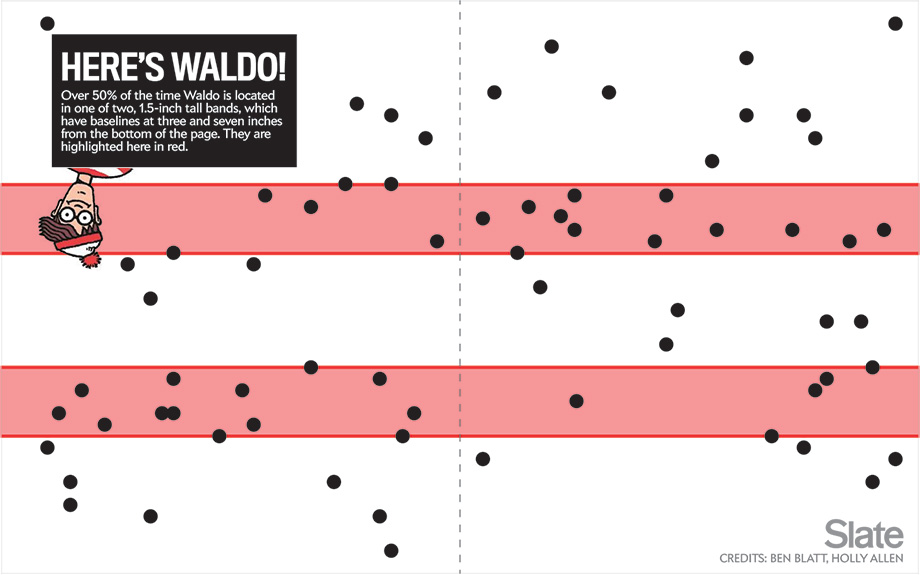
The map born of my experiment is below.

Turns out, more than 50% of the time, Waldo is hiding within one of two 1.5-inch tall bands, one starting three inches from the bottom of the page and another one starting seven inches from the bottom, stretching across the spread:

waldo_map


This makes sense. Most people would start looking near the top or bottom or at the corners, so that would be counterproductive to place Waldo there. Ignoring the small sample size, this is a better search criterion than the alternative!