Cheating on a Game Theory Test: One Professor’s Experience

Peter Nonacs is a professor in the Ecology and Evolutionary Biology Department at UCLA. He studies the evolution of social behavior across species. In this blog post, he recounts how one of the tests he gave in his Game Theory class he allowed the students to cheat (collaborate with one another):

So last quarter I had an intriguing thought while preparing my Game Theory lectures. Tests are really just measures of how the Education Game is proceeding. Professors test to measure their success at teaching, and students take tests in order to get a good grade. Might these goals be maximized simultaneously? What if I let the students write their own rules for the test-taking game? Allow them to do everything we would normally call cheating?

A week before the test, I told my class that the Game Theory exam would be insanely hard—far harder than any that had established my rep as a hard prof. But as recompense, for this one time only, students could cheat. They could bring and use anything or anyone they liked, including animal behavior experts. (Richard Dawkins in town? Bring him!) They could surf the Web. They could talk to each other or call friends who’d taken the course before. They could offer me bribes. (I wouldn’t take them, but neither would I report it to the dean.) Only violations of state or federal criminal law such as kidnapping my dog, blackmail, or threats of violence were out of bounds.

Gasps filled the room. The students sputtered. They fretted. This must be a joke. I couldn’t possibly mean it. What, they asked, is the catch?

I like the conclusion:

The best tests will not only find out what students know but also stimulate thinking in novel ways. This is much more than regurgitating memorized facts. The test itself becomes a learning experience—where the very act of taking it leads to a deeper understanding of the subject.
Roger Goodell and the Hugs at the NFL Draft

Today marks the start of the 2013 NFL Draft. The New York Times has a great story on how the commissioner of the NFL, Roger Goodell, has started giving out hugs at the Draft. It all started out in 2010 with Gerald McCoy:

When the Buccaneers selected him with the No. 3 pick in the 2010 N.F.L. draft, McCoy did something no player had done. He strode across the stage and embraced Commissioner Roger Goodell, a spontaneous show of emotion that proved significant: McCoy had broken the hug barrier.

“I wasn’t aware that I was the first when it happened,” McCoy said by telephone, “but I am now.”

Inspired by McCoy, Goodell has become a proactive hugger. But there are hugging rules:

In his predraft briefing with players, Goodell now includes hug-specific instructions. They can hug him for as long as they want, with one caveat: try not to break his ribs. A couple of players have come close. Such are the perils of “bringing it in” with 300-pound offensive linemen.

Wonderful.

Mark Bittman’s New Column: The Flexitarian

In this column, Mark Bittman introduces The Flexitarian. I look forward to reading it. As he puts it:

The moderate, conscious eater — the flexitarian — knows where the goal lies: a diet that’s higher in plants and lower in both animal products and hyperprocessed foods, the stuff that makes up something like three-quarters of what’s sold in supermarkets. That’s the kind of cooking and eating I’ll be exploring in this monthly column.

I hope these recipes demonstrate the general goal of The Flexitarian, which will be to marry the burning question “What should I be eating?” with another: “How do I cook it?” And just as it will describe the latter with the most flexibility and the greatest possible sense of ease and relaxation, it will recommend the former with as little dogma as an advice-giver can muster.

It’ll also be about personal experience: I’m just another guy trying to figure out what to eat. (Everyone is. And I’ve no intention of abandoning the occasional rib-eye, nor of seeing that as a betrayal of anything.) I might be able to cook nearly anything decently, but I can be slow to figure things out (it took me a long time to realize that popcorn with a little oil and salt was the closest you could get to healthy junk food), and I certainly struggle with cravings.

That makes the primary challenge to discover how to satisfy those cravings while staying as best as I can within the boundaries of what we know to be sane, or conscious, or well-informed — call it what you will — eating.

The New $100 Bill Coming October 2013

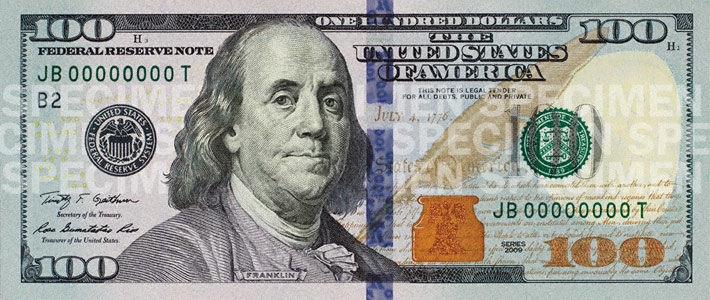
The new $100 bill is coming October 2013. Per USA today, this is what it will look like:

new_100-front

new_100-back

Not so impressive, considering the delay:

The revamped bill had been expected to go into circulation in February 2011. But in December 2010, officials announced an indefinite delay. They said they needed more time to fix production issues that left unwanted creases in many of the notes.

What are your thoughts on the design? Here are a few comparisons.

Is the Gourmet Cupcake Business in Decline?

The Wall Street Journal, using Crumbs as an example, explains the decline in the gourmet cupcake business:

As a business, making cupcakes has a relatively low barrier to entry and the field has become saturated with competitors, including individual bakeries, chains and grocery stores. Gigi’s Cupcakes USA, based in Nashville, Tenn., has opened 85 stores in 23 states since 2008 through its franchising system.

Crumbs rivals include people like Cynthia Hankerson, owner of the three-year-old Cupcake Salon in Jersey City, N.J. Sales at her bakery cafe are slipping and she said she suspects the cupcake fad may be waning. Last year, a typical Saturday brought in an average of $600 to $700 in sales for her signature cupcakes, which come in flavors like pistachio, amaretto vanilla and strawberry banana. But now “we’re lucky if we get $300,” she says. “People get tired of things,” the 42-year-old adds.

When I lived in Pasadena, my favorite cupcake place was Sprinkles. My friend Fiona introduced me to the chain. She says Sprinkles is still thriving: they even have special cupcake ATM in Beverly Hills!

On Reddit and the Wisdom of Crowds

James Surowiecki’s analysis of Reddit’s crowdsourcing ability in the wake of the Boston Marathon bombings is one of the best things I’ve read on the subject:

You can certainly fault the Redditors for not recognizing the limits of their own knowledge and for jumping to conclusions (even if a good deal of that jumping was done by the national press). But this isn’t a failing that’s specific to Reddit—on the contrary, official investigations fall prey to it all the time. Richard Jewell, of course, was seized on almost immediately by authorities as a prime suspect in the 1996 Olympics bombing, and continued to be treated as such for months before being cleared. The government investigated and harassed Steven Hatfill for years in connection with the 2001 anthrax mailings, before finally backing down. And the F.B.I., on the basis of faulty fingerprint analysis, accused Brandon Mayfield, a Portland lawyer, of assisting with the train bombings in Madrid in 2004; arrested him; and refused to acknowledge its mistake for weeks after Spanish authorities had definitively cleared him. These misidentifications were far more damaging and longer-lasting than anything Reddit did last week, yet one would hardly take them as per se evidence that the F.B.I. should stop investigating crimes.

I think this is an essential point:

The problem from Reddit’s perspective, of course, is that this method of sleuthing would be far less exciting for users, and would probably generate less traffic, than its current free-for-all approach. The point of the “find-the-bombers” subthread, after all, wasn’t just to find the bombers—it was also to connect and talk with others, and to feel like you were part of a virtual community.

Perhaps the secondary goal of Reddit was not to find the bombers, but to allow people to connect with one another after the traumatic event. In a way, participating in Reddit was a way of reconciling the event (and for some, a way to heal).

###

Related: Alexis Madrigal’s piece on how misinformation spread on Reddit.

On Coffee in Ethiopia

David Farley goes on a journey to Ethiopia to discover the world’s best coffee. He reports in a fascinating piece for Afar Magazine:

Coffee is to Ethiopia what hops are to Bohemia or grapes to Bordeaux. That is, coffee is almost everything, from the cornerstone of the community’s economic fortunes to the lifeblood of its social relations. Java drinking is so deeply rooted here that Azeb was dumbstruck that I could have lived 40 years on the planet never having seen what coffee looks like before it’s plucked, peeled, dried, roasted, and ground.

Which is exactly why I was in Ethiopia. I wanted to travel around this East African country’s primary coffee-growing regions and immerse myself in its coffee culture. I can sit around at coffeehouses in New York and San Francisco drinking all the Ethiopian coffee my brain can take before spinning out of control. But I was curious about the time and toil it takes to produce these beans, everything that goes into slaking the States’ obsessive thirst for small-batch artisan roasts.

After all, great coffee is harvested all over the world—in Guatemala, Colombia, Indonesia, Kenya, and Rwanda, for example—but no coffee-producing country on earth can match the variety that grows in Ethiopia. By some estimates, nearly 99 percent of the world’s arabica coffee can be traced to Ethiopia. Moreover, according to aficionados, it’s here that some of the best coffee in the world is being produced.

Ethiopia Coffee Trade

A useful corollary post is this one: where to buy Ethiopian coffee in the United States.

###

(via @travelreads)

The Secret to a Higher Salary: Ask for Nothing?

An interesting experience by Brooke Allen on negotiating the highest salary (in his mind) by asking for nothing at all (literally, $0):

The next time I had to negotiate a contract, it began in typical fashion with a prospective employer sending me a lopsided agreement and asking me to counter-propose. I said I was incompetent to do that and suggested they write a new contract as if they were me, putting in everything that would be in my best interests, and then taking out everything they would never agree to. Since that would be the best I could get, I would accept it subject to agreement on compensation.

We started with base pay. I wrote down the least I would work for and asked them to write down the most they would offer a perfect person, irrespective of whether I was that person or not. If when we exchanged papers, their number wasn’t higher than mine then we could stop there and save time. Their number was twice the best base pay I had ever received in past jobs, and my request was for $0. I explained that my goal is to live a debt-free life, and therefore I wanted to give value before receiving compensation.

We did the same thing with profit sharing percentages. However, this time I wanted the highest payout standard for our industry, which happened to match their number. We agreed on that percentage because it maximized my incentive to perform and minimize the risk I would ever want to go elsewhere. (As it turned out, because human resources wouldn’t put me on the books without paying me something, I ended up getting a better deal than the best I would have ever asked for.)

I’m all about the win-win, but I have doubts about the employer playing a game where they write their number down, you write your number down, and then perform a bilateral exchange. This process takes days or even weeks, not minutes as implied by Allen’s post.

Boston Marathon Bombings: The Story of Survivors near the Finish Line

 One week ago, at approximately 2:50 p.m. on Monday April 15, 2013, two bombs exploded yards away from the Boston Marathon finish line.

Today, The New York Times compiles an extraordinary feature titled 4:09:43, the “final split second of normalcy” before the area turned into a war zone. The Times interviewed the runners and spectators who witnessed the explosion:

David Abel, 41, reporter:

Mr. Abel, a Boston Globe reporter who is currently on sabbatical with a fellowship, was at the event to film a documentary on Juli Windsor, the first female dwarf to run the Boston Marathon. When the bomb went off, he was at the finish line waiting for her to arrive.

Debi Caprio, 50, nurse:

I said out loud, ‘This is how my life is going to end.

Joe Curciro, 63, information security officer:

Mr. Curcio has run about 70 marathons. His plan was to run the Boston Marathon every five years to keep it special for him, but after the events of last week, he is determined to go back next year.

Lisa Baragiola, 49, dietitian:

There’s a camaraderie among runners anyway, but I think this whole incident has brought the running community even closer together.

Kim Boglarski, 27, school psychologist:

A woman handed me a Kleenex to hold on my head. We weren’t sure if we should stay or run. I put my head down and started crying.

Worth reading these stories. And listening to the audio.

David Simon on Corrupt Politicians

Only fools play a rigged game forever, writes David Simon in his post titled “Dead Children and Monied Politicians”:

Our elections — and therefore our governance — have been purchased.  Instead of publicly funded elections, instead of level playing fields, instead of processes in which the power of actual ideas prevails over the size of the bankroll, we have given our democratic birthright over to capital itself.  A gun manufacturer’s opinion can be thousands of times louder than the voice of any grieving Connecticut parent.  And the damage that  might come to political careers from individual Americans who wish to have gun laws require as much responsibility of gun owners as, say, motor vehicle laws?  It pales when compared  to the damage that can come to political careers from a lobbying group backed to hilt by those who will profit directly from the fear and violence in our culture.

An acerbic take, but one we need to hear.