Computer Program Named Eugene Passes the Turing Test

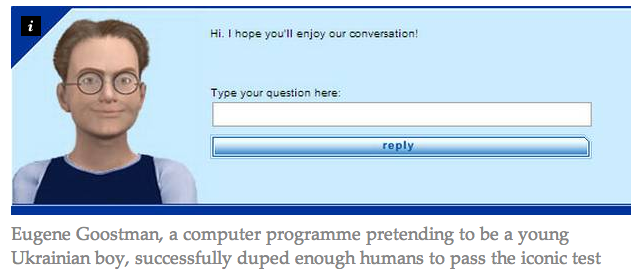
Some fascinating news in the artificial intelligence world: the Turing test was passed for the first time, ever, at The University of Reading this month. The news is all the more interesting because the test was passed with a program simulating a 13-year-old boy named Eugene:

The 65 year-old iconic Turing Test was passed for the very first time by supercomputer Eugene Goostman during Turing Test 2014 held at the renowned Royal Society in London on Saturday.

Screen Shot 2014-06-09 at 7.04.34 AM

‘Eugene’, a computer programme that simulates a 13 year old boy, was developed in Saint Petersburg, Russia. The development team includes Eugene’s creator Vladimir Veselov, who was born in Russia and now lives in the United States, and Ukrainian born Eugene Demchenko who now lives in Russia.

The Turing Test is based on 20th century mathematician and code-breaker Turing’s 1950 famous question and answer game, ‘Can Machines Think?’. The experiment investigates whether people can detect if they are talking to machines or humans. The event is particularly poignant as it took place on the 60th anniversary of Turing’s death, nearly six months after he was given a posthumous royal pardon.

If a computer is mistaken for a human more than 30% of the time during a series of five minute keyboard conversations it passes the test. No computer has ever achieved this, until now. Eugene managed to convince 33% of the human judges that it was human.

This historic event was organised by the University’s School of Systems Engineering in partnership with RoboLaw, an EU-funded organisation examining the regulation of emerging robotic technologies.

Professor Kevin Warwick, a Visiting Professor at the University of Reading and Deputy Vice-Chancellor for Research at Coventry University, said: “In the field of Artificial Intelligence there is no more iconic and controversial milestone than the Turing Test, when a computer convinces a sufficient number of interrogators into believing that it is not a machine but rather is a human. It is fitting that such an important landmark has been reached at the Royal Society in London, the home of British Science and the scene of many great advances in human understanding over the centuries. This milestone will go down in history as one of the most exciting.
Read more: What is the Turing Test and why does it matter?


Sophia Amoruso’s Advice For Millennials

New York Magazine has a feature on Sophia Amoruso, founder of Nasty Gal, and her memoir, #GIRLBOSS. This is some very good advice for millenials:

Amoruso has loads of advice about the workplace, all of it shrewd and unsweetened. Don’t ask for a promotion until you’ve held a job for a year; don’t mistake your boss for a friend; fight the natural human impulse to consider yourself an exception; and never have your phone visible during a job interview. Don’t compliment your interviewer’s outfit, because “making small talk about what someone is wearing is just another form of unsolicited feedback.” Spell-check your cover letters, for fuck’s sake. These rules may seem rudimentary to anyone born before 1982, but they’re aimed at millennial-specific bad manners. A #GIRLBOSS would never take a funeral selfie or wear pajamas on an airplane.

If there’s one generational habit that galls Amoruso more than informality, it’s entitlement. Even as a thief, she was diligent. “A lot of people in my generation don’t seem to get that you have to work your way up,” she writes. “I don’t care if filing invoices is beneath you. If you don’t do it, who do you think is going to? Your boss? Nope. That’s why she hired you.”

Read the rest here.

David Sedaris Book Signing at A Cappella Books in Atlanta, GA

Whilst I was walking in Atlanta yesterday, I stumbled upon a bookstore called A Cappella Books. While I didn’t end up going inside, I put it on my radar to check out in depth in a future visit.

Today, I browsed the bookstore’s website and saw that A Capella Books is hosting David Sedaris (one of my favourite writers) for a book signing for Let’s Explore Diabetes with Owls on June 16, 2014 at 7PM. You can purchase a copy of the book on Amazon (or don’t, actually*), or get it through A Cappella Books’s website for $17 (signed by David Sedaris).

I’m looking forward to this event. If you’re in Atlanta, I hope you can make it too.

###

*Based on the recent controversy with Amazon and Hachette, David Sedaris suggests getting his book(s) at an actual store, like A Cappella Books:

If you don’t want to go to a store, or if you don’t want to use some other website to buy the book, then don’t buy the book. Don’t do it. Get something else you can get on Amazon, like a toaster or thermal socks. I think they sell those. Go ahead. Don’t get my book. Get a flashlight instead.

For further reading on this blog:

(1) “On Guest Rooms and Conversation Snippets”

(2) David Sedaris on Socialized Medicine

On Art Galleries in Trucks

Since the rise of the food truck scene, the trend for mobile (fill-in-the-blank) has been going (presumably) more mainstream. The New York Times has a great article on a recent trend of galleries in trucks.

While statistics on mobile galleries are hard to come by, social media shows the trend catching on in Los Angeles; Seattle; Santa Fe, N.M.; Tampa Bay, Fla.; Chicago; and even Alberta, where a ’60s teardrop-red trailer presents works from a changing lineup of local artists. Pinterest boards show a range of designs on pages dedicated to mobile galleries, and Twitter is full of people advertising their whereabouts with hashtags such as #keeptrucking. Ann Fensterstock, a lecturer on contemporary art and the author of “Art on the Block,” a history of New York art galleries, said these galleries are “part of the zeitgeist of this moment in art creating.” Critics, however, point out that artists may not be taken seriously without gallery backing. This is hardly the first time American artists have gone mobile. Before opening a gallery in the East Village, Gracie Mansion staged her “Limo Show” in 1981 in a rented limousine, parked in SoHo, where she invited passers-by into the back seat for Champagne while she pitched her friends’ art.

Screen Shot 2014-06-01 at 10.44.56 AM

If one doesn’t care for the commercialization (selling) of art, this movement makes sense:

Ms. Fensterstock agreed that the truck model has limitations. “It doesn’t make for return business; it doesn’t make for contemplation of the art by spending time with it; it doesn’t make for building a strong commercial place out of which the art gets sold,” she said.

Memory as an Extreme Sport

This fascinating New York Times piece profiles the Extreme Memory Tournament (XMT):

The competitors gathered here for the XMT are not just anyone, however. This is the all-world team, an elite club of laser-smart types who take a nerdy interest in stockpiling facts and pushing themselves hard.

In his doctoral study of 30 world-class performers (most from Germany, which has by far the highest concentration because there are more competitions), Mr. Konrad has found as much. The average I.Q.: 130. Average study time: 1,000 to 2,000 hours and counting. The top competitors all use some variation of the memory-palace system and test, retest and tweak it.

This concept of how these people invoke a “memory palace” is very interesting:

Each competitor has his or her own variation. “When I see the eight of diamonds and the queen of spades, I picture a toilet, and my friend Guy Plowman,” said Ben Pridmore, 37, an accountant in Derby, England, and a former champion. “Then I put those pictures on High Street in Cambridge, which is a street I know very well.”

As these images accumulate during memorization, they tell an increasingly bizarre but memorable story. “I often use movie scenes as locations,” said James Paterson, 32, a high school psychology teacher in Ascot, near London, who competes in world events. “In the movie ‘Gladiator,’ which I use, there’s a scene where Russell Crowe is in a field, passing soldiers, inspecting weapons.”

More here.

On New and Inexperienced Managers

This is a very good question on Quora: What are common mistakes that new or inexperienced managers make? Ian McAllister, general manager at Amazon, has one of the most up-voted answers:

Performance Management

  1. Being slow to deal with performance issues – Smoke becomes fire. If you take note of performance issues early you can give gentle corrective feedback. If you’re too slow to notice you have to give stronger feedback, and the performance issues may be harder to reverse.
  2. Not documenting poor performance – Documenting poor performance via email helps employees understand the gravity of the situation (“This email summarizes the discussion we just had”) and it is also helpful to have on hand if it comes time to terminate the employee.
  3. Not documenting good performance – Documenting good performance via email, to the employee alone or to a wider audience, is a great way to recognize their contributions to the team and company. It’s also a good habit to regularly document good performance of team members for your own purposes, so you can remember what you want to praise them for at annual review time.


Career Development

  1. Not getting to know your employees – It’s great to know the names of all your employees’ kids. It’s even better to know the type of work each employee most likes to do, their particular pain points within the team or company, what their career objectives are (depth, breadth, management), or why they might be thinking about taking a different job or moving to a different company. You need to develop a rapport and level of trust with each employee before they’ll start to share these things with you.

  2. Not paying attention to your high-performing employees – If you’re very satisfied with how an employee is performing you need to turn the tables and invest in making them more satisfied with their job. Find ways for them to do more of what makes them happy and less of what doesn’t.

  3. Not investing in developing your employees – Every employee needs to be developed, either to support the career development (and retention) of strong performers or to improve the performance of weaker employees. Every year you should be trying to raise the level of performance of every employee.

Worth reading in entirety. And definitely worth keeping in mind.

How Do Rumors Spread on Facebook?

How do rumors propagate on Facebook? And what propels them to go viral? One component seems to be whether people try to stop false rumors by linking to Snopes.com debunking such a rumor. From the Facebook Data Science team, their blog post and paper titled “Rumor Cascades” explains:

Tracking rumors on Facebook requires two types of information: a corpus of known rumors, and a sample of reshare cascades circulating on Facebook which can be matched to the corpus. The website Snopes.com has diligently documented thousands of rumors, and provides the starting point for our analysis. To match known rumors to this anonymized set of reshare cascades, we identify uploads and reshares that have been snoped — someone linked to a Snopes.com article in a comment. Those comments are posted by people to either warn their friends that something they posted is inaccurate or to the contrary, to validate that a rumor, though hard to believe, is in fact true. 

We gathered 250K comments, posted during July and August 2013 on 17K individual cascades, containing 62 million shares…

A summary from the abstract:

We find that receiving such a comment increases the likelihood that a reshare of a rumor will be deleted. Furthermore, large cascades are able to accumulate hundreds of Snopes comments while continuing to propagate. 

Buried Atari Games Unearthed in New Mexico

From a 1983 article on Atari, The New York Times noted:

With the video game business gone sour, some manufacturers have been dumping their excess game cartridges on the market at depressed prices.

Now Atari Inc., the leading video game manufacturer, has taken dumping one step farther.

The company has dumped 14 truckloads of discarded game cartridges and other computer equipment at the city landfill in Alamogordo, N.M. Guards kept reporters and spectators away from the area yesterday as workers poured concrete over the dumped merchandise. An Atari spokesman said the equipment came from Atari’s plant in El Paso, Tex., which used to make videogame cartridges but has now been converted to recycling scrap. Atari lost $310.5 million in the second quarter, largely because of a sharp drop in video game sales.

Turns out, this is no longer a legend. Construction crews have unearthed a huge cache of Atari games in New Mexico:

Today’s dig became a reality thanks to an upcoming documentary, produced by Microsoft’s Xbox Entertainment Studios. The documentary, which will focus on the changing landscape of the video game industry, is expected to come out next year, and it is part of a broader push by Microsoft to produce original video content for Xbox 360 and Xbox One owners. Its biggest project is a live-action Halo TV series connected to Steven Spielberg.

I wonder if any of the games are still playable.

On Business and Design Considerations of 1st Class Airplane Seating

David Owen, writing in The New Yorker, in a cleverly titled article “Game of Thrones,” describes the business and design considerations of seats in modern-day airplanes. While the economy seating is fairly routine (cramped), there is a lot of creativity involved in how 1st class and business seating is designed and built:

Airplane interiors are even more tightly regulated. Nearly every element undergoes a safety-enhancing process called “delethalization”: seats have to withstand an impact equal to sixteen times the force of gravity, and to remain in place when they do, so that they don’t block exit routes or crush anyone, and they can’t burst into flames or release toxic gases when they get hot. Doing something as simple as slightly increasing the thickness of the padding in a seat cushion can necessitate a new round of testing and certification, because a more resilient seat could make a passenger bounce farther after an impact, increasing the risk of injury caused by turbulence or a hard landing. Delethalizing some premium-class seats—in which a passenger’s head and torso have a lot of room to accelerate before being stopped by something solid—requires the addition of a feature that many passengers don’t even realize is there: an air bag concealed in the seat belt.

This bit about how expensive video-back video screens is fascinating:

In economy, the tight spacing of the seats makes air bags mostly unnecessary. But seat-back video screens and the hard frames that surround them pose a safety challenge, partly because of the potential for injuries caused by head strikes, and partly because the computers and the electrical systems that serve them have to be both fireproof and fully isolated from the plane’s—so that crossed wires in somebody’s seat don’t allow a ten-year-old playing a video game to suddenly take control of the cockpit. Largely as a result, in-flight entertainment systems are almost unbelievably expensive. The rule of thumb, I was told, is “a thousand dollars an inch”—meaning that the small screen in the back of each economy seat can cost an airline ten thousand dollars, plus a few thousand for its handheld controller.

1st_class_seat

The article mentions but doesn’t link to the TheDesignAir’s Top 10 International Business Classes of 2014 (it’s well worth a look).

The Male Deficit Model and Friendships

Do men suck at friendships? Or, at least, are they worse at being friends than their female counterparts? Research suggests the answer is yes. This Men’s Journal article provides an excellent overview:

The Male Deficit Model is based on 30 years of research into friendship and relationships — from Mayta Caldwell’s and Letitia Peplau’s 1982 UCLA study, which found that male friendships are far less intimate than female friendships, to a 2007 study at the College of the Holy Cross in Worcester, Massachusetts, which reported greater interpersonal competition and lower friendship satisfaction among men. A just-completed report from California State University Humboldt, meanwhile, holds that the closer men adhere to traditional male gender roles, like self-reliance and a reluctance to spill their guts, the worse their friendships fare. “Since most men don’t let themselves think or feel about friendship, this immense collective and personal disappointment is usually concealed, sloughed over, shrugged away,” writes the psychologist Stuart Miller in his opus, Men and Friendship. “The older we get, the more we accept our essential friendlessness.”

What’s the key to healthy aging? Good diet and exercise, right? Well, perhaps another factor outweighs them all:

That’s because nearly all research into healthy aging has found that the key to a long, happy life is not diet or exercise but strong social connections – that is, friendships. Loneliness accelerates age-related declines in cognition and motor function, while a single good friend has been shown to make as much as a 10-year difference in overall life expectancy. A huge meta-study performed in part at Brigham Young University, which reviewed 148 studies with a combined 308,849 subject participants, found that loneliness is just as harmful to health as not exercising, smoking 15 cigarettes a day, and alcoholism, and fully twice as bad as being obese. Still more startling is a 2010 study published in the Journal of Clinical Oncology that looked at 2,230 cancer patients in China. Social well-being, including friendship, turned out to be the number one predictor of survival.

Some of this stems from the fact that isolated people tend to exercise less, eat poorly, and drink too much. But some researchers believe that loneliness has a negative health impact all on its own. In numerous studies over the past 30 years, John T. Cacioppo, a professor of psychology at the University of Chicago and the pioneer of the biological study of loneliness, has found that lonely people have chronically elevated levels of the stress and fear hormones cortisol and epinephrine. In a 2007 paper published in Genome Biology, Cacioppo even demonstrated a correlation between loneliness and the activity of certain genes associated with systemic inflammation, elevating risk for viral invasion and cardiovascular disease.

And yet the capacity of men to combat loneliness – and improve their health – by building strong friendships seems to be steadily eroding. Cambridge, Massachusetts, professors Jacqueline Olds and Richard S. Schwartz, writing in The Lonely American: Drifting Apart in the Twenty-First Century, point to a current tendency among adults to build stronger, more intimate marriages at the expense of almost all other social connections. In a study of contemporary childcare arrangements, Olds and Schwartz found a deep sense of loneliness among many parents, especially men. “Almost every father we spoke with explained that he had lost contact with most of his male friends,” they write. And lest you believe family is company enough, the 2005 Australian Longitudinal Study of Aging showed that family relationships have almost no impact on longevity. Friendships, by contrast, boosted life span as much as 22 percent.

Read the rest here.