Blogging Hiatus

I’ve been meaning to write something about my absence from this blog over the past couple of months.

A query from a reader concerned about my well-being has prompted me to answer publicly that I am okay and that I’m still reading—I just haven’t been blogging. A full-time day job has been consuming me over the past few months, but I am hoping to resurrect writing on this blog, slowly. With that said, I would like your (reader) input on my next steps. Which of the following would you prefer me to blog about in the future? Please vote in the poll below.

(1) Links to articles I read throughout the day or week.

(2) Longer form pieces, such as analysis of longform articles or book reviews

I am thinking there is also a way to strike a balance between (1) and (2), but I’d be curious to hear your thoughts; feel free to reply in the comments. If there is a weighing toward (1), I am thinking of posting 5 to 10 posts per week. If the weighing is toward (2), I am thinking of posting 1 to 4 posts per month.

Thanks for your input!


The Fed Raises Rates, Explained by the Rube Goldberg Machine

Today, the Federal Reserve raised interest rates for the first time in more than half a decade. I cheered a little bit when the announcement came to pass, I admit. For the last two to three years, the question of when the Fed will raise rates has been an ongoing topic of discussion in my line of work.

The New York Times has put together a very clever explainer of the impact of the Fed raising rates via the Rube Goldberg Machine.

The short-term interest rates vs. long-term interest rates is something worth considering:

When the Fed raised rates in the mid-2000s, long-term rates didn’t go up. This puzzled a lot of economists, including the Fed chairman at the time, Alan Greenspan. The culprit, according to a theory put forward by his successor, Ben Bernanke, may have been savers in countries like China. They were sitting on piles of cash and had few reliable places to park it, so they chose the safest vehicle they could find: United States government debt. Whether that analysis is correct or not, the key idea is that while the Fed has a great deal of control over interest rates in the short run, it has a good deal less in the long run.

I also liked this explainer on the notion of the increase in rates being “priced in”:

The Fed must change beliefs in a way that doesn’t surprise anyone, or it risks putting the economy in shock. This is why, for the last few weeks, the Fed has been loudly (by central bank standards, at least) telling markets and consumers that it’s going to raise rates in December. It wants people to be able to prepare for that announcement and for markets to price in their reaction ahead of time. So there’s a strong possibility that the Fed’s decision on Wednesday to raise rates will not cause much of anything to happen. And if indeed this is the case, the Fed will have actually succeeded in running its machine.

As the article correctly points out, rate increases make life a little bit harder for borrowers and a little bit easier for savers. Are you cheering this move?

The Difficulty in Translating Seinfeld to Other Languages

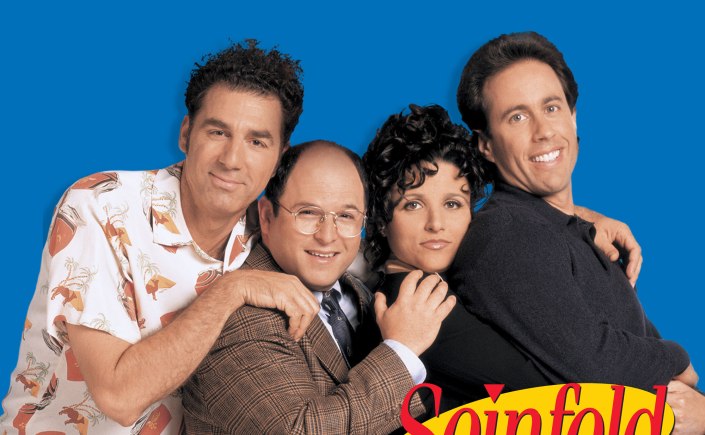
This Verge piece profiles the difficulty in translating the sitcom Seinfeld to other languages. In particular, the show has had difficulty finding a solid audience in Europe (such as in Germany). Seinfeld often relied on word-based humor, American customs, and Jewish references–difficult to convey to other cultures.

Jokes are the hardest things to translate into another language, another culture, another world. A good script for dubbing an American sitcom for foreign consumption does more than literally translate. It manages to convey the same meaning, the same feeling, the same story — the same direct hit to the lower frontal lobes of the brain that produces a laugh, even though those frontal lobes are steeped in a completely different cultural brew.

More so than the average American sitcom, Seinfeld has had difficulty reaching global audiences. While it’s popular in Latin America, it hasn’t been widely accepted in Germany, France, Italy, and the Netherlands. Two decades after it went off the air, Seinfeld remains relevant to American audiences — thanks in part to omnipresent syndicated reruns — but in much of Europe it is considered a cult hit, and commonly relegated to deep-late-night time slots. Its humor, it seems, is just too complicated, too cultural and word-based, to make for easy translation.

An interesting note on dubbing:

According to Israel-based translation company Trans-That, among European countries, France, Germany, Italy, and Spain tend to opt for the more expensive option of dubbing, while smaller countries like Belgium, Switzerland, and the Netherlands prefer subtitles. Dubbing countries often have a long history with the practice that goes back to the beginnings of the film industry. In the 1930s, when many American films were being exported to Europe, the strong preference for dubbing grew out of nationalist concerns — preserving language meant preserving cultural identity. In these countries, entire industries developed around dubbing. Today, certain voice actors will specialize in playing specific American stars, to the point where audiences expect to hear their voice each time they go to see, say, a Tom Cruise movie.

Lip-synch dubbing, despite its ultimate benefits, can get very complicated. It’s not just that the lines may not translate directly — they also have to take just as long to say in both languages and approximate, to the best of their abilities, the lip movements of the original actors. That can pose an added challenge when translating from laconic languages like English into verbose languages like German. And Seinfeld was already a very wordy show, making accurate translation that much more critical.

Definitely worth reading in entirety if you’re a big fan of Seinfeld.
What’s Causing Global Warming?

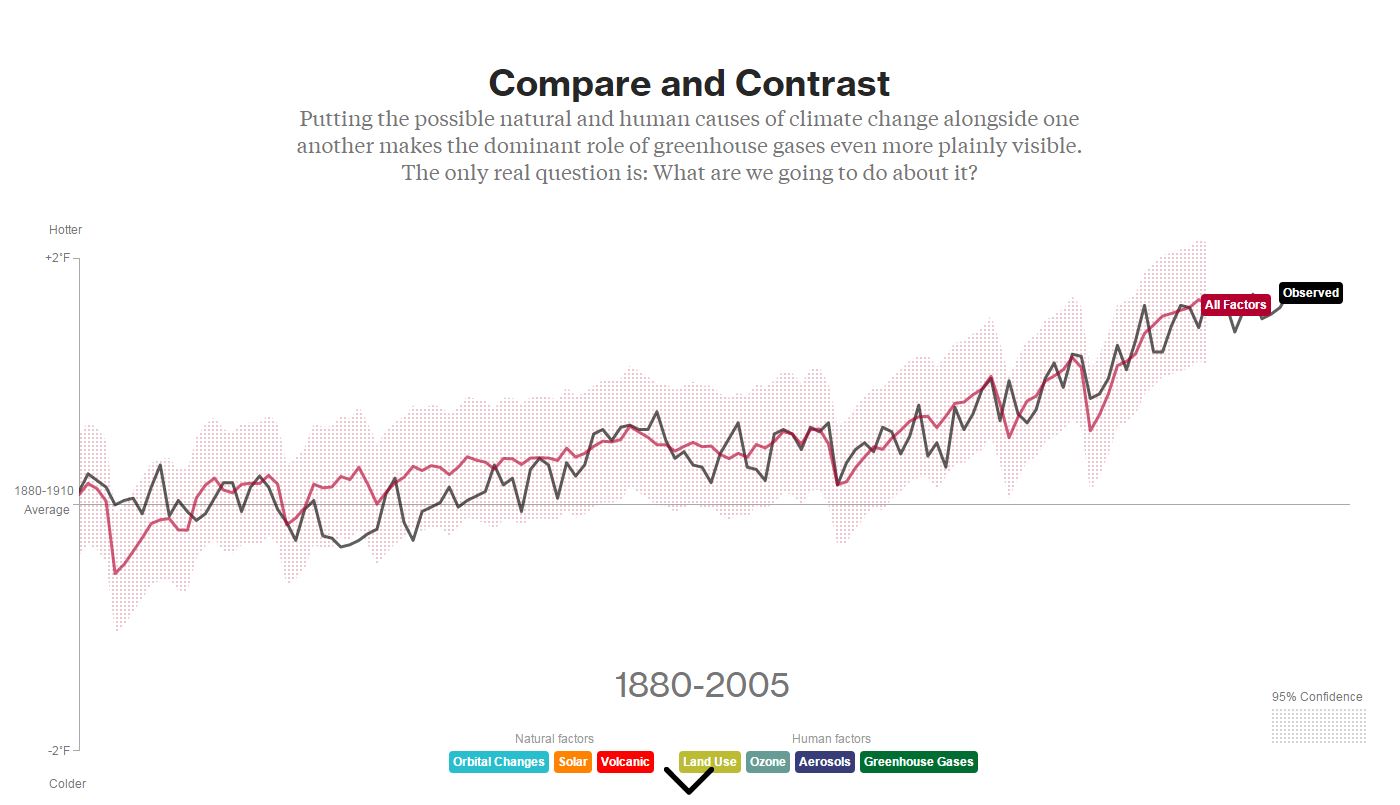
Bloomberg has created a nice interactive to explain the cause(s) of global warming. Hint: it’s not the volcanoes or the Sun or ozone pollution. The cause of global warming is almost surely the greenhouse gas emissions.

global_warming

From the caption underneath the graphic:
Researchers who study the Earth’s climate create models to test their assumptions about the causes and trajectory of global warming. Around the world there are 28 or so research groups in more than a dozen countries who have written 61 climate models. Each takes a slightly different approach to the elements of the climate system, such as ice, oceans, or atmospheric chemistry.
The computer model that generated the results for this graphic is called “ModelE2,” and was created by NASA’s Goddard Institute for Space Studies (GISS), which has been a leader in climate projections for a generation. ModelE2 contains something on the order of 500,000 lines of code, and is run on a supercomputer at the NASA Center for Climate Simulation in Greenbelt, Maryland.

All the World’s Passports, Ranked

The Passport Index is a very clever websites that shows you thumbnails of all the passports in the world. Even better, there is a Passport Power Index, which shows you, in order, the most powerful passports in the world. The power is based on how many countries one could visit with said password without applying for a visa (or where a visa would be granted upon arrival to the destination).

The top passports in the world are:

1) United States (147 countries visited without a visa)
1) United Kingdom (147)
3) France (145)
3) Germany (145)
3) South Korea (145)
6) Italy (144)
6) Sweden (144)

At the very bottom of the Passport Power Index, we have: Solomon Islands (28), Myanmar (28), South Sudan (28), Sao Tome and Principe (28), and Palestinian Territories (28).

Also, you can see the passports organized by color, such as red and blue:

red_p

blue_p

What a great site! And the passport index was exactly what I was wondering about on my recent trip to Costa Rica.

###

Hat tip: The Washington Post

JPMorgan Chase Has More than 1,000 Models in Production

This afternoon, I spent some time reviewing the annual shareholder letter from JPMorgan Chase. The most interesting bit to me was this section on Model Risk Management (“Model review”) at the Bank:

More than 300 employees are working in Model Risk and Development. In 2014, this highly specialized team completed over 500 model reviews, implemented a system to assess the ongoing performance of the 1,000+ most complex models in the firm, and continued to enhance capital and loss models for our company.

So there at least 1,000 models currently in production at JPMorgan Chase, which doesn’t include the non-complex models…

I also thought Jamie Dimon’s comments on the Comprehensive Capital Analysis and Review (CCAR) were illuminating:

We believe that we would perform far better under the Fed’s stress scenario than the Fed’s stress test implies. Let me be perfectly clear – I support the Fed’s stress test, and we at JPMorgan Chase think that it is important that the Fed stress test each bank the way it does. But it also is important for our shareholders to understand the difference between the Fed’s stress test and what we think actually would happen. Here are a few examples of where we are fairly sure we would do better than the stress test would imply:

  • We would be far more aggressive on cutting expenses, particularly compensation, than the stress test allows.
  • We would quickly cut our dividend and stock buyback programs to conserve capital. In fact, we reduced our dividend dramatically in the first quarter of 2009 and stopped all stock buybacks in the first quarter of 2008.
  • We would not let our balance sheet grow quickly. And if we made an acquisition, we would make sure we were properly capitalized for it. When we bought Washington Mutual (WaMu) in September of 2008, we immediately raised $11.5 billion in common equity to protect our capital position. There is no way we would make an acquisition that would leave us in a precarious capital position.
  • And last, our trading losses would unlikely be $20 billion as the stress test shows. The stress test assumes that dramatic market moves all take place on one day and that there is very little recovery of values. In the real world, prices drop over time, and the volatility of prices causes bid/ask spreads to widen – which helps marketmakers. In a real-world example, in the six months after the Lehman Brothers crisis, J.P. Morgan’s actual trading results were $4 billion of losses – a significant portion of which related to the Bear Stearns acquisition – which would not be repeated. We also believe that our trading exposures are much more conservative today than they were during the crisis.

The last point is important because the way the scenarios have worked in the recent years for CCAR, the assumption was that there was a one-time (one day to less than a month-long), massive shock to the equity markets (50 to 60% drop in the severely adverse case).

Costa Rica is Now Running Completely on Renewable Energy

I am currently on vacation in Costa Rica, and right at the beginning of my trip, I found out that the entire country is now running on 100% renewable energy:

Thanks to some heavy rainfall this year, Costa Rica’s hydropower plants alone are generating nearly enough electricity to power the entire country. With a boost from geothermal, solar, and wind energy sources, the country doesn’t need an ounce of coal or petroleum to keep the lights on. Of course, the country has a lot of things going in its favor. Costa Rica is a small nation, has less than 5 million people, doesn’t have much of a manufacturing industry that would require a lot of energy, and is filled with volcanoes and other topographical features that lend themselves to renewable energy.

That is pretty remarkable.

Here is the press release (in Spanish) from ICE, Costa Rican Electricity Institute (ICE).

###

(via Science Alert)

Evan Osnos Wins the 2014 National Book Award for Nonfiction

The National Book Foundation recently announced its winners for 2014. Of interest to me is the winner for nonfiction, Evan Osnos (he is one of my favorite writers at The New Yorker). I haven’t read Age of Ambition: Chasing Fortune, Truth, and Faith in the New China but I have read his fantastic piece in The New Yorker titled “Boss Rail,” published in 2012:

Until now, China’s trains had always been a symbol of backwardness. More than a century ago, when the Empress Dowager was given a miniature engine to bear her about the Imperial City, she found the “fire cart” so insulting to the natural order that she banished it and insisted that her carriage continue to be dragged by eunuchs. Chairman Mao crisscrossed the countryside with tracks, partly for military use, but travel for ordinary people remained a misery of delayed, overcrowded trains nicknamed for the soot-stained color of the carriages: “green skins” were the slowest, “red skins” scarcely better. Even after Japan pioneered high-speed trains, in the nineteen-fifties, and Europe followed suit, China lagged behind, with what the state press bemoaned as two inches of track per person—“less than the length of a cigarette.”

In 2003, China’s Minister of Railways, Liu Zhijun, took charge of plans to build seventy-five hundred miles of high-speed railway—more than could be found in the rest of the world combined. For anyone with experience on Chinese trains, it was hard to picture. “Back in 1995, if you had told me where China would be today, I would have thought you were stark raving mad,” Richard Di Bona, a British transportation consultant in Hong Kong, told me recently. With a total investment of more than two hundred and fifty billion dollars, the undertaking was to be the world’s most expensive public-works project since President Eisenhower’s Interstate Highway System, in the nineteen-fifties. To complete the first route by 2008, Minister Liu, whose ambition and flamboyance earned him the nickname Great Leap Liu, drove his crews and engineers to work in shifts around the clock, laying track, revising blueprints, and boring tunnels. “To achieve a great leap,” he liked to say, “a generation must be sacrificed.” (Some colleagues called him Lunatic Liu.) The state news service lionized an engineer named Xin Li, because he remained at his computer so long that he went partly blind in his left eye. (“I will keep working even without one eye,” he told a reporter.) When the first high-speed line débuted with a test run in June, 2008, it was seventy-five per cent over budget and relied heavily on German designs, but nobody dwelled on that during the ceremony. Cadres wept. When another line made its maiden run, Liu took a seat beside the conductor and said, “If anyone is going to die, I will be the first.”

Well worth the re-read.

###

Also by Evan Osnos published in 2014: China’s “Web Junkies”

College Football in America: Athletics over Academics

This is an unsettling piece in The New York Times on the biggest college football conferences (the SEC, the ACC, the Pacific-12, the Big Ten, and the Big 12) vying to become more autonomous:

This is a portrait of life in the wealthiest districts of college sports.

The denizens of these rarefied quarters, universities like Alabama and Louisiana State, are still institutions of higher education. But athletics have become ever more central to their missions, and their bottom lines, thanks to the juggernaut programs that generate hundreds of millions of dollars a year.

Recruiters fly on private planes, athletes train on top-of-the-line equipment, and teams compete in mammoth stadiums that are the envy of many professional teams. It is not uncommon for a university’s athletic budget to exceed $60 million.

I went to an ACC school that is known for its academic rigor: Georgia Tech. But even there, I felt the athletics often overshadowed academics. Those that attended the university on an athletic scholarship had their priorities in the following order: 1) sports and/or team the athlete was competing for and 2) academics.

The new rules will likely sway the athletics over academics even further. Sad.

What Kind of Motivation Works Best?

Amy Wrzesniewski, associate professor of organizational behavior at the Yale School of Management, and Barry Schwartz, a professor of psychology at Swarthmore College, pen a brief, but fascinating piece in The New York Times that highlights a study of intrinsic vs. extrinsic motivation (dubbed “internal” vs “instrumental” motivation):

We found, unsurprisingly, that the stronger their internal reasons were to attend West Point, the more likely cadets were to graduate and become commissioned officers. Also unsurprisingly, cadets with internal motives did better in the military (as evidenced by early promotion recommendations) than did those without internal motives and were also more likely to stay in the military after their five years of mandatory service — unless (and this is the surprising part) they also had strong instrumental motives.

Remarkably, cadets with strong internal and strong instrumental motives for attending West Point performed worse on every measure than did those with strong internal motives but weak instrumental ones. They were less likely to graduate, less outstanding as military officers and less committed to staying in the military.

The takeaway:

The implications of this finding are significant. Whenever a person performs a task well, there are typically both internal and instrumental consequences. A conscientious student learns (internal) and gets good grades (instrumental). A skilled doctor cures patients (internal) and makes a good living (instrumental). But just because activities can have both internal and instrumental consequences does not mean that the people who thrive in these activities have both internal and instrumental motives.

Our study suggests that efforts should be made to structure activities so that instrumental consequences do not become motives. Helping people focus on the meaning and impact of their work, rather than on, say, the financial returns it will bring, may be the best way to improve not only the quality of their work but also — counterintuitive though it may seem — their financial success.

Read the rest here.

###

For more on motivation, watch this great TED talk by Daniel Pink.