This is my fourth year compiling the best longreads of the year (see the 2010 best longreads, 2011 best longreads, and the 2012 best longreads). There was so much incredible writing that I’ve read this year that I am expanding my usual list of the best five longreads to the best ten longreads of the year. They are:
(1) “And Then Steve Said, ‘Let There Be an iPhone’” [New York Times Magazine] — more than six years after Steve Jobs unveiled the iPhone, there were a number of things that the public had not known about. Fred Vogelstein’s piece that was published in October was incredibly revealing:
It’s hard to overstate the gamble Jobs took when he decided to unveil the iPhone back in January 2007. Not only was he introducing a new kind of phone — something Apple had never made before — he was doing so with a prototype that barely worked. Even though the iPhone wouldn’t go on sale for another six months, he wanted the world to want one right then. In truth, the list of things that still needed to be done was enormous. A production line had yet to be set up. Only about a hundred iPhones even existed, all of them of varying quality. Some had noticeable gaps between the screen and the plastic edge; others had scuff marks on the screen. And the software that ran the phone was full of bugs.
The iPhone could play a section of a song or a video, but it couldn’t play an entire clip reliably without crashing. It worked fine if you sent an e-mail and then surfed the Web. If you did those things in reverse, however, it might not. Hours of trial and error had helped the iPhone team develop what engineers called “the golden path,” a specific set of tasks, performed in a specific way and order, that made the phone look as if it worked.
But even when Jobs stayed on the golden path, all manner of last-minute workarounds were required to make the iPhone functional. On announcement day, the software that ran Grignon’s radios still had bugs. So, too, did the software that managed the iPhone’s memory. And no one knew whether the extra electronics Jobs demanded the demo phones include would make these problems worse.
Jobs wanted the demo phones he would use onstage to have their screens mirrored on the big screen behind him. To show a gadget on a big screen, most companies just point a video camera at it, but that was unacceptable to Jobs. The audience would see his finger on the iPhone screen, which would mar the look of his presentation. So he had Apple engineers spend weeks fitting extra circuit boards and video cables onto the backs of the iPhones he would have onstage. The video cables were then connected to the projector, so that when Jobs touched the iPhone’s calendar app icon, for example, his finger wouldn’t appear, but the image on the big screen would respond to his finger’s commands. The effect was magical. People in the audience felt as if they were holding an iPhone in their own hands. But making the setup work flawlessly, given the iPhone’s other major problems, seemed hard to justify at the time.
This bit about the compromises that Apple took to make the demo iPhone work is phenomenal:
The software in the iPhone’s Wi-Fi radio was so unstable that Grignon and his team had to extend the phones’ antennas by connecting them to wires running offstage so the wireless signal wouldn’t have to travel as far. And audience members had to be prevented from getting on the frequency being used. “Even if the base station’s ID was hidden” — that is, not showing up when laptops scanned for Wi-Fi signals — “you had 5,000 nerds in the audience,” Grignon says. “They would have figured out how to hack into the signal.” The solution, he says, was to tweak the AirPort software so that it seemed to be operating in Japan instead of the United States. Japanese Wi-Fi uses some frequencies that are not permitted in the U.S.
You do not have to be an Apple enthusiast like me to appreciate this piece. As I wrote back in October, “From concept to prototype to Steve Jobs’s unveiling of the revolutionary device, this piece has it all. It is so much better than the section devoted to the iPhone in Walter Isaacson’s biography of Steve Jobs.” And that ending to the piece? A tear jerker.
(2) “Thanksgiving in Mongolia” [The New Yorker] — reading this devastating account of a pregnancy gone wrong by Ariel Levy hit me like a brick. If you haven’t read it, it’s one of the best nonfiction pieces I’ve read the entire year. Just don’t read without a tissue nearby.
When I woke up the next morning, the pain in my abdomen was insistent; I wondered if the baby was starting to kick, which everyone said would be happening soon. I called home to complain, and my spouse told me to find a Western clinic. I e-mailed Cox to get his doctor’s phone number, thinking that I’d call if the pain got any worse, and then I went out to interview people: the minister of the environment, the president of a mining concern, and, finally, a herdsman and conservationist named Tsetsegee Munkhbayar, who became a folk hero after he fired shots at mining operations that were diverting water from nomadic communities. I met him in the sleek lobby of the Blue Sky with Yondon Badral—a smart, sardonic man I’d hired to translate for me in U.B. and to accompany me a few days later to the Gobi, where we would drive a Land Rover across the cold sands to meet with miners and nomads. Badral wore jeans and a sweater; Munkhbayar was dressed in a long, traditional deel robe and a fur hat with a small metal falcon perched on top. It felt like having a latte with Genghis Khan…
I felt an unholy storm move through my body, and after that there is a brief lapse in my recollection; either I blacked out from the pain or I have blotted out the memory. And then there was another person on the floor in front of me, moving his arms and legs, alive. I heard myself say out loud, “This can’t be good.” But itlooked good. My baby was as pretty as a seashell.
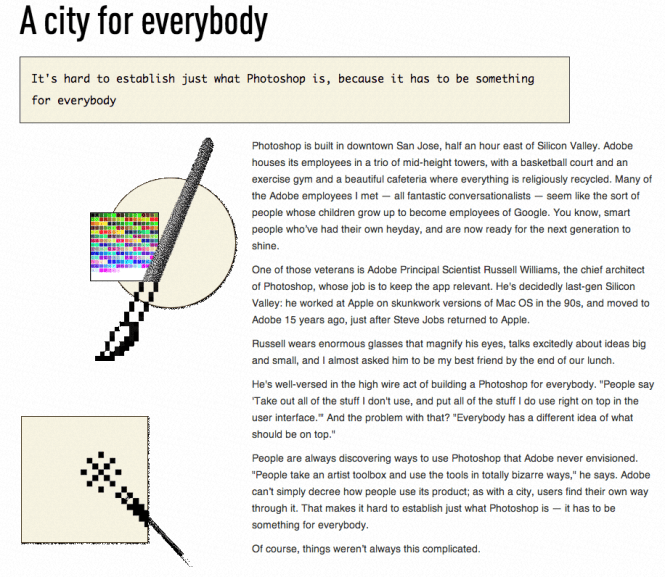
(3) “Photoshop is a City for Everyone: How Adobe Endlessly Rebuilds Its Classic App” [The Verge] — Paul Miller takes us on a delightful path with everyone’s favorite photography tool, Photoshop. We learn how the company iterates on its products and its vision for the future:
For instance, Adobe obsessively documents color profiles and lens distortion data for hundreds of cameras and lenses, taking hundreds of pictures with each combo. It’s expensive, laborious, and seemingly quixotic. But Camera RAW used those specs to automatically correct aberrations — even for multiple body / lens combinations. Then some researchers used the data to design a feature for CS6 that allows a user to straighten warped objects in extreme angle shots.
The holy grail is to give Photoshop computer vision. The app should simply select “objects” the way users see, like a “beach ball” or a “tree” or a “head,” not as “blob of color one,” “blob of color two.” Then the user should be able to do what she pleases to the object, with the software filling in the details like what might’ve been behind that object — something that’s available in a nascent form in CS6. Content vision also means the software should know when you’re working on a family photo and when you’re working on a logo, adjusting color grading techniques accordingly. It means unifying many of Photoshop’s features — which, once again, its architecture is uniquely suited to do.
(4) “Bad Blood: The Mysterious Life and Brutal Death of a Russian Dissident” [Matter for Medium] — an incredibly detailed (9,000+ words, fascinating piece that looks back on the life of Alexander Litvinenko, who as a Russian dissident fled to the U.K., was poisoned via radioactive polonium-210 in a London bar in November 2006, and the subsequent investigation that followed:
Because it is so highly soluble, polonium-210 is easily ingested. And when Litvinenko started vomiting on the evening of November 1st, the radiation had already begun to destroy the lining of his gut.
The cells lining the walls of the stomach are among the first to react to the toxin. They start sloughing and breaking away minutes after contact. The intestines, and the soft, unprotected skin inside the throat and mouth suffer the same fate.
Polonium is hugely radioactive, firing off a massive bombardment of alpha particles — and without any screening, the delicate mechanisms of the body’s internal organs get the full dose. As the atoms try to stabilize, alpha particles crash into nearby body tissue, knocking electrons from the molecules they encounter. Each time they do, the trail of wrecked cells expands; the poison turns them cancerous, or kills them off entirely…

How radioactive poison became the assassin’s weapon of choice, a story on Matter.
At its height… the Soviet Union had the largest biological warfare program in the world. Sources have claimed there were 40,000 individuals, including 9,000 scientists, working at 47 different facilities. More than 1,000 of these experts specialized in the development and application of deadly compounds. They used lethal gasses, skin contact poisons that were smeared on door handles and nerve toxins said to be untraceable. The idea, at all times, was to make death seem natural — or, at the very least, to confuse doctors and investigators. “It’s never designed to demonstrate anything, only to kill the victim, quietly and unobtrusively,” Volodarsky writes in The KGB’s Poison Factory. “This was an unbreakable principle.”
Murderous poisons come in three varieties: chemical, biological, and radiological. It’s believed that the first Soviet attempt at a radiological assassination took place in 1957. The target was Nikolai Khokhlov, a defector who had left for the United States a few years earlier. He became drastically ill after drinking coffee at an anti-communist conference he was speaking at in West Germany. After his collapse, he was successfully treated at a US army hospital in Frankfurt for what was believed to be poisoning by radioactive thallium.
This was a beautifully illustrated piece and marked one of the best posts on Medium this year (originally the longform journalistic startup Matter took down their paywall and began publishing on Medium, one of my favorite publishing platforms).
(5) “Did Goldman Sachs Overstep in Criminally Charging Its Ex-Programmer?” [Vanity Fair] — perhaps the best piece Michael Lewis published the entire year, this 11,000 word “second trial” held by Michael Lewis was thoroughly fascinating:
A month after ace programmer Sergey Aleynikov left Goldman Sachs, he was arrested. Exactly what he’d done neither the F.B.I., which interrogated him, nor the jury, which convicted him a year later, seemed to understand. But Goldman had accused him of stealing computer code, and the 41-year-old father of three was sentenced to eight years in federal prison. Investigating Aleynikov’s case, Michael Lewis holds a second trial.
(6)
“7 Things I Learned in 7 Years of Reading, Writing, and Living” [
Brainpickings] — one of my favourite bloggers, Maria Popova, wrote a personal post on the things she’s learned maintaining her wildly popular blog on arts, culture, writing, history, books, and everything in between (in Maria’s words: “combinatorial creativity”) :
- Be generous. Be generous with your time and your resources and with giving credit and, especially, with your words. It’s so much easier to be a critic than a celebrator. Always remember there is a human being on the other end of every exchange and behind every cultural artifact being critiqued. To understand and be understood, those are among life’s greatest gifts, and every interaction is an opportunity to exchange them.
- Build pockets of stillness into your life. Meditate. Go for walks. Ride your bike going nowhere in particular. There is a creative purpose todaydreaming, even to boredom. The best ideas come to us when we stop actively trying to coax the muse into manifesting and let the fragments of experience float around our unconscious mind in order to click into new combinations. Without this essential stage of unconscious processing, the entire flow of the creative process is broken.Most importantly, sleep. Besides being the greatest creative aphrodisiac, sleep also affects our every waking moment, dictates our social rhythm, and even mediates our negative moods. Be as religious and disciplined about your sleep as you are about your work. We tend to wear our ability to get by on little sleep as some sort of badge of honor that validates our work ethic. But what it really is is a profound failure of self-respect and of priorities. What could possibly be more important than your health and your sanity, from which all else springs?
- When people tell you who they are, Maya Angelou famously advised, believe them. Just as importantly, however, when people try to tell you who you are, don’t believe them. You are the only custodian of your own integrity, and the assumptions made by those that misunderstand who you are and what you stand for reveal a great deal about them and absolutely nothing about you.
Invaluable wisdom therein.
I try to support Brain Pickings with a one-time donation every year around the holidays. I recommend you do the same.
(7) “Slow Ideas” [The New Yorker] — Why do some innovations spread so quickly and others so slowly? That is the central premise that Atul Gawande answered in this enthralling piece:
Here we are in the first part of the twenty-first century, and we’re still trying to figure out how to get ideas from the first part of the twentieth century to take root. In the hopes of spreading safer childbirth practices, several colleagues and I have teamed up with the Indian government, the World Health Organization, the Gates Foundation, and Population Services International to create something called the BetterBirth Project. We’re working in Uttar Pradesh, which is among India’s poorest states. One afternoon in January, our team travelled a couple of hours from the state’s capital, Lucknow, with its bleating cars and ramshackle shops, to a rural hospital surrounded by lush farmland and thatched-hut villages. Although the sun was high and the sky was clear, the temperature was near freezing. The hospital was a one-story concrete building painted goldenrod yellow. (Our research agreement required that I keep it unnamed.) The entrance is on a dirt road lined with rows of motorbikes, the primary means of long-distance transportation. If an ambulance or an auto-rickshaw can’t be found, women in labor sit sidesaddle on the back of a bike.
(8) “Lost on Everest” [Outside Magazine] — Using never before published transcripts from the American 1963 expedition, Grayson Schaffer takes a deep look at an ascent to the world’s highest peak that many people (myself included) had no idea about before this piece was published:
By 1963, the golden age of Himalayan mountaineering was winding down. All but one of the world’s 8,000-meter peaks had been summited. Most of them were claimed by massive expeditions run like military campaigns, with siege-style tactics, top-down chains of command, and an emphasis on the collective over the individual. From an outsider’s perspective, the American expedition was no different. The operation required an army of men, including more than 900 lowland porters who carried 27 tons of equipment into Base Camp. And it was organized like a military detachment, with Dyhrenfurth in charge and the other men given ministerial titles like deputy leader and climbing leader.
On the other hand, the American expedition had a lot in common with modern climbing projects. It was laden with science experiments[2] that, like charity causes and awareness raising, have since become standard operating procedure for anybody who wants to get funding. Likewise, Dyhrenfurth’s desire for good footage of the trip for his film Americans on Everest was second only to his need to put somebody on the summit. (In 2012, you couldn’t find a climber on Everest who wasn’t making a documentary.) And as Dyhrenfurth admitted in his audio diary, the 1963 expedition was not run like those that came before it. “I am not a dictator,” he said. “We try to be as democratic as possible.”
This is a tour-de-force of an article, split into seven chapters, best read on your desktop (not in mobile).
(9) “I Am An Object Of Internet Ridicule, Ask Me Anything” [The Awl] — C.D. Hermelin’s personal story of how he brought a vintage typewriter and crafted stories for people on the spot made a deep impression of me:
When I set up at the High Line, I had lines of people asking for stories. At seven to 10 minutes per a story, I had to tell people to leave and come back. It surprised me when they would do just that. I never had writer’s block, although sometimes I would stare off into space for the right word, and people watching would say, “Look! He’s thinking!” Writing is usually a lonely, solitary act. On the High Line with my typewriter, all the joy of creating narrative was infused with a performer’s high—people held their one-page flash fictions and read them and laughed and repeated lines and translated into their own languages, right in front of me. Perhaps other writers would have their nerves wracked by instant feedback on rough drafts, but all I could do was smile.
Each time I went, I’d walk home, my typewriter case full of singles, my fingers ink-stained. Lots of people were worried about copycats—what if I saw someone “stealing” my idea? I tried to soothe them. If every subway guitarist had fights about who came up with the idea to play an acoustic cover of John Lennon’s “Imagine,” the underground would be a violent place. More violent than it already is. Others, perhaps drawn by the sounds of the typewriter, would stop and just talk to me, watch me compose a story for someone else. Then they’d shake their head and tell me that the idea and the execution were “genius.”
But then someone took a photo of him, posted it on Reddit, and the hipster-hating commenters flocked to the forums like a pack of wolves:
Of course I sat back down. Of course I read every single comment. I did not ready myself mentally for a barrage of hipster-hating Internet commenters critiquing me for everything: my pale skin, my outfit, my hair, my typing style, my glasses. An entire sub-thread was devoted to whether or not I had shaved legs. It was not the first time I had been labeled a “hipster.” I often wear tight jeans, big plastic-frame glasses, shirts bought at thrift stores. I listen to Vampire Weekend, understand and laugh at the references in “Portlandia.” I own and listen to vintage vinyl. The label never bothered me on its own. But with each successive violent response to the picture of me, I realized that hipsters weren’t considered a comically benign undercurrent of society. Instead, it seemed like Redditors saw hipsters and their ilk as a disease, and I was up on display as an example of depraved behavior.
But it was how C.D. chose to deal with the adversity that is worth highlighting (and the reason I pick this story as one of the ten best I’ve read this year):
The day after the first, un-memeified picture was posted to Reddit, I went out with my typewriter, very nervous. I tweeted on my “@rovingtypist” Twitter account that Redditors should stop by, say hello, talk about the post if they wanted. Someone responded immediately, told me that I should watch out for bullies—the message itself was more creepy than he probably meant it to be. I was nervous for nothing; a few Redditors came out, took pictures with me, grabbed a story. I was mostly finished for the evening when Carla showed up—Carla was the Brazilian tourist who took the picture of me and put it up onto Reddit. She was sweet and apologetic for the outpouring of hate, as bewildered by it as I was. She took a story as well, although I can’t remember what it was about. I messaged her when I first saw the picture posted with the meme text, letting her know that her picture had been appropriated. “I’m not concerned about it,” she said.
Hers was the position to take, and one I should have adopted earlier.
(10) “The Finish Line” [GQ Magazine] — it would not be an exaggeration to say that one of the most important events of 2013 were the Boston Marathon bombings. In a thoroughly researched piece for GQ, Sean Flynn profiles the harrowing minutes in which a “superhuman effort to help those injured” during that fateful day. The way the piece was written, in timeline form, only adds to the suspense of the piece:
10:00: Finish Line
Charles Krupa has photographed the Boston Marathon twenty-four times, every race since 1986 except for the three when the Associated Press posted him to the Philadelphia office. Krupa shoots a lot of things for the AP, but mostly he does sports. Boston’s a good town for a sports photographer: He’s shot the championships of all four major leagues, been there on the field or the court or the ice, been in the celebrations but not a part of them, the camera lens a small barrier that separates witness from participant.
The marathon coincides with a state holiday, Patriots’ Day, the third Monday in April, so traffic is always light on the drive south from New Hampshire, where Krupa lives. He was at the finish line in Copley Square by eight o’clock for his twenty-fifth marathon. It’s routine by now. Like riding a bike, he says. He’ll shoot from the media bridge spanning Boylston Street a few yards behind the line, like he always does, and his AP partner, Elise Amendola, will shoot from the pavement. He set up a remote camera on a riser to catch the line from the side if the finish is close. He knows exactly what pictures he needs: the wheelchair, men’s and women’s winners breaking the tape, an emotional reaction shot for each if he can get it, the top American finishers. Then he’ll edit those images on his laptop in the media center in the Fairmont Copley Plaza hotel and upload them to the AP’s servers. He might shoot a feature later, a runner crawling across the line or something like that guy last year who finished walking on his hands. Or he might call it a day after lunch.
2:49: The Blast
Inside the Fairmont Copley Plaza, Charles Krupa hears a tremendous metallic bang that reverberates and echoes. It sounds like a Dumpster dropped by a garbage truck in an alley before dawn. His gut tells him he’s just heard a bomb, but his head just as quickly tells him that can’t be true. He wonders if a forklift breaking down the staging might have dropped a scaffold.
Stephen Segatore hears a sound like a steel plate dropped onto cement from twenty feet. Then he feels the puff of a pressure wave that flutters the soft sides of the tent.
Michael Powers is talking to one of the physicians and another athletic trainer in the medical tent, remarking how good the weather’s been for the runners. He hears a bang, like a big firecracker, only an order of magnitude louder. He tells them, “That wasn’t thunder.”
Though the piece was published more than two months after the Boston Marathon bombings, I think it is the best all-around piece of journalism I’ve read on the topic.
###
Bonus (Published by Yours Truly)…
I experimented with writing this year more than in the last few years. To that end, I wrote something personal that can be tagged with #longreads as well. It’s something that I am proud of having compiled in one place, after more than a year of data aggregation, taking copious notes, and flushing ideas through my brain. It’s about my goal of taking control of one aspect of my life: health and fitness.
“How Fitness and Becoming Quantified Self Changed My Life” [Medium]:
I promised my sister that I would join a gym. But this promise was secondary: more importantly, I was making a promise to myself to make a difference in my life. One of my core life philosophies has been this: “If you keep saying you want to make something a priority in your life but aren’t doing something about it, then you have other priorities.” Becoming healthier became my number one priority. This wasn’t a resolution because resolutions never last. But habits do.
When I arrived to the Athletic Club at City Club of Buckhead that morning, I was committed. Having read much research on our mind’s tendency to sway us from sticking to our habits, I made a major financial commitment: I paid for six months of membership at the gym in advance. Plunking down about $350 was meant to serve as a reminder that if I quit, it was going to sting a little. You could call it an insurance policy, but I likened it to an investment in myself. I was going to kick some ass in the next six months.
You can read the entire piece here.
The year 2013 has been another spectacular one for @longreads/#longreads. I can’t wait what 2014 will bring.
 Books I Read