The Siberian Times reports an incredible exclusive: for the first time ever, researchers have found liquid blood from a preserved woolly mammoth. Note how casually the author drops this line about cloning of the animal:
It comes amid a hotly contested debate on whether scientists should try to recreate the extinct species using DNA, though there now seems little doubt that this WILL happen, and the Russian team from Yakutsk that made the find is working in a partnership with South Korean scientists who are actively seeking to bring the mammoth back to life.
The find was made on the New Siberian Islands – or Novosibirsk Islands, off the coast of the Republic of Sakha. The scientists believed from studying her teeth that this mammoth died when she was between 50 and 60 years of age.
So why did the blood not freeze? According to scientists, they speculate that mammoth blood contains a kind of natural antifreeze. Fascinating.
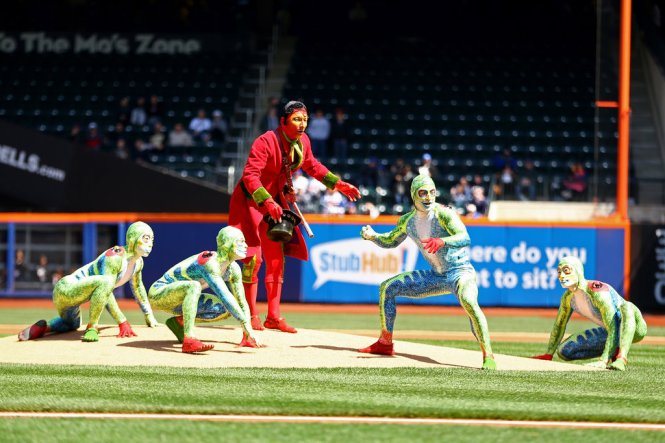
In a sport that clings to its traditions — from managers wearing uniforms to the playing of “Take Me Out to the Ball Game” during the seventh-inning stretch — one time-honored feature at the ballpark has taken an absurd turn, at least for the game’s purists: the ceremonial first pitch.
I had no idea it was this bad until I read about animals throwing out the first pitch:
For decades, the honor was extended only a few times a season to a rarefied group that included presidents, mayors and military veterans. These days, it is regarded as a marketing opportunity, a sweetener in sponsorship deals between baseball teams and groups that want a piece of the spotlight.
The rite, now carried out nightly, is handed to actors and reality television stars, sponsors’ representatives and contest winners, and people dressed as animals as well as actual animals.
A capuchin monkey carried the ball out for a San Diego Padres game in September. Twice in the last two seasons, the Los Angeles Dodgers have welcomed to the mound Hello Kitty, or, rather, a person dressed as Hello Kitty.
Sometimes, there are ceremonial second, third, fourth and fifth pitches. The day after making his major league debut this month, John Gast, a promising pitcher for the St. Louis Cardinals, crouched up and down to catch five pitches. The honorees that day were Edward Jones, a financial planning company; the National Geospatial-Intelligence Agency; the Washington University School of Medicine; a local radio station; and the Cystic Fibrosis Foundation.
So next time you’re at the game, you may be witness to something like this prior to the game:
Some psychologists point to FOMO, or “fear of missing out” on social opportunities, says a study published earlier this year in Computers in Human Behavior. Young adults who are dissatisfied with their lives or relationships feel compelled to check mobile gadgets repeatedly to see what social opportunities they are missing—even when they don’t enjoy it, the study says.
But my favorite is this one, on the perils of “too much eye contact”:
Too much eye contact can cause problems, too. In a social context, it may be seen as a sign of romantic interest, or just plain creepy.
I am confused by this statement taken as fact: holding eye contact works best for 7 to 10 seconds in a one-on-one conversation. Is this 7 to 10 seconds at a time? How long can one glance away before making eye contact again? I believe context is key, and the article just seems goofy. Also, there’s this “graphic” that looks like a page out of a graphic novel:
Don’t worry, sir! These red laser beams are non-lethal and won’t affect your vision.
An interesting post by Felix Salmon on “promiscuous media.” He thinks that because of the proliferation of blogs and various social media services, everyone is a curator (I don’t disagree):
Everybody is a curator, these days: publishers design platforms for certain types of content, editors shape publications by deciding what to leave out; journalists try to make sure that the stuff they’re doing is expressed to its best possible effect on the best possible platform. The result is a more fluid media ecosystem than we’ve been used to, but also a more effective one. Let content live where it works best; that way, the publishers of that content will be able to present something with maximal coherence and a minimum of feeling that they’re trying to do something they’re not particularly good at. The publishers who win are going to be the ones with addictive, compelling, distinctive content. Rather than the ones who are constantly flailing around, trying to copy everything that’s good somewhere else.
I don’t think blogging is dead. It’s just evolved.
What are your go-to sites for blogging? I’ve been on the fence about Tumblr: I like its ease of publishing, but what do I blog about?
For the first time since it began in 1927, the contest is requiring young spellers in preliminary and semifinal rounds to take a vocabulary test. Organizers say it is part of the Bee’s commitment to deepening contestants’ command of English.
Since 2002, a written or computer spelling test has been a component that, along with onstage spelling, factored in determining which spellers advanced to the semi-finals.
This year, competitors will advance to the semi-finals and finals based on their onstage spelling, as well as computer-based spelling and vocabulary questions. Vocabulary evaluation will count for half of a speller’s overall score.
Why? Because while being able to spell well is an excellent skill, it is, ultimately, a short-sighted one. Deep knowledge begins with knowing what the word means.
As a final sign-off for his mission aboard the International Space Station, Canadian astronaut Chris Hadfield performed David Bowie’s rendition of “Space Oddity.” The video has generated more than 15 million views on YouTube so far, and if you haven’t seen it yet, it’s worth it:
The Economistpublished a great explainer on how copyright works in space, applied to this rendition of “Space Oddity”:
The song “Space Oddity” is under copyright protection in most countries, and the rights to it belong to Mr Bowie. But compulsory-licensing rights in many nations mean that any composition that has been released to the public (free or commercially) as an audio recording may be recorded again and sold by others for a statutorily defined fee, although it must be substantively the same music and lyrics as the original. But with the ISS circling the globe, which jurisdiction was Commander Hadfield in when he recorded the song and video? Moreover, compulsory-licensing rights for covers of existing songs do not include permission for broadcast or video distribution. Commander Hadfield’s song was loaded onto YouTube, which delivers video on demand to users in many countries around the world. The first time the video was streamed in each country constituted publication in that country, and with it the potential for copyright infringement under local laws. Commander Hadfield could have made matters even more complicated by broadcasting live as he sang to an assembled audience of fellow astronauts for an onboard public performance while floating from segment to segment of the ISS.
That is because the space station consists of multiple modules and other pieces (called “elements”) under the registration of the United States, the European Space Agency (ESA) consortium, Russia and Japan. The agreement governing the ISS makes it clear (in Article 5) that the applicable laws, including those governing IP rights, depend on which part of it an astronaut is in. This is most relevant when astronauts conduct science or write accounts of their work, whether for public or private parties, although equally true during their off hours. The audio and video seem to have been recorded in the Destiny module, owned by America’s space agency, NASA, the Cupola, which previously owned by the ESA (and would thus have been governed by European law) but was transferred to NASA in 2005, and the Japanese Experiment Module, developed by Japan’s aerospace agency, JAXA. The video was transmitted to Canada (probably through ground stations around the globe), where Mr Bowie’s former bandmate Emm Gryner added a piano accompaniment and others edited and produced the final product. But recording a private performance does not violate any laws; a violation only occurs if the material is publicly distributed. Had the song been broadcast from space, Mr Bowie’s lawyers would have been entitled to seek redress in Canadian, American and Japanese courts, in addition to any objections they might have raised based on YouTube views elsewhere.
Turns out the making of this video took months of preparation, as Commander Hadfield had obtained permission to record and distribute the song; production and distribution of the song was entirely terrestrial.
In 1998, this magazine ran a story recounting the early attempts by scientists to understand fibrodysplasia ossificans progressiva. Since then, their progress has shot forward. The advances have come thanks in part to new ways of studying cells and DNA, and in part to Jeannie Peeper.
Starting in the 1980s, Peeper built a network of people with FOP. She is now connected to more than 500 people with her condition—a sizable fraction of all the people on Earth who suffer from it. Together, members of this community did what the medical establishment could not: they bankrolled a laboratory dedicated solely to FOP and have kept its doors open for more than two decades. They have donated their blood, their DNA, and even their teeth for study.
…
Four times a year, Peeper sent out a newsletter she called “FOP Connection.” She included questions people sent her—What to do about surgery? How do you eat when your jaw locks?—and printed answers from other readers. But her ambitions were much grander: she wanted to raise money for research that might lead to a cure. With a grand total of 12 founding members, she created the International Fibrodysplasia Ossificans Progressiva Association (IFOPA).
Peeper didn’t realize just how quixotic this goal was. FOP had never been Zasloff’s main area of research. As the director of the Human Genetics branch of the NIH, he had discovered an entirely new class of antibiotics, and in the late 1980s, he left the NIH to develop them at the Children’s Hospital of Philadelphia. His departure meant that no one—not a single scientist on Earth—was looking for the cause of FOP.
As a trivia side note, I had no idea there was a definition for a “rare disease”:
A rare disease is defined as any condition affecting fewer than 200,000 patients in the United States. More than 7,000 such diseases exist, afflicting a total of 25 million to 30 million Americans.
A fascinating discovery was recently published in the magazine Science on perhaps the world’s most adaptable insect: the cockroach. From the abstract:
In response to the anthropogenic assault of toxic baits, populations of the German cockroach have rapidly evolved an adaptive behavioral aversion to glucose (a phagostimulant component of baits). We hypothesized that changes in the peripheral gustatory system are responsible for glucose aversion. In both wild-type and glucose-averse (GA) cockroaches, D-fructose and D-glucose stimulated sugar–gustatory receptor neurons (GRNs), whereas the deterrent caffeine stimulated bitter-GRNs. In contrast, in GA cockroaches, D-glucose also stimulated bitter-GRNs and suppressed the responses of sugar-GRNs. Thus, D-glucose is processed as both a phagostimulant and deterrent in GA cockroaches, and this newly acquired peripheral taste sensitivity underlies glucose aversion in multiple GA populations. The rapid emergence of this highly adaptive behavior underscores the plasticity of the sensory system to adapt to rapid environmental change.
As The New York Timesnotes, what this means is that the cockroach has somehow evolved a way to make glucose smell/taste bitter to it, and it can thus avoid modern-day traps that use glucose as a primary ingredient. Instead of taste buds, roaches have taste hairs on many parts of their bodies. The three North Carolina researchers concentrated on those around the mouth area and on two types of nerve cells that sense tastes and respond by firing electrical signals to the brain. One responds only to sugars and other sweet substances; the other responds only to bitter substances. Whenever a molecule of something sweet attaches to a sweet detector, it fires electrical impulses and the roach brain senses sweetness, which makes it want to eat whatever it is tasting. Whenever a molecule of something bitter attaches to the bitter detector, that cell fires and the brain senses bitterness, which makes the roach want to avoid that substance.
Evolutionary advantages like this have helped the cockroach endure for millions of years. Fascinating.
The Tokyo City Symphony interactive website is a digital project that allows users to project images and music onto a miniature version of Tokyo, built to a 1:1,000 scale. Combining all the musical contributions to create a single symphony, the site is a wonderful example of a community effort.
To demonstrate an example, user “roppongi hills” came out with this beautiful, mind-blowing video:
Click through to go to the website, where you can make your own projection onto Tokyo in three versions: Future City, Rock City, and Edo City.
The Wall Street Journalreports on two Belgian entrepreneurs who thought people would pay lavish sums to dangle from a crane and have their meal too:
Their effort began here as a stunt six years ago, when publicist David Ghysels and crane specialist Stefan Kerkhofs seated 22 people around a chef and hoisted everybody 180 feet into the air for a meal. Today, the Dinner in the Sky franchise has tables dangling in more than 40 countries, serving about 1,000 people each month.
Rising to a city near you. As the WSJ suggests, yes, hanger steak is on the menu. Just make sure to go to the bathroom before your trip!
This was an interesting bit:
Expanding into Saudi Arabia posed a problem because of rules against men and women mixing socially. So rather than offering a single table, the company developed a cluster of six four-person tables served by tethered wait staff. The arrangement is now being offered as Lounge in the Sky. Two tables can be removed to make room for musicians or dancers, who perform in tethers similar to parachute harnesses.