
Should You Walk or Run in the Rain?

The question whether to walk slowly or to run when it starts raining in order to stay as dry as possible has been considered for many years—and with different results, depending on the assumptions made and the mathematical descriptions for the situation.

BBC reports that Franco Bocci, publishing in the European Journal of Physics, now asserts that both wind direction and a person’s stature figure into the answer:

In most cases, the general answer is to run as fast as possible; but the answer changes in a tailwind, or for the thin.

As for wind direction – and again, in general – you should run as fast as you can unless the wind is behind you, in which case the optimal speed will be exactly the speed of the wind.

In summary, if you want to stay the most dry in the rain: it’s better to run fast. Unless you’re thin. And there’s wind.

The Trouble with Online Education

In the wake of Coursera announcing partnerships with twelve new universities, Mark Edmundson (author of Why Read?) has a fantastic op-ed in The New York Times. He argues that online educations tends to be a monologue rather than a dialogue. The Internet teacher, even the one who actively responds to students via e-mail, can never have the immediacy of contact that the teacher on the scene can, with his sensitivity to unspoken moods and enthusiasms. This is the gist of the message:

We tend to think that the spellbinding lecturers we had in college survey classes were gifted actors who could strut and fret 50 amazing minutes on the stage. But I think that the best of those lecturers are highly adept at reading their audiences. They use practical means to do this — tests and quizzes, papers and evaluations. But they also deploy something tantamount to artistry. They are superb at sensing the mood of a room. They have a sort of pedagogical sixth sense. They feel it when the class is engaged and when it slips off. And they do something about it. Their every joke is a sounding. It’s a way of discerning who is out there on a given day.

A truly memorable college class, even a large one, is a collaboration between teacher and students. It’s a one-time-only event. 

I absolutely agree. The best professors I’ve had in college were magicians in front of the stage: able to guess student’s emotions, and to tune their lecture accordingly. The corollary to the argument is that Internet courses can work, but it requires extremely motivated students to slog through the lectures. This motivation, arguably, is easier to find (and tune) in students who attend live lectures and interact with their professors.

An Interview with Designer Jonathan Mak

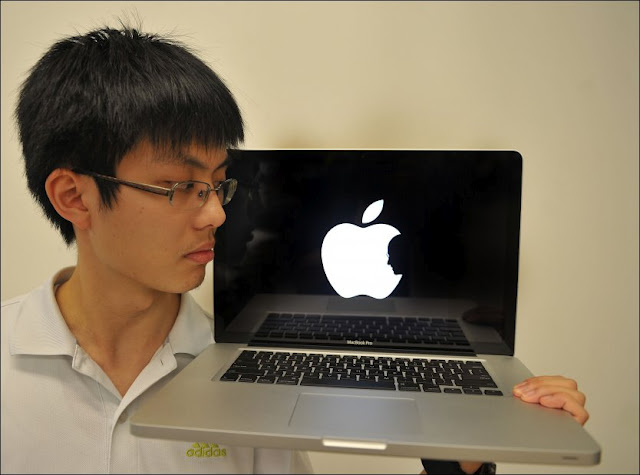
You’re probably familiar with the student artist from Hong Kong named Jonathan Mak Long. Last October, shortly after the death of Steve Jobs, Mak dreamed up a little tribute—an Apple symbol subtly embedded with Jobs’s silhouette, seen below:

Jonathan Mak with the now iconic Steve Jobs tribute logo.

Recently, Mak interviewed with Evan Osnos at The New Yorker. It’s a great interview:

I am twenty years old, was born and raised in Hong Kong, and seldom travelled. (My current student-exchange program in Germany marks my second trip beyond Asia.) My mother is a teacher, and my father works as a translator. They do not have a background in visual creativity, but they are the main reason for my interest in language, which has been tremendously helpful to my growth as a designer.

Like almost everybody else, I loved doodling and making things when I was young, but I never quite left that phase. I continued to create, such as writing a class newspaper, trying my hand at songwriting, and even recording my own podcast. Graphic design began as simply part of my compulsion to create, but, as I got increasingly comfortable with the medium, my love for it grew, and it has not stopped since.

The bulk of the interview is focused on design in China:

Discussing Chinese design is tricky. On one hand, you have the cream of the crop—contemporary graphics effortlessly combined with just enough Chinese motifs to differentiate them from the West. But at the same time, we have countless adverts that are flamboyant, sickly sweet, and just hyperbolic all around, often with jarring color combinations and tragic abuse of effect filters. “That is so ‘mainland,’ ” a Hong Konger might snort in derision. I am sometimes guilty of this reaction, but I am trying to see the other side of this issue.

Click through the interview to see the design he made for Coca-Cola, China.


Grammar as Litmus Test in Hiring

Kyle Wiens, CEO of iFixit, writes about his interview process at his company. In particular, candidates must pass a mandatory grammar test:

Everyone who applies for a position at either of my companies, iFixit or Dozuki, takes a mandatory grammar test. Extenuating circumstances aside (dyslexia, English language learners, etc.), if job hopefuls can’t distinguish between “to” and “too,” their applications go into the bin.

Of course, we write for a living. iFixit.com is the world’s largest online repair manual, and Dozuki helps companies write their own technical documentation, like paperless work instructions and step-by-step user manuals. So, it makes sense that we’ve made a preemptive strike against groan-worthy grammar errors.

But grammar is relevant for all companies. Yes, language is constantly changing, but that doesn’t make grammar unimportant. Good grammar is credibility, especially on the internet. In blog posts, on Facebook statuses, in e-mails, and on company websites, your words are all you have. They are a projection of you in your physical absence. And, for better or worse, people judge you if you can’t tell the difference between their, there, and they’re.

I absolutely approve of this process and wish more companies had similar initiatives. I am a huge stickler for proper grammar (I’ve been nicknamed “Grammarian” in my high school and college years), and I judge people who use poor grammar. As Wiens writes: “If it takes someone more than 20 years to notice how to properly use “it’s,” then that’s not a learning curve I’m comfortable with. So, even in this hyper-competitive market, I will pass on a great programmer who cannot write.”

Instagram Photos in Sports Illustrated Magazine

Brad Mangin shares his story of how Sports Illustrated picked up his Instagram photos and is publishing them in the latest issue of the magazine. The set consists of 18 baseball photos spread over six pages. He describes his process in this blog post:

I shoot all of my pictures with the native camera in my phone. All editing and toning happens within the iPhone, too, using a few of my favorite iPhone apps. Once it looks good, I import the final image into Instagram. The final step in my workflow involves uploading the images to my PhotoShelter archive, which is where editors like Nate can easily view and download them for publication.

Some of my favorite apps include Dynamic LightSnapseed, and Camera+. I really love Snapseed for converting images to black and white and for toning my images. Dynamic Light is my favorite app for making a sky look dramatic and for adding great color to images. Once I get the image into Instagram I usually apply the Lo-fi filter and border if I want high contrast and rich color, or rich black and white. If I want muted colors with an old-school look, or if I want to make a black and white image into sepia-toned I use the Earlybird filter and border.

This is good news for photography and Instagram.

15-Year-Old Improves Pancreatic Cancer Test

Maryland teenager Jack Andraka (featured in the video above) isn’t old enough to drive yet, but he’s just pioneered a new, improved test for diagnosing pancreatic cancer that is 90% accurate, 400 times more sensitive, and 26,000 times less expensive than existing methods.

When Andraka had solidified ideas for his novel paper sensor, he wrote out his procedure, timeline, and budget, and emailed 200 professors at research institutes. He got 199 rejections and one acceptance from Johns Hopkins: “If you send out enough emails, someone’s going to say yes.” Andraka was recently awarded the grand prize at the Intel International Science and Engineering Fair for his groundbreaking discoveries.

Persistence is the key.

###

(via Make)

Riding the Plasma Wave

A cloud forms as an F/A-18 Hornet aircraft speeds up to supersonic speed. Aircraft flying this fast push air up to the very limits of its speed, forming what’s called a bow shock in front of them.

Lynn Wilson who is a space plasma physicist at NASA’s Goddard Space Flight Center in Greenbelt, Maryland, writes the following:

Throughout the universe more than 99 percent of matter looks nothing like what’s on Earth. Instead of materials we can touch and see, instead of motions we intuitively expect like a ball rolling down a hill, or a cup that sits still on a table, most of the universe is governed by rules that react more obviously to such things as magnetic force or electrical charge. It would be as if your cup was magnetized, perhaps attracted to a metal ceiling above, and instead of resting, it floats up, hovering somewhere in the air, balanced between the upward force and the pull of gravity below.

This material that pervades the universe, making up the stars and our sun, and also – far less densely, of course – the vast interstellar spaces in between, is called plasma. Plasmas are similar to gases, and indeed are made of familiar stuff such as hydrogen, helium, and even heavier elements like iron, but each particle carries electrical charge and the particles tend to move together as they do in a fluid. Understanding the way the plasma moves under the combined laws of motion we know on Earth and the less intuitive (to most Earthlings, at least) electromagnetic forces, lies at the heart of understanding the events that spur giant explosions on the sun as well as changes in Earth’s own magnetic environment – the magnetosphere.

Understanding this mysterious world of plasma, however, is not easy. With its complex rules of motion, the study of plasmas is rife with minute details to be teased out.

Which particles are moving, what is the source of energy for the motion, how does a moving wave interact with the particles themselves, do the wave fields rotate to the right or to the left – all of these get classified.

Wilson is the first author of a paper in Geophysical Research Letters that was published on April 25, 2012. Using data from the WAVES instrument on NASA’s Wind mission, he and his colleagues have discovered evidence for a type of plasma wave moving faster than theory predicted it could move. The research suggests that a different process than expected, electrical instabilities in the plasma, may be driving the waves. This offers scientists another tool to understand how heat and energy can be transported through plasma.

For the study, Wilson examined coronal mass ejections (CMEs) – clouds of solar material that burst off the sun and travel through space — that move so much faster than the background solar wind that they create shock waves. These shock waves are similar to those produced by a supersonic jet when it moves faster than the speed of sound in our atmosphere.

Read more here. Photo credit: NASA/Goddard.
The Spanish Baby Snatching Phenomenon

This is a very interesting piece in Der Spiegel on the baby snatching phenomenon in Spain:

All of these women share a similar fate. From the beginning of the Spanish Civil War, in 1936, until well into the 1990s, more than 300,000 children were reportedly taken from their biological parents and passed on to adoptive parents.

In regions captured by the anti-communist Nationalists during the war, doctors and nuns felt it was their patriotic duty to take newborns from “red parents” and give them to other families. There, they were to be raised in accordance with Nationalist and Catholic beliefs.

After the victory of the rebels under General Francisco Franco over the Republicans, the organized theft of babies became a political tool, a way of depriving leftists of their offspring. In 1941, Franco enacted a law that made it permissible to erase evidence of the ancestry of such children by changing their last names.

Most of these stolen children were entrusted to the care of Catholics loyal to the regime. The aim behind this was to rid an entire people of the “Marxist gene,” at least according to the theories of Antonio Vallejo-Nájera, the national psychiatrist of Francoist Spain, that were widespread at the time.

Here is part 2 of the story.

How to Make $44 Million in 20 Minutes

Short answer: become and exit as CEO of Duke Energy, all in less than a day’s work.

Earlier this month, Bill Johnson enjoyed one of the shortest (and most lucrative, in dollars/hour) terms as CEO in U.S. history, as he was ousted from his new position at Duke Energy after only a few minutes on the job. Earlier today, Johnson explained to regulators that his brief time on the job was just as surprising to him as it was to the rest of the world.

Only a few weeks ago, Johnson has been the CEO of Progress Energy. Then that company merged with the larger Duke — becoming the nation’s largest electric utility provider — and Johnson was named CEO of the combined businesses… but only for about 20 minutes, at which point the board called for him to leave (with the help of a payout worth around $44 million).

The Wall Street Journal has more details about this crazy story. Call it a see-saw turn of events.

How to Capture Magic Kingdom’s Cinderella Castle

Someone asked this on Quora: what are the optimal siege tactics for taking Magic Kingdom’s Cinderella Castle? Jonathan Kirk Davis, Sergeant of Marines, who fought in the Iraq War, provides an awesome response.

The best part of the post is the description of the primary assault on Cinderella’s Stronghold:

Now comes the glory. An assault force comprised of an infantry company staged in Tango base will attack the back of the castle. The most obvious route is to take on the castle through the Mainstreet. This is what they want you to think and will result in the sure death of you and your men. The front of the castle is lined with a moat and the counterattack will be an easy matter if they blow the bridge and your men stand helpless staring at the statue of Walt as they are taken out one by one. Go through Fantasyland and attack the castle in the rear. There is no moat and the defenses are much weaker. This will also be the time when you would need to prepare with additional reinforcements at the train station for the final assault.

The secondary objective sounds impressive as well:

While in Fantasyland we will have the opportunity to take down the menace of all parents everywhere. The “It’s a Small World” ride will be within our reach. Our secondary objective is to eliminate the ride with extreme prejudice. This isn’t a capture mission like the castle, but one of complete annihilation. Expect heavy casualties as their adorable repetitiveness burns into your skulls like white phosphorous in the jungle. Our sacrifices will be great, but our suffering is in the name of protecting others. 

I love stuff like this.

###

(hat tip: @kottke)