A $75 Horse Bet Turns into a $1.5 Million Payoff

A cool story of Conor Murphy, a man who used to shovel manure for a living but got lucky with a bet, and now owns his own ranch:

Mr. Murphy, 29, knew his horses well. He was able to tell which ones were on their toes and which ones needed a little more care. He also knew his way around a betting window. On a hunch, he bet $75 on five of his favorites. It was the sort of desperate stab that only a man who loves horses would make.

Haruki Murakami on the Spirit of the Boston Marathon

If you’re as much a fan of Haruki Murakami as I am, then you know how much of an avid runner he is. He’s run more than two dozen marathons in his life. But the Boston Marathon is his favorite. Writing in The New Yorker, he reflects on the spirit of the Marathon with the April 2013 bombings in mind:

What’s great about marathons in general is the lack of competitiveness. For world-class runners, they can be an occasion of fierce rivalry, sure. But for a runner like me (and I imagine this is true for the vast majority of runners), an ordinary runner whose times are nothing special, a marathon is never a competition. You enter the race to enjoy the experience of running twenty-six miles, and you do enjoy it, as you go along. Then it starts to get a little painful, then it becomes seriously painful, and in the end it’s that pain that you start to enjoy. And part of the enjoyment is in sharing this tangled process with the runners around you. Try running twenty-six miles alone and you’ll have three, four, or five hours of sheer torture. I’ve done it before, and I hope never to repeat the experience. But running the same distance alongside other runners makes it feel less grueling. It’s tough physically, of course—how could it not be?—but there’s a feeling of solidarity and unity that carries you all the way to the finish line. If a marathon is a battle, it’s one you wage against yourself.

Running the Boston Marathon, when you turn the corner at Hereford Street onto Boylston, and see, at the end of that straight, broad road, the banner at Copley Square, the excitement and relief you experience are indescribable. You have made it on your own, but at the same time it was those around you who kept you going. The unpaid volunteers who took the day off to help out, the people lining the road to cheer you on, the runners in front of you, the runners behind. Without their encouragement and support, you might not have finished the race. As you take the final sprint down Boylston, all kinds of emotions rise up in your heart. You grimace with the strain, but you smile as well.

I love Murakami’s message on how to cope with the pain, and how to remember the victims of the Boston bombings:

For me, it’s through running, running every single day, that I grieve for those whose lives were lost and for those who were injured on Boylston Street. This is the only personal message I can send them. I know it’s not much, but I hope that my voice gets through. I hope, too, that the Boston Marathon will recover from its wounds, and that those twenty-six miles will again seem beautiful, natural, free.

Murakami’s What I Talk About When I Talk About Running is one of the best books I’ve read on the subject.

Data Science of the Facebook World

The ever insightful Stephen Wolfram has another graph-heavy post, this time compiling data on Facebook analytics:

More than a million people have now used our Wolfram|Alpha Personal Analytics for Facebook. And as part of our latest update, in addition to collecting some anonymized statistics, we launched a Data Donor program that allows people to contribute detailed data to us for research purposes.

A few weeks ago we decided to start analyzing all this data. And I have to say that if nothing else it’s been a terrific example of the power of Mathematica and the Wolfram Language for doing data science. (It’ll also be good fodder for the Data Science course I’m starting to create.)

We’d always planned to use the data we collect to enhance our Personal Analyticssystem. But I couldn’t resist also trying to do some basic science with it.

I’ve always been interested in people and the trajectories of their lives. But I’ve never been able to combine that with my interest in science. Until now. And it’s been quite a thrill over the past few weeks to see the results we’ve been able to get. Sometimes confirming impressions I’ve had; sometimes showing things I never would have guessed. And all along reminding me of phenomena I’ve studied scientifically in A New Kind of Science.

So what does the data look like? Here are the social networks of a few Data Donors—with clusters of friends given different colors. (Anyone can find their own network usingWolfram|Alpha—or the SocialMediaData function in Mathematica.)

It’s a pretty fascinating read.

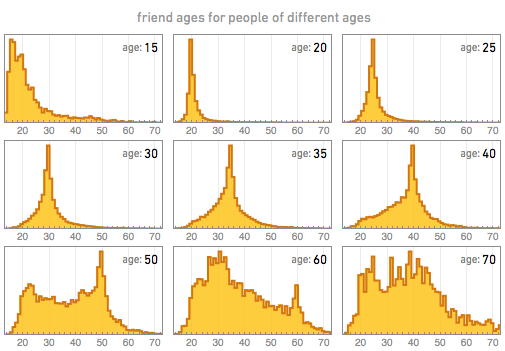
My favorite graph was this one of the distribution of  your Facebook friends’ age versus your age:

The age of your Facebook friends versus your age.

The age of your Facebook friends versus your age.

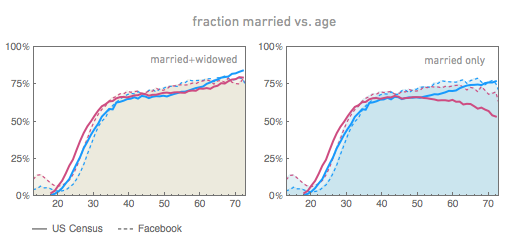
It’s also quite interesting how the marriage statistics from Facebook line up with the official Census data:

Facebook marriage age vs. Census data.

Facebook marriage age vs. Census data.

For a lot more analysis, read Stephen Wolfram’s entire post.

The Gmail of 2013 is Terrible

This is a very good post explaining what is wrong with the 2013 version of Gmail. Summary: I feel like Gmail went from being Photoshop to Draw Something.

1. I can’t easily delete my signatures. You know when you’re messaging back and forth with people, you sometimes strip out your email signatures to reduce clutter and make it more readable and less formal? Now you have to click on three tiny dots and then do it. And sometimes I forget because it’s hidden from view. This is crappy. It’s not user friendly.

2. I can’t easily change my email subject. Sometimes you’re replying or forwarding an email and you need to modify the subject. For example, you want to modify an email to send to someone else. It takes 3 clicks!! You first click on type of response. Edit subject. And then click into the subject. This is stupid.

Read the rest of the post here. The author’s conclusion:

You’re making something more basic and harder to use in favor of minimal design. This isn’t search. You can’t reduce a full-email platform down to a message box. If I wanted that, I’d use Facebook which supports email now.

For me, the new compose window is poorly designed. I just want to go back to the 2012 version of Gmail, you know?

Teens and Promposals

The New York Post leads: Teens are engaging in over-the-top prom proposals as a competitive sport — but have these public displays of popping the question gone too far?

At $100 a pop, the centerfield video board at Yankee Stadium has seen seven promposals so far this season.

Some students are even renting plane banners to pop the prom question, which can cost upward of $1,000 in the New York area.

“It started last year — I’ve been in the business six years, and we had never sold a prom banner before then,” says Remy Colin of Aerial Messages in Daytona Beach, Fla.

Finetuxedos.com, headquartered in White Plains, even launched its first annual “Best Promposal” contest this year (to help Sandy-affected students afford tuxes), after staffers noticed an unprecedented number of “prom proposal” queries in its search engine.

Yes, absolutely.

Facebook is Blowing it With Its Mobile Advertisements

Andrew Leonard pens a very good rant on the annoying, intrusive ads Facebook is delivering to users of the mobile version of the app:

And now she’s in my phone. And guess what? In Facebook’s mobile app, there is no option to hide all sponsored ads from a particular advertiser. Your only choice is the basic option you have with any kind of post — you can mark it as spam. Supposedly, reporting posts as spam will decrease the likelihood that you see them, but I’m afraid I’ve seen zero positive change in the frequency or content of Facebook’s sponsored story ads, despite what Facebook claims. Instead I am getting more of the ads I don’t want on my phone, after years of telling Facebook I don’t like exactly those types of ads. This is not an encouraging trend line.

By the time the first trickle of caffeine had woken up my synapses, I realized that I was done. I had reached my tipping point. I no longer want to check Facebook on my phone.

Does Facebook really think so little of me? Am I not man enough to seek my own romantic path without Facebook’s help?

And the money quote:

I’m sorry, Mark Zuckerberg, but my iPhone screen is just not big enough for those breasts.

As a user of the app on my iPhone, I’ve noticed these annoying ads as well. I haven’t quite reached the tipping point of quitting the service, but I am irked enough to highlight others’ reactions to it and am not surprised with Mr. Leonard’s decision.

How Oslo is Running out of Garbage

In the Scandinavian countries of Norway and Sweden, garbage is a precious commodity. That’s because it is used to generate heat/electricity. And in the case of Norway’s capital, Oslo, there is a problem: the city doesn’t have enough garbage to burn:

Oslo, a recycling-friendly place where roughly half the city and most of its schools are heated by burning garbage — household trash, industrial waste, even toxic and dangerous waste from hospitals and drug arrests — has a problem: it has literally run out of garbage to burn.

Part of the success has to do with the meticulousness of the citizens sorting the garbage:

Garbage may be, well, garbage in some parts of the world, but in Oslo it is very high-tech. Households separate their garbage, putting food waste in green plastic bags, plastics in blue bags and glass elsewhere. The bags are handed out free at groceries and other stores.

How difficult would it be to ship some of America’s garbage across the Atlantic Ocean to Norway?

Warren Buffett: Women are Key To America’s Future Prosperity

Warren Buffett joined Twitter today. To coincide with that move, he also penned a piece in CNN/Fortune, in which he explains how women are key to America’s prosperity:

Start with the fact that our country’s progress since 1776 has been mind-blowing, like nothing the world has ever seen. Our secret sauce has been a political and economic system that unleashes human potential to an extraordinary degree. As a result Americans today enjoy an abundance of goods and services that no one could have dreamed of just a few centuries ago.

But that’s not the half of it — or, rather, it’s just about the half of it. America has forged this success while utilizing, in large part, only half of the country’s talent. For most of our history, women — whatever their abilities — have been relegated to the sidelines. Only in recent years have we begun to correct that problem.

Despite the inspiring “all men are created equal” assertion in the Declaration of Independence, male supremacy quickly became enshrined in the Constitution. In Article II, dealing with the presidency, the 39 delegates who signed the document — all men, naturally — repeatedly used male pronouns. In poker, they call that a “tell.”

Finally, 133 years later, in 1920, the U.S. softened its discrimination against women via the 19th Amendment, which gave them the right to vote. But that law scarcely budged attitudes and behaviors. In its wake, 33 men rose to the Supreme Court before Sandra Day O’Connor made the grade — 61 years after the amendment was ratified. For those of you who like numbers, the odds against that procession of males occurring by chance are more than 8 billion to one.

I couldn’t agree more. Go Warren go!

Paul Miller Reflects on a Year Without the Internet

On April 30 of 2012, Paul Miller took a hiatus. From the internet. For one year. 

How did his experiment go? He divulges in this excellent post on The Verge:

At 11:59PM on April 30th, 2012, I unplugged my Ethernet cable, shut off my Wi-Fi, and swapped my smartphone for a dumb one. It felt really good. I felt free.

A couple weeks later, I found myself among 60,000 ultra-Orthodox Jews, pouring into New York’s Citi Field to learn from the world’s most respected rabbis about the dangers of the internet. Naturally. Outside the stadium, I was spotted by a man brandishing one of my own articles about leaving the internet. He was ecstatic to meet me. I had chosen to avoid the internet for many of the same reasons his religion expressed caution about the modern world.

This is a profound observation:

As my head uncluttered, my attention span expanded. In my first month or two, 10 pages of The Odyssey was a slog. Now I can read 100 pages in a sitting, or, if the prose is easy and I’m really enthralled, a few hundred.

I used to be able to read two hundred pages in one day. Now, I consider myself lucky if I can get fifty pages done in one sitting without itching to grab my phone or computer.

But reading on, we learned that Paul’s experience without the Internet markedly changed after the first months of freedom:

So the moral choices aren’t very different without the internet. The practical things like maps and offline shopping aren’t hard to get used to. People are still glad to point you in the right direction. But without the internet, it’s certainly harder to find people. It’s harder to make a phone call than to send an email. It’s easier to text, or SnapChat, or FaceTime, than drop by someone’s house. Not that these obstacles can’t be overcome. I did overcome them at first, but it didn’t last.

It’s hard to say exactly what changed. I guess those first months felt so good because I felt the absence of the pressures of the internet. My freedom felt tangible. But when I stopped seeing my life in the context of “I don’t use the internet,” the offline existence became mundane, and the worst sides of myself began to emerge.

My plan was to leave the internet and therefore find the “real” Paul and get in touch with the “real” world, but the real Paul and the real world are already inextricably linked to the internet. Not to say that my life wasn’t different without the internet, just that it wasn’t real life.

I’ve linked to Paul Miller’s past posts. The archive is here.
The Single Most Valuable Document in the History of the World Wide Web

Subject to debate, but according to this article in the BBC, the claim of the “most valuable document in the history of the World Wide Web” belongs to a legal document that made the web publicly available in such a way that no one could claim ownership of it and that would ensure it was a free and open standard for everyone to use.

A team at the European Organisation for Nuclear Research (Cern) has launched a project to re-create the first web page.

The aim is to preserve the original hardware and software associated with the birth of the web.

Interesting.