TIME’s 50 Best Websites of 2013

TIME just announced the 50 best websites of 2013. It’s a good list overall, especially the news/information section:

However, my two new favorite sites I discovered this year are Distance to Mars (open it in your non-mobile browser for best effect) and Coffitivity (playing ambient noise as though you’re in a coffee shop to help you concentrate).

Is The Avenues School the Best Education Money Can Buy?

A fun profile in New York Times Magazine of Avenues: The World School in Chelsea, a for-profit (to the tune of $43,000/year) school in New York City. What happens when each set of parents is entitled to an opinion on how the school should be run? Chaos:

In September, Avenues opened with 740 students, from pre-K to ninth grade. And with those students came 740 sets of parents, many of them determined to design the perfect 21st-century school in their own high-earning, creative-class image. They were entrepreneurs and tech millionaires, talent agents and fashion designers, Katie Holmes, hedge-fund managers and artists who refuse to live above 23rd Street. And they wanted to be heard. The school subsequently formed a parents’ association, but it had no rules. So there was a debate about who got to go to the meetings and who got to vote. Bylaws had to be created, which, in Avenues’ case, meant collecting the rules and regulations of 30 other private schools so as to determine the best way to even make bylaws. “There was nothing in place,” says Jacquie Hemmerdinger, head of the standards and values committee on the Avenues Parents Association, “and they empowered 700 parents.”

A committee was created to manage events, like galas and book fairs and bake sales, even though, as a for-profit school, Avenues couldn’t hold any events that raised money. (Did Avenues even want book fairs, some wondered? That was debated, too.) A task force was formed to investigate the safety of the neighborhood after at least one mother fretted that her child had seen the upper outlines of a homeless man’s backside en route to a playground. The complaint became known as the butt-crack e-mail. Other debates waged over the classrooms (were there enough books?); pickup (it was mayhem); identification cards (the photos were too high-resolution); and the school uniforms (was anyone enforcing the policy?). “I think we underestimated the degree of their energy and creativity,” says Gardner P. Dunnan, the former Dalton headmaster and Avenues’ academic dean and head of the Upper School. “They would take over if they could. They are New York parents.”

And then there was the food committee. After the PowerPoint presentation concluded in the black-box theater, the questions started flying: Why so much bread? What was the policy on genetically modified organisms? Why no sushi?

My question: what does it mean for the identification cards to be too high resolution? New Yorkers!

Read the entire story here.

Ted Heller: Self-Publishing is Not Fun

If you’re thinking about publishing your own novel, consider the cautionary story by Ted Heller. This is the author of Pocket Kings, which has a 4.5 star rating on Amazon and was favorably reviewed in The New York Review of Books. But Mr. Heller decided what would happen if he tried to self-publish his new book, West of Babylon. In two words: no luck.

I can tell you that self-publishing is not fun.

As I write these words, I am now in my seventh week of attempting to spread the word about “West of Babylon.” I have sent emails to many newspapers, from the Boston Globe down to the Miami Herald across to the San Francisco … well, to just about everywhere. I’ve sent emails to newspapers and magazines in England, too, and to websites and book blogs. In each email I send, I announce that “West of Babylon” will be available online only as of early May 2013. I attach the cover image and stellar reviews of my three novels. I do everything I possibly can in about four or five paragraphs to inspire interest in whomever the email is sent to.

Sometimes I get replies. Overwhelmingly I do not.

When I hit the send button, I assume that nothing will come of it. (The lyrics from a Rogue Wave song come to me: “But it don’t matter/Because no one comes out to see us.”) Sometimes I cannot even get the correct email address or find out whom to send the book to — who at the Cleveland Plain Dealer edits the book section now? The Los Angles Times said I could email them the book and that was a truly great day for me, despite the 10 other newspapers that day that didn’t want the book.

Continuing:

After a few weeks of this 9-to-5 masochism, you lose your sense of shame. I’m no longer so hesitant about sending emails because, I figure, nobody is going to read the damn thing anyway. The worst thing they can do is turn you down or ignore you, and by now I am used to that. I sent an email to the book section editor of a newspaper I thought would find “West of Babylon” to its liking and, through an intermediary, was able to discover that the editor had never gotten the email. I have to assume that this is just one of the reasons for the great silence: I’m sending queries to people and my email is probably going straight into spam folders, right along with the ads for Viagra and Cialis. I have no idea what’s worse: writing books that don’t ever get published, or writing books that get published but don’t ever get read, or writing emails that don’t ever get read to people about books that don’t ever get published and won’t ever get read.

So discouraging. I get the purpose of having a real-life agent and going with the traditional publishing route. I also get why people would want to self-publish. It’s a delicate balance. But if Mr. Heller’s story is any indication, even if you’ve had great success in the past, it is no guarantee for future success.

I am sticking with my non-revenue generating blogging for now.

###

(update: reflected that Mr. Heller still has an agent, but when self-publishing, most of us won’t have that access/luxury)

Iron Man 3 in China

An interesting bit on the importance of China for the Hollywood industry, via some Iron Man 3 and Robert Downey Jr. trivia:

And it’s not just records: Marvel and its Chinese partner, DMG, are setting new standards for foreign movies looking to earn government clearance in China. To curry favor, the company added four minutes of footage just for the mainland, including throwaway parts for Chinese A-list actors Fan Bingbing and Wang Xueqi, and a ham-handed milk drink product placement.

Also new is the aggressive outreach to Chinese audiences by Iron Man himself, Robert Downey Jr. Not only did he visit China for the first time in his life to talk up the film, but Downey also set up a personal account on Sina Weibo

I haven’t seen the movie yet, but I want to. I enjoyed Iron Man 2.

The Onion Makes Fun of an Atlanta Social Media Rock Star

This is the first The Onion post I’ve ever linked to, and damn, if it isn’t a great one. Titled “Social Media Rock Star Makes $28,000 Per Year,” it’s chock-full of awesome one-liners and non sequiturs:

Sources confirmed that Wasserman, who is paid $13 per hour and is not eligible for overtime, appears regularly on the FavStar daily leaderboard and is frequently featured in “Must Follow” lists from the Huffington Post, CNN, andTIME. Influential Twitter users such as musician Questlove, actress Olivia Wilde, Mashable founder Pete Cashmore, and NBA star Blake Griffin also follow Wasserman’s tweets, which the high-profile social media icon reportedly writes on the iPhone his parents bought him and still keep on their family plan.

Moreover, experts say the swift ascent of the 28-year-old entry-level employee into the upper echelons of internet superstardom is showing no signs of slowing down.

I wonder why they chose to pick on an Atlanta suburbanite. Anyway, you have to click through the article to watch the video. HILARIOUS.

###

(Oddly, the Twitter account in the article is one that belongs to Erika of Chicago).

The Anar Foundation Uses Lenticular Printing to Target a Message Only for Children

The ANAR Foundation is a Spanish organization which helps kids in risk of abuse. They Operate a unique phone number – 116 111 – where minors at risk can get aid and consultation.

Anar did a campaign advertising the number, but they faced a potential problem: they didn’t want adults (i.e., possible aggressors) to see that a kid was even looking at the ad.

So they came up with a nifty solution. They used Lenticular printing on street signs. Lenticular printing is a technology in which Lenticular lenses (a technology that is also used for 3D displays) are used to produce printed images with an illusion of depth, or the ability to change or move as the image is viewed from different angles.

In this case, the image seen by an adult is innocuous, while the one seen by the average ten year old kid displays the phone number:

The ad appears different based on the height of the viewer.

The ad appears differently based on the height of the viewer.

anar-lenticular-06

The bloody lip, and the phone number, is visible only to kids in a height range typical for a ten year old.

In case this is confusing, watch the video that explains how lenticular imaging works:

Fascinating.

###

(via Creativity Online)

The People You Meet at McDonald’s

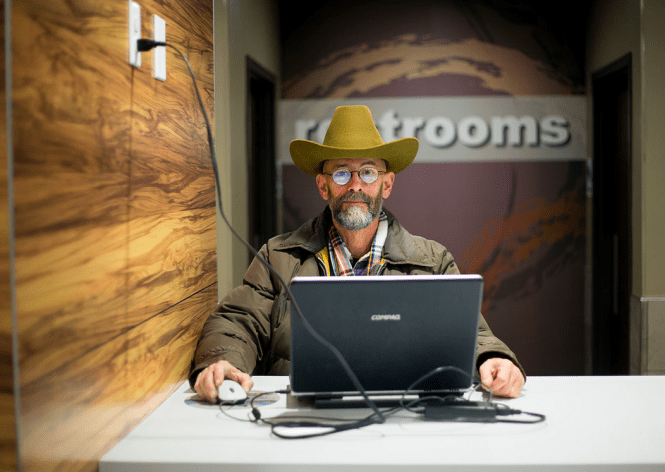
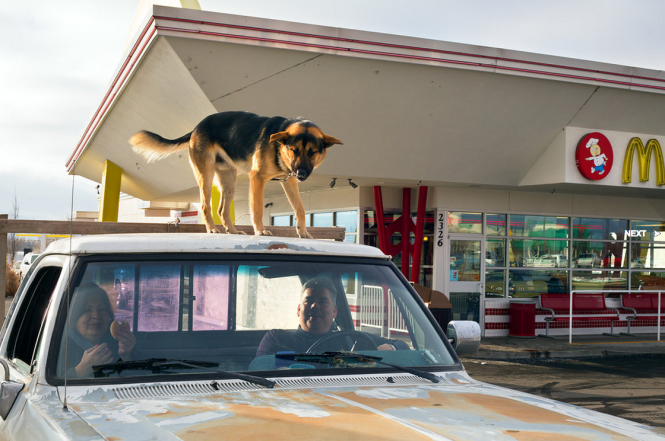
Vance Evans, a 66-year-old retiree from Bakersfield, California, “has been eating double cheeseburgers at McDonald’s since he flipped them himself as a teenager.” In a photo essay titled “The People You Meet at McDonald’s,” photographer Nolan Conway presents a menagerie of the people that visits the Golden Arches:

mcd6
mcd5
mcd4
mcd3 mcd2
mcd1

Mr. Conway has visited almost 150 McDonald’s restaurants in 22 states. See the entire gallery here.

I’m looking forward to seeing more of this series. Would be interesting to see project extend beyond the U.S. borders as well.


The Uner Tan Syndrome, or The Case of The Bear Walking Family

I’d never heard of the Uner Tan Syndrome before reading this article. It is named after a Turkish scientist who discovered a family who walk on all fours:

The subject of bear crawling hibernated for many decades until a couple of Turkish doctors, in 2004, made a discovery that was more science fiction than science. In a rural village, they happened upon a group of siblings who had never stood up. Members of a family with 19 children, all of whom bear-walked in their infancy, these five brothers and sisters had never lifted up off their hands. They had walked like bears all their life. The siblings actually wrist-walked, with their palms pressed flat against the ground. (Think of someone doing the downward-facing dog yoga pose while walking.) No one had ever seen an adult human move like this before.

The siblings were able to stand upright if they really concentrated on it, an early report on them noted, “but they become unsteady if they try to walk bipedally, and soon go down onto their hands.” They were quadrupeds. To help support the family, the lone male bear crawler ranged as far as a mile from home collecting cans and bottles. While bear-crawling, he was indefatigable. “This contrasts markedly with normal adult humans,” the report noted, “who find such a gait—if and when they try it—tiring and uncomfortable even after practice.”


I’d also never heard of the term “reverse evolution,” but that is the phrase that was used in this academic paper on the syndrome.

###

More: a documentary on the bear-walking family.

Marc Maron’s Quest for the Perfect Fitting Jeans

Marc Maron, author of Attempting Normalgoes on a quest to find the perfect fitting jeans. In the process, he receives an uncanny advice from a Levi’s store clerk:

So I went to the Levi’s store in San Francisco because I had heard that good jeans were back. That they were making them the way they used to. They may cost a lot more, but if you want some emotional time travel and believe that denim in its raw form can make you feel whole, it’s going to be worth the purchase of that two-legged vessel to a simpler time.

The clerk helping me was a chubby fellow with a handlebar mustache. I have no patience for contemporary handlebar mustaches. They anger me. They look indulgent and ridiculous. If you have a handlebar mustache, that is pretty much all you are. You are a delivery system for a handlebar mustache. I saw a guy in Brooklyn once with a handlebar mustache, pierced ears, a fedora hat and jodhpurs. He was a collage of sartorial attempts at evading himself. It looked as if he were interrupted during a shave in the mid-1850s and had to grab some clothes and dress quickly while being chased through a time tunnel.

Desperate and stupid are good descriptions when you get to the part of what he actually did to make the pants try to fit. Made me laugh.

Last of a Breed: Postal Workers Who Decipher Bad Handwriting

Have you ever wondered who deciphers the illegible handwriting on envelopes sent by the United States Post Office? I have. The New York Times profiles Melissa Stark, “the last of the breed”:

Ms. Stark is one of the Postal Service’s data conversion operators, a techie title for someone who deciphers unreadable addresses, and she is one of the last of a breed. In September, the post office will close one of its two remaining centers where workers try to read the scribble on envelopes and address labels that machines cannot. At one time, there were 55 plants around the country where addresses rejected by machines were guessed at by workers aided with special software to get the mail where it was intended.

Computers have made this job virtually obsolete, and yet:

But for now, this center operates 365 days a year, 24 hours a day. More than 700 workers stare at images of letters, packages, change-of-address cards and other mail, trying to figure out where they are supposed to go. It is not easy work. With software, a knowledge of geography and more than a little intuition, an operator has exactly 90 seconds to move each piece of mail.

Interesting.